The closest alternatives to “faced” are confronted, met, and encountered. For a person who dealt with a problem directly, tackled and addressed also fit. These words follow the most common meaning of “face”: to deal with something difficult or unpleasant.
The best alternative depends on what “faced” means in your sentence. It can mean dealing with a problem, competing against a team, having a front turned toward a direction, or covering a surface with a material. A hotel can face the sea, a team can face a rival, and a wall can be faced with stone. Each use calls for a different word.
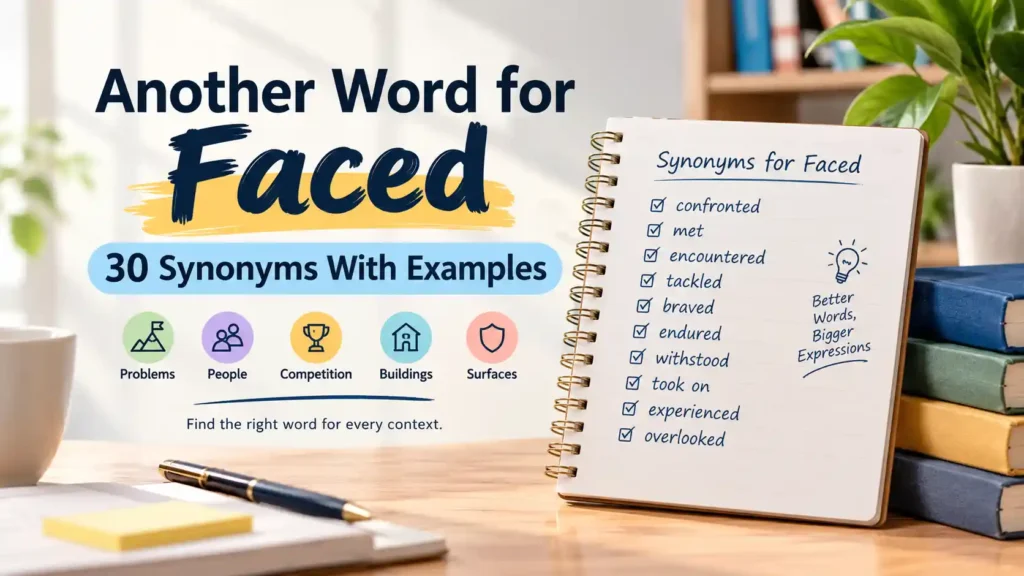
Quick list: confronted, met, encountered, tackled, braved, endured, withstood, took on, experienced, overlooked
This article looks at 30 alternatives. Each has a definition, IPA, a usage note, an example, and context to show when it fits. The alternatives are given in the past tense to match “faced.”
At a Glance: Faced Synonyms and Related Alternatives
| Alternative | Part of Speech | Meaning | Register / Tone | Ideal Context |
| confronted | verb (past) | Came face to face with and dealt with | Neutral to formal | Problems, people, accusations |
| met | verb (past) | Came across or dealt with | Neutral | Challenges, opponents |
| encountered | verb (past) | Came across, often unexpectedly | Neutral to formal | Difficulties, obstacles |
| tackled | verb (past) | Dealt with a problem energetically | Neutral | Problems, tasks |
| braved | verb (past) | Faced danger or hardship without fear | Neutral, a little literary | Storms, crowds, risks |
| endured | verb (past) | Suffered through something hard | Neutral to formal | Long hardship |
| withstood | verb (past) | Resisted or survived successfully | Formal | Pressure, attack, weather |
| took on | verb (past) | Accepted a challenge or opponent | Informal | Sports, work, rivals |
| experienced | verb (past) | Lived through | Neutral | Delays, changes |
| overlooked | verb (past) | Had a view over | Neutral | Buildings, rooms |
Which Word Should You Use?
| If you want to… | Use | Why |
| Say you dealt with a problem directly | confronted, tackled | They show direct action. |
| Show courage against danger | braved, stared down | They suggest facing fear. |
| Say you came across a difficulty | encountered, met | They stress meeting it, not fighting it. |
| Say you lived through something hard | endured, suffered, withstood | They show lasting through hardship. |
| Describe an opponent or a match | took on, competed against, opposed | They fit competition. |
| Describe the direction of a building | overlooked, fronted, looked onto | They describe position and view. |
| Describe covering a surface | covered, clad, veneered | They fit materials on walls and furniture. |
| Say a problem stood in your way | was up against, was confronted by | They describe being met with a difficulty. |
Exploring the Multiple Meanings of “Faced”
“Faced” is the past tense and past participle of the verb “face.”
1. Confronted or Dealt With a Difficulty
- Meaning: Met a problem, danger, or unpleasant fact and dealt with it.
- Explanation: This is the most common sense. Merriam-Webster gives “face the facts” and “face a grim future.” The object is usually a problem or a hard truth.
- Example: The company faced serious financial problems last year.
2. Met in Competition
- Meaning: Played against or met an opponent.
- Explanation: Merriam-Webster gives “to meet face-to-face or in competition,” with the example “faced the opposing team.” Took on and competed against are close alternatives.
- Example: The home team faced the league leaders on Saturday.
3. Been Forced to Deal With Something (Faced With)
- Meaning: Been placed in front of a problem or choice.
- Explanation: Merriam-Webster gives “to bring face-to-face,” with the example “he was faced with ruin.” This is passive and uses “with.” Confronted by and up against are close alternatives.
- Example: She was faced with a difficult choice.
4. Had the Front Toward a Direction
- Meaning: Had the front, side, or view directed toward something.
- Explanation: This is the physical sense for buildings and rooms. Merriam-Webster’s example is “the house faced south.” Overlooked and fronted are alternatives, though they are less exact.
- Example: The hotel faced the sea.
5. Turned One’s Face Toward Something
- Meaning: Turned the front of your body or face toward someone or something.
- Explanation: Merriam-Webster gives “the teacher faced the class.” This is about turning, not difficulty.
- Example: He faced the audience and began to speak.
6. Covered a Surface With a Material
- Meaning: Covered the surface of something with another material.
- Explanation: Merriam-Webster gives “faced the building with marble,” and also “face a hem” in sewing. This is a technical sense. Clad and covered are alternatives.
- Example: The builders faced the old wall with brick.
Sources: Merriam-Webster (face); Etymonline (face).
Analyzing 30 Faced Alternatives in Detail
Some of these are direct synonyms of “faced,” while others are context-specific related alternatives. Each usage note says which is which.
Core Alternatives for Dealing With a Problem
1. Confronted
IPA: /kənˈfrʌntɪd/ (US and UK)
Definition: Came face to face with someone or something and dealt with it directly.
- Usage: A direct synonym for the “deal with a problem” sense. It is a bit stronger and more direct than “faced,” and it fits people, accusations, and hard truths.
- Example: She confronted her fears and gave the speech.
2. Met
IPA: /mɛt/ (US and UK)
Definition: Came across or dealt with something, such as a challenge.
- Usage: A related alternative. “Met a challenge” can mean dealt with it successfully, and “met the requirements” means satisfied them, so check the context.
- Example: The team met every challenge with patience.
3. Encountered
IPA: US /ɪnˈkaʊntərd/ · UK /ɪnˈkaʊntəd/
Definition: Came across something, often unexpectedly, especially a difficulty.
- Usage: A close synonym for meeting a problem. It does not say how the person reacted.
- Example: The hikers encountered heavy snow near the top.
4. Tackled
IPA: /ˈtækəld/ (US and UK)
Definition: Began to deal with a problem or task with energy.
- Usage: A related alternative. It stresses action and effort, not just meeting a problem.
- Example: The mayor tackled the housing crisis first.
5. Addressed
IPA: /əˈdrɛst/ (US and UK)
Definition: Began to deal with a problem or question.
- Usage: A formal related alternative. It is common in politics and business writing.
- Example: The report addressed several safety concerns.
Alternatives for Facing Danger or Hardship
6. Braved
IPA: /breɪvd/ (US and UK)
Definition: Faced danger, pain, or unpleasant conditions without showing fear.
- Usage: A direct synonym when courage is the point. It fits storms, crowds, and risks.
- Example: Fans braved the rain to watch the match.
7. Withstood
IPA: /wɪðˈstʊd/ (US and UK)
Definition: Resisted or survived something difficult successfully.
- Usage: A formal related alternative. It implies the person or thing was not defeated.
- Example: The old bridge withstood the flood.
8. Weathered
IPA: US /ˈwɛðərd/ · UK /ˈwɛðəd/
Definition: Came safely through a difficult period.
- Usage: A figurative related alternative. It suggests surviving a hard time, as in “weathered the storm.”
- Example: The small shop weathered the recession.
9. Endured
IPA: US /ɪnˈdʊrd/ · UK /ɪnˈdjʊəd/
Definition: Went through something painful or hard, usually over time.
- Usage: A related alternative. It stresses lasting through a long hardship, not meeting it once.
- Example: The villagers endured a long, cold winter.
10. Stared down
IPA: US /ˌstɛrd ˈdaʊn/ · UK /ˌsteəd ˈdaʊn/
Definition: Faced someone or something so firmly that they gave way.
- Usage: An informal related alternative. It matches Merriam-Webster’s “faced down his critics.”
- Example: The captain stared down the angry crowd.
Alternatives for Competition and Opposition
11. Opposed
IPA: US /əˈpoʊzd/ · UK /əˈpəʊzd/
Definition: Acted against, or stood against, someone or something.
- Usage: A related alternative for competition. It often appears as “the two teams opposed each other.”
- Example: The two schools opposed each other in the final.
12. Challenged
IPA: /ˈtʃælɪndʒd/ (US and UK)
Definition: Invited someone to compete, or questioned someone’s claim.
- Usage: A related alternative. It starts the contest, while “faced” can describe simply meeting an opponent.
- Example: The new player challenged the champion.
13. Took on
IPA: US /tʊk ˈɑːn/ · UK /tʊk ˈɒn/
Definition: Accepted a challenge, task, or opponent.
- Usage: An informal related alternative. It suggests willingness to fight or compete.
- Example: The small club took on a much bigger rival.
14. Competed against
IPA: /kəmˈpiːtɪd əˈɡɛnst/ (US and UK)
Definition: Took part in a contest against someone.
- Usage: A direct synonym for the “met in competition” sense. It is neutral and clear.
- Example: She competed against the best runners in the country.
15. Contended with
IPA: /kənˈtɛndɪd wɪð/ (US and UK)
Definition: Struggled to deal with a difficult person or problem.
- Usage: A formal related alternative. It stresses struggle.
- Example: The farmers contended with drought for years.
Alternatives for Experiencing Something Unpleasant
16. Experienced
IPA: US /ɪkˈspɪriənst/ · UK /ɪkˈspɪəriənst/
Definition: Lived through or felt something.
- Usage: A related alternative. It is neutral and weaker than “faced,” because it does not suggest dealing with it.
- Example: The town experienced long delays after the storm.
17. Underwent
IPA: US /ˌʌndərˈwɛnt/ · UK /ˌʌndəˈwent/
Definition: Went through something, especially a difficult process or treatment.
- Usage: A formal related alternative. It is common with surgery, tests, and big changes.
- Example: The patient underwent a long recovery.
18. Suffered
IPA: US /ˈsʌfərd/ · UK /ˈsʌfəd/
Definition: Went through pain, loss, or harm.
- Usage: A related alternative. It is stronger and more negative than “faced.”
- Example: The company suffered heavy losses.
19. Risked
IPA: /rɪskt/ (US and UK)
Definition: Put oneself in danger of something bad.
- Usage: A related alternative for sentences like “faced a fine.” It means there was a chance, not that it happened.
- Example: He risked a fine for parking there.
20. Was up against
IPA: /wəz ˌʌp əˈɡɛnst/ (US and UK)
Definition: Had to deal with a difficult person, team, or problem.
- Usage: An informal direct alternative to “was faced with.” It stresses the difficulty of the opponent or problem.
- Example: The team was up against the best defense in the league.
Alternatives for Direction and Position
21. Overlooked
IPA: US /ˌoʊvərˈlʊkt/ · UK /ˌəʊvəˈlʊkt/
Definition: Had a view of something from above, or looked over it.
- Usage: A related alternative for buildings and rooms. It suggests a higher viewpoint. Be careful: “overlooked” also means failed to notice.
- Example: The balcony overlooked the garden.
22. Fronted
IPA: /ˈfrʌntɪd/ (US and UK)
Definition: Had its front toward something, such as a street.
- Usage: A related alternative, often used as “fronted onto.” It is formal and a little technical. It also has other meanings, such as leading a band.
- Example: The shops fronted onto the main square.
23. Looked onto
IPA: US /lʊkt ˈɑːntuː/ · UK /lʊkt ˈɒntuː/
Definition: Had a view of something.
- Usage: A related alternative. It is neutral and is common in descriptions of rooms and windows.
- Example: Her bedroom looked onto a quiet courtyard.
24. Turned toward
IPA: US /tɜːrnd təˈwɔːrd/ · UK /tɜːnd təˈwɔːd/
Definition: Moved so that the face or front pointed at something.
- Usage: A close alternative for the “turned the face toward” sense. It is about movement.
- Example: She turned toward the window.
25. Was opposite
IPA: US /wəz ˈɑːpəzɪt/ · UK /wəz ˈɒpəzɪt/
Definition: Stood across from something.
- Usage: A related alternative. It describes a position facing something else.
- Example: The bank was opposite the old library.
Alternatives for Covering a Surface
26. Covered
IPA: US /ˈkʌvərd/ · UK /ˈkʌvəd/
Definition: Put a layer over a surface.
- Usage: A plain related alternative for the “covered a surface” sense.
- Example: They covered the wall with painted tiles.
27. Clad
IPA: /klæd/ (US and UK)
Definition: Covered a building or surface with a material.
- Usage: A formal related alternative. It is common in architecture, as in “clad in stone.”
- Example: The tower was clad in glass.
28. Veneered
IPA: US /vəˈnɪrd/ · UK /vəˈnɪəd/
Definition: Covered with a thin layer of fine or decorative material.
- Usage: A narrower related alternative. It is common for wood and furniture.
- Example: The carpenter veneered the cheap boards with oak.
29. Overlaid
IPA: US /ˌoʊvərˈleɪd/ · UK /ˌəʊvəˈleɪd/
Definition: Covered the surface with a layer.
- Usage: A related alternative. It suggests adding a layer on top, often for decoration.
- Example: The artist overlaid the table with gold leaf.
30. Sheathed
IPA: /ʃiːðd/ (US and UK)
Definition: Covered with a protective layer.
- Usage: A related alternative. It suggests protection, as in “sheathed in metal.”
- Example: The hull was sheathed in copper.
Sources: Merriam-Webster (face); Etymonline (face).
Faced, Faced With, Faced Down, and Faced Up To
These forms look alike, but they differ in meaning and structure.
| Form | Pattern | Meaning | Example |
| faced | faced + object | Dealt with or met something | She faced the problem. |
| was faced with | faced with + noun | Was forced to deal with something | He was faced with ruin. |
| faced down | faced down + person | Stood firm until they gave way | The mayor faced down her critics. |
| faced up to | faced up to + noun | Accepted something unpleasant honestly | He faced up to the truth. |
Merriam-Webster lists “faced with ruin” and “faced down his critics.” WordReference also lists “face up to.” Use “faced” for a plain meeting, “faced with” for a problem you did not choose, “faced down” for standing firm against people, and “faced up to” for accepting a hard truth.
Sources: Merriam-Webster (face); WordReference (face up to).
Faced and Opposite/Paired Word Pairs
| Word | Paired Word | Note |
| faced | avoided | The most common opposite for problems. |
| faced | dodged | Informal, suggests escaping a difficulty. |
| faced | evaded | Formal, suggests cleverly escaping. |
| faced | ignored | Contrasts dealing with a problem and pretending it is not there. |
| faced | fled from | Contrasts meeting danger with running away. |
| faced | backed onto | Fits buildings. It describes the rear toward something. |
| faced | overcame | A common pair in “faced and overcame.” |
| faced | defied | Often paired in stories of courage. |
“Avoided” is the clearest opposite for the problem sense. For buildings, there is no single opposite. “Backed onto” is the nearest, because the back is toward the view. “Overcame” and “defied” are not opposites. They often follow “faced” in stories about challenges.
Sources: Merriam-Webster (face).
Common Word Partners of “Faced”
| Pattern | Common Partners | Example |
| faced + problem | challenge, problem, criticism, pressure, backlash | The company faced criticism online. |
| faced + legal trouble | charges, prison, a fine, a lawsuit | He faced charges after the crash. |
| faced + opponent | team, rival, opponent | The champions faced a tough rival. |
| faced with + noun | a choice, a decision, ruin, a shortage | She was faced with a hard choice. |
| faced + direction | south, east, the street, the sea | The house faced south. |
| faced + fact | the facts, reality, the truth | He finally faced reality. |
| adverb + faced | bravely, squarely, directly, head-on | The team faced the problem head-on. |
Sources: Merriam-Webster (face).
Idiomatic Phrases Featuring “Faced”
These are established expressions and compounds. Each uses “faced” or “-faced.”
1. Faced the music
- Meaning: Accepted the consequences of your actions. Merriam-Webster defines “face the music” as meeting an unpleasant situation or its consequences. Etymonline dates it to 1850, from U.S. congressional debate.
- Example: After the mistake, he faced the music and apologized.
2. Two-faced
- Meaning: Insincere or hypocritical, saying one thing and doing another. Etymonline records the metaphor “two faces under one hood” from the mid-15th century.
- Example: Nobody trusted the two-faced manager.
3. Red-faced
- Meaning: Embarrassed, with a flushed face.
- Example: He was red-faced after calling the wrong name.
4. Straight-faced
- Meaning: Showing no sign of amusement or emotion.
- Example: She told the joke with a straight face and everyone laughed.
Sources: Merriam-Webster (face); Etymonline (face).
Word Formation of “Faced”
Etymology & Structure
“Faced” is the verb “face” plus the past-tense ending -ed. The verb comes from Middle English facen, a verbal derivative of the noun “face,” according to Merriam-Webster. The noun comes from Old French face, from Vulgar Latin facia, from Latin facies, “appearance, form, figure.” Etymonline says facies is probably related to facere, “to make.”
Date and History
Etymonline dates the noun “face” to about 1300. It dates the verb “face,” meaning “confront with assurance” or “show a bold face,” to the mid-15th century. “Face the music” is dated to 1850, and “face to face” to the mid-14th century. Etymonline dates “volte-face,” a sudden reversal, to 1819, from French.
Word Class Variations
- Verb: face, faces, faced, facing
- Noun: face, facing (a covering layer, or a front)
- Adjective: facing (as in “the facing page”); -faced as a combining form (two-faced, red-faced)
- Related words from the same root: deface, efface, façade
Sources: Merriam-Webster (face); Etymonline (face, deface, efface, facade).
Common Word-Choice Mistakes
- “She faced to a serious problem”: use “faced a serious problem.” “Face” does not take “to.”
- “He was faced a hard decision”: use “was faced with a hard decision.” The passive form needs “with.”
- “The team faced against Brazil”: use “faced Brazil.” “Face” does not need “against.”
- “She faced up the truth”: use “faced up to the truth” or “faced the truth.”
- “The house was faced to the south”: use “the house faced south.”
- “She overlooked the challenge” (meaning she dealt with it): use “confronted.” “Overlooked” can also mean failed to notice.
- “He braved to speak”: use “dared to speak” or “was brave enough to speak.” “Braved” takes an object, as in “braved the storm.”
FAQs
1. What is the closest synonym for faced?
“Confronted” is the closest. “Met” and “encountered” are common alternatives.
2. What is the difference between faced and confronted?
“Faced” is the more general word. “Confronted” suggests dealing with a problem or person more directly and firmly.
3. What does “faced with” mean?
It means forced to deal with a problem or choice. Merriam-Webster gives the example “faced with ruin.”
4. What is a formal alternative to faced?
“Confronted,” “encountered,” and “withstood” are more formal. “Addressed” is common for problems in reports.
5. What is an informal alternative to faced?
“Took on,” “was up against,” and “stared down” are casual. They fit sports, work, and stories.
6. What does it mean when a house faced south?
It means the front of the house was directed toward the south. Merriam-Webster gives this as an intransitive use, “the house faced south.”
7. What is the opposite of faced?
“Avoided” is the clearest opposite. “Dodged,” “evaded,” and “ignored” also work.
8. Can “faced” be used for sports?
Yes. It means met an opponent, as in “faced the opposing team.” “Took on” and “competed against” are alternatives.
9. Is “faced” the past tense and the past participle?
Yes. “Face” is a regular verb, so both forms are “faced.” The present participle is “facing.”
10. What does “faced the music” mean?
It means accepted the consequences of your actions. Etymonline dates the expression to 1850 in American English.
Conclusion
The closest alternatives to “faced” are confronted, met, and encountered. Tackled and addressed fit problems you worked on, while braved, endured, and withstood fit hardship. Took on and competed against fit opponents.
Context matters because “faced” has several unrelated meanings. It can mean dealing with a difficulty, meeting a rival, having a front turned toward something, or covering a surface. A word that fits one sense, like overlooked or clad, may not fit another.
To choose, first decide which meaning you need: a problem, a contest, a direction, or a surface. Then think about tone, formal or casual. When in doubt, “confronted” and “met” are clear and safe for the most common meaning.

Hello,I’m Natalia, a professional content writer with three years of experience. My niche is Another Word for, where I create clear, engaging, and SEO-friendly content about words, meanings, synonyms, phrases, and language. I turn complex word-related topics into simple, useful content for readers.