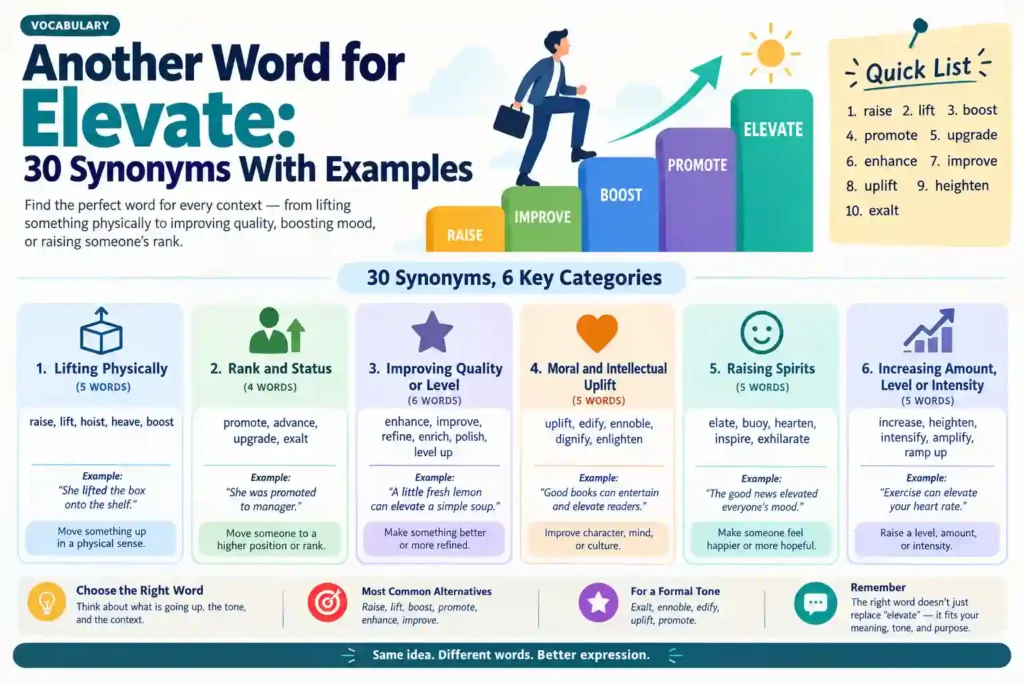
The closest everyday alternatives to “elevate” are raise, lift, and boost. For a higher job or rank, promote fits best. For better quality, enhance and improve work well. “Elevate” often sounds a little more formal or more impressive than these plain words.
The best alternative depends on what is going up. A box can be lifted, a person can be promoted, a dish can be enhanced, and a mood can be buoyed. A level, like a heart rate, can increase. Merriam-Webster notes that “elevate” can replace “lift” or “raise,” especially when exalting or enhancing is implied.
Quick list: raise, lift, boost, promote, upgrade, enhance, improve, uplift, heighten, exalt
This article looks at 30 alternatives. Each has a definition, IPA, a usage note, an example, and context to show when it fits.
At a Glance: Elevate Synonyms and Related Alternatives
| Alternative | Part of Speech | Meaning | Register / Tone | Ideal Context |
| raise | verb | Move to a higher position or level | Neutral | Everyday speech and writing |
| lift | verb | Move something up | Neutral | Physical lifting, mood |
| boost | verb | Increase or improve something | Neutral to informal | Confidence, sales, energy |
| promote | verb | Move to a higher rank or position | Neutral | Jobs, schools, sports |
| upgrade | verb | Move to a higher grade or quality | Neutral | Products, seats, software |
| enhance | verb | Improve quality, value, or strength | Neutral to formal | Features, flavor, skills |
| improve | verb | Make better | Neutral | General use |
| uplift | verb | Raise spiritually, morally, or emotionally | Formal to literary | Speeches, communities |
| heighten | verb | Increase a degree or intensity | Neutral to formal | Feelings, awareness, risk |
| exalt | verb | Raise in rank or praise highly | Formal, literary | Honor, religion, writing |
Which Word Should You Use?
| If you want to… | Use | Why |
| Move something up physically | lift, raise, hoist | They are plain and direct. |
| Move someone to a higher job | promote, advance | They are the standard words for rank. |
| Make something better in quality | enhance, improve, refine | They focus on improvement. |
| Raise someone’s mood | buoy, hearten, elate | They describe lifting feelings. |
| Improve character or mind in formal writing | uplift, edify, ennoble | They have a moral or intellectual tone. |
| Increase an amount or intensity | increase, heighten, intensify | They describe raising a level. |
| Sound casual about improving | level up | It is informal and modern. |
| Praise or honor highly | exalt | It adds high praise or respect. |
Exploring the Multiple Meanings of “Elevate”
1. Lifting Physically
- Meaning: To lift something up or make it higher.
- Explanation: This is the literal sense. It is common in medical advice and technical writing, where “raise” or “lift” would also work.
- Example: The nurse told him to elevate his injured leg.
2. Raising Rank or Status
- Meaning: To move someone to a higher position, rank, or level of importance.
- Explanation: This sense is dated to about 1500 by Etymonline. Promote and advance are the closest alternatives.
- Example: She was elevated to chairman last year.
3. Improving Morally, Intellectually, or Culturally
- Meaning: To improve the mind, character, or taste of someone or something.
- Explanation: Etymonline dates this sense to the 1620s. It sounds serious and lofty. Uplift, edify, and ennoble fit here.
- Example: Good books can entertain and elevate readers.
4. Raising Quality or Level
- Meaning: To make something better, more refined, or more impressive.
- Explanation: This is a common modern use, especially in food, design, and writing. Enhance and refine are close alternatives.
- Example: A little fresh lemon can elevate a simple soup.
5. Raising Spirits
- Meaning: To make someone feel happier or more hopeful.
- Explanation: Merriam-Webster lists “elate” for this sense. It is less common than the others.
- Example: The good news elevated everyone’s mood.
6. Rising or Increasing in Level
- Meaning: To become higher, or to increase a level or amount.
- Explanation: This covers things like voices, heart rates, and numbers. Merriam-Webster also records an intransitive use, “to become elevated.”
- Example: Running can elevate your heart rate.
Sources: Merriam-Webster (elevate); Etymonline (elevate).
Analyzing 30 Elevate Alternatives in Detail
Some of these are direct synonyms of “elevate,” while others are context-specific related alternatives. Each usage note says which is which.
Everyday Alternatives for Lifting
1. Raise
IPA: /reɪz/ (US and UK)
Definition: To move something to a higher position or level.
- Usage: A direct synonym and the plainest choice. Merriam-Webster lists it with elevate. It is less lofty than “elevate.”
- Example: Please raise the screen a little.
2. Lift
IPA: /lɪft/ (US and UK)
Definition: To move something from a lower to a higher place.
- Usage: A direct synonym for the physical sense. It also works for moods (“lift your spirits”).
- Example: She lifted the box onto the shelf.
3. Hoist
IPA: /hɔɪst/ (US and UK)
Definition: To raise something up, often with effort, ropes, or a machine.
- Usage: A related alternative. It is more physical than “elevate” and rarely works for status or quality.
- Example: The crew hoisted the flag at dawn.
4. Heave
IPA: /hiːv/ (US and UK)
Definition: To lift something heavy with great effort.
- Usage: A related alternative. Merriam-Webster lists it with elevate, but it stresses strain and heaviness.
- Example: They heaved the trunk into the truck.
5. Boost
IPA: /buːst/ (US and UK)
Definition: To raise or increase something, or to push it upward.
- Usage: A close alternative, especially in figurative use. It fits confidence, sales, and energy.
- Example: A short walk can boost your mood.
Alternatives for Rank and Status
6. Promote
IPA: US /prəˈmoʊt/ · UK /prəˈməʊt/
Definition: To raise someone to a higher rank or position.
- Usage: A direct synonym for the rank sense. It is the standard word for jobs and school grades.
- Example: The company promoted her to manager.
7. Advance
IPA: US /ədˈvæns/ · UK /ədˈvɑːns/
Definition: To move forward, or to raise someone to a higher position.
- Usage: A related alternative. It stresses progress over time.
- Example: He advanced to a senior role within two years.
8. Upgrade
IPA: /ʌpˈɡreɪd/ (US and UK)
Definition: To raise something to a higher grade, class, or quality.
- Usage: A close synonym for improving quality or class. It is common with products, seats, and software.
- Example: The airline upgraded us to business class.
9. Exalt
IPA: /ɪɡˈzɔːlt/ (US and UK)
Definition: To raise in rank, power, or character, or to praise highly.
- Usage: A formal, literary synonym. It is stronger and more solemn than “elevate.”
- Example: The poem exalts the courage of ordinary people.
Alternatives for Improving Quality or Level
10. Enhance
IPA: US /ɪnˈhæns/ · UK /ɪnˈhɑːns/
Definition: To increase or improve quality, value, or strength.
- Usage: A close synonym for the “improve quality” sense. It is more precise than “elevate.”
- Example: The new lighting enhances the room.
11. Improve
IPA: /ɪmˈpruːv/ (US and UK)
Definition: To make something better.
- Usage: A direct but plainer synonym for the quality sense. It lacks the lofty feel of “elevate.”
- Example: Daily practice will improve your writing.
12. Refine
IPA: /rɪˈfaɪn/ (US and UK)
Definition: To improve something by removing flaws or making small changes.
- Usage: A related alternative. It suggests careful polishing, not lifting to a new level.
- Example: The chef refined the recipe over several weeks.
13. Enrich
IPA: /ɪnˈrɪtʃ/ (US and UK)
Definition: To make something fuller, richer, or better in quality.
- Usage: A related alternative. It suggests adding value, flavor, or meaning.
- Example: Travel enriched her view of the world.
14. Polish
IPA: US /ˈpɑːlɪʃ/ · UK /ˈpɒlɪʃ/
Definition: To improve something by making it smoother or more refined.
- Usage: A related alternative for finishing touches. It does not mean raising to a higher level.
- Example: She polished her speech before the conference.
15. Level up
IPA: /ˌlɛvəl ˈʌp/ (US and UK)
Definition: To improve to a higher level.
- Usage: An informal phrasal verb, common in casual speech. Avoid it in formal writing.
- Example: He leveled up his cooking by taking a class.
Moral and Intellectual Uplift
16. Uplift
IPA: /ʌpˈlɪft/ (US and UK)
Definition: To raise someone emotionally, morally, or spiritually.
- Usage: A close synonym for the moral and emotional senses. It sounds formal and hopeful.
- Example: The choir’s singing uplifted the whole room.
17. Edify
IPA: /ˈɛdɪfaɪ/ (US and UK)
Definition: To instruct and improve someone morally or intellectually.
- Usage: A formal related alternative. It is rare in everyday speech.
- Example: The lecture was meant to edify the audience.
18. Ennoble
IPA: US /ɪˈnoʊbəl/ · UK /ɪˈnəʊbəl/
Definition: To give someone or something a noble quality, or to make someone a noble.
- Usage: A formal related alternative. It fits character and dignity. It also has a literal sense of granting a title.
- Example: Honest work can ennoble a person.
19. Dignify
IPA: /ˈdɪɡnɪfaɪ/ (US and UK)
Definition: To give dignity or distinction to someone or something.
- Usage: A related alternative. It suggests making something seem worthy of respect.
- Example: The ceremony dignified the occasion.
20. Enlighten
IPA: /ɪnˈlaɪtən/ (US and UK)
Definition: To give someone knowledge or understanding.
- Usage: A related alternative. It fits the intellectual side of “elevate,” but it is about knowledge, not status.
- Example: The documentary enlightened viewers about the issue.
Alternatives for Raising Spirits
21. Elate
IPA: /ɪˈleɪt/ (US and UK)
Definition: To make someone very happy and proud.
- Usage: A direct synonym for the “raise spirits” sense. Merriam-Webster lists it in that sense of elevate.
- Example: The win elated the whole team.
22. Buoy
IPA: US /ˈbuːi/ · UK /bɔɪ/
Definition: To lift someone’s spirits or keep them hopeful.
- Usage: A close alternative, often used as “buoy up.” It suggests support in hard times.
- Example: The kind letter buoyed her spirits.
23. Hearten
IPA: US /ˈhɑːrtn/ · UK /ˈhɑːtn/
Definition: To give someone courage or cheer.
- Usage: A related alternative. It is a bit formal and fits encouragement.
- Example: The early results heartened the researchers.
24. Inspire
IPA: US /ɪnˈspaɪər/ · UK /ɪnˈspaɪə/
Definition: To fill someone with the wish or energy to do something.
- Usage: A related alternative. It focuses on motivation, not a rise in status or quality.
- Example: Her story inspired many young readers.
25. Exhilarate
IPA: /ɪɡˈzɪləreɪt/ (US and UK)
Definition: To make someone feel lively, excited, and happy.
- Usage: A related alternative. It describes an energetic rush, not a lasting lift.
- Example: The cold morning air exhilarated him.
Alternatives for Increasing Amount, Level, or Intensity
26. Increase
IPA: /ɪnˈkriːs/ (US and UK) (as a verb)
Definition: To make something greater in amount, size, or degree.
- Usage: A related alternative for the “level” sense. It does not suggest improvement in quality.
- Example: Exercise can increase your energy.
27. Heighten
IPA: /ˈhaɪtn/ (US and UK)
Definition: To increase the degree or intensity of something.
- Usage: A close alternative for feelings, awareness, or risk.
- Example: The noise heightened her fear.
28. Intensify
IPA: /ɪnˈtɛnsɪfaɪ/ (US and UK)
Definition: To make something stronger or more extreme.
- Usage: A related alternative. It suggests more force or strength, not a higher position.
- Example: The storm intensified overnight.
29. Amplify
IPA: /ˈæmplɪfaɪ/ (US and UK)
Definition: To make something louder, stronger, or greater.
- Usage: A related alternative, best for sound, effects, or messages.
- Example: The speaker amplified her voice.
30. Ramp up
IPA: /ˌræmp ˈʌp/ (US and UK)
Definition: To increase something, often quickly or in steps.
- Usage: An informal related alternative. It fits production, effort, and activity.
- Example: The factory ramped up production before the holidays.
Sources: Merriam-Webster (elevate); Etymonline (elevate).
Elevate vs. Raise vs. Lift vs. Promote
These four words overlap, but they are not always interchangeable. Merriam-Webster says “elevate” may replace “lift” or “raise,” especially when exalting or enhancing is implied.
| Word | Main Focus | Typical Sentence |
| elevate | Higher position, status, or quality; often a step up in tone | The film elevated the genre. |
| raise | Simple upward move or increase | She raised her hand. |
| lift | Physical upward move, or a mood lift | He lifted the box. |
| promote | Higher rank or position | The firm promoted him to director. |
If the action is plain and physical, “lift” or “raise” is usually better. If you want a lofty or impressive tone, or you mean improving quality, “elevate” fits well.
Sources: Merriam-Webster (elevate).
Elevate and Opposite/Paired Word Pairs
| Word | Paired Word | Note |
| elevate | lower | The plainest opposite. |
| elevate | demote | The opposite for rank. |
| elevate | degrade | The opposite for moral or social standing. |
| elevate | depress | Can mean lowering spirits. |
| elevate | diminish | Contrasts raising with making less. |
| elevate | reduce | The opposite for amounts and levels. |
| elevate | enhance | A common pair in writing about quality. |
| elevate | inspire | Often appear together in speeches and marketing. |
“Lower” is the general opposite. The best contrast depends on the sense: “demote” for rank, “degrade” for moral standing, and “reduce” for levels. “Enhance” and “inspire” are not opposites, but they often appear next to “elevate.”
Sources: Merriam-Webster (elevate).
Common Word Partners of “Elevate”
| Pattern | Common Partners | Example |
| elevate + noun | status, mood, standards, profile, heart rate, voice | Exercise can elevate your heart rate. |
| elevate + to | to chairman, to a higher position, to the rank of | She was elevated to chairman. |
| elevate + above | above the ordinary, above the crowd | The design elevates the product above its rivals. |
| elevate + with | with better flavor, with fresh herbs | Elevate the dish with fresh herbs. |
| elevate + your | your game, your style, your skills | The course will elevate your skills. |
| adverb + elevate | greatly, further, significantly | The award further elevated her profile. |
| elevated + noun | blood pressure, levels, risk, platform | The test showed elevated levels. |
Sources: Merriam-Webster (elevate).
Idiomatic Phrases Featuring “Elevate”
These are established expressions, not strict idioms. The last one uses the related form “elevated.”
1. Elevate your game
- Meaning: To improve your performance to a higher level. It is common in sports and business.
- Example: The new coach helped the team elevate its game.
2. Elevate to the peerage
- Meaning: To give someone a noble title, especially in Britain.
- Example: The writer was elevated to the peerage for his service.
3. Elevate someone to sainthood
- Meaning: To treat someone as perfect or deserving of great honor, often unfairly.
- Example: Fans elevated the player to sainthood after one great season.
4. Elevated (old slang)
- Meaning: Drunk. Etymonline notes this as old slang for “elevated.”
- Example: In the old novel, the guest arrived home slightly elevated.
Sources: Merriam-Webster (elevate); Etymonline (elevate).
Word Formation of “Elevate”
Etymology & Structure
“Elevate” comes from Latin elevatus, the past participle of elevare, “to lift up, raise.” Etymonline notes that Latin elevare also meant, figuratively, “to lighten, alleviate.” It is formed from e- (a form of ex-, “out”) plus levare, “to lighten, raise,” from levis, “light” in weight. Merriam-Webster links it to the word “lever.”
Date and History
Etymonline dates “elevate” to the late 15th century, with the sense “to raise above the usual position.” The sense “raise in rank or status” is dated to about 1500. The moral or intellectual sense is dated to the 1620s. Merriam-Webster places the first known use in the 15th century.
Word Class Variations
- Verb: elevate, elevates, elevated, elevating
- Adjective: elevated, elevating
- Noun: elevation; elevator (from Latin elevator, “one who raises up,” dated to the 1640s by Etymonline, originally of muscles; as a mechanical lift, 1787)
Sources: Etymonline (elevate, elevator); Merriam-Webster (elevate).
Common Word-Choice Mistakes
- “Please elevate your hand”: use “raise your hand.” “Elevate” sounds too formal for a simple action.
- “The news hoisted her spirits”: use “lifted her spirits.” “Hoist” is for physical lifting with effort, such as a flag.
- “The company elevated my salary”: use “raised my salary.” “Elevate” suits rank and quality, not pay.
- “We uplifted the software to the latest version”: use “upgraded.” “Uplift” suggests moral or emotional improvement.
- “My blood pressure is elevate”: use “elevated.” The adjective needs the -ed form.
- “She was elevated as director”: use “elevated to director.”
- “I heaved my phone off the table”: use “picked up” or “lifted.” “Heave” suggests heavy effort.
FAQs
1. What is the closest synonym for elevate?
“Raise” and “lift” are the closest everyday synonyms. For rank, “promote” is closest, and for quality, “enhance” is closest.
2. What is the difference between elevate and raise?
“Raise” is the plainer, more general word. “Elevate” often adds a sense of improving, honoring, or lifting to a higher level.
3. What is the difference between elevate and enhance?
“Elevate” suggests a step up to a higher level. “Enhance” means adding to quality, value, or strength.
4. What is a formal alternative to elevate?
Exalt, ennoble, edify, and promote suit formal writing. Each fits a different sense, such as honor, character, or rank.
5. What is a literary alternative to elevate?
Exalt, uplift, and ennoble sound literary. They suit writing about honor, spirit, or character.
6. What is the opposite of elevate?
“Lower” is the general opposite. “Demote,” “degrade,” and “reduce” fit specific senses.
7. Can “elevate” be used for people?
Yes. People can be elevated to a higher rank, such as “elevated to chairman,” or lifted in spirit or character.
8. Can “elevate” mean “increase”?
Yes. Merriam-Webster gives the example of exercise elevating the heart rate. In this sense, “increase” and “raise” also work.
9. What does “elevated” mean as an adjective?
It means raised or higher, as in “elevated levels.” It can also mean lofty, as in “elevated language.” Etymonline notes it was once slang for “drunk.”
10. Is “elevate” related to “elevator”?
Yes. Etymonline traces “elevator” to Latin elevator, “one who raises up,” from the same verb. It was first used for muscles in the 1640s and for a mechanical lift in 1787.
Conclusion
The closest alternatives to “elevate” are raise, lift, and boost. For rank, promote is bes For mood, buoy and elate work, and for levels, increase and heighten are good choices.
Context matters because “elevate” has several senses. It can mean lifting something physically, raising rank, improving quality or character, lifting spirits, or increasing a level. Words like hoist, edify, and amplify each cover only part of that range.
To choose, first ask what is going up: an object, a person, a quality, a mood, or an amount. Then think about tone, formal or casual. When in doubt, “raise,” “improve,” and “promote” are clear and safe.

Hy, Sophia is a content writer with 3 years of experience creating engaging, informative, and SEO-friendly articles focused on synonyms, vocabulary, and word meanings.