30 Another Word for Initiatives: Synonyms, Meanings, and Examples
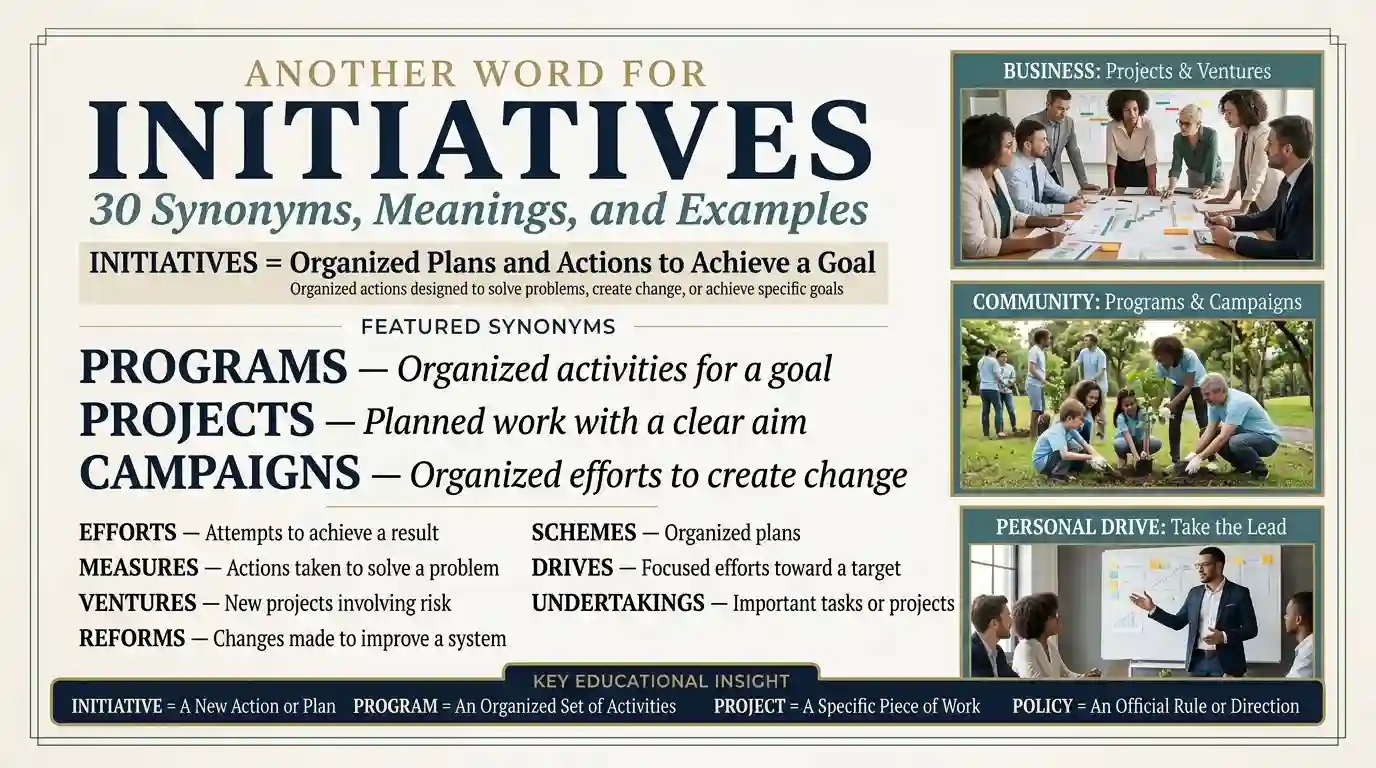
The most common another word for initiatives is programs. Projects, campaigns, and efforts also fit, depending on what the initiatives are. Public and social initiatives are often called programs, campaigns, or measures. Business initiatives are often projects or ventures.
Initiative has other meanings too. It can mean the first step (“take the initiative”), the ability to act without being told (“show initiative”), or a citizen-proposed law on a ballot. The plural initiatives usually means organized plans, so most alternatives below fit that meaning. The other senses have their own sections.
Quick list: programs, projects, campaigns, efforts, measures, ventures, schemes, undertakings, reforms, drives
This article looks at 30 alternatives. Each one has a meaning, IPA, a usage note, and an example. Some are direct synonyms of initiatives, and others only fit one context. Each entry says which.
At a Glance: Initiatives Synonyms and Related Alternatives
| Alternative | Part of Speech | Meaning | Register / Tone | Ideal Context |
| Programs | Noun (plural) | Organized sets of activities for a goal | Neutral | Government, schools, charities |
| Projects | Noun (plural) | Planned pieces of work with an aim | Neutral | Work, school, building |
| Campaigns | Noun (plural) | Organized efforts for a social or commercial goal | Neutral | Advertising, politics, health |
| Schemes | Noun (plural) | Organized plans | Neutral (UK), often negative (US) | Savings, housing, public services |
| Efforts | Noun (plural) | Organized attempts to achieve something | Neutral | Relief, conservation |
| Measures | Noun (plural) | Actions taken to deal with a problem | Formal | Safety, security, policy |
| Ventures | Noun (plural) | New projects, often with risk | Neutral | Business, startups |
| Reforms | Noun (plural) | Changes meant to improve a system | Formal | Law, education, health |
| Pilots | Noun (plural) | Trial versions of a larger plan | Neutral, technical | Testing new services |
| Drives | Noun (plural) | Organized efforts for a specific purpose | Neutral | Food drives, voter drives |
Which Word Should You Use?
| If you want to… | Use | Why |
| Describe organized plans to solve a social problem | Programs or campaigns | They suit public and charity work. |
| Describe a piece of work with a clear start and end | Projects | It points to a specific task with a goal. |
| Describe business plans that carry risk | Ventures | It suggests a new business effort. |
| Describe government actions to fix a problem | Measures or reforms | They fit policy and law. |
| Describe a trial before a full launch | Pilots | It means a smaller test version. |
| Describe first approaches to start talks | Overtures | It fits peace talks and deals. |
| Describe an organized push for donations or votes | Drives | It suggests a time-limited effort for a purpose. |
| Describe a person’s willingness to act without being told | Enterprise or resourcefulness | They name the quality, not the plan. |
Exploring the Multiple Meanings of “Initiatives”
1. An Organized Plan or Program
- Meaning: A planned set of actions to solve a problem or reach a goal.
- Explanation: This is the most common meaning of the plural. It is often used for governments, schools, and charities. Collocations such as peace initiative and government initiative show this use.
- Example: The city launched new initiatives to reduce traffic.
2. A Project Launched by an Organization
- Meaning: A specific project or effort started by a company or group.
- Explanation: In business writing, initiatives often means named projects with a goal, a team, and a deadline. It sounds more official than projects.
- Example: The company announced three sustainability initiatives.
3. The First Step or the Lead
- Meaning: The power or chance to act first.
- Explanation: This sense is almost always singular and appears in take the initiative. Etymonline records the sense “disposition to take the lead” from 1793.
- Example: She took the initiative and called the client.
4. The Ability to Act Without Being Told
- Meaning: The quality of starting things on your own.
- Explanation: This sense is uncountable. People say “show initiative,” not “show initiatives.” It is a common word in job reviews and school reports.
- Example: He showed great initiative during his first month.
5. A Ballot Initiative
- Meaning: A process or proposal in which citizens put a law or measure on a ballot, usually by collecting signatures.
- Explanation: This is a political sense, common in some US states. Ballot initiatives are decided by public vote.
- Example: Voters will decide on two ballot initiatives in November.
Sources: Etymonline, “initiative”; Oxford Learner’s Dictionaries, “initiative”; Merriam-Webster, “initiative”; Collins English Dictionary, “initiative”.
Analyzing 30 Initiatives Alternatives in Detail
Some of these words are direct synonyms of initiatives in one sense. Others are related alternatives that only fit a narrow context. Each usage note says which is which.
Core Alternatives for Plans and Programs
1. Programs
IPA: US /ˈproʊɡræmz/ · UK /ˈprəʊɡræmz/
Definition: Organized sets of activities or services with a purpose.
- Usage: A close synonym for initiatives in the public and social sense. It suggests an ongoing, organized effort. British English often spells it programmes.
- Example: The school runs programs for new students.
2. Projects
IPA: US /ˈprɑːdʒekts/ · UK /ˈprɒdʒekts/
Definition: Planned pieces of work meant to achieve a specific aim.
- Usage: A close synonym in the business and work sense. It usually suggests a start and an end, so it is narrower than initiatives.
- Example: The team finished three projects this year.
3. Plans
IPA: /plænz/ (US and UK)
Definition: Ideas or arrangements for how to do something.
- Usage: A related, neutral alternative. Plans can stay on paper, while initiatives usually suggests action has started.
- Example: The council shared its plans for the new park.
4. Campaigns
IPA: /kæmˈpeɪnz/ (US and UK)
Definition: Organized series of actions meant to reach a social, political, or commercial goal.
- Usage: A close synonym for public initiatives, especially those meant to change behavior or win support. It suggests public messaging.
- Example: The health office ran two campaigns against smoking.
5. Schemes
IPA: /skiːmz/ (US and UK)
Definition: Organized plans or systems.
- Usage: A related alternative. In British English it is neutral, as in “a savings scheme.” In American English it often suggests a secret or dishonest plan, so use it with care.
- Example: The government introduced new housing schemes.
6. Undertakings
IPA: US /ˈʌndərˌteɪkɪŋz/ · UK /ˌʌndəˈteɪkɪŋz/
Definition: Tasks or projects that someone has taken on.
- Usage: A related, formal alternative. It stresses accepting a serious responsibility and often describes large efforts.
- Example: Building the bridge was one of the city’s largest undertakings.
Business and Project Alternatives
7. Ventures
IPA: US /ˈventʃərz/ · UK /ˈventʃəz/
Definition: New projects or businesses, usually with some risk.
- Usage: A related alternative for business. It suggests risk and newness, so it does not fit routine or public programs.
- Example: The two firms started several joint ventures.
8. Strategies
IPA: /ˈstrætədʒiz/ (US and UK)
Definition: Long-term plans for reaching a goal.
- Usage: A related alternative, not an exact synonym. A strategy is the plan, while an initiative is the action taken under it.
- Example: The company’s growth strategies include new markets.
9. Efforts
IPA: US /ˈefərts/ · UK /ˈefəts/
Definition: Organized attempts to achieve something.
- Usage: A close, neutral synonym when the focus is on work done, not the plan. It is common in phrases like relief efforts.
- Example: Local efforts helped reduce waste in the city.
10. Endeavors
IPA: US /ɪnˈdevərz/ · UK /ɪnˈdevəz/ (spelled endeavours in British English)
Definition: Serious attempts to do something.
- Usage: A related, formal alternative. It suggests careful or ambitious work and sounds more formal than efforts.
- Example: The foundation supports educational endeavors in rural areas.
11. Pilots
IPA: /ˈpaɪləts/ (US and UK)
Definition: Small trial versions of a larger plan.
- Usage: A context-specific alternative. It only fits initiatives that are being tested before a full launch, as in pilot programs.
- Example: The bank ran two pilots before the full rollout.
Government and Policy Alternatives
12. Measures
IPA: US /ˈmeʒərz/ · UK /ˈmeʒəz/
Definition: Actions taken to deal with a problem.
- Usage: A close, formal synonym for government or official initiatives, as in safety measures. It stresses actions taken to solve something.
- Example: The city introduced new measures to cut pollution.
13. Policies
IPA: US /ˈpɑːləsiz/ · UK /ˈpɒləsiz/
Definition: Official plans or rules that guide decisions.
- Usage: A related alternative, not an exact synonym. A policy sets a rule or direction, while an initiative is a specific action or project.
- Example: The school changed its attendance policies.
14. Reforms
IPA: US /rɪˈfɔːrmz/ · UK /rɪˈfɔːmz/
Definition: Changes meant to improve a system or organization.
- Usage: A related, formal alternative. It fits only initiatives that change how a system works, such as law or education.
- Example: The new reforms simplified the tax system.
15. Proposals
IPA: US /prəˈpoʊzəlz/ · UK /prəˈpəʊzəlz/
Definition: Plans or ideas suggested for others to consider.
- Usage: A related alternative for initiatives that have not yet started. It stresses that the plan still needs approval.
- Example: The mayor presented two proposals for new housing.
16. Actions
IPA: /ˈækʃənz/ (US and UK)
Definition: Things done to achieve a result.
- Usage: A related, general alternative. It is neutral and wide, so it often needs an adjective such as government or practical.
- Example: The company announced several actions to cut costs.
Alternatives for First Steps and Moves
17. Steps
IPA: /steps/ (US and UK)
Definition: Actions taken toward a goal.
- Usage: A close alternative for the “first step” sense. It is neutral and often appears with first or important.
- Example: The council took steps to protect the river.
18. Moves
IPA: /muːvz/ (US and UK)
Definition: Actions taken to gain an advantage or make progress.
- Usage: A related, informal alternative. It suggests strategy and timing, so it fits news about companies and governments.
- Example: The firm’s bold moves surprised its rivals.
19. Overtures
IPA: US /ˈoʊvərtʃʊrz/ · UK /ˈəʊvətʃʊəz/
Definition: First approaches made to start talks or a relationship.
- Usage: A related, formal alternative. It fits only initiatives that open talks, as in peace overtures.
- Example: Both countries made overtures to restart trade talks.
20. Pushes
IPA: /ˈpʊʃɪz/ (US and UK)
Definition: Strong, organized efforts to achieve something.
- Usage: A related, informal alternative. It is common in news writing, as in “a push for reform.” It suggests energy and speed.
- Example: Both parties announced pushes to improve schools.
Alternatives for Personal Drive
The words in this group fit the “ability to act without being told” sense. They are usually uncountable, so they replace the singular initiative more naturally than the plural.
21. Enterprise
IPA: US /ˈentərpraɪz/ · UK /ˈentəpraɪz/
Definition: Readiness to try new and difficult things.
- Usage: A close synonym for the personal-drive sense of initiative. It also means a business or project, so context matters.
- Example: The students showed great enterprise with their fundraiser.
22. Ambition
IPA: /æmˈbɪʃn/ (US and UK)
Definition: A strong wish to achieve success.
- Usage: A related alternative. Ambition is the wish to succeed, while initiative is the habit of acting without being told.
- Example: She has the ambition to run her own company.
23. Resourcefulness
IPA: US /rɪˈsɔːrsfəlnəs/ · UK /rɪˈsɔːsfəlnəs/
Definition: The ability to find clever ways to solve problems.
- Usage: A related alternative. It stresses problem-solving, while initiative stresses starting something.
- Example: His resourcefulness saved the project.
24. Gumption
IPA: /ˈɡʌmpʃn/ (US and UK)
Definition: Bold, practical energy to get things done.
- Usage: A close, informal synonym for the personal-drive sense. It sounds warm and a little old-fashioned.
- Example: She had the gumption to start her own business.
25. Leadership
IPA: US /ˈliːdərʃɪp/ · UK /ˈliːdəʃɪp/
Definition: The ability to guide others, or the act of taking the lead.
- Usage: A related alternative for the “take the lead” sense. It focuses on guiding people, not on starting tasks alone.
- Example: The coach showed strong leadership during the crisis.
Civic and Campaign Alternatives
26. Propositions
IPA: US /ˌprɑːpəˈzɪʃnz/ · UK /ˌprɒpəˈzɪʃnz/
Definition: Measures put to voters in an election, in some US states.
- Usage: A context-specific alternative for the ballot sense of initiatives. It also means a suggested idea in other contexts.
- Example: California voters will decide on several propositions.
27. Referendums
IPA: /ˌrefəˈrendəmz/ (US and UK)
Definition: Public votes on one specific question.
- Usage: A related alternative, not an exact synonym. A referendum asks voters to approve or reject a measure, while an initiative is usually started by citizens. The plural can also be referenda.
- Example: The town held two referendums on school funding.
28. Petitions
IPA: /pəˈtɪʃnz/ (US and UK)
Definition: Formal written requests signed by many people.
- Usage: A related alternative. In many places, ballot initiatives begin with petitions, but a petition alone does not create a new law.
- Example: Residents signed petitions to protect the park.
29. Movements
IPA: /ˈmuːvmənts/ (US and UK)
Definition: Groups of people working together for a shared cause.
- Usage: A related alternative for initiatives driven by large groups of people. It is broader and less formal than a program.
- Example: Youth movements have pushed for cleaner air.
30. Drives
IPA: /draɪvz/ (US and UK)
Definition: Organized efforts to collect something or reach a target.
- Usage: A close synonym for short, goal-focused initiatives, as in food drives and voter registration drives.
- Example: The church held two drives for winter coats.
Sources: Merriam-Webster; Collins English Dictionary; Collins Thesaurus; Oxford Learner’s Dictionaries.
Initiative vs. Program vs. Project vs. Policy
These four words often appear in the same reports. They overlap, but each has a different focus.
| Word | Main Idea | Typical Feature | Example |
| Initiative | A new action or plan started to solve a problem | Often new and goal-driven | A city initiative to plant trees |
| Program | An organized set of activities or services | Often ongoing | A school lunch program |
| Project | A specific piece of work | Clear start and end | A bridge repair project |
| Policy | An official rule or direction | Guides decisions | A recycling policy |
An initiative can lead to a program or a project, and a policy can support an initiative. In practice, writers often use initiative for something new, program for something ongoing, and project for a task with an end date.
Sources: Merriam-Webster, “initiative,” “program,” “project,” “policy”; Collins English Dictionary.
Initiatives and Opposite/Paired Word Pairs
| Word | Paired Word | Note |
| Initiative | Referendum | A common pair in civic writing, as in “initiative and referendum.” |
| Initiative | Response | Acting first versus reacting to what others do. |
| Initiative | Inaction | The nearest opposite for the “taking action” sense. |
| Initiative | Passivity | The opposite of the personal-drive sense. |
| On your own initiative | On instruction | Acting by choice versus acting because you were told. |
Initiative has no single opposite, because it has several senses. Inaction and passivity fit the personal-drive sense best. Referendum is a pair in civic life, not an opposite, and response contrasts acting first with reacting.
Sources: Merriam-Webster; Collins English Dictionary.
Common Word Partners of “Initiatives”
| Pattern | Common Partners | Example |
| verb + initiatives | launch, announce, support, fund | The city will launch new initiatives next month. |
| adjective + initiatives | new, government, joint, local, peace, policy | The two groups ran joint initiatives. |
| initiatives + preposition | to, against, by, for | An initiative against car theft began last year. |
| topic + initiatives | health, education, climate | Health initiatives reached many villages. |
| type + initiatives | ballot, citizen, state | Two ballot initiatives passed this year. |
| lack of + initiative | lack of initiative | A lack of initiative slowed the team. |
Sources: Oxford Learner’s Dictionaries, “initiative”; Merriam-Webster; Collins English Dictionary.
Idiomatic Phrases Featuring “Initiatives”
The established expressions below use the singular initiative, since the plural is rare in fixed phrases.
1. Take the initiative
- Meaning: To be the first to act, rather than wait for others.
- Example: She took the initiative and organized the meeting.
2. On your own initiative
- Meaning: Without being told or asked to do it.
- Example: He fixed the problem on his own initiative.
3. Seize the initiative
- Meaning: To gain an advantage by acting first.
- Example: The team seized the initiative early in the second half.
4. Use your initiative
- Meaning: To act sensibly without detailed instructions.
- Example: If the door is locked, use your initiative and call the office.
Sources: Oxford Learner’s Dictionaries, “initiative”; Etymonline, “initiative”; Merriam-Webster.
Word Formation of “Initiatives”
Etymology & Structure
Initiative comes from French initiative, from Latin initiatus, the past participle of initiare, “to begin.” That comes from Latin initium, “a beginning.” According to Etymonline, initium is a noun use of the participle of inire, “to go into, enter upon, begin,” from in- “into” plus ire “to go.” The plural initiatives adds the regular English plural ending -s.
Date and History
Etymonline records initiative as “power of initiating” from 1775, borrowed from French (16th century). From 1793 it also meant “disposition to take the lead.” The phrase take the initiative is recorded by 1815. Oxford Learner’s Dictionaries also gives the origin as late 18th century.
Word Class Variations
- Noun: initiative, initiatives (singular for the personal-drive sense, plural for plans)
- Related verb: initiate (c. 1600)
- Related nouns: initiator, initiation (1580s), initiate (a person who has been initiated, 1732)
- Related adjectives: initial (1520s), initiatory (1610s)
Sources: Etymonline, “initiative,” “initiate,” “initiation,” “initial,” “initiatory”; Oxford Learner’s Dictionaries, “initiative.”
Common Word-Choice Mistakes
- Do an initiative: launch or start an initiative.
- She has many initiatives (meaning drive): She has a lot of initiative.
- Use your own initiatives: use your own initiative.
- He acted on his own initiatives: on his own initiative.
- The initiative stage of the project: the initial stage (initial means “first”).
- He initiative the project: He initiated the project (use the verb).
- I took an initiative to clean the kitchen: I took the initiative to clean the kitchen.
FAQs
What is the closest synonym for initiatives?
Programs and projects are the closest everyday synonyms. Campaigns fits public initiatives that aim to change behavior.
What is a formal alternative to initiatives?
Undertakings, endeavors, and measures are formal choices, depending on the context.
What is the difference between an initiative and a project?
A project is a specific piece of work with a start and an end. An initiative is often broader and may include several projects.
What is the difference between an initiative and a policy?
A policy sets a rule or direction. An initiative is a specific action or plan carried out to reach a goal.
What is the difference between an initiative and a strategy?
A strategy is the long-term plan. An initiative is an action taken as part of it.
Is initiative countable?
When it means plans or programs, yes, as in “new initiatives.” When it means the quality of acting on your own, it is uncountable.
What is a ballot initiative?
It is a proposal that citizens place on a ballot, usually by collecting signatures. Voters then decide on it.
What is another word for “take the initiative”?
Take the lead and make the first move are close alternatives.
What is the opposite of initiative?
Inaction and passivity are the nearest opposites for the personal-drive sense.
What can I write on a resume instead of “led initiatives”?
Use led projects, managed programs, or ran campaigns, depending on what you did.
Conclusion
The closest alternatives to initiatives are programs, projects, and campaigns. Efforts, measures, ventures, and drives work in more specific cases, and enterprise and gumption fit when the word means personal drive.
Context decides the right word. Initiatives can mean organized plans, business projects, first steps, personal drive, or ballot proposals. Each meaning has its own alternatives, and some words only work in one area.
To choose well, first decide what the initiatives are: public programs, business projects, first moves, or a personal quality. Then pick the word that fits that meaning and the tone you want.
Discover More Article

Hello,I’m Natalia, a professional content writer with three years of experience. My niche is Another Word for, where I create clear, engaging, and SEO-friendly content about words, meanings, synonyms, phrases, and language. I turn complex word-related topics into simple, useful content for readers.