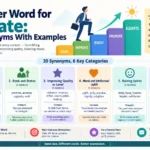

The closest everyday alternatives to “reveals” are shows, discloses, and uncovers. All of them mean making something known or visible. “Discloses” sounds more formal, “shows” is the simplest, and “uncovers” suggests finding something hidden.
The best alternative depends on what is being revealed and how. A secret can be disclosed, divulged, or leaked. A new product can be unveiled. Evidence can indicate or demonstrate something, and a trusted person can confide it. “Reveal” is also a noun, as in “the big reveal,” and a term in building, which brings in a few more alternatives.
Quick list: shows, discloses, uncovers, exposes, divulges, unveils, demonstrates, indicates, leaks, spills
This article looks at 30 alternatives. Each has a definition, IPA, a usage note, an example, and context to show when it fits.
At a Glance: Reveals Synonyms and Related Alternatives
| Alternative | Part of Speech | Meaning | Register / Tone | Ideal Context |
| show | verb | Make something visible or clear | Neutral | Everyday speech and writing |
| disclose | verb | Make hidden or private information known | Formal | Business, legal, news |
| uncover | verb | Find or reveal something hidden | Neutral | Investigations, discoveries |
| expose | verb | Reveal something hidden, often wrong or embarrassing | Neutral, often negative | Scandals, hidden problems |
| divulge | verb | Tell something private or secret | Formal | Breaches of confidence |
| unveil | verb | Show or announce publicly for the first time | Neutral to formal | New products, plans, statues |
| demonstrate | verb | Show clearly with proof or example | Formal to neutral | Research, teaching |
| indicate | verb | Point to or show | Formal to neutral | Data, signs, test results |
| leak | verb | Let secret information out without permission | Neutral, news style | Inside sources, media |
| spill | verb | Tell a secret | Informal | Casual talk with friends |
Which Word Should You Use?
| If you want to… | Use | Why |
| Say it simply | show, tell | They are short and clear in most sentences. |
| Make private information known in formal writing | disclose, divulge | Both sound serious and official. |
| Show something new in public | unveil, announce | They suit launches and ceremonies. |
| Find hidden facts through effort | uncover, unearth | They suggest searching or investigating. |
| Show something with evidence or data | indicate, demonstrate | They focus on proof, not secrets. |
| Describe an inside source sharing secret information | leak | It suggests unofficial release, usually to media. |
| Tell a secret by accident | let slip, give away | They suggest the secret was not meant to come out. |
| Reveal a person’s true identity | unmask | It means removing a disguise. |
Exploring the Multiple Meanings of “Reveals”
“Reveals” is the third-person singular of the verb “reveal” and the plural of the noun “reveal.”
1. Making a Secret Known
- Meaning: Making something secret or hidden known to others.
- Explanation: This is the most common sense. The thing was hidden or private, and now people know it. Disclose and divulge fit best.
- Example: The company refuses to reveal its plans.
2. Opening Something to View
- Meaning: Showing something that was covered or hidden from sight.
- Explanation: This is the physical sense, close to the word’s origin. Something blocked from view becomes visible. Uncover and unveil fit well.
- Example: The curtain opened to reveal the stage.
3. Showing Through Evidence or Behavior
- Meaning: Making something clear or showing something about the truth, a person, or a situation.
- Explanation: Nothing may have been secret here. The thing becomes clear through data, actions, or results. Indicate and demonstrate fit best.
- Example: The test results reveal a problem with the engine.
4. Making Truth Known by Divine Inspiration
- Meaning: Making truth known through divine or supernatural means.
- Explanation: This is the oldest recorded sense in English. It is mostly religious and formal, and it is the same idea behind “revelation.”
- Example: Many faiths teach that God reveals truth to believers.
5. A First Public Showing (Noun)
- Meaning: The act of showing or announcing something for the first time, such as a surprising fact or a new product.
- Explanation: As a noun, “reveal” is common in media and marketing. “The big reveal” and “the slow reveal” are common patterns. Unveiling and revelation are close alternatives.
- Example: The reveal of the new car drew a large crowd.
6. The Side of a Window or Door Opening (Noun)
- Meaning: The side of an opening, such as a window, between the frame and the outer surface of the wall.
- Explanation: This is a technical building term. Merriam-Webster lists “jamb” as another word for it. It has no connection to secrets.
- Example: The deep reveal around the window let less sun into the room.
Sources: Merriam-Webster (reveal); Etymonline (reveal).
Analyzing 30 Reveals Alternatives in Detail
Some of these are direct synonyms of “reveal,” while others are context-specific related alternatives. Verbs are listed in base form, so add the ending to match “reveals” (for example, “discloses”). The last group covers the noun senses.
Core Everyday Alternatives
1. Show
IPA: US /ʃoʊ/ · UK /ʃəʊ/
Definition: To make something visible or clear to others.
- Usage: A related alternative and the simplest choice. It fits the “display” and “make clear” senses, but it does not suggest a secret.
- Example: The photo shows how much the town has changed.
2. Disclose
IPA: US /dɪsˈkloʊz/ · UK /dɪsˈkləʊz/
Definition: To make something private or hidden known.
- Usage: A direct synonym. Merriam-Webster groups it with reveal, divulge, tell, and betray. It is more formal than “reveal” and common in business and legal writing.
- Example: The firm must disclose any risks to investors.
3. Uncover
IPA: US /ʌnˈkʌvər/ · UK /ʌnˈkʌvə/
Definition: To find or reveal something that was hidden.
- Usage: A close synonym for the “bring hidden things to view” sense. It often suggests searching or investigating.
- Example: Reporters uncovered the hidden payments.
4. Expose
IPA: US /ɪkˈspoʊz/ · UK /ɪkˈspəʊz/
Definition: To make something hidden known, especially something wrong or shameful.
- Usage: A related alternative with a stronger, often negative tone than “reveal.” It also means leaving something unprotected.
- Example: The article exposed the company’s unsafe practices.
5. Tell
IPA: /tɛl/ (US and UK)
Definition: To give information to someone in words.
- Usage: A related alternative. Merriam-Webster says “tell” is sometimes interchangeable with “reveal.” It suggests sharing useful information, not exposing a secret.
- Example: She told us the date of the wedding.
6. Announce
IPA: /əˈnaʊns/ (US and UK)
Definition: To make something known publicly or officially.
- Usage: A related alternative. It fits news and plans, but the thing announced is not always a secret.
- Example: The school announced the winners on Friday.
Formal Alternatives for Making Information Known
7. Divulge
IPA: /dɪˈvʌldʒ/ (US and UK)
Definition: To tell something private or secret.
- Usage: A direct synonym with a formal tone. Merriam-Webster says it implies some impropriety or breach of confidence.
- Example: The lawyer would not divulge what his client said.
8. Impart
IPA: US /ɪmˈpɑːrt/ · UK /ɪmˈpɑːt/
Definition: To make information or knowledge known to someone.
- Usage: A formal related alternative. It suggests passing on knowledge, not exposing secrets.
- Example: The teacher imparted her knowledge to the students.
9. Release
IPA: /rɪˈliːs/ (US and UK)
Definition: To make information or a product available to the public.
- Usage: A related alternative for official publication. It does not suggest anything was hidden.
- Example: The agency released the full report on Monday.
10. Unveil
IPA: /ʌnˈveɪl/ (US and UK)
Definition: To show or announce something publicly for the first time.
- Usage: A close synonym for the “first public showing” sense. It is a good fit for products, plans, and statues, and it is close to the word’s roots.
- Example: The company unveiled its new phone.
Showing and Making Clear Through Evidence
11. Display
IPA: /dɪˈspleɪ/ (US and UK)
Definition: To put something where people can see it.
- Usage: A related alternative. Merriam-Webster uses “display” in defining one sense of reveal. It suggests showing, not exposing.
- Example: The museum displays rare maps.
12. Exhibit
IPA: /ɪɡˈzɪbɪt/ (US and UK)
Definition: To show something in public, or to show a quality or feeling.
- Usage: A formal related alternative. It fits shows and also behavior or feelings.
- Example: The child exhibited signs of tiredness.
13. Demonstrate
IPA: /ˈdɛmənstreɪt/ (US and UK)
Definition: To show clearly, often with proof or an example.
- Usage: A related alternative. It fits the “show through evidence” sense and does not suggest secrets.
- Example: The study demonstrates the benefits of exercise.
14. Indicate
IPA: /ˈɪndɪkeɪt/ (US and UK)
Definition: To point to or show that something is true.
- Usage: A related alternative. It is often used with data or signs, and it is less direct than “reveal.”
- Example: The results indicate a strong link.
15. Manifest
IPA: US /ˈmænəfɛst/ · UK /ˈmænɪfɛst/
Definition: To show something plainly, especially a feeling or quality.
- Usage: A formal related alternative. It often describes feelings, symptoms, or signs that become visible.
- Example: The illness manifested itself as a mild fever.
16. Evince
IPA: /ɪˈvɪns/ (US and UK)
Definition: To show clearly that you have a feeling or quality.
- Usage: A formal, rare related alternative. Use it only in careful, formal writing.
- Example: The speech evinced a deep respect for the workers.
Bringing Hidden Things to Light
17. Unearth
IPA: US /ʌnˈɜːrθ/ · UK /ʌnˈɜːθ/
Definition: To find something hidden or lost, often by searching.
- Usage: A close synonym for “uncover.” It suggests digging up facts or objects.
- Example: Researchers unearthed old letters in the archive.
18. Unmask
IPA: US /ʌnˈmæsk/ · UK /ʌnˈmɑːsk/
Definition: To reveal the true identity or nature of someone or something.
- Usage: A related alternative. It fits secret identities and hidden motives.
- Example: The investigation unmasked the writer behind the fake reviews.
19. Bare
IPA: US /bɛr/ · UK /beə/
Definition: To uncover or show something, especially something private.
- Usage: A related alternative, common in “bare your soul.” It sounds literary and emotional.
- Example: He bared his feelings in the letter.
20. Bring to light
IPA: (US and UK) /ˌbrɪŋ tə ˈlaɪt/
Definition: To make something known or discovered, especially a hidden fact.
- Usage: A direct synonym phrase. It suits news, history, and investigations.
- Example: The audit brought the errors to light.
Informal Alternatives and Accidental Revealing
21. Leak
IPA: /liːk/ (US and UK)
Definition: To let secret information out without permission.
- Usage: A related alternative. It usually means an insider shares information with the media or the public.
- Example: Someone leaked the plans to the press.
22. Spill
IPA: /spɪl/ (US and UK)
Definition: To tell a secret or news.
- Usage: An informal related alternative, often used in “spill the beans.” It fits casual talk with friends.
- Example: Come on, spill! What did he say?
23. Blab
IPA: /blæb/ (US and UK)
Definition: To tell secrets or talk too much without thinking.
- Usage: An informal related alternative with a negative tone. It suggests a careless or foolish telling.
- Example: Don’t blab about the surprise party.
24. Let slip
IPA: /lɛt ˈslɪp/ (US and UK)
Definition: To tell something by accident.
- Usage: A related phrase that stresses the accident. Use it when the person did not mean to say it.
- Example: He let slip that he was moving away.
25. Give away
IPA: /ɡɪv əˈweɪ/ (US and UK)
Definition: To reveal something, often by accident.
- Usage: A related phrasal verb. It also means “donate,” so context matters.
- Example: Her smile gave away the surprise.
26. Betray
IPA: /bɪˈtreɪ/ (US and UK)
Definition: To reveal something that should be hidden, often without meaning to.
- Usage: A related alternative. Merriam-Webster lists it with reveal. It also means to break someone’s trust, which is a separate sense.
- Example: His voice betrayed his nerves.
Noun Alternatives
27. Revelation
IPA: /ˌrɛvəˈleɪʃən/ (US and UK)
Definition: The act of making something known, especially a surprising fact.
- Usage: A close noun synonym for “reveal.” It can also mean a surprising discovery or a religious disclosure.
- Example: The documentary was full of shocking revelations.
28. Disclosure
IPA: US /dɪsˈkloʊʒər/ · UK /dɪsˈkləʊʒə/
Definition: The act of making private information known.
- Usage: A formal noun synonym. It is common in legal and business writing.
- Example: The law requires full disclosure of any risks.
29. Unveiling
IPA: /ʌnˈveɪlɪŋ/ (US and UK)
Definition: The first public showing of something new.
- Usage: A close noun alternative for “the big reveal.” It fits events and launches.
- Example: The unveiling of the statue drew a large crowd.
30. Jamb
IPA: /dʒæm/ (US and UK)
Definition: The vertical side of a door or window opening.
- Usage: A related term for the building sense only. Merriam-Webster gives it as another name for this sense of “reveal.” Do not use it for any other meaning.
- Example: The carpenter fixed the window jamb.
Sources: Merriam-Webster (reveal); Etymonline (reveal).
Reveal vs. Disclose vs. Divulge vs. Betray
These words are close, but they differ in tone and what they suggest. Merriam-Webster groups reveal, disclose, divulge, tell, and betray as words that mean making known what has been or should be concealed.
| Word | Main Nuance | Typical Use |
| reveal | Makes something known or visible, including by divine inspiration | General use, news, stories |
| disclose | Makes private information known, often formally | Business, legal, official |
| divulge | Suggests a breach of trust or improper telling | Secrets, private information |
| tell | Shares useful information | Everyday speech |
| betray | Reveals something that should be hidden, often unintentionally | Feelings, secrets, character |
If you only need to make something known, “reveal” is the safe choice. If the telling feels improper, use “divulge.”
Sources: Merriam-Webster (reveal).
Reveals and Opposite/Paired Word Pairs
| Word | Paired Word | Note |
| reveal | conceal | The clearest opposite. |
| reveal | hide | The everyday opposite. |
| reveal | withhold | Contrasts sharing with keeping back. |
| reveal | cover up | Fits scandals and wrongdoing. |
| reveal | obscure | Contrasts making clear with making unclear. |
| reveal | disguise | Contrasts showing with hiding a true form. |
| unveil | veil | Related through the same Latin root. |
| reveal | explain | Often paired in reports and stories. |
“Conceal” is the standard opposite, and “hide” is the plainer choice. The other contrasts depend on context, such as “withhold” for information or “cover up” for wrongdoing. “Reveal” and “explain” are not opposites, but they often appear together, as in “reveal and explain the findings.”
Sources: Merriam-Webster (reveal); Etymonline (reveal, veil).
Common Word Partners of “Reveals”
| Pattern | Common Partners | Example |
| reveal + noun | secret, truth, identity, details, plans, results | She would not reveal the secret. |
| subject + reveals | study, report, data, investigation, poll | The report reveals new details. |
| reveal + that clause | that, how, what, why | The survey reveals that most people prefer mornings. |
| reveal + to | reveal to the public, to the press, to a friend | He revealed the news to his family. |
| adverb + reveal | finally, publicly, fully, recently | The company finally revealed its plans. |
| reveal itself | reveal itself, reveal himself | The truth slowly revealed itself. |
| adjective + reveal (noun) | big, slow, surprise | The big reveal came in the last scene. |
Sources: Merriam-Webster (reveal).
Idiomatic Phrases Featuring “Reveals”
These are established expressions, not all strict idioms. Each is shown in its common form with “reveal.”
1. The big reveal
- Meaning: The moment when something surprising or long-awaited is finally shown or announced.
- Example: The big reveal came at the end of the show.
2. The slow reveal
- Meaning: A gradual disclosure of information, especially in storytelling.
- Example: The author builds suspense with a slow reveal of the family’s past.
3. Reveal your hand
- Meaning: To let others know your plans or strategy. The image comes from card games. People also say “show your hand.”
- Example: She did not want to reveal her hand before the meeting.
4. Reveal your true colors
- Meaning: To show your real character, often a negative side. People also say “show your true colors.”
- Example: Under stress, he revealed his true colors.
Sources: Merriam-Webster (reveal).
Word Formation of “Reveals”
Etymology & Structure
“Reveal” came into English from Old French reveler, from Latin revelare, meaning “to uncover, reveal, disclose.” Etymonline explains that Latin revelare literally meant “unveil.” It was formed from re-, here probably meaning “the opposite of,” plus velare, “to cover or veil.” That comes from velum, “a veil.” The form “reveals” adds the -s ending for the third-person singular verb or the plural noun.
Date and History
Etymonline dates “reveal” to about 1400, as revelen, with the sense of making something known by divine or supernatural means. It dates the sense “display, make clear or visible, expose to sight” to about 1500. Merriam-Webster gives the 15th century as the first known use. Etymonline dates the related noun “revelation” earlier, to about 1300.
Word Class Variations
- Verb: reveal, reveals, revealed, revealing
- Noun: reveal (plural reveals); revealer; revelation
- Adjective: revealing (dated to the 1590s by Etymonline)
- Adverb: revealingly
Sources: Etymonline (reveal, revealing, revelation, veil); Merriam-Webster (reveal).
Common Word-Choice Mistakes
- “She revealed me her secret”: use “She revealed her secret to me” or “She told me her secret.” “Reveal” needs “to” before the person.
- “The teacher divulged the test results to the class”: use “announced” or “shared.” “Divulge” suggests an improper breach of trust.
- “The company unmasked its new phone”: use “unveiled.” “Unmask” is for removing a disguise.
- “The brand exposed its new logo”: use “unveiled.” “Expose” usually sounds negative.
- “She leaked her feelings to a friend”: use “confided in a friend.” “Leak” is for unofficial release of information.
- “The studies reveals a problem”: use “The studies reveal a problem.” The plural subject takes the plain verb.
- “The report blabbed the findings”: use “revealed” or “disclosed.” “Blab” is informal and negative.
FAQs
1. What is the closest synonym for reveals?
“Discloses” is the closest in meaning, and “shows” is the simplest. “Uncovers” fits when something was hidden.
2. What is the difference between reveal and disclose?
Both mean making something known that was hidden. “Disclose” is more formal and common in business and legal writing.
3. What is the difference between reveal and divulge?
“Divulge” suggests the telling is improper or breaks someone’s trust. “Reveal” does not carry that suggestion.
4. Is “expose” the same as “reveal”?
Not quite. “Expose” usually suggests something wrong or shameful. “Reveal” is neutral.
5. What is a formal word for reveals?
Discloses, divulges, and unveils work in formal writing. “Imparts” is formal too, but it suggests sharing knowledge, not secrets.
6. What is an informal word for reveals?
Spills, lets slip, gives away, and blabs are informal. “Blabs” has a negative tone.
7. What is the opposite of reveals?
“Conceals” is the clearest opposite, and “hides” is the simpler choice. “Withholds” fits information.
8. Can “reveal” be a noun?
Yes. As a noun, it means a first public showing, as in “the big reveal.” It also names the side of a window or door opening in building.
9. Can things reveal, or only people?
Both. People reveal secrets, and things like reports, photos, and data reveal facts.
10. Is it “the data reveal” or “the data reveals”?
Formal writing often treats “data” as plural, as in “the data reveal.” Many writers use it as singular in everyday English. Pick one and stay consistent.
Conclusion
The closest alternatives to “reveals” are discloses, shows, uncovers, and divulges. For public announcements, unveils fits well. For evidence, demonstrates and indicates are good choices.
Context matters because “reveal” covers several ideas. It can mean making a secret known, showing something to view, or making something clear through evidence. It is also a noun for a first showing and a building term. Words like divulge, expose, and leak add tones such as impropriety, scandal, or insider release.
To choose, first ask whether something was hidden or just shown. Then think about tone, formal or casual, and whether the revealing was planned or accidental. When in doubt, “shows,” “discloses,” and “uncovers” are clear and safe.

Hello,I’m Natalia, a professional content writer with three years of experience. My niche is Another Word for, where I create clear, engaging, and SEO-friendly content about words, meanings, synonyms, phrases, and language. I turn complex word-related topics into simple, useful content for readers.