30 Another Word for Maybe: Synonyms With Meaning & Example
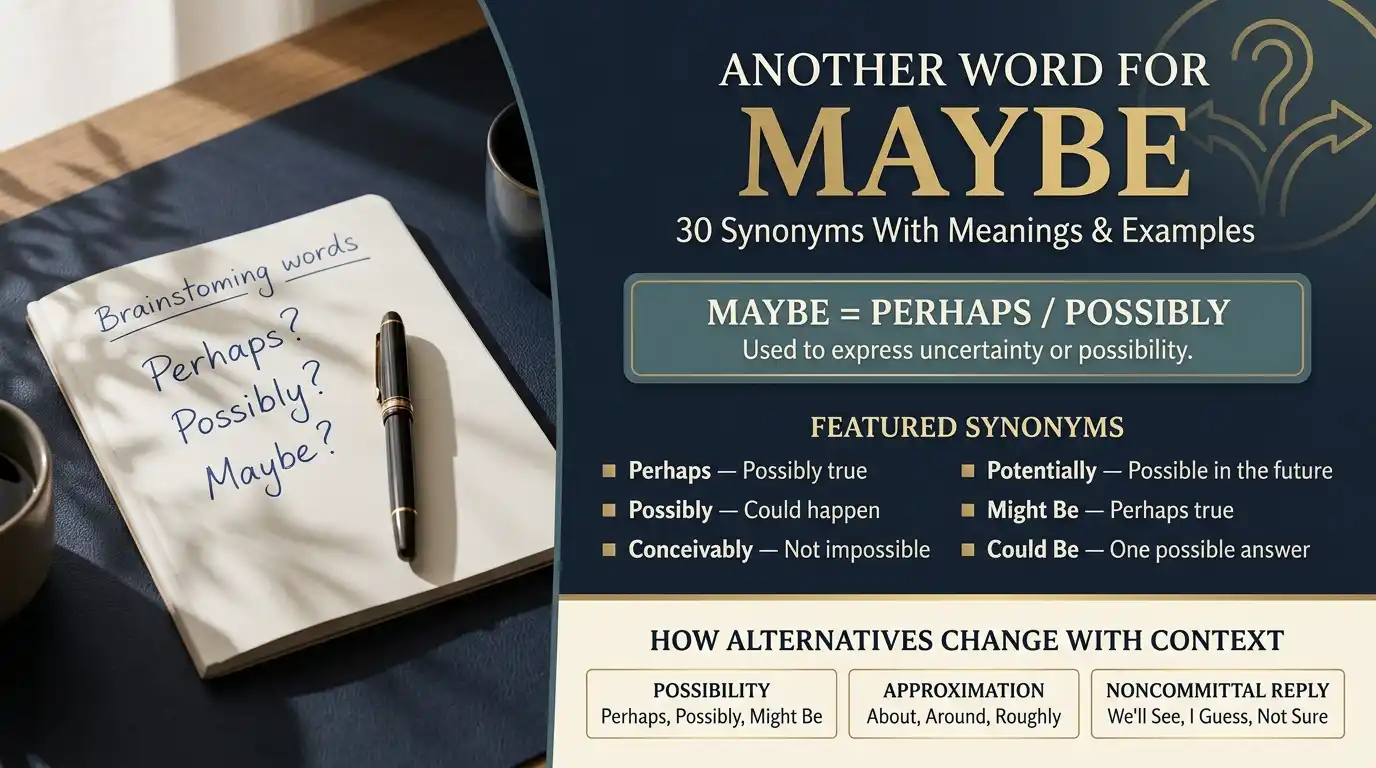
The closest everyday alternative to “maybe” is perhaps. Other common choices are possibly, conceivably, potentially, could be, and might be. These words all show that something is uncertain but not ruled out.
The best alternative depends on what “maybe” is doing in your sentence. It can show a possibility (“Maybe it will rain”), give a noncommittal answer (“Maybe, I’ll see”), mean “about” before a number (“maybe fifty people”), or soften a suggestion (“Maybe we should wait”).
Quick list: perhaps, possibly, conceivably, potentially, could be, might be, perchance, roughly, we’ll see, I guess
This article looks at 30 alternatives. Each has a meaning, IPA, a usage note, and an example, so you can match the word to the situation.
At a Glance: Maybe Synonyms and Related Alternatives
| Alternative | Part of Speech | Meaning | Register / Tone | Ideal Context |
| Perhaps | Adverb | Possibly; it may be so | Neutral, slightly formal | Writing and speech |
| Possibly | Adverb | Within the range of what can happen | Neutral | Everyday and professional |
| Conceivably | Adverb | In a way that can be imagined | Formal | Reasoning, speculation |
| Potentially | Adverb | Capable of becoming or happening | Formal to neutral | Business, science, risk |
| Could be | Phrase | It is possible | Casual | Speech, messages |
| Might be | Phrase | It is possibly true | Casual to neutral | Guesses, explanations |
| Perchance | Adverb | By chance; perhaps | Literary, old-fashioned | Poetry, historical style |
| I guess | Phrase | I think so, but I’m not sure | Casual | Hesitant replies |
| Roughly | Adverb | Not exactly; about | Neutral | Estimates |
| We’ll see | Phrase | I’ll decide later | Casual, noncommittal | Delaying an answer |
Which Word Should You Use?
| If you want to… | Use | Why |
| Say something may be true in a neutral way | Perhaps | It is clear, natural, and suits most writing. |
| Sound more formal in an email or report | Possibly | It sounds measured and professional. |
| Talk about a risk or future chance | Potentially | It points to what could develop later. |
| Suggest an idea that is hard to believe but not impossible | Conceivably | It shows you can imagine it, even if it is unlikely. |
| Give a vague answer in conversation | We’ll see | It leaves the decision open without refusing. |
| Give a rough number | Roughly | It tells the reader the figure is not exact. |
| Write in an old-fashioned or poetic style | Perchance | It adds a literary tone. |
| Offer an idea politely | How about | It invites a response without pushing. |
Exploring the Multiple Meanings of “Maybe”
1. Possibility
- Meaning: Perhaps; possibly.
- Explanation: This is the main sense. The speaker thinks something could be true or could happen but does not know. The chance is open, not high or low.
- Example: Maybe the train is late because of the snow.
2. A Noncommittal Answer
- Meaning: Used to reply when you have not decided yes or no.
- Explanation: As a reply, “maybe” delays a decision. It can sound polite, but it can also sound like a soft refusal, depending on tone.
- Example: “Are you coming to the party?” “Maybe. I’ll let you know tomorrow.”
3. An Approximate Amount
- Meaning: About; roughly.
- Explanation: Before a number or amount, “maybe” shows the figure is a guess. It is informal.
- Example: There were maybe forty people in the room.
4. A Polite Suggestion
- Meaning: A softener used to offer an idea.
- Explanation: In a suggestion, “maybe” does not express real doubt. It makes the idea sound gentle instead of like an order.
- Example: Maybe we should leave a little earlier.
5. A Thing That Is Uncertain (Noun)
- Meaning: A statement or answer that is neither yes nor no, or something not yet certain.
- Explanation: “Maybe” can be a noun. The plural form “maybes” is informal and common in speech.
- Example: His answer was a maybe, so we kept looking for other options.
Sources: Merriam-Webster (maybe); Collins English Dictionary (maybe); Dictionary.com (maybe)
Analyzing 30 Maybe Alternatives in Detail
Some words below are close synonyms of “maybe,” while others are related alternatives that fit only one sense, such as approximation or a noncommittal reply.
Everyday Core Synonyms
1. Perhaps
IPA: US /pərˈhæps/ · UK /pəˈhæps/
Definition: Possibly; used to say something may be true or may happen.
- Usage: The closest synonym of “maybe.” It is slightly more formal and common in writing, though both words work in speech.
- Example: Perhaps she missed the bus.
2. Possibly
IPA: US /ˈpɑːsəbli/ · UK /ˈpɒsəbli/
Definition: In a way that can happen or be true; perhaps.
- Usage: A direct synonym. It sounds a little more careful than “maybe,” so it is useful at work. In some sentences it can also mean “at all,” as in “I can’t possibly come,” which is a different meaning.
- Example: The package could possibly arrive by Friday.
3. Probably
IPA: US /ˈprɑːbəbli/ · UK /ˈprɒbəbli/
Definition: Most likely; with a good chance of being true.
- Usage: A related alternative, not an exact synonym. “Maybe” leaves the chance open, while “probably” says it is more likely than not.
- Example: He will probably call you tonight.
4. Conceivably
IPA: (US and UK) /kənˈsiːvəbli/
Definition: In a way that can be imagined or believed.
- Usage: A formal synonym for the possibility sense. It often suggests the idea is surprising but not impossible.
- Example: The storm could conceivably last all week.
5. Potentially
IPA: (US and UK) /pəˈtɛnʃəli/
Definition: In a way that could develop or happen in the future.
- Usage: A related alternative. It describes what something may become or cause, not a guess about what is true now.
- Example: The leak could potentially damage the floor.
6. Likely
IPA: (US and UK) /ˈlaɪkli/
Definition: Probably; used as an adverb, often with “most,” “very,” or “quite.”
- Usage: A related alternative. It is stronger than “maybe” and fits only when the chance is good. Alone, “likely” is more often an adjective.
- Example: She will most likely accept the offer.
Formal and Literary Alternatives
7. Perchance
IPA: US /pərˈtʃæns/ · UK /pəˈtʃɑːns/
Definition: Perhaps; by chance.
- Usage: A direct but old-fashioned and literary synonym. It sounds odd in modern conversation.
- Example: Perchance the answer lies in the old letters.
8. Mayhap
IPA: (US and UK) /ˈmeɪhæp/
Definition: Perhaps; possibly.
- Usage: A direct synonym, but archaic. It is mostly found in historical writing or playful, old-style speech.
- Example: Mayhap we shall meet again by the river.
9. Peradventure
IPA: US /ˌpɛrədˈvɛntʃər/ · UK /ˌpɛrədˈvɛntʃə/
Definition: Perhaps; by chance (archaic).
- Usage: A direct synonym, but rare and archaic. It appears mainly in older or religious texts and is not a practical everyday choice.
- Example: Peradventure he will forgive us.
10. Haply
IPA: (US and UK) /ˈhæpli/
Definition: By chance; perhaps (archaic).
- Usage: A literary synonym found in older poetry. It is included for reading rather than for everyday use.
- Example: Haply the traveler found shelter before dark.
11. Feasibly
IPA: (US and UK) /ˈfiːzəbli/
Definition: In a way that can be done or is practical.
- Usage: A related alternative. It focuses on whether something can be done, not on whether it is true.
- Example: The team could feasibly finish the work by Monday.
12. Plausibly
IPA: (US and UK) /ˈplɔːzəbli/
Definition: In a way that seems reasonable or believable.
- Usage: A related alternative. It says an explanation sounds believable, not simply that it is possible.
- Example: The delay could plausibly be caused by a weather problem.
Casual and Spoken Alternatives
13. Could be
IPA: (US and UK) /kʊd ˈbiː/
Definition: A phrase meaning it is possible.
- Usage: A casual stand-alone reply that works like “maybe.”
- Example: “Is that her car?” “Could be.”
14. Might be
IPA: (US and UK) /maɪt ˈbiː/
Definition: A phrase meaning it is possibly true.
- Usage: A casual to neutral alternative, a little less sure than “could be.” It is useful for guesses.
- Example: This might be the right street.
15. For all I know
IPA: US /fɔːr ɔːl aɪ ˈnoʊ/ · UK /fɔːr ɔːl aɪ ˈnəʊ/
Definition: A phrase meaning “as far as I am aware,” often used when you cannot rule something out.
- Usage: A related alternative. It shows that you lack information, so it fits only when the speaker truly does not know.
- Example: For all I know, he already left.
16. I guess
IPA: (US and UK) /aɪ ˈɡɛs/
Definition: A phrase meaning “I think so, but I’m not certain.”
- Usage: A related alternative for hesitant replies. It leans toward yes, while “maybe” does not.
- Example: “Do you like the new design?” “I guess.”
17. I suppose
IPA: US /aɪ səˈpoʊz/ · UK /aɪ səˈpəʊz/
Definition: A phrase meaning “I think so, though I’m not sure.”
- Usage: A related alternative, slightly more polite and thoughtful than “I guess.” It often shows reluctant agreement.
- Example: I suppose we could try again tomorrow.
18. Who knows
IPA: US /huː ˈnoʊz/ · UK /huː ˈnəʊz/
Definition: A phrase meaning nobody can be sure.
- Usage: A related alternative that stresses uncertainty. It can sound light or doubtful depending on tone.
- Example: Who knows? The meeting might run late.
Alternatives for Approximate Amounts
19. About
IPA: (US and UK) /əˈbaʊt/
Definition: Approximately; near a given number or amount.
- Usage: A related alternative for the approximation sense only. It does not mean “possibly.”
- Example: The trip takes about two hours.
20. Around
IPA: (US and UK) /əˈraʊnd/
Definition: Approximately; near a time or number.
- Usage: A related alternative for the approximation sense only, with a casual tone.
- Example: I’ll arrive around six.
21. Roughly
IPA: (US and UK) /ˈrʌfli/
Definition: Approximately; not exactly.
- Usage: A related alternative that clearly signals an estimate.
- Example: The hall holds roughly 300 people.
22. Approximately
IPA: US /əˈprɑːksɪmətli/ · UK /əˈprɒksɪmətli/
Definition: Almost exactly; close to a stated figure.
- Usage: A related, formal alternative for the approximation sense. It suits reports and measurements.
- Example: The package weighs approximately two kilograms.
23. Give or take
IPA: US /ɡɪv ɔːr ˈteɪk/ · UK /ɡɪv ɔː ˈteɪk/
Definition: A phrase meaning “with a small amount more or less.”
- Usage: A related, casual alternative that follows a number. It is not a synonym for the possibility sense.
- Example: It took ten minutes, give or take.
Noncommittal Replies
24. We’ll see
IPA: (US and UK) /wiːl ˈsiː/
Definition: A phrase used to say you will decide later.
- Usage: A related alternative for the “noncommittal answer” sense. It can sound hopeful or like a polite no.
- Example: “Can we get a dog?” “We’ll see.”
25. It depends
IPA: (US and UK) /ɪt dɪˈpɛndz/
Definition: A phrase meaning the answer changes with the situation.
- Usage: A related alternative. It gives a conditional answer and often invites follow-up questions.
- Example: “Will you join us?” “It depends on my schedule.”
26. Not sure
IPA: US /nɑːt ˈʃʊr/ · UK /nɒt ˈʃɔː/
Definition: A phrase meaning you do not know or have not decided.
- Usage: A related alternative. It admits doubt directly and is more honest than a vague “maybe.”
- Example: I’m not sure I can make it on Friday.
27. I’ll think about it
IPA: (US and UK) /aɪl ˈθɪŋk əˌbaʊt ɪt/
Definition: A phrase meaning you will consider something before replying.
- Usage: A related alternative. It fits offers and invitations and sounds more considerate than a bare “maybe.”
- Example: The offer is generous, so I’ll think about it.
Suggestion and Noun Alternatives
28. What if
IPA: US /wʌt ˈɪf/ · UK /wɒt ˈɪf/
Definition: A phrase used to introduce a possible idea or situation.
- Usage: A related alternative for suggestions or “maybe” in a question. It opens an idea for discussion.
- Example: What if we moved the meeting to Thursday?
29. How about
IPA: (US and UK) /haʊ əˈbaʊt/
Definition: A phrase used to offer an idea or ask for an opinion.
- Usage: A related alternative for the polite suggestion sense. It is friendly and informal.
- Example: How about we try the new café?
30. Possibility
IPA: US /ˌpɑːsəˈbɪləti/ · UK /ˌpɒsəˈbɪləti/
Definition: Something that may happen or may be true.
- Usage: A related noun alternative for “a maybe.” It is not an adverb, so it cannot replace “maybe” at the start of a sentence.
- Example: Moving abroad is still a possibility.
Sources: Merriam-Webster; Collins English Dictionary and Collins Thesaurus; Dictionary.com; Oxford Learner’s Dictionaries
Maybe vs. May Be
Learners often confuse the one-word adverb with the two-word verb phrase. A simple test helps: if you can replace the word with “perhaps,” use “maybe.” If you can replace it with “might be,” use “may be.”
| Form | Part of Speech | Meaning | Example |
| Maybe | Adverb | Perhaps | Maybe it is a mistake. |
| May be | Modal verb + verb | Is possibly | It may be a mistake. |
| Maybe | Noun | An uncertain answer or thing | Her reply was a maybe. |
Both sentences about the mistake mean the same thing. They differ only in grammar: “maybe” comes before the whole idea, while “may be” is the verb inside it.
Sources: Merriam-Webster (maybe); Collins English Dictionary (maybe); Cambridge Dictionary (maybe)
Maybe and Opposite/Paired Word Pairs
| Word | Paired Word | Note |
| Maybe | Definitely | The clearest opposite, showing complete certainty. |
| Maybe | Certainly | A close opposite, slightly more formal than “definitely.” |
| Maybe | Surely | Shows strong belief; often used when the speaker expects agreement. |
| Maybe | Never | Opposite for the possibility sense when the chance is zero. |
| Maybe | Yes / No | “Maybe” is the middle answer between a firm yes and a firm no. |
| Maybe | Probably not | Common contrast when the chance is low. |
“Maybe” sits in the middle of a scale of certainty. Words like “definitely” and “certainly” sit at the high end, and “never” sits at the low end. Because “maybe” has several senses, the opposite also changes: for a reply it is “yes” or “no,” and for an estimate it is an exact figure.
Sources: Merriam-Webster Thesaurus; Collins Thesaurus; Dictionary.com Thesaurus
Common Word Partners of “Maybe”
| Pattern | Common Partners | Example |
| maybe + time word | later, tomorrow, next week, one day, someday | Maybe we can talk later. |
| maybe + not / so | maybe not, maybe so | Maybe not, but it is worth a try. |
| maybe + even | maybe even | It was good, maybe even great. |
| maybe + just | maybe just | Maybe it’s just a small error. |
| or maybe / and maybe | or maybe, and maybe | Call him, or maybe send a message. |
| maybe + number | maybe ten, maybe a hundred | There were maybe ten of us. |
| maybe + I/we/you + modal | maybe I should, maybe we could, maybe you can | Maybe we should ask for help. |
Sources: Collins English Dictionary (examples of use); Oxford Learner’s Dictionaries (maybe); Cambridge Dictionary (maybe)
Idiomatic Phrases Featuring “Maybe”
“Maybe” has few true idioms. The items below are established expressions that speakers use often.
1. Maybe so
- Meaning: Perhaps that is true, though you may not fully agree.
- Example: “He says it’s too risky.” “Maybe so, but I still want to try.”
2. Maybe, maybe not
- Meaning: It is possible, but it is also possible it won’t happen.
- Example: Will the plan work? Maybe, maybe not.
3. Maybe next time
- Meaning: A polite way to decline now while leaving a small chance for later.
- Example: I can’t join tonight, but maybe next time.
4. A definite maybe
- Meaning: A humorous phrase for an answer that is firm in sounding unsure.
- Example: Am I going? It’s a definite maybe.
Sources: Merriam-Webster; Collins English Dictionary; Cambridge Dictionary
Word Formation of “Maybe”
Etymology & Structure
“Maybe” began as the phrase “(it) may be.” The modal verb “may” comes from Old English, and “be” is the basic verb of existence. Over time, the two words joined into one adverb meaning “perhaps.”
Date and History
Dictionaries such as Merriam-Webster and Etymonline place the adverb “maybe” in English in the 15th century. The noun use (“a maybe”) appears later.
Word Class Variations
- Adverb: maybe (perhaps, possibly)
- Noun: a maybe; plural, maybes (informal)
Sources: Etymonline (maybe); Merriam-Webster (maybe); Oxford English Dictionary (may, v.)
Common Word-Choice Mistakes
- Maybe he maybe late: He may be late, or Maybe he is late.
- Probably I’ll go, probably not: Maybe I’ll go, maybe not. (“Probably” shows a strong chance.)
- Perchance I’ll see you at lunch: Maybe I’ll see you at lunch. (“Perchance” sounds old-fashioned.)
- Maybe the data is wrong, in a formal report: The data may be inaccurate, or Perhaps the data is inaccurate.
- Maybe I should to go: Maybe I should go. (Modal verbs do not take “to.”)
- Approximatively ten people: Approximately ten people.
- Maybe I borrow your pen? to ask permission: May I borrow your pen?
FAQs
What is the closest synonym for “maybe”?
“Perhaps” is the closest synonym. The two words are interchangeable in most sentences.
Is “perhaps” more formal than “maybe”?
Slightly. “Maybe” is more common in speech, while “perhaps” appears often in writing and polite conversation.
What is a formal alternative to “maybe”?
“Perhaps,” “possibly,” and “conceivably” suit formal writing. “It is possible that” also works.
What is a literary alternative to “maybe”?
“Perchance,” “mayhap,” and “peradventure” appear in older and poetic writing. They are not natural in everyday English.
What is the opposite of “maybe”?
“Definitely” or “certainly” is the usual opposite. As an answer, “maybe” sits between “yes” and “no.”
Can “maybe” mean “about”?
Yes, in informal speech before a number: “maybe fifty people.” In writing, “approximately” or “roughly” is clearer.
Is “maybe” different from “probably”?
Yes. “Maybe” leaves the chance open, while “probably” says it is likely.
What is the difference between “maybe” and “may be”?
“Maybe” is one word meaning “perhaps.” “May be” is two words, a modal verb plus “be,” as in “It may be true.”
Is answering “maybe” rude?
Not always, but it can sound noncommittal. Adding a reason or a time, such as “Maybe, I’ll know by Friday,” sounds clearer and more polite.
Can “maybe” be used to make a suggestion?
Yes. “Maybe we should wait” sounds softer than “We should wait.”
Conclusion
The closest alternatives to “maybe” are “perhaps” and “possibly.” Words like “conceivably,” “potentially,” “could be,” and “might be” also express uncertainty. Old-fashioned choices such as “perchance” and “mayhap” belong mostly to literature.
Context matters because “maybe” does more than one job. It can show possibility, give a vague reply, estimate a number, or soften a suggestion. A word that works for one job, such as “roughly” for estimates or “we’ll see” for replies, may not work for another.
To choose the right word, ask what you want to say. Use “perhaps” or “possibly” for a plain possibility, “roughly” for a number, “we’ll see” for a delayed answer, and “how about” for a gentle suggestion. If you need a formal tone, avoid casual phrases like “could be” and “I guess.”
Discover More Article

Hello,I’m Natalia, a professional content writer with three years of experience. My niche is Another Word for, where I create clear, engaging, and SEO-friendly content about words, meanings, synonyms, phrases, and language. I turn complex word-related topics into simple, useful content for readers.