A simple vocabulary guide for students, bloggers, writers, and everyday English users
Have you ever said, “I hate Mondays,” and felt the sentence was too plain? You are not alone. The word “hate” is strong, but we use it too often. That is why hate synonyms are so helpful.
For example, you can say, “I detest cold coffee.” It sounds sharper and more exact than “I hate cold coffee.”
Hate means to dislike something or someone very much. Good synonyms for hate help you show how strong your feeling is. Students can use them in essays. Bloggers and content writers can use them to avoid repeating one word. Daily English users can sound clear and confident.
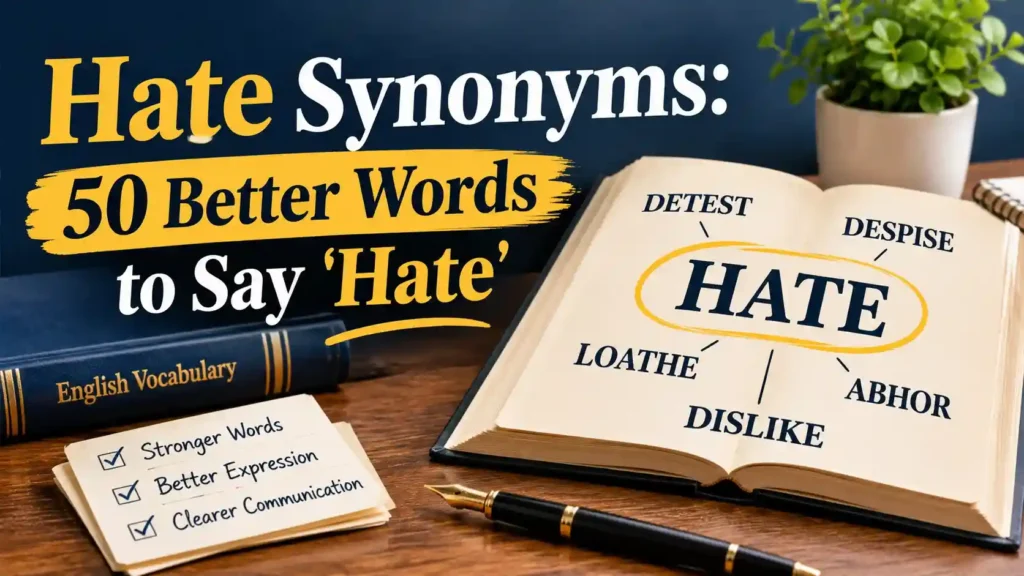
In this guide, you will find 50 simple hate synonyms with easy meanings and real examples.
Detest
Meaning: To dislike something very much.
Examples:
- I detest loud alarm clocks.
- She detests waiting in long lines.
Despise
Meaning: To dislike someone or something and think it is bad.
Examples:
- He despises people who lie.
- I despise cold, wet socks.
Loathe
Meaning: To feel a strong dislike and disgust.
Examples:
- Mia loathes the smell of fish.
- I loathe doing dishes late at night.
Abhor
Meaning: To hate something because it feels very wrong.
Examples:
- Good teachers abhor cheating.
- We abhor unfair rules.
Dislike
Meaning: To not like something.
Examples:
- I dislike spicy food.
- He dislikes getting up early.
Resent
Meaning: To feel angry about something that is not fair.
Examples:
- She resents working extra hours for free.
- I resent being left out of the plan.
Abominate
Meaning: To hate something in a very strong way.
Examples:
- The old king abominated cruelty.
- Many people abominate littering.
Scorn
Meaning: To treat something as if it has no value.
Examples:
- He scorned the cheap gift.
- Critics scorned the movie’s weak ending.
Can’t Stand
Meaning: To be unable to put up with something.
Examples:
- I can’t stand noisy restaurants.
- Dad can’t stand slow internet.
Disdain
Meaning: A feeling that something is not good enough for you.
Examples:
- She looked at the mess with disdain.
- He spoke about the offer with disdain.
Execrate
Meaning: To say you hate something in a very strong way.
Examples:
- Fans execrated the referee’s call.
- The town execrated the thief.
Revile
Meaning: To speak about someone in a hateful way.
Examples:
- The press reviled the coach after the loss.
- Some players are reviled online.
Hatred
Meaning: A very strong dislike.
Examples:
- His hatred of lies made him honest.
- Hatred can hurt the person who feels it.
Animosity
Meaning: A strong feeling of anger toward someone.
Examples:
- There was animosity between the two teams.
- She felt no animosity toward her rival.
Hostility
Meaning: Unfriendly and angry behavior.
Examples:
- The crowd met him with hostility.
- I felt hostility in the room.
Enmity
Meaning: A deep feeling of being enemies.
Examples:
- The two families shared an old enmity.
- Their enmity began over a small fight.
Antipathy
Meaning: A strong dislike that does not go away.
Examples:
- He felt antipathy toward big crowds.
- Her antipathy to rules was clear.
Aversion
Meaning: A strong wish to stay away from something.
Examples:
- I have an aversion to heights.
- Kids often show an aversion to bitter food.
Revulsion
Meaning: A feeling of being sick because of something nasty.
Examples:
- She turned away in revulsion.
- He felt revulsion at the rotten smell.
Disgust
Meaning: A strong dislike for something unpleasant.
Examples:
- I felt disgust at the dirty kitchen.
- Her face showed pure disgust.
Contempt
Meaning: A feeling that someone or something is worth nothing.
Examples:
- He showed contempt for the rules.
- She spoke to him with contempt.
Malice
Meaning: A wish to hurt someone.
Examples:
- He did it with malice.
- There was no malice in her joke.
Spite
Meaning: A mean wish to upset someone.
Examples:
- She broke the cup out of spite.
- He ignored my text out of spite.
Bitterness
Meaning: Angry sadness about something unfair.
Examples:
- Bitterness filled his voice.
- She spoke about the loss without bitterness.
Resentment
Meaning: Anger that stays after you were treated badly.
Examples:
- He felt resentment after he lost his job.
- Resentment grew between the friends.
Rancor
Meaning: Deep anger that lasts a long time.
Examples:
- The debate ended with rancor.
- They said goodbye without rancor.
Loathing
Meaning: Strong hate and disgust at the same time.
Examples:
- He looked at the food with loathing.
- Her loathing of liars was well known.
Odium
Meaning: Strong dislike that many people feel.
Examples:
- The company faced public odium.
- He carried the odium of his bad choice.
Abhorrence
Meaning: A deep hate for something that is wrong.
Examples:
- She spoke of cruelty with abhorrence.
- We share an abhorrence of bullying.
Dread
Meaning: To feel scared of something and not want it to happen.
Examples:
- I dread test days.
- He dreads going to the dentist.
Begrudge
Meaning: To feel upset that someone has something.
Examples:
- I don’t begrudge her success.
- He begrudged every dollar he paid.
Shun
Meaning: To keep away from someone or something on purpose.
Examples:
- She shuns fast food.
- The group shunned the new boy.
Spurn
Meaning: To say no to something in a rude way.
Examples:
- He spurned my help.
- She spurned the cheap offer.
Deplore
Meaning: To say that something is very bad.
Examples:
- Leaders deplore the violence.
- I deplore rude language.
Object To
Meaning: To say that you do not agree with something.
Examples:
- I object to the new rule.
- Many parents object to late homework.
Be Sick Of
Meaning: To be tired of something and want it to stop.
Examples:
- I’m sick of this rain.
- She is sick of the same old song.
Be Fed Up With
Meaning: To be annoyed after too much of something.
Examples:
- I’m fed up with the delays.
- He is fed up with the noise next door.
Disapprove Of
Meaning: To think that something is wrong.
Examples:
- My mother disapproves of late nights.
- Teachers disapprove of copying.
Recoil From
Meaning: To pull back because you dislike something.
Examples:
- She recoiled from the dirty room.
- He recoils from loud fights.
Shudder At
Meaning: To shake a little because something feels awful.
Examples:
- I shudder at the thought of spiders.
- He shudders at his old school photos.
Grudge
Meaning: A long feeling of anger toward someone.
Examples:
- She held a grudge for years.
- Let go of the grudge and talk it out.
Vilify
Meaning: To say very bad things about someone.
Examples:
- Some fans vilify the umpire.
- The article vilified the new manager.
Denounce
Meaning: To say in public that something is bad.
Examples:
- The leader denounced the attack.
- Students denounced the unfair test.
Animus
Meaning: A strong feeling of hate or anger.
Examples:
- He felt no animus toward his rival.
- Her animus was hard to hide.
Ill Will
Meaning: A wish for bad things to happen to someone.
Examples:
- I bear no ill will toward you.
- Ill will ended their friendship.
Bad Blood
Meaning: Old hate between two people or groups.
Examples:
- There is bad blood between the two coaches.
- Old bad blood kept the cousins apart.
Venom
Meaning: Hateful and mean feelings or words.
Examples:
- She spoke with venom.
- His message was full of venom.
Loath
Meaning: Not willing to do something because you dislike it.
Examples:
- I am loath to leave early.
- He was loath to say sorry.
Distaste
Meaning: A mild dislike for something.
Examples:
- She looked at the dish with distaste.
- He felt distaste for loud music.
Disfavor
Meaning: A feeling of not liking or not approving something.
Examples:
- The plan fell into disfavor.
- He looked at the idea with disfavor.
Conclusion
Learning synonyms makes your words stronger. When you use the right word, your writing feels clear and fresh. Your blog posts become more fun to read. Your speaking sounds more confident, and your messages say exactly what you mean.
Now it is your turn. Pick five hate synonyms from this list and use them this week. Try them in emails, essays, and daily talks with friends. Small practice leads to big growth. Keep learning one word at a time, and your English will keep getting better.
Discover More Article

Hello,I’m Natalia, a professional content writer with three years of experience. My niche is Another Word for, where I create clear, engaging, and SEO-friendly content about words, meanings, synonyms, phrases, and language. I turn complex word-related topics into simple, useful content for readers.