Have you ever typed “however” three times in one email? It happens to all of us.
“However” is a small word, but it does a big job. It shows a change in your idea. For example: “I love pizza. However, I can’t eat it today.”
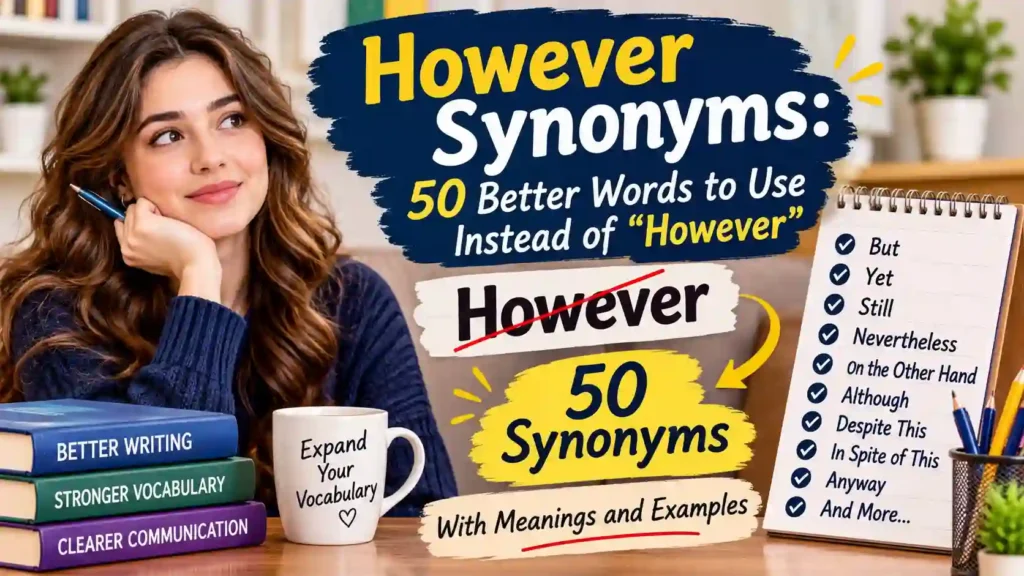
In simple words, “however” means “but” or “on the other hand.” Using different however synonyms keeps your writing fresh. Students can make essays smoother. Bloggers and content writers can keep readers hooked. Daily English users can sound clear and natural.
These however synonyms are easy to learn. In this guide, you will find 50 simple synonyms for however. Each one has an easy meaning and two real examples.
But
Meaning: Used to add an opposite idea.
Examples:
- I wanted to go, but it rained.
- She is small, but she is strong.
Yet
Meaning: Used to show a surprise or an opposite idea.
Examples:
- He studied little, yet he passed.
- It was cold, yet we went outside.
Still
Meaning: Used to say something is true even after another fact.
Examples:
- It was raining. Still, we went out.
- She was tired. Still, she finished her work.
Nevertheless
Meaning: Used to say “even after that.”
Examples:
- The test was hard. Nevertheless, I did well.
- He was sick. Nevertheless, he came to class.
Nonetheless
Meaning: Used to say something is true in spite of what came before.
Examples:
- The road was long. Nonetheless, we kept walking.
- It was a small gift. Nonetheless, she loved it.
Even So
Meaning: Used to show something is true in spite of what you just said.
Examples:
- The pie was burnt. Even so, we ate it.
- It was late. Even so, they played on.
That Said
Meaning: Used to add a different point after the first one.
Examples:
- The food was cheap. That said, it was not tasty.
- I love my job. That said, I need a rest.
On the Other Hand
Meaning: Used to show another side of an idea.
Examples:
- Cats are calm. On the other hand, dogs are playful.
- Big cities are fun. On the other hand, they are loud.
In Contrast
Meaning: Used to show that two things are very different.
Examples:
- Summer is hot. In contrast, winter is cold.
- Tom is shy. In contrast, his sister is bold.
By Contrast
Meaning: Used to compare two different things.
Examples:
- My room is tiny. By contrast, hers is huge.
- The first quiz was easy. By contrast, the second was hard.
Although
Meaning: Used to show an opposite idea in one sentence.
Examples:
- Although it was late, we kept talking.
- She smiled although she felt sad.
Though
Meaning: A short way to say “although.”
Examples:
- Though he was tired, he helped us.
- I liked the film, though it was long.
Even Though
Meaning: Used to stress a surprising fact.
Examples:
- Even though it snowed, school stayed open.
- He ran even though his foot hurt.
Whereas
Meaning: Used to show a clear difference between two things.
Examples:
- I love tea, whereas my brother loves coffee.
- Dogs bark, whereas cats meow.
While
Meaning: Used to show that two ideas are different.
Examples:
- While I like math, she likes art.
- He sings well, while I can’t sing at all.
Despite This
Meaning: Used to say something is true even after a fact.
Examples:
- The coat was cheap. Despite this, nobody bought it.
- The plan was risky. Despite this, they tried it.
In Spite of This
Meaning: A longer way to say “despite this.”
Examples:
- He lost. In spite of this, he smiled.
- It was hard. In spite of this, she never quit.
All the Same
Meaning: Used to say something stays true anyway.
Examples:
- I know it’s silly. All the same, I’m scared.
- He said no. All the same, I asked again.
Just the Same
Meaning: Used to say that something did not change anything.
Examples:
- The rain was heavy. We walked home just the same.
- She felt nervous but spoke just the same.
Having Said That
Meaning: Used to add an opposite point.
Examples:
- The hotel is old. Having said that, it is clean.
- I’m happy for you. Having said that, I will miss you.
Be That as It May
Meaning: Used to accept a point and then move on.
Examples:
- Be that as it may, we must leave now.
- You may be right. Be that as it may, I will try.
Conversely
Meaning: Used to show that the opposite is also true.
Examples:
- Some people love mornings. Conversely, others love nights.
- Too much salt is bad. Conversely, too little is bad too.
Instead
Meaning: Used to show one thing in place of another.
Examples:
- I didn’t take the bus. I walked instead.
- She chose tea instead of juice.
Rather
Meaning: Used to show a better choice.
Examples:
- I’d rather sleep than watch TV.
- He is not rude, but rather shy.
On the Contrary
Meaning: Used to say the opposite is true.
Examples:
- I’m not angry. On the contrary, I’m glad.
- It wasn’t boring. On the contrary, it was fun.
Then Again
Meaning: Used to add a second thought.
Examples:
- I could buy it. Then again, it costs a lot.
- Let’s go out. Then again, it’s cold.
At the Same Time
Meaning: Used to add a second idea that is also true.
Examples:
- I love my town. At the same time, I want to travel.
- She is kind. At the same time, she is firm.
Notwithstanding
Meaning: A formal word that means “in spite of.”
Examples:
- Notwithstanding the noise, she slept well.
- Rain notwithstanding, the fair opened.
Regardless
Meaning: Used to say that something does not matter.
Examples:
- It may rain. We’ll go regardless.
- Regardless of the cost, I’ll buy it.
Anyway
Meaning: Used to say something is still true.
Examples:
- It’s far. We’ll go anyway.
- Thanks anyway for trying.
Anyhow
Meaning: A casual way to say “anyway.”
Examples:
- I was tired, but I went anyhow.
- Anyhow, let’s get back to work.
Alternatively
Meaning: Used to give another choice.
Examples:
- We can walk. Alternatively, we can take a bus.
- Call me. Alternatively, send a text.
Otherwise
Meaning: Used to say what will happen if something does not change.
Examples:
- Hurry up. Otherwise, we’ll be late.
- Wear a coat. Otherwise, you’ll freeze.
Mind You
Meaning: Used to add a small, different point.
Examples:
- It’s a nice town. Mind you, it’s very quiet.
- He’s strict. Mind you, he’s fair.
Admittedly
Meaning: Used to say a point is true, but only in part.
Examples:
- Admittedly, I made a mistake.
- The plan is good. Admittedly, it is not perfect.
Granted
Meaning: Used to agree with a point before you give another view.
Examples:
- Granted, the test was hard, but you can pass.
- Granted, he’s young, but he’s smart.
Even Then
Meaning: Used to say something stays true after a fact.
Examples:
- I asked twice. Even then, he said no.
- She tried again. Even then, it failed.
Still and All
Meaning: An old way to say “even so.”
Examples:
- It was tough. Still and all, we had fun.
- Still and all, I’m glad I came.
For All That
Meaning: Used to say “in spite of that.”
Examples:
- He is rich. For all that, he is kind.
- It’s old, but for all that, it works.
Even If
Meaning: Used to say something stays true in any case.
Examples:
- I’ll go even if it rains.
- Even if you’re late, come in.
Contrarily
Meaning: Used to show a very different view.
Examples:
- She likes noise. Contrarily, he likes calm.
- Some say yes. Contrarily, others say no.
In Any Case
Meaning: Used to say something is true no matter what.
Examples:
- I may fail. In any case, I’ll try.
- In any case, call me tonight.
After All
Meaning: Used to show a surprise ending to a thought.
Examples:
- She passed after all.
- I didn’t need the umbrella after all.
Only
Meaning: Used to add a small limit to what you said.
Examples:
- I’d go, only I’m busy.
- The food is great, only it’s slow.
Except
Meaning: Used to leave something out.
Examples:
- I like all fruit except mango.
- Everyone came except Sam.
Albeit
Meaning: A formal word that means “although.”
Examples:
- He won, albeit by a little.
- She spoke, albeit softly.
At Any Rate
Meaning: Used to say what matters most.
Examples:
- At any rate, we are safe.
- He may be late. At any rate, we’ll start.
Despite That
Meaning: Used to say something is true in spite of a fact.
Examples:
- She was scared. Despite that, she jumped.
- He fell. Despite that, he finished the race.
That Being Said
Meaning: Used to add a different point.
Examples:
- The book is slow. That being said, the end is great.
- I like her. That being said, we are not close.
Unlike
Meaning: Used to show a difference between two things.
Examples:
- Unlike me, he loves spicy food.
- Unlike winter, summer is bright.
Conclusion
Learning synonyms makes your words stronger. When you use the right word, your writing flows smoothly. Your blog posts become easier to read. Your speaking sounds clear and confident, and your ideas connect better.
Now it is your turn. Choose five words from this list and use them this week. Try them in emails, essays, and daily talks with friends. Small practice leads to big growth. Keep learning one word at a time, and your English will keep getting better.
Discover More Post

Hy, Rose is a professional content writer with 3 years of experience creating engaging, informative, and SEO-friendly content. She specializes in crafting clear, reader-focused articles that deliver value, improve online visibility, and help websites grow.