30 Another Word for Component: Synonyms With Meaning & Examples
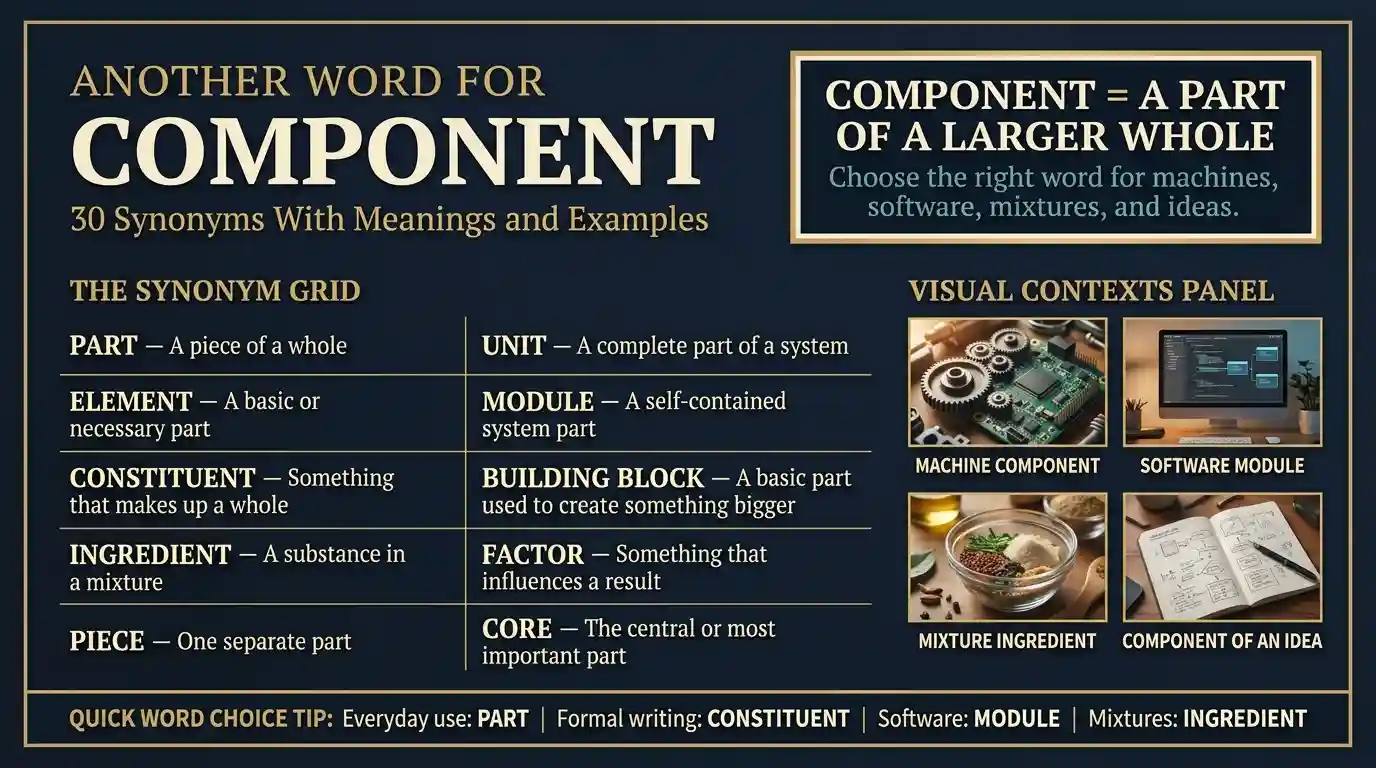
Another word for component is part, element, constituent, or ingredient. Part is the simplest everyday choice. Element and constituent sound more formal, and ingredient fits mixtures such as food or chemicals. For machines and software, you may prefer unit or module.
The best alternative depends on what the component belongs to. A component can be a physical piece of a machine, an ingredient in a mixture, a module in software, or an important idea inside a plan. Each context has its own natural words, and some choices change the tone from plain to technical or figurative.
Quick list: part, element, constituent, ingredient, piece, unit, module, building block, factor, core
Below are 30 alternatives with meanings, IPA, usage notes, examples, and context. Some are close synonyms and some fit only one meaning of component, and each usage note says which.
At a Glance: Component Synonyms and Related Alternatives
| Alternative | Part of Speech | Meaning | Register / Tone | Ideal Context |
| Part | noun | One of the pieces that make up a whole | Neutral, simple | Everyday writing and speech |
| Element | noun | A basic or necessary part | Neutral to formal | Plans, ideas, systems |
| Constituent | noun | One of the parts that make up something | Formal | Science, law, academic writing |
| Ingredient | noun | One of the substances in a mixture | Neutral | Food, products, chemistry |
| Piece | noun | A separate part of something larger | Informal to neutral | Physical objects, sets |
| Unit | noun | A single, complete part of a larger whole | Neutral to technical | Machines and systems |
| Module | noun | A self-contained part of a larger system | Technical | Software, equipment, courses |
| Building block | noun | A basic part used to build something larger | Neutral, figurative | Learning, design, systems |
| Factor | noun | Something that helps cause a result | Neutral | Decisions, causes, analysis |
| Core | noun | The central or most important part | Neutral | Ideas, groups, products |
Which Word Should You Use?
| If you want to… | Use | Why |
| Use the simplest everyday word | part | It is short and works in almost any context. |
| Write in a formal or scientific style | constituent, element | Both sound precise and professional. |
| Name something in a recipe, product, or mixture | ingredient | It fits foods and substances, not machines. |
| Describe a piece of a machine or device | unit, part | They are plain and technical without being heavy. |
| Describe a self-contained piece of software | module, plug-in | They are standard computing terms. |
| Describe one cause in a decision or problem | factor, aspect | They fit abstract ideas, not physical things. |
| Say a component is the most important one | core, cornerstone | They show importance as well as being part of the whole. |
| Describe one part of a group | member | It fits people and things in a set. |
| Describe a part made by dividing a whole | section, segment | They stress division into separate parts. |
Exploring the Multiple Meanings of “Component”
1. A Part of a Larger Whole
- Meaning: A part or element that helps make up something larger.
- Explanation: This is the general meaning. It works for physical things and for ideas, and it usually suggests a part with a clear role.
- Example: Trust is a key component of any good team.
2. A Physical Part of a Machine or Device
- Meaning: A separate piece used to build a machine, vehicle, or device.
- Explanation: This sense became common in the late 19th century. It focuses on parts that can be made, replaced, or tested on their own.
- Example: The mechanic replaced a faulty component in the engine.
3. An Ingredient or Substance in a Mixture
- Meaning: One of the substances that together make up a mixture, material, or compound.
- Explanation: This sense is common in chemistry and science. It describes what something is made of.
- Example: The main component of air is nitrogen.
4. A Module in Software or a System
- Meaning: A self-contained part of a program or system with a specific job.
- Explanation: In computing and engineering, components are designed so they can be built, tested, or replaced separately.
- Example: Each component of the app can be updated on its own.
5. A Part of a Vector
- Meaning: One of the parts into which a force, velocity, or other vector can be split, usually along an axis.
- Explanation: This is a technical sense used in math and physics.
- Example: The force has a horizontal component and a vertical component.
6. Making Up a Whole (Adjective)
- Meaning: Forming one of the parts of something.
- Explanation: As an adjective, component appears before nouns, usually in the phrase “component parts.”
- Example: The company sells the component parts separately.
Sources: Merriam-Webster; Collins English Dictionary; Dictionary.com; Cambridge Dictionary
Analyzing 30 Component Alternatives in Detail
Some alternatives below are direct synonyms for component, while others fit only certain contexts, such as software or abstract ideas. The usage notes mark which is which.
Group 1: Core Synonyms
1. Part
IPA: US /pɑːrt/ · UK /pɑːt/
Definition: One of the pieces that make up a whole.
- Usage: The closest everyday synonym. It is broader and less technical than component, which suggests a separate piece with a clear job.
- Example: The engine is the most expensive part of the car.
2. Element
IPA: /ˈɛləmənt/ (US and UK)
Definition: A basic or necessary part of something.
- Usage: A close synonym, especially for abstract things such as plans and ideas. Do not confuse it with the chemical meaning of “element.”
- Example: Trust is an important element of any friendship.
3. Constituent
IPA: /kənˈstɪtʃuənt/ (US and UK)
Definition: One of the parts that make up something.
- Usage: A direct, formal synonym common in science, law, and academic writing. It also means a voter in a district, which is a different meaning.
- Example: Oxygen is one of the constituents of air.
4. Ingredient
IPA: /ɪnˈɡriːdiənt/ (US and UK)
Definition: One of the foods or substances in a mixture; also, a necessary part of success.
- Usage: A related alternative for recipes, products, and mixtures. It also works figuratively, as in “an ingredient for success,” but it does not fit machines.
- Example: Flour is the main ingredient in bread.
5. Piece
IPA: /piːs/ (US and UK)
Definition: One part of something larger, often a separate physical part.
- Usage: A related, informal alternative. It is natural for physical objects and sets.
- Example: Each piece of the shelf fits into a slot.
Group 2: Machine and Equipment Terms
6. Unit
IPA: /ˈjuːnɪt/ (US and UK)
Definition: A single, complete part of a larger whole.
- Usage: A related alternative for machines and systems, as in “cooling unit.” It can also mean a measure, such as “unit of length,” which is a different meaning.
- Example: The air conditioning unit needs a new filter.
7. Subassembly
IPA: /ˌsʌbəˈsɛmbli/ (US and UK)
Definition: A group of parts put together to form one section of a larger product.
- Usage: A technical, related alternative. It is larger than a single component, so it is not an exact synonym.
- Example: The factory builds the seat subassembly first.
8. Fitting
IPA: /ˈfɪtɪŋ/ (US and UK)
Definition: A small part attached to a larger machine, pipe, or structure.
- Usage: A related alternative with a narrow meaning, mostly in plumbing, machinery, and construction.
- Example: The plumber replaced a loose fitting on the pipe.
9. Attachment
IPA: /əˈtætʃmənt/ (US and UK)
Definition: A part that can be added to a machine to give it another function.
- Usage: A related alternative. It is usually removable, while many components are built into the machine.
- Example: The vacuum comes with a brush attachment.
10. Accessory
IPA: /əkˈsɛsəri/ (US and UK)
Definition: An extra item added to something for use or decoration.
- Usage: A related alternative with a limit. An accessory is optional, while a component is needed for the whole to work.
- Example: The phone case is a popular accessory.
Group 3: Software and System Terms
11. Module
IPA: US /ˈmɑːdʒuːl/ · UK /ˈmɒdjuːl/
Definition: A separate, self-contained part of a larger system or program.
- Usage: A close synonym in computing, engineering, and education. It suggests a part that can be built or replaced on its own.
- Example: The payment module connects the shop to the bank.
12. Widget
IPA: /ˈwɪdʒɪt/ (US and UK)
Definition: In computing, a small tool or user interface part, such as a button or small program.
- Usage: An informal, related alternative that applies mostly to software screens. It is not a general synonym.
- Example: The weather widget shows the forecast on your screen.
13. Plug-in
IPA: /ˈplʌɡɪn/ (US and UK)
Definition: A software part that adds a specific feature to a larger program.
- Usage: A related alternative for software only. It describes an optional add-on component.
- Example: The browser needs a plug-in to open this file.
14. Subsystem
IPA: /ˈsʌbˌsɪstəm/ (US and UK)
Definition: A smaller system that forms part of a larger system.
- Usage: A related, technical alternative. It is bigger than a single component, so it is not an exact synonym.
- Example: The braking subsystem includes the pedal, pump, and pads.
15. Building block
IPA: US /ˈbɪldɪŋ ˌblɑːk/ · UK /ˈbɪldɪŋ ˌblɒk/
Definition: A basic part used to build something larger.
- Usage: A related alternative, both literal and figurative. It stresses that the part is basic and can be combined with others.
- Example: Words are the building blocks of language.
Group 4: Sections, Portions, and Members of a Whole
16. Section
IPA: /ˈsɛkʃən/ (US and UK)
Definition: One of the parts into which something is divided.
- Usage: A related alternative. It stresses division of a whole, not a part made for a purpose.
- Example: The report has four sections.
17. Segment
IPA: /ˈsɛɡmənt/ (US and UK)
Definition: One of the parts into which something is divided or naturally separates.
- Usage: A related alternative, a little more technical than section. It is common in business, media, and biology.
- Example: The show is divided into three segments.
18. Portion
IPA: US /ˈpɔːrʃən/ · UK /ˈpɔːʃən/
Definition: A part of a whole, especially an amount.
- Usage: A related alternative. It focuses on amount, so it fits budgets, food, and shares.
- Example: A large portion of the budget goes to rent.
19. Member
IPA: US /ˈmɛmbər/ · UK /ˈmɛmbə/
Definition: A person or thing that belongs to a group or set.
- Usage: A related alternative for groups and sets. It works for people, which matches an older sense of “component.”
- Example: Each member of the team brought a different skill.
20. Division
IPA: /dɪˈvɪʒən/ (US and UK)
Definition: One of the parts into which something is split; also, a department.
- Usage: A related alternative. It stresses separation and often refers to parts of an organization.
- Example: The company has a sales division and a design division.
Group 5: Abstract Parts of Ideas, Plans, and Problems
21. Factor
IPA: US /ˈfæktər/ · UK /ˈfæktə/
Definition: Something that helps produce a result.
- Usage: A related alternative for causes and influences. A factor affects an outcome, while a component is part of the thing itself.
- Example: Price was a key factor in the decision.
22. Aspect
IPA: /ˈæspɛkt/ (US and UK)
Definition: One part or feature of a situation, idea, or problem.
- Usage: A related alternative for abstract things. It describes how something can be viewed, not a physical part.
- Example: Cost is only one aspect of the problem.
23. Facet
IPA: /ˈfæsɪt/ (US and UK)
Definition: One side or part of something complex.
- Usage: A related, slightly formal alternative for parts of a personality, topic, or issue.
- Example: She showed a new facet of her character.
24. Strand
IPA: /strænd/ (US and UK)
Definition: One of several parts or themes that are woven together.
- Usage: A related, figurative alternative for stories, arguments, and research.
- Example: The film follows three story strands.
25. Dimension
IPA: /dɪˈmɛnʃən/ (US and UK)
Definition: An aspect or feature of a situation.
- Usage: A related alternative used in phrases like “another dimension.” It adds the idea of depth or extra meaning.
- Example: Fear added a new dimension to the problem.
Group 6: Key and Essential Parts
26. Core
IPA: US /kɔːr/ · UK /kɔː/
Definition: The central or most important part of something.
- Usage: A related alternative for a component that is the center of the whole.
- Example: Teamwork is the core of our program.
27. Cornerstone
IPA: US /ˈkɔːrnərstoʊn/ · UK /ˈkɔːnəstəʊn/
Definition: A basic part on which something depends.
- Usage: A related, figurative alternative that shows a component is the foundation.
- Example: Trust is the cornerstone of a good friendship.
28. Pillar
IPA: US /ˈpɪlər/ · UK /ˈpɪlə/
Definition: A main support of a system, group, or idea.
- Usage: A related, figurative alternative. It suggests one of several main supports.
- Example: Education is a pillar of a strong society.
29. Backbone
IPA: US /ˈbækboʊn/ · UK /ˈbækbəʊn/
Definition: The main support or strongest part of something.
- Usage: A related, figurative alternative for the part that carries everything else.
- Example: Small shops are the backbone of the town’s economy.
30. Linchpin
IPA: /ˈlɪntʃpɪn/ (US and UK)
Definition: A person or thing that holds a group, system, or plan together.
- Usage: A related, strong alternative. It is also spelled “lynchpin,” and it suggests that everything fails without it.
- Example: The manager is the linchpin of the team.
Sources: Merriam-Webster; Collins English Dictionary and Thesaurus; Dictionary.com; Cambridge Dictionary
Component vs. Part vs. Element vs. Ingredient
These words are close, but each fits a different type of whole.
| Word | Main Idea | Typical Use | Example |
| Part | Any piece of a whole | Almost everything | A part of the wall fell down. |
| Component | A separate piece with a clear job | Machines, systems, plans | The battery is a key component of the phone. |
| Element | A basic or necessary part | Ideas, structures | Surprise is an element of good comedy. |
| Constituent | A part that makes up something | Science, law, formal writing | Water is a constituent of blood. |
| Ingredient | A substance in a mixture | Food, products | Sugar is an ingredient in the cake. |
Part is the broadest choice. Component suggests a piece with a defined role, often in a machine or system. Element and constituent are more formal, and ingredient is best kept for mixtures and recipes.
Sources: Merriam-Webster; Collins English Dictionary; Dictionary.com
Component and Opposite/Paired Word Pairs
| Word | Paired Word | Note |
| Component | Whole | The most natural pair. A component is part of the whole. |
| Component | System | The larger structure that components belong to. |
| Component | Assembly | A group of components put together. |
| Component | Product | The finished item made from components. |
| Component | Mixture | Components are what a mixture is made of. |
| Key component | Minor component | A natural contrast for importance. |
| Component | Add-on | A component is needed for the whole, while an add-on is optional. |
Component has no true opposite. The closest pairs are whole and system, because a component always belongs to something larger. In speech and writing, the contrast usually comes from words such as key and minor.
Sources: Merriam-Webster; Collins English Dictionary; Cambridge Dictionary
Common Word Partners of “Component”
| Pattern | Common Partners | Example |
| adjective + component | key, essential, major, critical, main, vital, basic | Sleep is an essential component of good health. |
| type + component | electronic, mechanical, hardware, software | The device uses several electronic components. |
| component + of | component of a system, component of a plan | Exercise is one component of a healthy lifestyle. |
| component + noun | component part, component supplier | The component parts arrive in separate boxes. |
| verb + component | replace, install, test, assemble | Technicians test each component before shipping. |
| individual + component | each, every, individual | Each component must pass a safety check. |
Sources: Collins English Dictionary; Cambridge Dictionary; Merriam-Webster
Idiomatic Phrases Featuring “Component”
The word “component” has no true idioms. The phrases below are established technical terms that contain the word.
1. Principal component analysis
- Meaning: A statistical method that simplifies a large set of data by finding its main patterns.
- Example: The researchers used principal component analysis to reduce the number of variables.
2. Component video
- Meaning: A way of sending video as separate signals instead of one combined signal.
- Example: The old TV connects to the player through component video cables.
3. Component-based development
- Meaning: A way of building software from separate, reusable parts.
- Example: Component-based development lets the team reuse the login screen in every app.
Sources: Merriam-Webster; Collins English Dictionary
Word Formation of “Component”
Etymology & Structure
Component comes from Latin componentem, the present participle of componere, meaning “to put together” or “to collect a whole from several parts.” The Latin verb combines com- (“with, together”) and ponere (“to place”). So the idea behind the word is “something put together with other things.” The word shares its Latin family with compound and position.
Date and History
According to Etymonline, the noun appears in the 1640s with the meaning “constituent part or element.” An earlier use in the 1560s meant “one of a group of persons.” The adjective use, meaning “constituent,” dates from the 1660s. The sense of “mechanical part of a bicycle, automobile, etc.” is from 1896, and the collective noun componentry is from 1956.
Word Class Variations
- Noun: component (plural: components)
- Adjective: component (as in “component parts”), componential
- Collective noun: componentry
- Related words: compound, position
Sources: Etymonline; Merriam-Webster; Collins English Dictionary
Common Word-Choice Mistakes
- Wrong: “This machine has many component.” Correct: “This machine has many components.” (Component is countable.)
- Wrong: “The components for this system is made in Japan.” Correct: “The components for this system are made in Japan.”
- Wrong: “An ingredient of the engine failed.” Correct: “A component of the engine failed.” (Ingredient fits mixtures, not machines.)
- Wrong: “The periodic table lists all the components.” Correct: “The periodic table lists all the elements.” (Element has a fixed scientific meaning.)
- Wrong: “The seat belt is an accessory of the car.” Correct: “The seat belt is a component of the car.” (An accessory is optional, but a component is part of how the whole works.)
- Wrong: “A facet of the engine needs repair.” Correct: “A part of the engine needs repair.” (Facet describes aspects of ideas, not physical pieces.)
- Wrong: “compenent” or “componant.” Correct: “component.” (Spell it with -ponent, like opponent.)
FAQs
1. What is the closest synonym for component?
Part is the closest everyday synonym. Element and constituent are close but more formal.
2. What is the difference between component and part?
Part is broader and can describe any piece of a whole. Component usually suggests a separate piece with a clear role, especially in a system or machine.
3. What is a formal word for component?
Constituent and element are the most common formal choices. Both are used in academic and scientific writing.
4. What is another word for component in software?
Module is the closest. Plug-in, widget, and subsystem are narrower options that fit specific cases.
5. What is the difference between component and ingredient?
An ingredient is a food or substance in a mixture, while a component can be any part of a machine, system, or plan. Both can be used figuratively.
6. Can component describe people?
Yes, in a figurative way, as in “a key component of the team.” Etymonline records an early use for “one of a group of persons” in the 1560s.
7. Is component a noun or an adjective?
It is mainly a noun, but it can also be an adjective, as in “component parts.”
8. What are good alternatives for “key component”?
Core, cornerstone, pillar, and backbone all show that a part is very important. Essential element is a plain choice.
9. What is the opposite of component?
There is no true opposite, but whole and system are the natural pairs. A component is always part of one of them.
10. Is a component the same as a module?
Not exactly. A module is a self-contained part designed to work on its own in a larger system, while a component can be any part of a whole.
Conclusion
The closest alternatives to component are part, element, constituent, and ingredient. Part is the simplest, element and constituent suit formal writing, and ingredient fits mixtures. Unit and module are useful for machines and software, and core, cornerstone, and pillar show that a component is especially important.
Context matters because component can describe machines, mixtures, software, ideas, and even groups of people. Words such as factor, accessory, and section look similar but describe causes, optional extras, or divisions, so they do not always fit.
To choose the right word, first decide what the component belongs to. Then match the tone, using part for everyday writing and constituent for formal or scientific writing. When you are unsure, part and element are safe choices, and the alternatives above can add precision.
Discover More Article

Hy, Sophia is a content writer with 3 years of experience creating engaging, informative, and SEO-friendly articles focused on synonyms, vocabulary, and word meanings.