30 Another Word for Long: Synonyms With Meaning & Examples
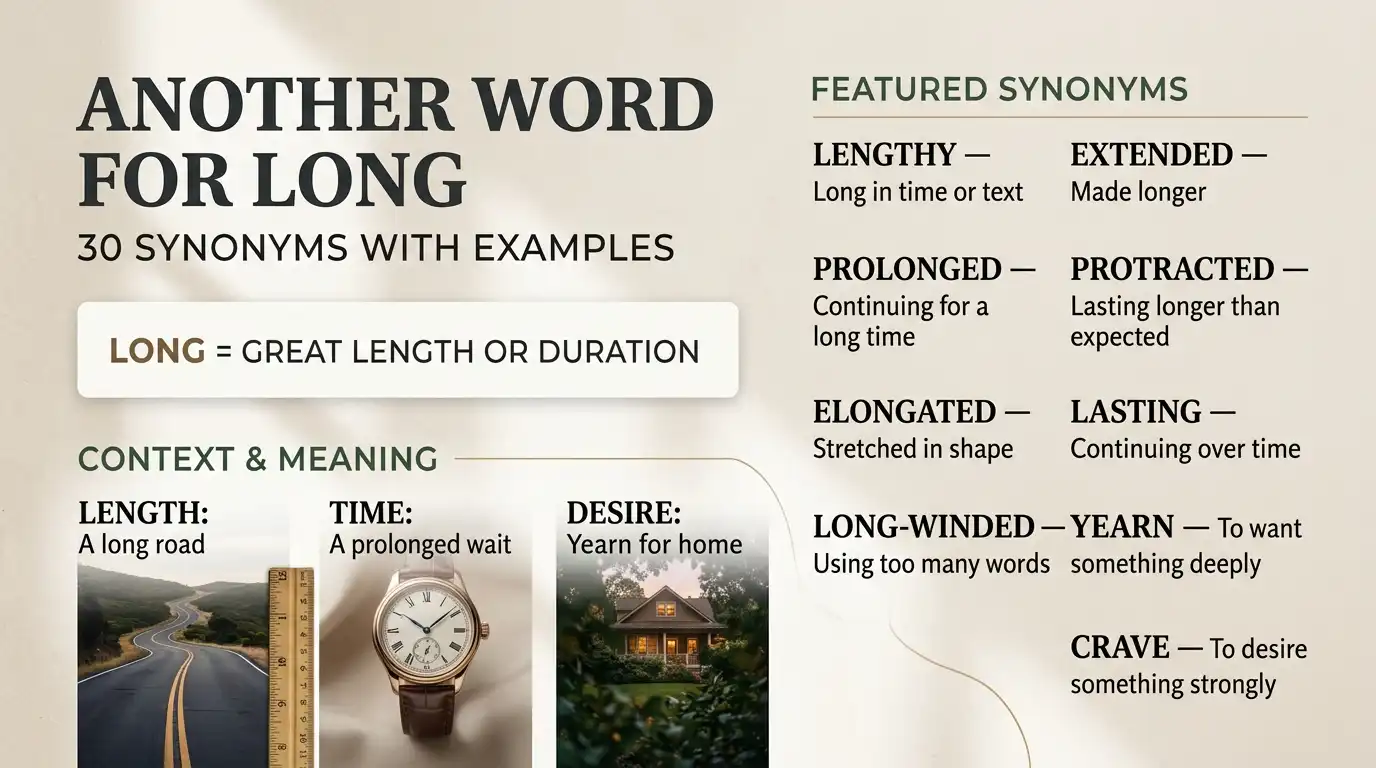
The best another word for long depends on what is long. For length or time, lengthy and extended are the closest everyday alternatives. If something lasts longer than you want, use protracted or drawn-out. For a speech or text that goes on too long, use long-winded or wordy. When long is a verb, as in “I long for home,” use yearn or crave.
Long is flexible. It can describe distance, time, size, or the number of items in a list. It can show that something is tiring or too much. As a verb it expresses a strong wish, and as an adverb it means “for a long time.” Each meaning has different alternatives.
Quick list: lengthy, extended, prolonged, protracted, lasting, extensive, long-winded, drawn-out, yearn, crave
This article looks at 30 alternatives. Each one has a meaning, IPA, a usage note, and an example. Some are direct synonyms of long, and others only fit one context. Each entry says which.
At a Glance: Long Synonyms and Related Alternatives
| Alternative | Part of Speech | Meaning | Register / Tone | Ideal Context |
| Lengthy | Adjective | Long, often in time or text | Neutral | Speeches, delays, reports |
| Extended | Adjective | Made longer, or lasting longer | Neutral | Stays, deadlines, periods |
| Prolonged | Adjective | Continuing for a long time | Formal | Illness, silence, effort |
| Protracted | Adjective | Lasting longer than expected | Formal | Disputes, talks, wars |
| Lasting | Adjective | Continuing for a long time | Neutral | Effects, memories, peace |
| Extensive | Adjective | Large in amount or range | Neutral to formal | Lists, damage, research |
| Elongated | Adjective | Stretched out in shape | Formal, descriptive | Shapes, bodies, objects |
| Long-winded | Adjective | Using too many words | Informal to neutral | Speeches, explanations |
| Interminable | Adjective | Seeming to have no end | Formal, strong | Waits, meetings |
| Yearn | Verb | Want something very much | Neutral, emotional | Home, change, a person |
Which Word Should You Use?
| If you want to… | Use | Why |
| Describe a stretched or narrow shape | Elongated | It focuses on form and sounds descriptive. |
| Say something lasted longer than expected | Protracted | It suggests a delay or an unwanted length. |
| Describe a long period in formal writing | Prolonged | It is neutral and common in reports. |
| Describe an effect or bond that stays | Lasting or enduring | They stress that it continues over time. |
| Describe a big list, study, or report | Extensive or comprehensive | They stress range and amount, not only length. |
| Say a speech goes on too long | Long-winded or wordy | They add the sense of too many words. |
| Say you want something badly | Yearn or pine | They match the verb long for. |
| Say a report covers everything | Exhaustive | It means complete, not just long. |
Exploring the Multiple Meanings of “Long”
1. Great Length in Space
- Meaning: Having a great distance from end to end.
- Explanation: This is the oldest sense. Etymonline gives the Old English meaning as “having a great linear extent.” It describes roads, rivers, hair, and lines.
- Example: It was a long road through the mountains.
2. Great Duration in Time
- Meaning: Lasting for a long period.
- Explanation: Old English lang was also used for time, “drawn out in duration.” This sense is common with day, wait, and delay.
- Example: We had a long wait at the airport.
3. Large Number or Amount
- Meaning: Containing many items or a lot of detail.
- Explanation: Here long describes lists, books, and reports. Etymonline also records the informal American phrase long on, meaning “having a lot of” something, from 1900.
- Example: She wrote a long list of names.
4. Too Long or Tiring
- Meaning: Seeming longer than it needs to be.
- Explanation: The word can carry a negative tone when something goes on and bores people. Alternatives like long-winded and interminable make that tone clear.
- Example: The meeting was so long that people stopped listening.
5. To Yearn (Verb)
- Meaning: To want something very much.
- Explanation: As a verb, long usually takes for or an infinitive. Etymonline says it comes from Old English langian, “to yearn after,” literally “to grow long.”
- Example: He longed for home.
6. For a Long Time (Adverb)
- Meaning: Over a long period.
- Explanation: This sense appears in phrases like long ago and long before. It is most common in questions, negatives, and fixed phrases.
- Example: They lived there long before the war.
Sources: Etymonline, “long”; Merriam-Webster, “long”; Collins English Dictionary, “long”.
Analyzing 30 Long Alternatives in Detail
Some of these words are direct synonyms of long in one sense. Others are related alternatives for a narrow context. Each usage note says which is which.
Alternatives for Length and Shape
1. Lengthy
IPA: /ˈleŋθi/ (US and UK)
Definition: Long, especially in time or in written and spoken material.
- Usage: A close synonym for long in the time and text senses. It is neutral, but it often hints that something is longer than needed. It is less common for physical objects.
- Example: The company faced a lengthy delay.
2. Extended
IPA: /ɪkˈstendɪd/ (US and UK)
Definition: Made longer, or lasting longer than usual.
- Usage: A close synonym for time and space. It suggests that something was stretched beyond its normal length.
- Example: She took an extended break from work.
3. Elongated
IPA: US /ɪˈlɔːŋɡeɪtɪd/ · UK /ˈiːlɒŋɡeɪtɪd/
Definition: Made longer, especially in shape.
- Usage: A related, descriptive alternative. It focuses on a stretched shape and is common in science and description. It does not describe time.
- Example: The fish has an elongated body.
4. Tall
IPA: /tɔːl/ (US and UK)
Definition: Having great height.
- Usage: A related alternative, not an exact synonym. It describes height, while long describes length. Etymonline notes that the old sense of long as “tall” is now dialectal or obsolete.
- Example: The tall tree stood near the fence.
Alternatives for Length in Time
5. Prolonged
IPA: US /prəˈlɔːŋd/ · UK /prəˈlɒŋd/
Definition: Continuing for a long time, often longer than usual.
- Usage: A close, formal synonym of long for time. It is common with illness, silence, and effort.
- Example: He suffered from a prolonged illness.
6. Protracted
IPA: /prəˈtræktɪd/ (US and UK)
Definition: Lasting longer than expected or wanted.
- Usage: A close, formal synonym with a negative tone. It suggests a delay or a drawn-out process, so it is less suitable for pleasant events.
- Example: The two sides held protracted talks.
7. Lasting
IPA: US /ˈlæstɪŋ/ · UK /ˈlɑːstɪŋ/
Definition: Continuing for a long time.
- Usage: A related alternative that focuses on staying power, not just length. It usually has a positive or neutral tone, as in “lasting peace.”
- Example: The storm left lasting damage.
8. Enduring
IPA: US /ɪnˈdʊrɪŋ/ · UK /ɪnˈdjʊərɪŋ/
Definition: Continuing to exist over a long time.
- Usage: A related alternative with a warm, serious tone. It fits traditions, friendships, and ideas that last.
- Example: They shared an enduring friendship.
9. Lingering
IPA: /ˈlɪŋɡərɪŋ/ (US and UK)
Definition: Slow to leave or end.
- Usage: A related alternative. It describes something that stays after it should have gone, such as a smell, doubt, or illness. It is not a general word for length.
- Example: A lingering cough kept her awake.
Alternatives for Amount and Range
10. Extensive
IPA: /ɪkˈstensɪv/ (US and UK)
Definition: Covering a large area or amount.
- Usage: A related alternative. It describes range and size, as in “an extensive list,” but not time.
- Example: The library has an extensive collection of maps.
11. Voluminous
IPA: /vəˈluːmɪnəs/ (US and UK)
Definition: Very large in amount, or filling many pages.
- Usage: A related, formal alternative for writing, records, or large quantities. It sounds literary and can describe clothing in a different sense.
- Example: She kept voluminous notes on the case.
12. Comprehensive
IPA: US /ˌkɑːmprɪˈhensɪv/ · UK /ˌkɒmprɪˈhensɪv/
Definition: Including everything, or nearly everything, on a subject.
- Usage: A related alternative. A comprehensive report is complete, which often makes it long, but the word focuses on coverage, not length.
- Example: The book gives a comprehensive history of the city.
13. Exhaustive
IPA: /ɪɡˈzɔːstɪv/ (US and UK)
Definition: Complete and covering every detail.
- Usage: A related, strong alternative to comprehensive. It suggests nothing was left out. It does not simply mean long.
- Example: The team made an exhaustive search of the building.
14. Full-length
IPA: /ˌfʊl ˈleŋθ/ (US and UK)
Definition: Not shortened, or of the usual full size.
- Usage: A related alternative for books, films, and mirrors. It means complete, not simply long.
- Example: She is writing a full-length novel.
Alternatives for Too Long or Tiring
15. Long-winded
IPA: US /ˌlɔːŋ ˈwɪndɪd/ · UK /ˌlɒŋ ˈwɪndɪd/
Definition: Talking or writing at great length, in a tiring way.
- Usage: A close, informal-to-neutral synonym for long in the “too long” sense. It is used for speeches, explanations, and people.
- Example: His long-winded answer lost the room.
16. Wordy
IPA: US /ˈwɝːdi/ · UK /ˈwɜːdi/
Definition: Using more words than necessary.
- Usage: A related alternative for writing and speech. It points to extra words, not time.
- Example: The report is clear but wordy.
17. Verbose
IPA: US /vɝːˈboʊs/ · UK /vɜːˈbəʊs/
Definition: Using more words than needed.
- Usage: A related, formal alternative to wordy. It is critical and often used for writing or speakers.
- Example: The lawyer’s verbose letter confused the client.
18. Rambling
IPA: /ˈræmblɪŋ/ (US and UK)
Definition: Long and without a clear point or direction.
- Usage: A related alternative. It says the speech or text wanders, so it adds the idea of poor focus.
- Example: He gave a rambling speech about his school days.
19. Drawn-out
IPA: /ˌdrɔːn ˈaʊt/ (US and UK)
Definition: Lasting longer than necessary.
- Usage: A close, informal-to-neutral synonym for time. It suggests the length was avoidable.
- Example: It was a drawn-out process with many forms.
20. Interminable
IPA: US /ɪnˈtɝːmɪnəbəl/ · UK /ɪnˈtɜːmɪnəbəl/
Definition: Seeming to have no end.
- Usage: A related, strong, formal alternative. It describes something tiring that feels endless. It is more emotional than long.
- Example: We sat through an interminable meeting.
Alternatives for the Verb “Long For”
21. Yearn
IPA: US /jɝːn/ · UK /jɜːn/
Definition: To want something very much, often with sadness.
- Usage: A close synonym for the verb long. It is usually followed by for or an infinitive. It suggests deep, often emotional desire.
- Example: She yearned for a quiet life.
22. Crave
IPA: /kreɪv/ (US and UK)
Definition: To want something very strongly.
- Usage: A related alternative. It is more physical or urgent than long, and it is common for food and attention.
- Example: I crave a cup of tea after work.
23. Pine
IPA: /paɪn/ (US and UK)
Definition: To feel sad and lonely while wanting someone or something.
- Usage: A close synonym when the wish brings sadness. It is usually followed by for and has a slightly literary tone.
- Example: The dog pined for its owner.
24. Hanker
IPA: US /ˈhæŋkər/ · UK /ˈhæŋkə/
Definition: To have a strong wish for something, especially something you cannot have easily.
- Usage: A related, informal alternative. It is often followed by for or after and sounds less poetic than yearn.
- Example: He hankered for a bigger house.
25. Ache
IPA: /eɪk/ (US and UK)
Definition: To feel a strong wish, often with pain.
- Usage: A related, figurative alternative for the verb sense, as in “ache for.” It is more emotional than long.
- Example: She ached for her family.
26. Hunger
IPA: US /ˈhʌŋɡər/ · UK /ˈhʌŋɡə/
Definition: To have a strong desire for something.
- Usage: A related, figurative alternative. It is common in the phrase “hunger for” and suggests a deep need.
- Example: The students hunger for new ideas.
Alternatives for Distance and Time Phrases
27. Distant
IPA: /ˈdɪstənt/ (US and UK)
Definition: Far away in space or time.
- Usage: A related alternative. It replaces long in phrases like “a long way off,” but it does not describe the length of an object.
- Example: She lives in a distant town.
28. Far
IPA: US /fɑːr/ · UK /fɑː/
Definition: At a great distance.
- Usage: A related alternative for the “long way” sense. It works as an adverb or adjective, but not for length of an object or time.
- Example: The school is not far from here.
29. At length
IPA: /æt ˈleŋθ/ (US and UK)
Definition: For a long time, or in full detail.
- Usage: A related, formal adverbial phrase. It is close to long as an adverb. It can also mean “finally” in older or formal writing.
- Example: The manager spoke at length about the plan.
30. Lengthily
IPA: /ˈleŋθɪli/ (US and UK)
Definition: In a way that takes a long time or uses many words.
- Usage: A related alternative for the adverb sense. It is less common than at length and mostly used for speaking or writing.
- Example: He explained the rule lengthily.
Sources: Merriam-Webster; Collins English Dictionary; Collins Thesaurus.
Long vs. Lengthy vs. Prolonged vs. Protracted
These four words are often confused. They all describe length, but each has a slightly different tone.
| Word | Main Idea | Tone | Example |
| Long | General length in space or time | Neutral | A long walk |
| Lengthy | Long, often in time or text | Neutral, sometimes critical | A lengthy report |
| Prolonged | Continued for a long time | Formal, neutral | Prolonged silence |
| Protracted | Longer than expected or wanted | Formal, negative | Protracted talks |
Long works in nearly every case. Lengthy is common for time and text. Prolonged is a formal choice for time. Protracted is best when the length is unwelcome.
Sources: Merriam-Webster, “long,” “lengthy,” “prolonged,” “protracted”; Collins English Dictionary.
Long and Opposite/Paired Word Pairs
| Word | Paired Word | Note |
| Long | Short | The main opposite, for length and time. |
| Long | Brief | A common opposite for time and writing. |
| Long | Concise | A common opposite for speech and text. |
| Long | Short-lived | The opposite of long-lasting. |
| Long-term | Short-term | A paired set for plans and effects. |
| Long | Wide | A pair of dimensions, as in “long and wide.” |
Short is the direct opposite of long. Brief and concise fit better for time and writing, and wide is not an opposite but a pair for describing size.
Sources: Merriam-Webster; Collins English Dictionary.
Common Word Partners of “Long”
| Pattern | Common Partners | Example |
| long + period of time | day, wait, delay, weekend | It was a long wait. |
| long + object or distance | road, line, hair, distance, list | She has long hair. |
| long + text or speech | speech, story, email, book | He sent a long email. |
| a long way | a long way to go, a long way off | We have a long way to go. |
| long + ago / before / after / since | long ago, long before, long after, long since | They met long ago. |
| long + for / to | long for, long to see | He longs for home. |
| all + time + long | all day long, all night long | It rained all day long. |
| as long as | as long as you like | Stay as long as you like. |
Sources: Merriam-Webster, “long”; Collins English Dictionary, “long”.
Idiomatic Phrases Featuring “Long”
1. In the long run
- Meaning: Over a long period of time, or in the end.
- Example: Saving money now will help you in the long run.
2. A long shot
- Meaning: An attempt that has only a small chance of success.
- Example: Winning the prize is a long shot, but I will try.
3. Long in the tooth
- Meaning: Old, often said about people or things that seem past their best.
- Example: The car is getting a bit long in the tooth.
4. Long time no see
- Meaning: An informal greeting to someone you have not seen for a while.
- Example: “Long time no see! How have you been?”
Sources: Merriam-Webster; Collins English Dictionary; Etymonline, “long.”
Word Formation of “Long”
Etymology & Structure
The adjective long comes from Old English lang, from a Proto-Germanic form *langa-. Etymonline says the Germanic words are perhaps from Proto-Indo-European *dlonghos-, from the root *del- meaning “long.” Latin longus is probably cognate with the Germanic words but is not their source. Latin longus gave English words like prolong, elongate, and longitude. Etymonline also notes the Old English tendency for short “a” to become short “o” before “n,” which explains the spelling change from lang to long.
The verb long (“to yearn”) comes from Old English langian, “to yearn after, grieve for,” literally “to grow long, lengthen.”
Date and History
The adjective goes back to Old English and was used for both space and time, with overtones of “serious” when used for time. Etymonline records so long (“for such a long time”) from late Old English and the adjective long-haired from the mid-15th century. It dates long ball to 1744 (originally in cricket), long division to 1808, and long jump as a sport to 1864. The slang use long on (“have a lot of”) is from 1900 in American English, and long time no see is first recorded in 1919.
Word Class Variations
- Adjective: long, longer, longest
- Adverb: long (as in long ago), longer, longest; Old English lange, longe; longly is rarely used
- Verb: long, longs, longed, longing
- Noun: longing (“yearning,” from Old English langung)
- Related forms: longingly; Latin-derived words prolong, elongate, longitude
Sources: Etymonline, “long,” “-long,” “longi-.”
Common Word-Choice Mistakes
- I have been here since a long time: I have been here for a long time.
- It takes long time: It takes a long time.
- I long to you: I long for you.
- A lengthy rope: a long rope (lengthy is usually used for time or text, not objects).
- A tall river: a long river (tall describes height, not length).
- I stayed there for long: I stayed there for a long time (for long is usually used in questions and negatives).
- A protracted holiday: a long holiday (protracted suggests the length was unwanted).
FAQs
What is the closest synonym for long?
Lengthy and extended are the closest everyday synonyms, depending on whether you mean time, text, or space.
What is a formal alternative to long?
Prolonged, protracted, and extensive are common formal choices, depending on the meaning.
What is the difference between long and lengthy?
Long is neutral and works everywhere. Lengthy is common for time and text, and it sometimes suggests the length is more than needed.
What is the difference between prolonged and protracted?
Prolonged describes something that continues for a long time. Protracted suggests it lasts longer than expected or wanted.
What is the difference between long and tall?
Long describes length from end to end, while tall describes height. A river is long, and a tree is tall.
What is another word for a speech that is too long?
Long-winded, wordy, rambling, and verbose all fit, with slightly different tones.
What is another word for long as a verb?
Yearn, pine, crave, and hanker are common choices for long for.
What is the opposite of long?
Short is the main opposite. Brief and concise fit better for time and writing.
Is long always an adjective?
No. It is also a verb meaning “to yearn” and an adverb meaning “for a long time.”
What can I say instead of “a long time ago”?
Years ago, long ago, and in the distant past all work, depending on how far back you mean.
Conclusion
The closest alternatives to long are lengthy and extended. For time, prolonged and protracted add formality, and lasting and enduring show that something continues. For too-long speech, long-winded and wordy are common, and for the verb, yearn and crave fit best.
Context decides the right word. Long can mean length, time, amount, or desire, and each meaning has its own alternatives. Some words, like tall and protracted, change the tone or the meaning in ways long does not.
To choose well, first decide what long means in your sentence: space, time, amount, too much, or a wish. Then pick the word that fits that meaning and the level of formality you want.
Discover More Article

Hy, Rose is a professional content writer with 3 years of experience creating engaging, informative, and SEO-friendly content. She specializes in crafting clear, reader-focused articles that deliver value, improve online visibility, and help websites grow.