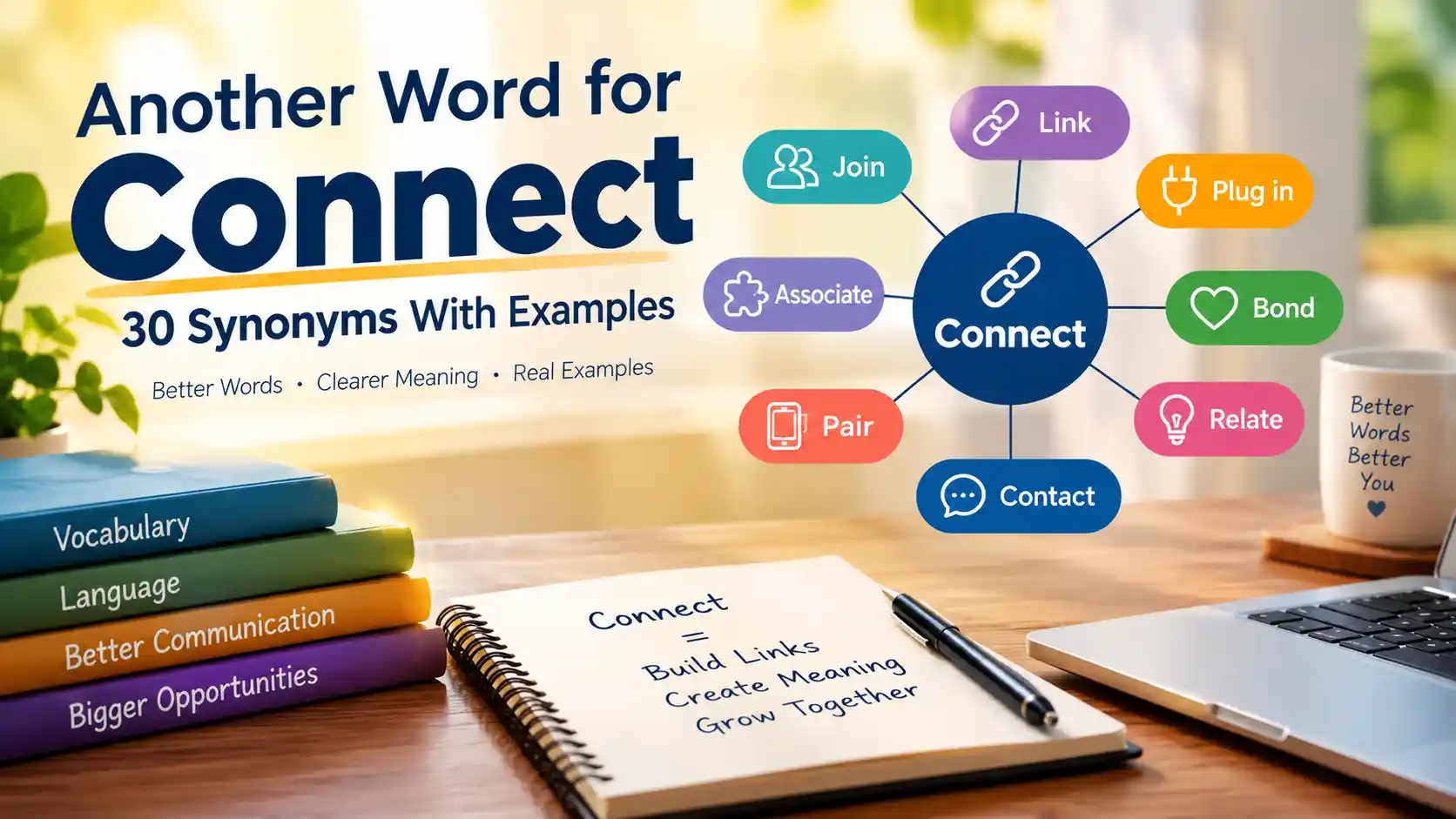
Another Word for Connect: 30 Synonyms With Examples
The best another word for connect depends on what is being joined. Use join or link to connect two things. For devices, use hook up, plug in, or pair. For ideas, use relate, associate, or tie together.
Connect works in four main areas: physical joining, technology, ideas and relationships, and travel. It can also describe a punch that reaches its target. Each area has its own alternatives, and many are not interchangeable.
Quick list: join, link, attach, hook up, plug in, associate, relate, tie, contact, bond
This article looks at 30 alternatives. Each has a meaning, IPA, a usage note, and an example. Some are direct synonyms of connect, and others only work in one context. Each entry says which.
At a Glance: Connect Synonyms and Related Alternatives
| Alternative | Part of Speech | Meaning | Register / Tone | Ideal Context |
| Join | Verb | Bring two things together | Neutral | Physical parts, groups |
| Link | Verb | Connect one thing to another | Neutral | Systems, ideas, websites |
| Attach | Verb | Fix one thing to another | Neutral | Files, parts, objects |
| Hook up | Phrasal verb | Connect equipment | Informal | Devices, appliances |
| Plug in | Phrasal verb | Connect to a power source or port | Informal | Chargers, cables |
| Pair | Verb | Connect two devices wirelessly | Neutral, technical | Bluetooth devices |
| Associate | Verb | Link in the mind | Neutral to formal | Ideas, memories |
| Relate | Verb | Show a link between things | Neutral | Facts, events, causes |
| Contact | Verb | Get in touch with a person | Neutral | Work, customer service |
| Bond | Verb | Form a close personal link | Neutral | Friends, family |
Which Word Should You Use?
| If you want to… | Use | Why |
| Join two physical things | Join or attach | They show parts coming together or being fixed on. |
| Connect a device to power or another device | Plug in, hook up, or pair | They are the natural words for equipment. |
| Show two ideas or facts belong together | Relate, link, or associate | They show a link in meaning or thought. |
| Describe a statistical link | Correlate | It is the precise word for data that move together. |
| Get in touch with a person | Contact or reach | They focus on starting communication. |
| Describe warmth between people | Bond or click | They suggest a real personal link, not just contact. |
| Combine separate systems into one | Integrate or interconnect | They suit systems, software, and networks. |
| Describe a punch or shot that hits | Land, hit, or strike | They match the “reach the target” sense. |
Exploring the Multiple Meanings of “Connect”
1. Join Things Physically
- Meaning: To join, bind, or fasten two or more things together.
- Explanation: This is the oldest sense. It applies to objects, parts, roads, and pipes. Etymonline gives the mid-15th century meaning as “to join, bind, or fasten together.”
- Example: The plumber connected the pipe to the tap.
2. Link Devices and Networks
- Meaning: To join equipment or systems so they work together.
- Explanation: This sense covers electricity, the internet, and wireless devices. It is probably the most common use today. A telephone sense, “get in touch with,” is recorded by 1926.
- Example: I connected my laptop to the Wi-Fi.
3. Link Ideas and Facts
- Meaning: To show or see that things are related.
- Explanation: Here connect is figurative. The things are not physically joined. They are linked by cause, meaning, or memory.
- Example: The police connected the two thefts.
4. Build a Relationship
- Meaning: To form a bond with another person or group.
- Explanation: This sense stresses feeling understood, not just making contact. Etymonline dates “to establish a relationship” to 1881, and the sense “establish rapport” to 1942.
- Example: She connects well with her students.
5. Join One Journey to Another
- Meaning: To link one train, bus, or flight with the next.
- Explanation: The vehicle arrives in time for passengers to continue on another. It is often used with with or to.
- Example: The morning train connects with a ferry at the port.
6. Hit a Target
- Meaning: To make contact with a target, as a punch or kick does.
- Explanation: This sense is informal and common in sports and fighting. Etymonline dates it to about 1920.
- Example: His punch connected with the other boxer’s chin.
Sources: Etymonline, “connect”; Merriam-Webster, “connect”; Collins English Dictionary, “connect”.
Analyzing 30 Connect Alternatives in Detail
Some of these words are direct synonyms of connect in one sense. Others are related alternatives that only fit a narrow context. Each usage note says which is which.
Core Alternatives for Joining Things
1. Join
IPA: /dʒɔɪn/ (US and UK)
Definition: To bring two or more things together.
- Usage: A close, neutral synonym for the physical sense of connect. It suggests that the parts become one, and it is less common for devices and networks.
- Example: Workers joined the two pieces of steel.
2. Link
IPA: /lɪŋk/ (US and UK)
Definition: To connect one thing with another.
- Usage: A close synonym in most senses of connect. It works for objects, systems, ideas, and websites. It sounds a little lighter than connect.
- Example: A new bridge links the island to the mainland.
3. Attach
IPA: /əˈtætʃ/ (US and UK)
Definition: To fix or join one thing to another.
- Usage: A close synonym when one thing is added to another, such as parts or files. It is narrower than connect because it implies the second thing is the main item.
- Example: Please attach the receipt to the form.
4. Couple
IPA: /ˈkʌpəl/ (US and UK)
Definition: To join two things, especially mechanical parts.
- Usage: A related alternative for machines and vehicles, such as railway cars and hoses. It is technical and not common in everyday speech.
- Example: The crew coupled the two train cars.
5. Unite
IPA: /juˈnaɪt/ (US and UK)
Definition: To bring people or things together as one.
- Usage: A related alternative for groups, countries, and causes. It stresses becoming one body and does not suit devices or cables.
- Example: The festival unites people from many towns.
6. Fasten
IPA: US /ˈfæsən/ · UK /ˈfɑːsən/
Definition: To fix something firmly in place.
- Usage: A related alternative that stresses a firm hold. It suits belts, doors, and straps, not networks or ideas.
- Example: She fastened the cable to the wall.
Alternatives for Devices and Networks
7. Hook up
IPA: /ˈhʊk ˌʌp/ (US and UK)
Definition: To connect equipment or a person to a system.
- Usage: A close, informal synonym for connecting devices and appliances. In some contexts, hook up also has other informal meanings, so check the sentence.
- Example: I need to hook up the new TV.
8. Plug in
IPA: /ˌplʌɡ ˈɪn/ (US and UK)
Definition: To connect a device to a power supply or socket.
- Usage: A related alternative for electrical or port connections. It does not suit wireless links.
- Example: Plug in the charger before you leave.
9. Wire
IPA: US /waɪr/ · UK /ˈwaɪə/
Definition: To connect something with electrical wires.
- Usage: A related alternative limited to electrical work. The verb wire also means to send money by wire transfer, so context matters.
- Example: The electrician wired the lights to the main switch.
10. Pair
IPA: US /per/ · UK /peə/
Definition: To connect two devices so they work together, usually wirelessly.
- Usage: A related, technical alternative used for Bluetooth devices. It has a different general meaning, to put two things together as a set.
- Example: You can pair your phone with the speaker.
11. Network
IPA: US /ˈnetwɜːrk/ · UK /ˈnetwɜːk/
Definition: To connect computers into a system, or to meet people for work contacts.
- Usage: A related alternative used as a verb for both computers and professional contacts. It is narrower than connect in each case.
- Example: The school networked all its computers last year.
Alternatives for Linking Ideas and Facts
12. Associate
IPA: US /əˈsoʊʃieɪt/ · UK /əˈsəʊʃieɪt/
Definition: To link people or things together in the mind.
- Usage: A close synonym for the idea-linking sense of connect. It stresses a mental link, such as memory or reputation, and does not suggest a physical join.
- Example: Many people associate that smell with summer.
13. Relate
IPA: /rɪˈleɪt/ (US and UK)
Definition: To show or see a link between things.
- Usage: A close synonym for connecting facts and events. It often appears in the passive, as in “related to.” It also means to tell a story, so context matters.
- Example: Doctors related the illness to the water supply.
14. Tie
IPA: /taɪ/ (US and UK)
Definition: To link or connect firmly, often as a cause or result.
- Usage: A close, informal-to-neutral alternative, often used in the form “tied to.” It suggests a strong link.
- Example: The company tied bonuses to sales.
15. Correlate
IPA: US /ˈkɔːrəleɪt/ · UK /ˈkɒrəleɪt/
Definition: To have a mutual relationship, so that one changes as the other does.
- Usage: A related, technical alternative used in science and statistics. It shows that two things change together, but not that one causes the other.
- Example: Test scores correlate with hours of sleep.
16. Bridge
IPA: /brɪdʒ/ (US and UK)
Definition: To connect two groups or things that are separate.
- Usage: A related, figurative alternative for closing a gap, as in “bridge the gap.” It suggests the two sides were far apart.
- Example: The program bridges the gap between school and work.
Alternatives for People and Relationships
17. Contact
IPA: US /ˈkɑːntækt/ · UK /ˈkɒntækt/
Definition: To get in touch with someone.
- Usage: A close synonym for the “get in touch” sense of connect. It takes a direct object, so you contact someone without a preposition.
- Example: Please contact the office by Friday.
18. Reach
IPA: /riːtʃ/ (US and UK)
Definition: To get in touch with someone, usually by phone or message.
- Usage: A related alternative that stresses success in making contact. It is neutral and common in speech.
- Example: I tried to reach her all morning.
19. Bond
IPA: US /bɑːnd/ · UK /bɒnd/
Definition: To form a close personal link.
- Usage: A related alternative for the relationship sense of connect. It suggests a deeper, longer-lasting link than simple contact.
- Example: The two sisters bonded over their love of music.
20. Click
IPA: /klɪk/ (US and UK)
Definition: To get along well with someone straight away.
- Usage: A related, informal alternative. It suggests an instant, easy link between people, so it is narrower than connect.
- Example: We clicked as soon as we met.
21. Resonate
IPA: /ˈrezəneɪt/ (US and UK)
Definition: To strike a chord or call up a strong response in someone.
- Usage: A related alternative for the “emotional link” sense. It describes how an idea or message affects people, not how people join one another.
- Example: Her speech resonated with young voters.
Formal and System-Level Alternatives
22. Integrate
IPA: /ˈɪntɪɡreɪt/ (US and UK)
Definition: To combine parts so they work as one system.
- Usage: A related, formal alternative for software, services, and teams. It suggests the parts work together fully, not just touch.
- Example: The app integrates with several payment services.
23. Interconnect
IPA: US /ˌɪntərkəˈnekt/ · UK /ˌɪntəkəˈnekt/
Definition: To connect with each other.
- Usage: A close, formal synonym that stresses links in both directions between several things. Etymonline dates it to 1863.
- Example: Roads interconnect the small villages.
24. Interlink
IPA: US /ˌɪntərˈlɪŋk/ · UK /ˌɪntəˈlɪŋk/
Definition: To link together, one with another.
- Usage: A close alternative similar to interconnect. It is often used for ideas and systems in a network.
- Example: The causes of the crisis are closely interlinked.
25. Combine
IPA: /kəmˈbaɪn/ (US and UK)
Definition: To join two or more things into one.
- Usage: A related alternative. It suggests the parts mix or merge, while connect does not always mean that.
- Example: The school combined the two classes.
26. Interlock
IPA: US /ˌɪntərˈlɑːk/ · UK /ˌɪntəˈlɒk/
Definition: To fit together so the parts hold each other in place.
- Usage: A related alternative for parts that fit tightly, such as gears or puzzle pieces. It is narrower than connect.
- Example: The puzzle pieces interlock at the edges.
Alternatives for Transport and Impact
27. Meet
IPA: /miːt/ (US and UK)
Definition: To join or touch at a point.
- Usage: A related alternative for roads, lines, and routes, as in “where the two roads meet.” It does not suit devices.
- Example: The trail meets the main road near the lake.
28. Land
IPA: /lænd/ (US and UK)
Definition: To succeed in hitting a target with a blow.
- Usage: A related alternative for the “hit a target” sense of connect, most often in “land a punch.” It is limited to blows and shots.
- Example: She landed a punch on her opponent’s shoulder.
29. Hit
IPA: /hɪt/ (US and UK)
Definition: To reach and strike a target.
- Usage: A close, everyday synonym for the “blow” sense of connect. It has no sense of linking things.
- Example: The ball hit the post.
30. Strike
IPA: /straɪk/ (US and UK)
Definition: To hit something with force.
- Usage: A related, slightly more formal alternative for blows. It stresses force more than hit does and does not mean to link things.
- Example: The stone struck the window.
Sources: Merriam-Webster; Collins English Dictionary; Collins Thesaurus.
Connect vs. Link vs. Join
These three verbs often overlap, but each has a slightly different focus. Connect is the widest. Link often suggests one thing tied to another, and join suggests two things becoming one.
| Word | Main Idea | Typical Use | Example |
| Connect | Two things are in contact or related | Devices, networks, people, ideas | Connect the printer to the computer. |
| Link | One thing is tied to another | Websites, systems, causes | The study links diet to sleep. |
| Join | Two things come together as one | Parts, groups, roads | The workers joined the two pipes. |
In many sentences they can be swapped. In others they cannot. You connect to Wi-Fi, but you do not usually link to it, and you join a team, not connect it.
Sources: Merriam-Webster, “connect,” “link,” “join”; Collins English Dictionary.
Connect and Opposite/Paired Word Pairs
| Word | Paired Word | Note |
| Connect | Disconnect | The most direct opposite. Etymonline dates disconnect to 1770. |
| Connect | Reconnect | Means to connect again. Etymonline dates it to 1752. |
| Connect | Detach | Means to take one thing off another. |
| Connect | Separate | Means to keep or put things apart. |
| Connect | Sever | A strong word for cutting a link, often figurative. |
| Connected | Unconnected | Etymonline dates unconnected to 1736. |
Disconnect is the clearest opposite, and it is the only one that mirrors connect in every sense. Detach and separate work best for physical things. Sever is stronger and often used for ties between people or groups.
Sources: Etymonline, “connect”; Merriam-Webster; Collins English Dictionary.
Common Word Partners of “Connect”
| Pattern | Common Partners | Example |
| connect + to + network | the internet, Wi-Fi, a server | The phone connects to Wi-Fi automatically. |
| connect + equipment | a printer, a cable, a speaker | Please connect the printer to the computer. |
| connect + two things | two points, two cities, two ideas | The tunnel connects two cities. |
| connect + with + people | customers, an audience, others | Good teachers connect with students. |
| connect + a call | a call, a caller | The operator connected the call. |
| connect + the dots | the dots | Can you connect the dots? |
| connect + with + travel | a flight, a train, a bus | The bus connects with the evening train. |
| adverb + connect | directly, closely, easily | The two rooms connect directly. |
Sources: Merriam-Webster, “connect”; Collins English Dictionary, “connect”.
Idiomatic Phrases Featuring “Connect”
Connect has few true idioms. The entries below are established expressions in common use.
1. Connect the dots
- Meaning: To see how separate facts or events fit together to form a clear picture.
- Example: After reading the reports, she finally connected the dots.
2. Make the connection
- Meaning: To realize that two things are related.
- Example: I knew his face, but I could not make the connection to where we had met.
3. Well-connected
- Meaning: Having many useful or powerful contacts.
- Example: She is well-connected in the film industry.
4. Connect with (someone)
- Meaning: To form an understanding or bond with a person or an audience.
- Example: The comedian connected with the crowd right away.
Sources: Merriam-Webster; Collins English Dictionary.
Word Formation of “Connect”
Etymology & Structure
Connect comes from Latin conectere, “join together.” The word is built from an assimilated form of com, “together,” plus nectere, “to bind, tie.” Etymonline traces nectere to the Proto-Indo-European root *ned-, “to bind, tie,” which is also linked to English node, nexus, and annex.
Date and History
Etymonline records connect in the mid-15th century, with the meaning “to join, bind, or fasten together.” In the 16th century it was displaced by connex (1540s), and connect was re-established from the 1670s. The sense “to establish a relationship” is from 1881. The telephone-related sense “get in touch with” is attested by 1926, “awaken meaningful emotions, establish rapport” is from 1942, and the sense of a blow reaching its target is from about 1920.
Word Class Variations
- Verb: connect, connects, connected, connecting
- Noun: connection (late 14th century); connector (Etymonline gives 1795); connectedness; connectivity
- Adjective: connected; connective (1650s); unconnected (1736); well-connected
- Related verbs: reconnect (1752), disconnect (1770), interconnect (1863)
Sources: Etymonline, “connect,” “connection,” “connective.”
Common Word-Choice Mistakes
- Connect on Wi-Fi: connect to Wi-Fi.
- The two events are connect: the two events are connected (use the adjective after are).
- The device is connected from the network: connected to the network.
- Please contact with me: please contact me (contact takes a direct object).
- Connect the file to the email: attach the file to the email.
- The punch connected to his chin: connected with his chin.
- The road connects between two cities: the road connects two cities.
Frequently Asked Questions
What is the closest synonym for connect?
Link and join are the closest everyday synonyms, and they cover most uses of connect.
What is a formal alternative to connect?
Interconnect, integrate, and interlink are formal choices, especially for systems and networks.
What is the difference between connect and link?
Connect is broader. Link often suggests that one thing is tied to another, as in a cause and a result or a web page and its target.
What is the difference between connect and join?
Join suggests that two things become one. Connect allows them to stay separate but in contact.
What can I say instead of connect to Wi-Fi?
Join, log on to, and get on are common. For devices, pair is used for wireless links like Bluetooth.
What is another word for connect with people?
Bond, click, and relate to all fit, depending on how close the link is. Contact and reach fit simple communication.
What is the opposite of connect?
Disconnect is the direct opposite. Detach, separate, and sever cover narrower ideas.
Can connect mean to hit something?
Yes. In informal use, a punch or shot that connects reaches its target. Land, hit, and strike are close alternatives.
Is connect the same as contact?
Not exactly. Contact means getting in touch with someone, while connect can also mean joining things or building a bond.
Can connect be used for ideas?
Yes. You can connect ideas, facts, or events. Relate, link, and associate are common alternatives in this sense.
Conclusion
The closest alternatives to connect are link and join, with hook up, plug in, and pair for devices. For ideas, relate, associate, and tie are common choices, and for people, contact, bond, and click each show a different level of closeness.
Context decides the right word. Connect covers joining objects, linking technology, relating ideas, building bonds, and even hitting a target. Each of these meanings has its own set of alternatives, and some words only work in one area.
To choose well, first decide what is being connected: things, devices, ideas, or people. Then pick the word that matches that context and the level of formality you want.

Hy, Sophia is a content writer with 3 years of experience creating engaging, informative, and SEO-friendly articles focused on synonyms, vocabulary, and word meanings.