30 Another Word for Rebellion: Synonyms With Examples & Meaning
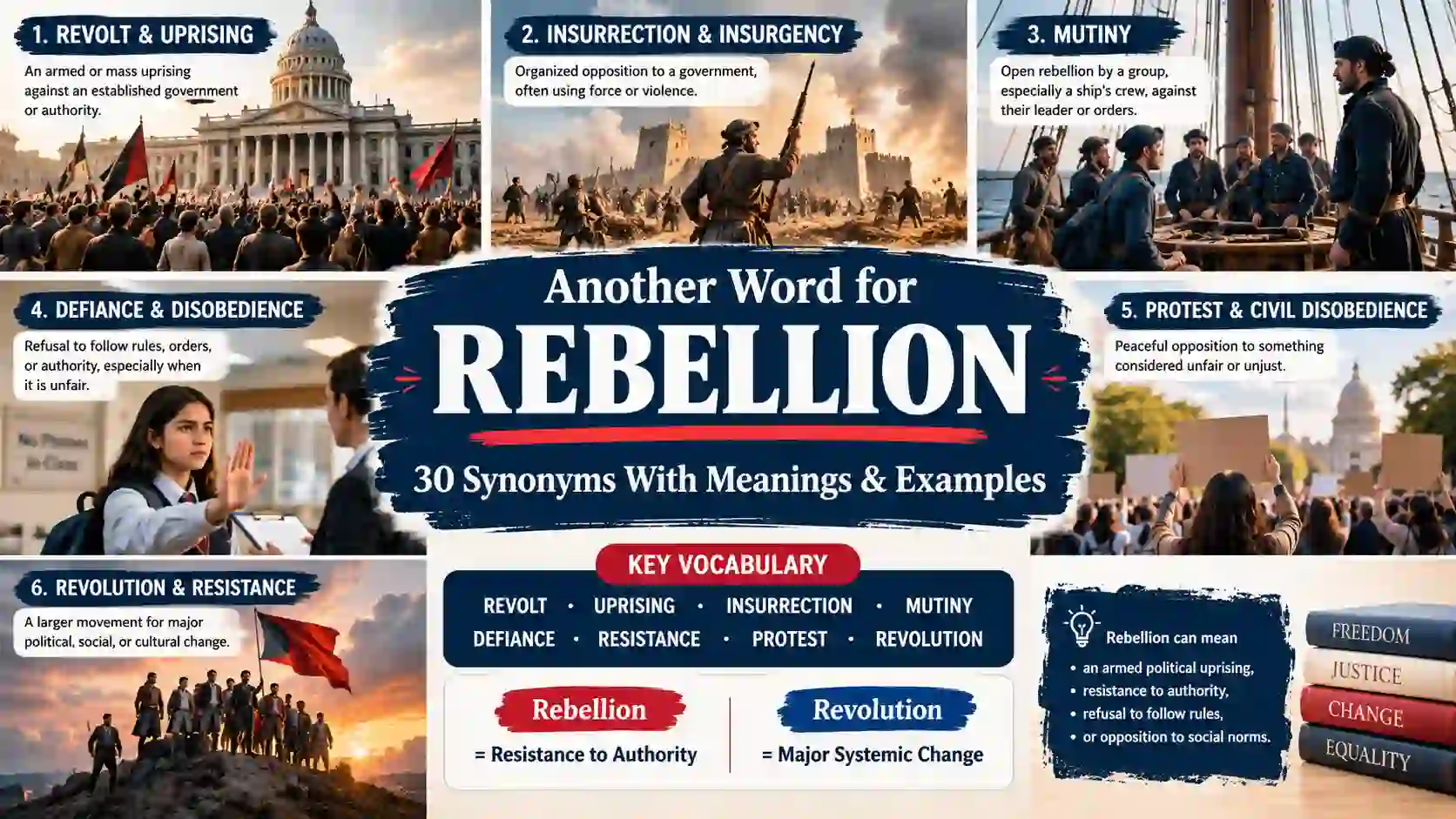
The most common another word for rebellion is revolt. Uprising and insurrection are also close, and all three mean a group rising against a government or ruler. If you mean refusing to follow rules or orders, defiance, disobedience, and insubordination often fit better.
The best alternative depends on who is rebelling, how, and against what. A rebellion can be an armed fight against a government, a crew refusing orders, a protest in the streets, or a teenager breaking house rules. Each situation has its own best word.
Quick list: revolt, uprising, insurrection, insurgency, revolution, mutiny, defiance, resistance, disobedience, protest
This article looks at 30 alternatives. For each one, you will find its meaning, IPA pronunciation, a usage note, and an example sentence. Some are direct synonyms, and others are related words that fit only certain contexts.
At a Glance: Rebellion Synonyms and Related Alternatives
| Alternative | Part of Speech | Meaning | Register / Tone | Ideal Context |
| Revolt | noun | A rising against a government or ruler | Neutral | News, history, everyday writing |
| Uprising | noun | A rising by people against authority | Neutral | News, history |
| Insurrection | noun | An organized rising against a government | Formal | Law, history, government |
| Insurgency | noun | A long armed campaign against a government | Formal | Military and political reporting |
| Revolution | noun | A radical, often forceful change of government or system | Neutral to formal | History, politics |
| Mutiny | noun | Rebellion by soldiers or sailors against their officers | Neutral | Military, ships, crews |
| Defiance | noun | Open refusal to obey or respect authority | Neutral | Personal, school, work |
| Resistance | noun | Refusal to accept something, or fighting back | Neutral | Politics, social change |
| Rebelliousness | noun | The quality of refusing to obey or follow rules | Neutral | Describing people and behavior |
| Protest | noun | An action or statement showing strong disapproval | Neutral | Public events, politics |
Which Word Should You Use?
| If you want to… | Use | Why |
| Describe an armed rising against a government | Revolt or uprising | Both are clear and common in news and history. |
| Use a formal or legal word for a rising against a state | Insurrection | It sounds official and often appears in law and history. |
| Describe soldiers or sailors refusing to obey officers | Mutiny | It is the standard word for rebellion inside a military or ship. |
| Describe a long fight by an armed group | Insurgency | It suggests a continuing campaign, not one event. |
| Describe a complete change of government or system | Revolution | It focuses on the change, not just the act of rising. |
| Describe a sudden seizure of power by a small group | Coup | A coup is usually quick and planned by a few people. |
| Describe refusing rules at school or work | Defiance or insubordination | These fit personal and workplace situations. |
| Describe peaceful opposition | Protest or civil disobedience | They suggest opposition without armed force. |
| Describe a person’s rule-breaking attitude | Rebelliousness | It names the trait, not the event. |
Exploring the Multiple Meanings of “Rebellion”
1. Armed Resistance Against a Government
- Meaning: Open, organized, and often armed resistance to a government or ruler.
- Explanation: This is the main political sense. The word often suggests a large group, and the rising may succeed or fail. Dictionaries also define it as an attempt to overthrow a government.
- Example: The rebellion began when farmers refused to pay the new tax and took up arms.
2. Defiance of Authority
- Meaning: The act of refusing to obey a person or group in charge.
- Explanation: This sense is smaller in scale. The authority can be a parent, teacher, boss, or leader, and no weapons are involved.
- Example: Her refusal to wear the uniform was a quiet rebellion against the school.
3. Resistance to Rules, Customs, or Norms
- Meaning: Action that challenges accepted rules, traditions, or the way things are normally done.
- Explanation: This sense is common when people talk about youth, style, music, or art. It describes a change in behavior, not a fight against a ruler.
- Example: Many people see punk music as a rebellion against the polished pop of its time.
4. Rebellion Against God or Church Authority
- Meaning: Resistance to religious authority.
- Explanation: According to Etymonline, the word was first used especially for rising against God or Church authority. This sense is now rare outside historical or religious writing.
- Example: Medieval writers sometimes described heresy as a rebellion against the Church.
Sources: Etymonline (rebellion); Dictionary.com (rebellion); Merriam-Webster (rebel); Wiktionary (rebellion)
Analyzing 30 Rebellion Alternatives in Detail
Some of these words are direct synonyms of rebellion, while others are related words that fit only certain situations. The usage notes say which is which.
Core Synonyms for Armed or Political Rebellion
1. Revolt
IPA: US /rɪˈvoʊlt/ · UK /rɪˈvəʊlt/
Definition: An act of rising against a government, ruler, or authority.
- Usage: This is the closest everyday synonym. It is neutral and works in news, history, and general writing. It can also describe smaller acts of protest by a group.
- Example: The revolt started in the northern provinces and spread within weeks.
2. Uprising
IPA: /ˈʌpraɪzɪŋ/ (US and UK)
Definition: An act of people rising up against those in power.
- Usage: This is a direct synonym. It often suggests ordinary people acting together, and it is very common in news and history.
- Example: The uprising was crushed within days.
3. Insurrection
IPA: /ˌɪnsəˈrɛkʃən/ (US and UK)
Definition: An act of rising in revolt against a government or established authority.
- Usage: This is a direct synonym with a formal tone. It appears often in law and history and usually suggests violence and organization.
- Example: Troops were sent to stop the insurrection.
4. Insurgency
IPA: US /ɪnˈsɜːrdʒənsi/ · UK /ɪnˈsɜːdʒənsi/
Definition: An organized armed rebellion by a group that is not the official government, often fought over a long time.
- Usage: This is a close alternative, not an exact synonym. It describes an ongoing campaign more than one event, and it is common in military and political reporting.
- Example: The insurgency lasted ten years and wore down the army.
5. Revolution
IPA: /ˌrɛvəˈluːʃən/ (US and UK)
Definition: A sudden, radical, or complete change, especially in a government or social system.
- Usage: This is a related alternative. A rebellion can fail, but a revolution usually means a deep change did happen. The word also has non-political meanings, such as the industrial revolution.
- Example: The revolution replaced the king with an elected government.
Specific Forms of Political and Military Rebellion
6. Mutiny
IPA: /ˈmjuːtəni/ (US and UK)
Definition: Open rebellion against authority, especially by soldiers or sailors against their officers.
- Usage: This is a direct synonym only in military or ship settings. It is also used loosely for groups that turn against a leader.
- Example: The crew’s mutiny forced the captain to turn the ship around.
7. Coup
IPA: /kuː/ (US and UK)
Definition: A sudden, forceful takeover of a government, usually by a small group.
- Usage: This is a related alternative, not an exact synonym. A coup is usually quick and planned by a few people, while a rebellion often involves many.
- Example: A group of officers took power in a coup.
8. Putsch
IPA: /pʊtʃ/ (US and UK)
Definition: A sudden attempt to overthrow a government, planned in secret.
- Usage: This is a related alternative with a formal, historical tone. It comes from German and usually describes a quick move by a small group.
- Example: The putsch failed when the army stayed loyal to the government.
9. Secession
IPA: /sɪˈsɛʃən/ (US and UK)
Definition: The formal withdrawal of a region or group from a larger nation or organization.
- Usage: This is a related alternative, not a synonym. Secession means breaking away, not fighting those in power, though it can lead to rebellion.
- Example: The region declared secession, and the government sent troops.
10. Sedition
IPA: /sɪˈdɪʃən/ (US and UK)
Definition: Speech or action that encourages people to rebel against the authority of a state.
- Usage: This is a related legal term. It describes urging rebellion more than the rebellion itself.
- Example: He was charged with sedition for urging soldiers to disobey their orders.
Everyday Defiance and Resistance
11. Defiance
IPA: /dɪˈfaɪəns/ (US and UK)
Definition: Open refusal to obey or respect authority.
- Usage: This is a close synonym for the personal sense of rebellion. It suggests a bold, visible act and is common in everyday writing.
- Example: She wore the badge in defiance of the school rules.
12. Disobedience
IPA: /ˌdɪsəˈbiːdiəns/ (US and UK)
Definition: Failure or refusal to obey rules or orders.
- Usage: This is a close synonym for the personal sense. It is milder than rebellion and can be quiet or accidental.
- Example: The dog’s disobedience made training difficult.
13. Resistance
IPA: /rɪˈzɪstəns/ (US and UK)
Definition: The act of refusing to accept something, or of fighting against it.
- Usage: This is a related alternative. It can be peaceful or armed and works for politics and everyday life. Historical groups, such as a wartime resistance, use it as a name.
- Example: Local resistance to the new law grew every month.
14. Insubordination
IPA: US /ˌɪnsəˌbɔːrdɪˈneɪʃən/ · UK /ˌɪnsəˌbɔːdɪˈneɪʃən/
Definition: Refusal to obey the orders of a person of higher rank.
- Usage: This is a close synonym for the workplace or military sense. It is formal and always involves a boss or superior.
- Example: He was fired for insubordination after ignoring his manager’s instructions.
15. Dissent
IPA: /dɪˈsɛnt/ (US and UK)
Definition: Disagreement with an official view or decision.
- Usage: This is a related alternative. It usually means opposition in words or votes, not in force, and has a formal tone.
- Example: The government does not tolerate dissent.
Protest and Public Disorder
16. Protest
IPA: US /ˈproʊtɛst/ · UK /ˈprəʊtɛst/
Definition: A statement or action that shows strong disapproval of something.
- Usage: This is a related alternative. It is usually milder and more peaceful than rebellion and does not aim to overthrow anyone.
- Example: Thousands joined the protest against the new tax.
17. Riot
IPA: /ˈraɪət/ (US and UK)
Definition: A violent public disturbance by a crowd.
- Usage: This is a related alternative. A riot is usually sudden and disorganized, while a rebellion is usually aimed at authority or the government.
- Example: The riot began after the match and spread through the city center.
18. Unrest
IPA: /ʌnˈrɛst/ (US and UK)
Definition: A state of public trouble or dissatisfaction, often with protests or violence.
- Usage: This is a related alternative. It describes the situation around a rebellion, not the rebellion itself.
- Example: Rising food prices led to unrest in several cities.
19. Agitation
IPA: /ˌædʒɪˈteɪʃən/ (US and UK)
Definition: Public campaigning or action to stir up support for political or social change.
- Usage: This is a related alternative with a formal tone. It describes the build-up to change, often without any violence.
- Example: Years of agitation by workers finally led to reform.
20. Civil disobedience
IPA: /ˌsɪvəl ˌdɪsəˈbiːdiəns/ (US and UK)
Definition: The peaceful refusal to obey certain laws as a form of protest.
- Usage: This is a related alternative. It describes a deliberate, nonviolent form of rebellion.
- Example: The group practiced civil disobedience by sitting in the road.
Attitude and Behavior
21. Rebelliousness
IPA: /rɪˈbɛljəsnəs/ (US and UK)
Definition: The quality of being rebellious, or of refusing to obey rules or authority.
- Usage: This is a direct synonym for the trait of rebelling. It describes a person’s attitude, not a single act.
- Example: Her rebelliousness showed in the way she dressed.
22. Nonconformity
IPA: US /ˌnɑːnkənˈfɔːrməti/ · UK /ˌnɒnkənˈfɔːmɪti/
Definition: Refusal to follow accepted rules, customs, or beliefs.
- Usage: This is a related alternative. It fits the social sense of rebellion against norms and is quieter than rebellion.
- Example: The artist was known for her nonconformity.
23. Recalcitrance
IPA: /rɪˈkælsɪtrəns/ (US and UK)
Definition: Stubborn resistance to authority or control.
- Usage: This is a formal, close alternative for stubborn disobedience. It is less common in everyday speech.
- Example: The workers’ recalcitrance slowed down the project.
24. Contumacy
IPA: US /ˈkɑːntəməsi/ · UK /ˈkɒntjʊməsi/
Definition: Stubborn refusal to obey authority, especially a court order.
- Usage: This is a rare, formal word used mainly in legal or historical writing. It is related to rebellion but narrower.
- Example: He was punished for contumacy after refusing to answer the court.
25. Unruliness
IPA: /ʌnˈruːlinəs/ (US and UK)
Definition: The quality of being hard to control or manage.
- Usage: This is a related alternative and much milder than rebellion. It suits children, crowds, or animals.
- Example: The teacher struggled with the unruliness of the class.
Historical, Figurative, and Related Alternatives
26. Rising
IPA: /ˈraɪzɪŋ/ (US and UK)
Definition: An act of rebelling, especially a revolt against authority.
- Usage: This is a direct synonym in historical writing. It often appears in the names of events, as in “the Easter Rising.”
- Example: The rising was put down within a week.
27. Jacquerie
IPA: /ʒɑːkˈriː/ (US and UK)
Definition: A revolt of peasants. The word comes from the peasant revolt in France in 1358.
- Usage: This is a historical term for a peasant uprising. It is rare and best used in history writing.
- Example: Historians describe the revolt as a jacquerie driven by hunger and anger.
28. Upheaval
IPA: /ʌpˈhiːvəl/ (US and UK)
Definition: A sudden, violent change or disturbance.
- Usage: This is a related alternative. It describes the shock of big change, which may or may not include a rebellion.
- Example: Years of political upheaval followed the war.
29. Backlash
IPA: /ˈbæklæʃ/ (US and UK)
Definition: A strong negative reaction by a group of people to a change or event.
- Usage: This is a figurative, related alternative. It describes public anger, not an organized rebellion.
- Example: The new rules caused a backlash among parents.
30. Subversion
IPA: US /səbˈvɜːrʒən/ · UK /səbˈvɜːʃən/
Definition: The act of trying to weaken or overthrow a government or institution, often secretly from within.
- Usage: This is a related alternative. It suggests hidden action, while rebellion is usually open.
- Example: The group was accused of subversion against the state.
Sources: Merriam-Webster; Dictionary.com; Wiktionary
Rebellion vs. Revolt vs. Insurrection vs. Revolution
These four words overlap, but they are not always interchangeable.
| Word | Main Idea | Usually Suggests | Example |
| Rebellion | Open resistance to authority | Can be large or small, successful or not | The rebellion was defeated after two years. |
| Revolt | A rising against a ruler or government | A more direct, often shorter action | The revolt began in the capital. |
| Insurrection | A formal word for a rising against a government | Violence and organization, with a legal tone | He was charged in connection with the insurrection. |
| Revolution | A complete change of government or system | Success and deep change | The revolution changed how the country was ruled. |
In everyday writing, rebellion, revolt, and uprising are often used the same way. Use revolution only when a major change took place. A failed rebellion is not usually called a revolution.
Sources: Dictionary.com (rebellion); Merriam-Webster (rebel); Wiktionary (rebellion)
Rebellion and Opposite/Paired Word Pairs
| Word | Paired Word | Note |
| Rebellion | Obedience | The most common opposite for the defiance sense. |
| Rebellion | Submission | Suggests giving in to authority. |
| Rebellion | Conformity | Contrasts rebellion against norms with following them. |
| Rebellion | Loyalty | Contrasts turning against a ruler with staying faithful. |
| Rebel | Loyalist | A person pair, used in historical and political writing. |
| Rebellion | Suppression | Describes what authorities do to stop a rebellion. |
| Rebellion | Order | Contrasts disorder with a peaceful, stable system. |
Rebellion has no single perfect opposite, because its meaning changes with context. For political rebellion, loyalty and order are the closest contrasts. For personal defiance, obedience and compliance fit best.
Sources: Wiktionary (rebellion); Dictionary.com (rebellion)
Common Word Partners of “Rebellion”
| Pattern | Common Partners | Example |
| verb + rebellion | lead, launch, join, support, crush, quell, suppress | The general led the rebellion from the mountains. |
| adjective + rebellion | armed, violent, popular, failed, peasant | The failed rebellion left many leaders in prison. |
| rebellion + preposition | against | The rebellion against the king began in spring. |
| rebellion + verb | break out, spread, fail, succeed | The rebellion spread quickly across the country. |
| noun + of + rebellion | spirit of, wave of, leader of | A wave of rebellion swept through the region. |
| rebellion + noun | leader, forces | The rebellion leader escaped to the hills. |
Sources: Dictionary.com (rebellion); Merriam-Webster (rebel)
Idiomatic Phrases Featuring “Rebellion”
Rebellion has few true idioms. The phrases below are strongly established expressions.
1. In open rebellion
- Meaning: Openly and publicly resisting authority, with no attempt to hide it.
- Example: Several towns were in open rebellion against the capital.
2. Put down a rebellion
- Meaning: To stop a rebellion by force or authority.
- Example: The army put down the rebellion within a month.
3. An act of rebellion
- Meaning: A single action that shows resistance to rules or authority, often a small or personal one.
- Example: Keeping her phone on in class was her small act of rebellion.
4. Teenage rebellion
- Meaning: The common pattern of young people pushing against parents’ rules and expectations.
- Example: His loud music was just part of normal teenage rebellion.
Sources: Dictionary.com (rebellion); Merriam-Webster (rebel)
Word Formation of “Rebellion”
Etymology & Structure
According to Etymonline, rebellion came into English from Old French rebellion and directly from Latin rebellionem (nominative rebellio), which meant “rebellion, revolt” and “renewal of war.” It comes from Latin rebellis (“insurgent, rebellious”), which comes from rebellare (“to rebel, revolt”). That verb is built from re- (“against,” or perhaps “again”) and bellare (“to wage war”), from bellum (“war”). The English ending -ion turns the idea into a noun.
Date and History
Etymonline dates rebellion to the mid-14th century, in the spelling rebellioun. It originally meant war waged against a government by some part of its people, especially against God or Church authority. The related word rebel (adjective) appears around 1300.
Word Class Variations
- Noun: rebellion (countable and uncountable), rebel (a person who rebels), rebelliousness
- Verb: rebel (rebelled, rebelling)
- Adjective: rebellious, rebel (as in “rebel forces”)
- Adverb: rebelliously
Sources: Etymonline (rebellion, rebel); Wiktionary (rebellion); Merriam-Webster (rebel)
Common Word-Choice Mistakes
- He did a rebellion against the rules: He rebelled against the rules, or He led a rebellion.
- The rebellion to the king: The rebellion against the king.
- The crowd rebelled the government: The crowd rebelled against the government.
- The rebel lasted three years: The rebellion lasted three years.
- A mutiny by the farmers: An uprising or revolt by the farmers (mutiny is for soldiers, sailors, or crews).
- A coup by the people: An uprising by the people (a coup is usually carried out by a small group).
- She has a rebellion personality: She has a rebellious personality.
FAQs
What is the closest synonym for rebellion?
Revolt is the closest everyday synonym. Uprising is also very close.
What is a formal alternative to rebellion?
Insurrection is the most common formal alternative. It is often used in law and history.
What is the difference between rebellion and revolution?
A rebellion is resistance to authority and may fail. A revolution usually means a complete change in a government or system.
Is mutiny the same as rebellion?
Mutiny is a kind of rebellion, but it is mainly used for soldiers, sailors, or crews who turn against their officers.
What is the opposite of rebellion?
Obedience is the most common opposite. Loyalty and order are also used, depending on context.
Can rebellion be used for non-political situations?
Yes. Rebellion can describe a child, student, or worker resisting rules, as in “teenage rebellion.”
Is a protest the same as a rebellion?
Not exactly. A protest is usually peaceful and shows disapproval, while a rebellion usually aims to resist or overthrow authority.
What is a word for rebellion in a workplace?
Insubordination is the best choice. It means refusing to follow a boss’s orders.
Is rebellion a countable noun?
It can be both. “A rebellion” is a single event, while “rebellion” alone can mean the general act of resisting.
What is a historical word for a peasant rebellion?
Jacquerie is the historical term, taken from the peasant revolt in France in 1358.
Conclusion
The closest alternatives to rebellion are revolt, uprising, and insurrection. For personal or social situations, defiance, disobedience, and rebelliousness are the most natural choices.
Context changes the best word. Mutiny suits a crew, insurgency suits a long armed campaign, and revolution suggests a complete change of government or system. Protest and civil disobedience describe opposition without armed force.
To choose well, ask three questions. Who is rebelling? How are they doing it? What are they resisting? The answers will usually point to the right word.
Discover More Article

Hy, Rose is a professional content writer with 3 years of experience creating engaging, informative, and SEO-friendly content. She specializes in crafting clear, reader-focused articles that deliver value, improve online visibility, and help websites grow.