30Another Word for Rapid: Synonyms With Meaning & Examples
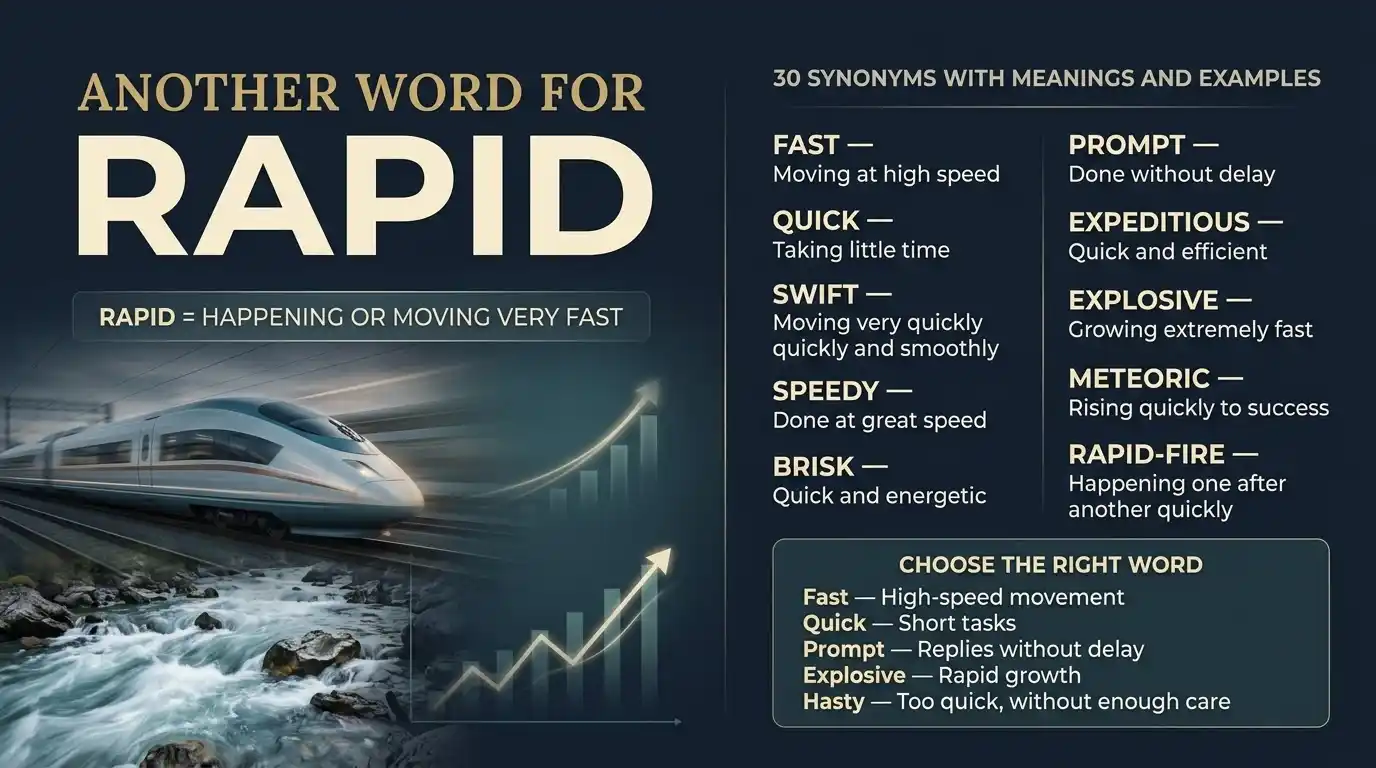
The closest everyday alternatives to “rapid” are fast, quick, and swift. For a fast reply, prompt is a good fit. For fast growth, explosive or sharp may be better. In formal writing, expeditious works well.
The best alternative depends on what “rapid” describes. It can describe high-speed movement, quick change or growth, things that follow one another fast, or work done in a short time. As a noun, “rapids” also names a fast part of a river. Each of these has its own best word.
Quick list: fast, quick, speedy, swift, brisk, prompt, expeditious, sharp, rapid-fire, immediate
This article looks at 30 alternatives. Each has a definition, IPA, a usage note, and an example, so you can match the word to the situation.
At a Glance: Rapid Synonyms and Related Alternatives
| Alternative | Part of Speech | Meaning | Register / Tone | Ideal Context |
| Fast | Adjective | Moving or happening at high speed | Neutral, everyday | Vehicles, people, processes |
| Quick | Adjective | Done in a short time | Neutral, everyday | Tasks, replies, looks |
| Speedy | Adjective | Moving or done at great speed | Neutral, friendly | Service, recovery |
| Swift | Adjective | Very fast and smooth | Neutral to literary | Movement, action |
| Brisk | Adjective | Quick and energetic | Neutral | Walking, pace, trade |
| Expeditious | Adjective | Done quickly and efficiently | Formal | Reviews, handling, decisions |
| Prompt | Adjective | Done without delay | Neutral to formal | Replies, payments, service |
| Sudden | Adjective | Happening quickly and without warning | Neutral | Storms, changes, events |
| Explosive | Adjective | Growing or increasing extremely fast | Neutral to strong | Growth, spread, expansion |
| Rapid-fire | Adjective | Coming one after another very quickly | Informal to neutral | Questions, comments |
Which Word Should You Use?
| If you want to… | Use | Why |
| Say something moves at high speed in plain words | Fast | It is the simplest and most common choice. |
| Say something takes only a short time | Quick | It stresses a short time, not high speed. |
| Describe a fast reply to a request | Prompt | It shows there was no delay. |
| Describe quick and efficient handling in formal writing | Expeditious | It sounds professional and adds efficiency. |
| Describe very fast growth | Explosive (or meteoric for a fast rise to success) | Both show growth much faster than usual. |
| Describe things coming one after another | Rapid-fire | It matches “rapid succession.” |
| Describe a decision made too quickly | Hasty | It adds the idea of carelessness. |
| Describe fast, rough water in a river | White water or rushing | They name the river sense of “rapids.” |
Exploring the Multiple Meanings of “Rapid”
1. Moving at Great Speed
- Meaning: Moving or acting at a high speed.
- Explanation: This is the basic sense. It describes motion, such as a rapid current or a rapid pulse.
- Example: The boat was carried away by the rapid current.
2. Happening Quickly Over Time
- Meaning: Changing or developing in a short period of time.
- Explanation: This is the most common use today. It fits growth, change, decline, and other processes.
- Example: The town has seen rapid growth in new businesses.
3. Following One After Another Quickly
- Meaning: Coming or happening in fast succession.
- Explanation: This sense appears in phrases like “in rapid succession” and “rapid-fire.” It describes events that happen close together.
- Example: The camera took three photos in rapid succession.
4. Done in a Short Time
- Meaning: Done or completed quickly.
- Explanation: This sense fits responses, tests, and decisions. It is common in work and health settings.
- Example: The hospital’s rapid response saved the cyclist’s life.
5. A Fast Part of a River (Noun)
- Meaning: A part of a river where the current is fast and the water is rough.
- Explanation: The noun is usually plural, as in “rapids.” It is not used for general speed.
- Example: The guide led the raft through the rapids.
Sources: Merriam-Webster (rapid); Dictionary.com (rapid); Collins English Dictionary (rapid); Etymonline (rapid)
Analyzing 30 Rapid Alternatives in Detail
Some alternatives below are close synonyms of “rapid,” while others are related words that fit only one sense, such as fast growth, quick replies, or river water.
Everyday Synonyms for Fast Movement
1. Fast
IPA: US /fæst/ · UK /fɑːst/
Definition: Moving, working, or happening at high speed.
- Usage: The closest everyday synonym. It is plainer than “rapid” and works for both things and actions.
- Example: She is a fast runner.
2. Quick
IPA: (US and UK) /kwɪk/
Definition: Done or happening in a short time.
- Usage: A close synonym that stresses a short time, not high speed. It is common for tasks, replies, and looks.
- Example: Give me a quick call when you arrive.
3. Speedy
IPA: (US and UK) /ˈspiːdi/
Definition: Moving or done at great speed.
- Usage: A close synonym that sounds friendly and positive. It is common for service and recovery, as in “a speedy recovery.”
- Example: We wish you a speedy recovery.
4. Swift
IPA: (US and UK) /swɪft/
Definition: Moving or happening very quickly and smoothly.
- Usage: A close, slightly formal or literary synonym. Merriam-Webster says “swift” suggests great speed together with ease of movement.
- Example: The fox made a swift escape.
5. Brisk
IPA: (US and UK) /brɪsk/
Definition: Quick and full of energy.
- Usage: A related alternative for walking, pace, and business. It suggests lively movement, not extreme speed. It also describes cool, fresh weather.
- Example: They took a brisk walk before breakfast.
6. Nimble
IPA: (US and UK) /ˈnɪmbl/
Definition: Quick and light in movement or thinking.
- Usage: A related alternative for agility. It is about skill in moving, not speed in general.
- Example: The nimble goalkeeper reached the ball in time.
Formal and Literary Alternatives
7. Expeditious
IPA: (US and UK) /ˌɛkspəˈdɪʃəs/
Definition: Done quickly and efficiently.
- Usage: A close formal synonym for processes, reviews, and handling. It adds the idea of efficiency.
- Example: The agency promised an expeditious review of the request.
8. Fleet
IPA: (US and UK) /fliːt/
Definition: Fast and light in movement.
- Usage: A literary alternative, as in “fleet of foot.” It is rare in modern conversation.
- Example: The fleet deer vanished into the woods.
9. Accelerated
IPA: (US and UK) /əkˈsɛləreɪtɪd/
Definition: Happening faster than normal or planned.
- Usage: A related alternative that shows speed was increased on purpose. It fits courses, schedules, and growth.
- Example: She joined an accelerated course to finish in one year.
10. Precipitate
IPA: (US and UK) /prɪˈsɪpɪtət/
Definition: Happening very quickly or suddenly, often without enough thought.
- Usage: A related formal alternative for sudden changes. It often suggests the speed was too great, and it is also a verb with a different pronunciation.
- Example: The company’s precipitate decline surprised investors.
Words for Fast Growth and Change
11. Meteoric
IPA: US /ˌmiːtiˈɔːrɪk/ · UK /ˌmiːtiˈɒrɪk/
Definition: Very fast, especially in rising to success or fame.
- Usage: A related alternative for sudden rises. It suggests a bright rise that may not last.
- Example: The singer’s meteoric rise began with one video.
12. Explosive
IPA: US /ɪkˈsploʊsɪv/ · UK /ɪkˈspləʊsɪv/
Definition: Increasing or developing extremely fast.
- Usage: A related alternative that is stronger than “rapid.” It fits growth and spread. It also means likely to explode.
- Example: The city saw explosive growth in the 1990s.
13. Sharp
IPA: US /ʃɑːrp/ · UK /ʃɑːp/
Definition: Sudden and large, as of a change.
- Usage: A related alternative for rises and falls in numbers, as in “a sharp increase.”
- Example: There was a sharp rise in fuel prices.
14. Steep
IPA: (US and UK) /stiːp/
Definition: Very large or very quick, as of a rise or fall.
- Usage: A related alternative for prices and drops. It also describes a slope that rises at a sharp angle.
- Example: The company reported a steep drop in sales.
15. Sudden
IPA: (US and UK) /ˈsʌdn/
Definition: Happening quickly and without warning.
- Usage: A related alternative that stresses surprise, not speed. A rapid change can be expected, but a sudden one is not.
- Example: A sudden storm ended the picnic.
Words for Quick Responses and Actions
16. Prompt
IPA: US /prɑːmpt/ · UK /prɒmpt/
Definition: Done at once or without delay.
- Usage: A related alternative for responses and payments. It is about no delay, not the speed of movement.
- Example: Thank you for your prompt reply.
17. Immediate
IPA: (US and UK) /ɪˈmiːdiət/
Definition: Happening at once, with no gap in time.
- Usage: A related alternative that is stronger than “prompt.” It also means “nearest,” as in “the immediate area.”
- Example: The medicine gave immediate relief.
18. Instant
IPA: (US and UK) /ˈɪnstənt/
Definition: Happening at once or in no time.
- Usage: A related alternative that is stronger than “rapid.” It fits results and feedback. It also describes foods like instant coffee.
- Example: The app gives instant results.
19. Hasty
IPA: (US and UK) /ˈheɪsti/
Definition: Done too quickly, often without enough care.
- Usage: A related alternative that is often negative. “Rapid” is neutral, while “hasty” suggests carelessness.
- Example: A hasty decision cost them money.
20. Snappy
IPA: (US and UK) /ˈsnæpi/
Definition: Quick and lively (informal).
- Usage: A related informal alternative for replies, service, and pace. It can also mean stylish.
- Example: The store is known for its snappy service.
Words for Fast Pace and Succession
21. Rapid-fire
IPA: US /ˌræpɪd ˈfaɪər/ · UK /ˌræpɪd ˈfaɪə/
Definition: Coming one after another very quickly.
- Usage: A close alternative for the “succession” sense. It fits questions, comments, and shots.
- Example: The reporter asked rapid-fire questions.
22. Fast-paced
IPA: US /ˌfæst ˈpeɪst/ · UK /ˌfɑːst ˈpeɪst/
Definition: Moving or developing at a quick rate.
- Usage: A close alternative for stories, jobs, and games. It describes the overall pace.
- Example: It is a fast-paced game with little rest.
23. Breakneck
IPA: (US and UK) /ˈbreɪknɛk/
Definition: Dangerously fast.
- Usage: A related alternative that is stronger and suggests risk, as in “breakneck speed.”
- Example: The car raced down the hill at breakneck speed.
24. Whirlwind
IPA: US /ˈwɜːrlwɪnd/ · UK /ˈwɜːlwɪnd/
Definition: Very fast and busy, leaving little time to stop.
- Usage: A related alternative for tours, romances, and schedules.
- Example: They took a whirlwind tour of five cities.
25. High-speed
IPA: (US and UK) /ˌhaɪ ˈspiːd/
Definition: Moving or working at a fast speed.
- Usage: A close technical alternative for machines, trains, and internet service.
- Example: A high-speed train links the two cities.
26. Lightning-fast
IPA: US /ˌlaɪtnɪŋ ˈfæst/ · UK /ˌlaɪtnɪŋ ˈfɑːst/
Definition: Extremely quick.
- Usage: An informal, strong alternative. It adds drama and is not exact.
- Example: She gave a lightning-fast reply.
Words for Fast Water (the “Rapids” Sense)
27. White water
IPA: US /ˈwaɪt ˌwɔːtər/ · UK /ˈwaɪt ˌwɔːtə/
Definition: Fast, rough water in a river, often with foam.
- Usage: A close related noun phrase for “rapids.” It is common in rafting and kayaking.
- Example: The raft bounced through the white water.
28. Torrent
IPA: US /ˈtɔːrənt/ · UK /ˈtɒrənt/
Definition: A strong, fast stream of water.
- Usage: A related alternative that is about the flow of water. It is also used figuratively, as in “a torrent of words.”
- Example: A torrent of water poured down the hill.
29. Cascade
IPA: (US and UK) /kæˈskeɪd/
Definition: A small waterfall, or water tumbling down over rocks.
- Usage: A related alternative for water that falls in steps. It does not mean a long fast river.
- Example: The stream forms a cascade over the rocks.
30. Rushing
IPA: (US and UK) /ˈrʌʃɪŋ/
Definition: Moving very fast, as of water.
- Usage: A related adjective for the river sense, as in “rushing water.” It describes the movement, not the place.
- Example: The rushing river was loud.
Sources: Merriam-Webster; Collins English Dictionary; Dictionary.com; Oxford Learner’s Dictionaries; Cambridge Dictionary
Rapid vs. Fast vs. Quick vs. Swift
These four words are close, but each one points to a different focus. Merriam-Webster says that “fast” and “rapid” are very close in meaning, but “fast” applies especially to the thing that moves, while “rapid” applies to the movement itself.
| Word | Main Focus | Typical Use | Example |
| Fast | The thing that moves | Cars, runners, trains | She drives a fast car. |
| Rapid | The movement or process | Growth, change, pulse | The river has a rapid current. |
| Quick | A short time | Tasks, looks, replies | He took a quick look. |
| Swift | Speed with ease | Movement, escape, action | The fox made a swift escape. |
In everyday speech, “fast” is the most natural choice for people and things. “Rapid” fits processes, changes, and rates better, as in “rapid growth” or “rapid response.”
Sources: Merriam-Webster (rapid, Choose the Right Synonym); Collins English Dictionary (rapid); Cambridge Dictionary (rapid)
Rapid and Opposite/Paired Word Pairs
| Word | Paired Word | Note |
| Rapid | Slow | The clearest opposite. |
| Rapid | Gradual | The opposite for change and growth over time. |
| Rapid | Sluggish | The opposite when movement or activity is weak and slow. |
| Rapid | Leisurely | The opposite for a relaxed pace. |
| Rapid | Steady | A contrast. Steady means constant, not necessarily slow. |
| Rapids | Calm water | A natural contrast for the river sense. |
“Slow” is the main opposite, but the best opposite depends on the meaning. For change and growth, “gradual” is the natural contrast. For a relaxed pace, “leisurely” fits.
Sources: Merriam-Webster Thesaurus; Collins Thesaurus; Dictionary.com (rapid, antonyms)
Common Word Partners of “Rapid”
| Pattern | Common Partners | Example |
| rapid + noun | growth, change, increase, decline, expansion, development, rise, progress | The city saw rapid growth. |
| rapid + noun (health and response) | response, pulse, heartbeat, recovery, test | The rapid response saved a life. |
| at a rapid + noun | pace, rate | The ice is melting at a rapid rate. |
| in rapid + noun | succession | Three goals came in rapid succession. |
| adverb + rapid | increasingly, remarkably, surprisingly, relatively | The decline was surprisingly rapid. |
| rapidly + verb | grow, change, spread, increase, expand | The disease spread rapidly. |
| rapids (noun) | river rapids, white-water rapids, a stretch of rapids | The river has a long stretch of rapids. |
Sources: Merriam-Webster (rapid, example sentences); Collins English Dictionary (rapid); Oxford Learner’s Dictionaries (rapid); Cambridge Dictionary (rapid)
Idiomatic Phrases Featuring “Rapid”
“Rapid” has few true idioms. The four items below are established expressions and terms that use the word.
1. Rapid-fire
- Meaning: Coming one after another very quickly. It appeared in 1890 as an adjective for guns, and it was used figuratively by 1900.
- Example: He answered the rapid-fire questions without stopping.
2. Rapid eye movement (REM)
- Meaning: A stage of sleep in which the eyes move quickly under the closed lids. The term dates from 1906.
- Example: Most dreams happen during rapid eye movement sleep.
3. Rapid transit
- Meaning: A public transport system that moves large numbers of people quickly, such as a subway. The term is first recorded in 1852, for street railways.
- Example: The city built a new rapid transit line.
4. Shoot the rapids
- Meaning: To travel down a fast, rough stretch of a river by boat.
- Example: They shot the rapids in a small canoe.
Sources: Etymonline (rapid); Merriam-Webster (rapid-fire, rapid transit); Collins English Dictionary (rapid, rapids)
Word Formation of “Rapid”
Etymology & Structure
“Rapid” is a base adjective with no prefix or ending. It comes from French rapide in the 1600s and directly from Latin rapidus, meaning hurried, swift, or seizing, which comes from rapere, meaning to seize or carry off. The Latin root also gave English the word “rapacious,” which means greedy. The old idea was of something that seizes and carries away.
Date and History
Etymonline records “rapid” in the 1630s, with the meaning of moving or acting quickly. Merriam-Webster gives 1634 as the first known use. Dictionary.com gives a first record between 1625 and 1635. The meaning of happening in a short time, or coming on quickly, is recorded from 1780.
Word Class Variations
- Adjective: rapid
- Adverb: rapidly
- Noun: rapidity, rapidness; rapids (a fast part of a river)
- Related compounds: rapid-fire, rapid transit
Sources: Etymonline (rapid); Merriam-Webster (rapid); Dictionary.com (rapid)
Common Word-Choice Mistakes
- She drives a rapid car: She drives a fast car. (“Fast” fits the thing that moves.)
- We sailed through the rapid of the river: We sailed through the rapids of the river. (The river noun is usually plural.)
- He ran rapid to the station: He ran rapidly (or quickly) to the station. (Use an adverb.)
- The hasty growth of the city: The rapid growth of the city. (“Hasty” suggests carelessness.)
- Sales showed an immediate growth for five years: Sales showed rapid growth for five years. (“Immediate” means at once.)
- Can you do me a rapid favor?: Can you do me a quick favor? (“Quick” fits small tasks.)
- The sudden decline took ten years: The rapid (or steady) decline took ten years. (“Sudden” means without warning.)
FAQs
What is the closest synonym for “rapid”?
“Fast” is the closest everyday synonym. “Quick” and “swift” are also common choices.
What is the difference between rapid and fast?
They are very close. “Fast” is the more common word for people and things, while “rapid” often describes processes, changes, and rates.
What is a formal alternative to “rapid”?
“Expeditious,” “swift,” and “accelerated” are formal choices. “Expeditious” adds the idea of efficiency.
What is another word for rapid growth?
“Explosive,” “sharp,” “swift,” and “meteoric” fit. “Meteoric” is best for a fast rise to success or fame.
What is another word for a rapid response?
“Prompt,” “immediate,” “quick,” and “speedy” fit. “Prompt” stresses no delay.
What is a literary alternative to “rapid”?
“Fleet” and “swift” fit poetic or older writing. “Fleet” is especially literary.
What is the opposite of “rapid”?
“Slow” is the main opposite. “Gradual,” “sluggish,” and “leisurely” fit narrower situations.
Can “rapid” describe a person?
Yes, as in “a rapid worker.” In everyday speech, “fast” or “quick” is more natural for people.
What does “rapids” mean?
“Rapids” means the part of a river where the water moves fast and is rough. It is usually plural.
Is “rapid” the same as “sudden”?
No. “Rapid” means fast, while “sudden” means without warning. A change can be rapid but expected.
Conclusion
The closest alternatives to “rapid” are “fast,” “quick,” and “swift.” For responses, “prompt” and “immediate” fit well. For growth, “explosive,” “sharp,” and “meteoric” are good choices, and for formal writing, “expeditious” works.
Context matters because “rapid” covers several meanings. It can describe high-speed movement, quick change over time, events in fast succession, or work done in a short time. As a noun, it names a fast part of a river. A word that fits one meaning, such as “hasty,” may not fit another.
To choose the right word, ask what is moving or changing. Use “fast” for things, “quick” for short tasks, “prompt” for replies, “explosive” or “sharp” for growth and prices, and “rushing” or “white water” for rivers. If you need a neutral, widely understood word, “rapid” itself is often the clearest choice.
Discover More Article

Hello,I’m Natalia, a professional content writer with three years of experience. My niche is Another Word for, where I create clear, engaging, and SEO-friendly content about words, meanings, synonyms, phrases, and language. I turn complex word-related topics into simple, useful content for readers.