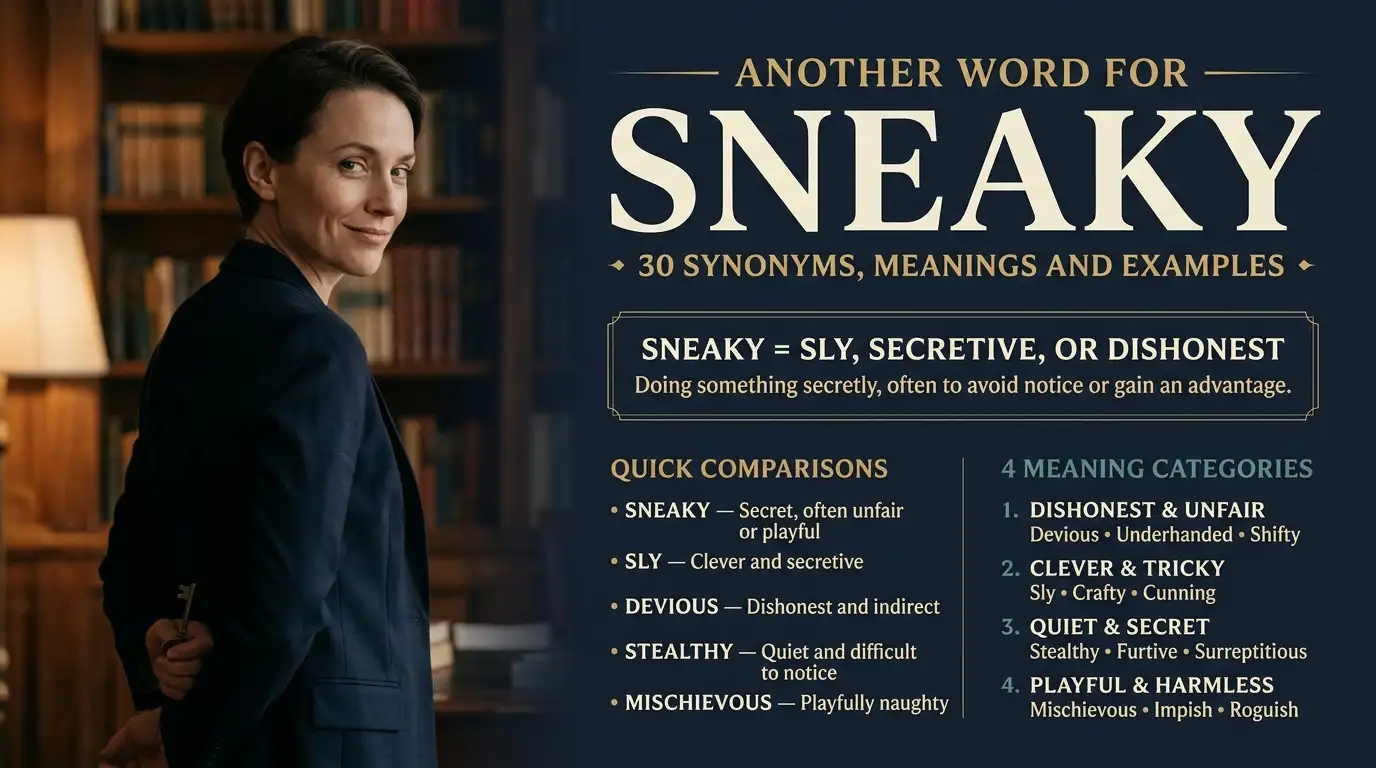
30 Another Word for Sneaky: Synonyms, Meanings and Examples
The closest everyday alternatives to “sneaky” are sly, crafty, and devious. For quiet, hidden movement, use stealthy or furtive. For dishonest or unfair behavior, underhanded and deceitful fit better, and for a harmless trick, mischievous is a good choice.
The best alternative depends on what “sneaky” means in your sentence. It can mean dishonest, quiet and hard to notice, playfully secret, or a feeling you do not openly admit. Some of these meanings are negative, and others are light and friendly, so the right word depends on the tone.
Quick list: sly, crafty, cunning, devious, underhanded, deceitful, stealthy, furtive, surreptitious, shifty
This article looks at 30 alternatives. Each has a definition, IPA, a usage note, and an example, so you can match the word to the situation.
At a Glance: Sneaky Synonyms and Related Alternatives
| Alternative | Part of Speech | Meaning | Register / Tone | Ideal Context |
| Sly | Adjective | Clever at tricking or hiding things | Neutral, can be playful | Everyday speech, stories |
| Crafty | Adjective | Clever at getting what you want, often by tricks | Neutral, mild | Plans, animals, characters |
| Devious | Adjective | Using dishonest or indirect methods | Negative | Tricks, plans, people |
| Underhanded | Adjective | Dishonest, secret, and unfair | Negative | Business, games, politics |
| Deceitful | Adjective | Willing to lie or mislead | Strongly negative | Lies, fraud, betrayal |
| Stealthy | Adjective | Quiet and careful so as not to be noticed | Neutral | Movement, animals, spies |
| Furtive | Adjective | Secret and quick, as if guilty | Neutral to negative | Looks, glances, movements |
| Surreptitious | Adjective | Done secretly to avoid being noticed | Formal | Actions, calls, messages |
| Shifty | Adjective | Looking dishonest or hard to trust | Informal, negative | People, eyes, behavior |
| Mischievous | Adjective | Playfully naughty | Light, friendly | Children, pets, jokes |
Which Word Should You Use?
| If you want to… | Use | Why |
| Describe a clever person who is a little tricky | Sly | It is simple, common, and can be playful. |
| Describe someone who uses dishonest plans | Devious | It clearly points to dishonest, indirect methods. |
| Describe unfair methods in business or sports | Underhanded | It suggests secret and unfair behavior. |
| Describe quiet movement that avoids being heard | Stealthy | It is neutral and describes careful, quiet action. |
| Describe a nervous or guilty look | Furtive | It shows quick, secret, guilty behavior. |
| Describe a secret act in formal writing | Surreptitious | It sounds formal and fits actions done quietly. |
| Describe a harmless, playful trick | Mischievous | It keeps the tone light and friendly. |
| Describe a doubt you cannot explain | Nagging | It fits a feeling that keeps coming back. |
Exploring the Multiple Meanings of “Sneaky”
1. Dishonest or Unfair
- Meaning: Acting in a secret, dishonest, or unfair way to get what you want.
- Explanation: This is the most common negative sense. It describes tricks, plans, and people that do not play fair.
- Example: Hiding the extra fee was a sneaky move.
2. Quiet and Stealthy
- Meaning: Moving or acting quietly so that other people do not notice.
- Explanation: This literal sense can be neutral or even admiring, especially for animals and spies.
- Example: The cat took a sneaky path along the fence.
3. Playfully Secret
- Meaning: Done in secret in a light, playful way, often as a small guilty pleasure.
- Explanation: Common in everyday speech, as in “a sneaky snack” or “a sneaky peek.” The tone is friendly, not harmful.
- Example: I took a sneaky look at my birthday gift.
4. Not Openly Admitted
- Meaning: Describes a feeling or suspicion that you have but do not openly show or cannot fully explain.
- Explanation: This sense appears in phrases like “a sneaky feeling.” The more common form of the phrase is “a sneaking suspicion.”
- Example: I have a sneaky feeling that he already knows.
Sources: Merriam-Webster (sneaky); Collins English Dictionary (sneaky); Dictionary.com (sneaky); Etymonline (sneaky, sneak)
Analyzing 30 Sneaky Alternatives in Detail
Some alternatives below are close synonyms of “sneaky,” while others are related words that fit only one meaning, such as dishonesty, quiet movement, or playfulness.
Everyday Synonyms for Sly and Tricky
1. Sly
IPA: (US and UK) /slaɪ/
Definition: Clever at tricking others or at keeping secrets; also playfully secretive.
- Usage: The closest everyday synonym. It can be negative or playful, as in “a sly smile.”
- Example: He gave a sly smile and hid the cookie behind his back.
2. Crafty
IPA: US /ˈkræfti/ · UK /ˈkrɑːfti/
Definition: Clever at getting what you want, often by using tricks.
- Usage: A close synonym that is milder than “devious.” It often shows some admiration for the person’s cleverness.
- Example: The crafty fox found a way into the henhouse.
3. Cunning
IPA: (US and UK) /ˈkʌnɪŋ/
Definition: Clever in a sly way, especially at deceiving others.
- Usage: A close synonym that is stronger than “crafty.” It stresses skill at trickery.
- Example: She made a cunning plan to win the game.
4. Devious
IPA: (US and UK) /ˈdiːviəs/
Definition: Willing to use dishonest or indirect methods.
- Usage: A close synonym that is more clearly dishonest than “sly.” It also means winding, as in “a devious route,” which is a different meaning.
- Example: He used a devious trick to get the password.
5. Wily
IPA: (US and UK) /ˈwaɪli/
Definition: Clever in a sly way, especially at avoiding traps or problems.
- Usage: A close synonym that sounds a little old-fashioned. It is common in stories and in descriptions of animals or leaders.
- Example: The wily thief escaped through a small window.
6. Tricky
IPA: (US and UK) /ˈtrɪki/
Definition: Clever at tricking people; also difficult to deal with.
- Usage: A related informal alternative. For people it points to trickery, but the word more often means “difficult,” so the context must be clear.
- Example: He is a tricky salesman, so read the contract carefully.
Dishonest and Deceitful Words
7. Underhanded
IPA: US /ˌʌndərˈhændɪd/ · UK /ˌʌndəˈhændɪd/
Definition: Dishonest, secret, and unfair.
- Usage: A close synonym for the unfair sense. It is common in business, sports, and politics. British English often uses “underhand.”
- Example: Hiding the fee from customers was an underhanded move.
8. Deceitful
IPA: (US and UK) /dɪˈsiːtfəl/
Definition: Willing to lie or mislead others.
- Usage: A related alternative that is much stronger. “Sneaky” can be mild, but “deceitful” suggests serious dishonesty.
- Example: The deceitful agent hid the real price from buyers.
9. Duplicitous
IPA: US /duːˈplɪsɪtəs/ · UK /djuːˈplɪsɪtəs/
Definition: Deceitful by saying or doing two different things.
- Usage: A related formal alternative. It points to a person who pretends one thing and does another.
- Example: Her duplicitous behavior cost her many friends.
10. Conniving
IPA: (US and UK) /kəˈnaɪvɪŋ/
Definition: Secretly planning to do something dishonest or harmful.
- Usage: A related negative alternative for people who plot. It suggests planning, not just a quick trick.
- Example: The conniving manager plotted to get his rival fired.
11. Scheming
IPA: (US and UK) /ˈskiːmɪŋ/
Definition: Making secret plans to gain an advantage.
- Usage: A related alternative that focuses on planning and plots. It is stronger than “sneaky.”
- Example: The scheming uncle wanted to take the whole farm.
12. Treacherous
IPA: (US and UK) /ˈtrɛtʃərəs/
Definition: Betraying trust; also dangerous in a hidden way.
- Usage: A related and much stronger alternative. It means betrayal, which “sneaky” does not always mean. It also describes dangerous roads or water.
- Example: His treacherous friend told the secret to the press.
Stealthy and Secret Words
13. Stealthy
IPA: (US and UK) /ˈstɛlθi/
Definition: Done quietly and carefully so as not to be noticed.
- Usage: A close synonym for the quiet sense. It is neutral and does not suggest dishonesty.
- Example: The cat made a stealthy approach to the bird.
14. Furtive
IPA: US /ˈfɜːrtɪv/ · UK /ˈfɜːtɪv/
Definition: Secret and quick, as if guilty or afraid of being caught.
- Usage: A close synonym for glances and movements. It adds a feeling of guilt or nervousness.
- Example: He took a furtive look at the exam paper.
15. Surreptitious
IPA: US /ˌsɜːrəpˈtɪʃəs/ · UK /ˌsʌrəpˈtɪʃəs/
Definition: Done secretly to avoid being noticed or stopped.
- Usage: A close formal synonym for secret actions, such as calls, looks, and messages.
- Example: She made a surreptitious call during class.
16. Clandestine
IPA: (US and UK) /klænˈdɛstɪn/
Definition: Kept secret, often because it is not allowed.
- Usage: A related formal alternative for plans, meetings, and operations. It is stronger and more serious than “sneaky.”
- Example: The two leaders held a clandestine meeting.
17. Covert
IPA: US /ˈkoʊvɜːrt/ · UK /ˈkəʊvɜːt/
Definition: Not openly shown or admitted.
- Usage: A related formal alternative for operations and actions. Its opposite is “overt.”
- Example: The agency ran a covert operation.
18. Secretive
IPA: (US and UK) /ˈsiːkrətɪv/
Definition: Tending to hide things or not share information.
- Usage: A related alternative that describes a person’s habit, not a trick. A secretive person is not always dishonest.
- Example: He is secretive about his past.
Shifty and Hard-to-Trust Words
19. Shifty
IPA: (US and UK) /ˈʃɪfti/
Definition: Looking dishonest or hard to trust.
- Usage: A close informal synonym that focuses on appearance and behavior, as in “shifty eyes.”
- Example: The shifty salesman would not meet my eyes.
20. Shady
IPA: (US and UK) /ˈʃeɪdi/
Definition: Informal word for seeming dishonest or illegal.
- Usage: A related informal alternative, common for deals, people, and places. It also means “giving shade,” which is a different meaning.
- Example: He was involved in some shady deals.
21. Slippery
IPA: (US and UK) /ˈslɪpəri/
Definition: Hard to trust or pin down; clever at avoiding blame.
- Usage: A related informal alternative for people who avoid giving a direct answer. It also means “smooth and wet.”
- Example: The slippery politician never gave a direct answer.
22. Evasive
IPA: (US and UK) /ɪˈveɪsɪv/
Definition: Avoiding giving a clear or direct answer.
- Usage: A related alternative for words and answers. It points to hiding the truth by not answering.
- Example: Her evasive answers made us suspicious.
23. Cagey
IPA: (US and UK) /ˈkeɪdʒi/
Definition: Unwilling to give information; careful and secretive.
- Usage: A related informal alternative. It is milder than “devious” and suits someone who is being careful.
- Example: He was cagey about his plans for the summer.
Playful and Mischievous Words
24. Mischievous
IPA: (US and UK) /ˈmɪstʃɪvəs/
Definition: Playfully naughty; causing small trouble.
- Usage: A related alternative for the playful sense. It keeps the tone light and friendly.
- Example: The mischievous boy hid his sister’s shoes.
25. Impish
IPA: (US and UK) /ˈɪmpɪʃ/
Definition: Playfully naughty, like an imp.
- Usage: A related, affectionate alternative. It suits smiles, looks, and small jokes.
- Example: She gave an impish grin.
26. Roguish
IPA: US /ˈroʊɡɪʃ/ · UK /ˈrəʊɡɪʃ/
Definition: Playfully naughty or charmingly dishonest.
- Usage: A related, slightly literary alternative. It suggests charm, unlike the serious word “rogue.”
- Example: He had a roguish smile.
Hidden or Not Obvious
27. Insidious
IPA: (US and UK) /ɪnˈsɪdiəs/
Definition: Slowly and quietly harmful, in a way that is hard to notice.
- Usage: A related alternative for things such as diseases, problems, and ideas. It is not used for playful tricks.
- Example: The insidious damage spread under the floor.
28. Subtle
IPA: (US and UK) /ˈsʌtl/
Definition: Not obvious; delicate or clever in a quiet way.
- Usage: A related alternative that is neutral or positive. It fits quiet methods that are not harmful.
- Example: The store used subtle ways to guide shoppers.
29. Secret
IPA: (US and UK) /ˈsiːkrɪt/
Definition: Kept hidden from others.
- Usage: A related alternative for hidden feelings and plans. It is plainer and has no suggestion of guilt.
- Example: She had a secret hope of winning.
30. Nagging
IPA: (US and UK) /ˈnæɡɪŋ/
Definition: Continually worrying or annoying.
- Usage: A related alternative only for the “feeling” sense, as in “a sneaky suspicion.” It does not describe tricks or secret acts.
- Example: She had a nagging doubt about the plan.
Sources: Merriam-Webster; Collins English Dictionary; Dictionary.com; Oxford Learner’s Dictionaries; Cambridge Dictionary
Sneaky vs. Sly vs. Devious vs. Furtive vs. Stealthy
These words overlap, but each one points to a different part of the idea. Etymonline records the adjective “sneaky” in 1833 with the meaning of rather mean and stealthy.
| Word | Main Idea | Tone | Example |
| Sneaky | Secret, often unfair or playful | Informal, mild to negative | That was a sneaky trick. |
| Sly | Clever and secretive | Neutral, can be playful | She gave a sly smile. |
| Devious | Dishonest and indirect | Negative | He used a devious plan. |
| Furtive | Quick, secret, and guilty | Neutral to negative | He took a furtive glance. |
| Stealthy | Quiet and careful | Neutral | The cat was stealthy. |
“Sneaky” is informal and works for many situations. “Sly” adds cleverness, “devious” adds dishonest planning, “furtive” adds guilt and nerves, and “stealthy” stresses quiet movement without suggesting dishonesty.
Sources: Etymonline (sneaky); Merriam-Webster (sneaky, sly, devious, furtive, stealthy); Collins English Dictionary (sneaky)
Sneaky and Opposite/Paired Word Pairs
| Word | Paired Word | Note |
| Sneaky | Honest | The clearest opposite for the dishonest sense. |
| Sneaky | Open | The opposite for hidden behavior. |
| Sneaky | Straightforward | The opposite of indirect methods. |
| Sneaky | Upfront | An informal opposite for someone who says things openly. |
| Sneaky | Transparent | The opposite when actions are clear to everyone. |
| Sneaky | Trustworthy | The opposite for people you cannot rely on. |
| Sneaky | Sly | A common pair, as in “sly and sneaky.” |
“Sneaky” has several opposites because it has several meanings. For dishonest behavior, “honest” and “trustworthy” fit. For hidden behavior, “open” and “transparent” fit.
Sources: Merriam-Webster Thesaurus; Collins Thesaurus; Dictionary.com (sneaky, antonyms)
Common Word Partners of “Sneaky”
| Pattern | Common Partners | Example |
| sneaky + noun | trick, move, tactic, plan, way, look, smile | That was a sneaky move. |
| a sneaky + informal noun | peek, glance, snack, look | I had a sneaky peek at the results. |
| sneaky + person | person, thief, kid, little | A sneaky thief took the bag. |
| adverb + sneaky | pretty, really, a bit, rather | That was a bit sneaky. |
| it is sneaky of + person to | hide, take, read, listen | It was sneaky of her to read my messages. |
| sneakily + verb | add, slip, take, move | He sneakily added another cookie to his plate. |
| sneaking + suspicion / feeling | a sneaking suspicion, a sneaking feeling | I have a sneaking suspicion that he knows. |
Sources: Oxford Learner’s Dictionaries (sneaky); Collins English Dictionary (sneaky); Cambridge Dictionary (sneaky); Merriam-Webster (sneaky)
Idiomatic Phrases Featuring “Sneaky”
“Sneaky” has few true idioms. The three items below are established expressions and terms.
1. Sneaky Pete
- Meaning: A slang term for cheap liquor. Etymonline records it in 1949. It is old-fashioned and now rare.
- Example: The old bar once sold something it called Sneaky Pete.
2. A sneaky suspicion
- Meaning: A quiet feeling that something is true, though you have no proof. The more common form is “a sneaking suspicion.”
- Example: I have a sneaky suspicion that the surprise party is tonight.
3. A sneaky peek
- Meaning: An informal phrase for a quick, secret look at something. The more common forms are “sneak peek” and “sneak preview.”
- Example: She took a sneaky peek at the final scene before the show.
Sources: Etymonline (sneaky, sneak); Merriam-Webster (sneak peek, sneaking suspicion); Collins English Dictionary (sneaky)
Word Formation of “Sneaky”
Etymology & Structure
“Sneaky” is formed from the verb “sneak” plus the ending “-y,” which makes adjectives. “Sneak” may come from a dialect survival of Middle English sniken, meaning to creep or crawl, from about 1200. That word comes from Old English snican, meaning to creep along, and from Proto-Germanic sneikanan, which is related to the roots of “snail” and “snake.”
Date and History
The adjective “sneaky” is recorded in 1833. The related form “sneakish” is recorded in 1864. The verb “sneak” is recorded in the 1550s, and the phrase “sneak up on” is recorded by 1869. As an adjective for feelings and suspicions, meaning not openly stated, “sneak” is recorded from 1748.
Word Class Variations
- Adjective: sneaky (sneakier, sneakiest); sneakish (rare)
- Adverb: sneakily
- Noun: sneakiness; sneak (a person who sneaks)
- Verb: sneak, sneaks, sneaked or snuck (snuck is informal and common in American English), sneaking
Sources: Etymonline (sneaky, sneak); Merriam-Webster (sneaky, sneak); Collins English Dictionary (sneaky)
Common Word-Choice Mistakes
- He is a sneak person: He is a sneaky person. (Use the adjective before a noun.)
- He walked sneaky across the room: He walked sneakily across the room. (Use an adverb to describe the action.)
- I was surprised by the sneaky of the plan: I was surprised by the sneakiness of the plan.
- The ninja moved in a sneaky way, which was impressive: The ninja moved in a stealthy way. (“Stealthy” is neutral, while “sneaky” often suggests dishonesty.)
- The kids planned a deceitful surprise party: The kids planned a sneaky surprise party. (“Deceitful” is too serious for a harmless secret.)
- She made a sneaky suspicion: She had a sneaking suspicion.
- The treacherous cat stole a fish: The sneaky cat stole a fish. (“Treacherous” means betraying trust.)
FAQs
What is the closest synonym for “sneaky”?
“Sly” is the closest everyday synonym. “Devious” is closer when the person is dishonest.
What is another word for sneaky meaning stealthy?
“Stealthy,” “furtive,” and “surreptitious” fit. “Stealthy” is neutral, “furtive” suggests guilt, and “surreptitious” is more formal.
What is another word for sneaky meaning dishonest?
“Devious,” “underhanded,” “deceitful,” and “duplicitous” are common. “Deceitful” and “duplicitous” are stronger.
What is another word for sneaky meaning playful?
“Mischievous,” “impish,” and “roguish” fit. They keep the tone light and friendly.
What is the difference between sneaky and sly?
“Sly” stresses cleverness and can be playful. “Sneaky” is more informal and often suggests secret or unfair behavior.
What is the difference between sneaky and stealthy?
“Stealthy” is about quiet, careful movement and does not suggest dishonesty. “Sneaky” often suggests that the action is not allowed or not fair.
What is a formal alternative to “sneaky”?
“Surreptitious,” “clandestine,” “covert,” and “duplicitous” are formal choices. Pick by meaning, since each one has a narrower use.
Can “sneaky” describe a person?
Yes. It can describe a person, an action, a plan, a look, or a feeling.
Is “sneaky” always negative?
No. It is negative for dishonest behavior, but it can be playful, as in “a sneaky snack” or “a sneaky peek.”
What is the opposite of “sneaky”?
“Honest,” “open,” “straightforward,” and “transparent” are common opposites. The best choice depends on the meaning.
Conclusion
The closest alternatives to “sneaky” are “sly,” “crafty,” and “devious.” For dishonest behavior, “underhanded” and “deceitful” fit, and for quiet movement, “stealthy” and “furtive” work well. For a light, playful tone, “mischievous” and “impish” are good choices.
Context matters because “sneaky” ranges from harmless to harmful. It can mean dishonest, quiet and hard to notice, playfully secret, or a feeling you do not openly admit. A word that fits one meaning, such as “treacherous,” may be too strong for another.
To choose the right word, first decide whether the action is dishonest, quiet, playful, or only a feeling. Use “devious” or “underhanded” for unfair plans, “stealthy” for quiet movement, “mischievous” for a harmless trick, and “nagging” for a doubt you cannot explain. If you need a plain, widely understood word, “sneaky” or “sly” is usually enough.
Discover More Article

Hy, Rose is a professional content writer with 3 years of experience creating engaging, informative, and SEO-friendly content. She specializes in crafting clear, reader-focused articles that deliver value, improve online visibility, and help websites grow.