30 Another Word for Disrespectful: Synonyms With Meaning & Examples
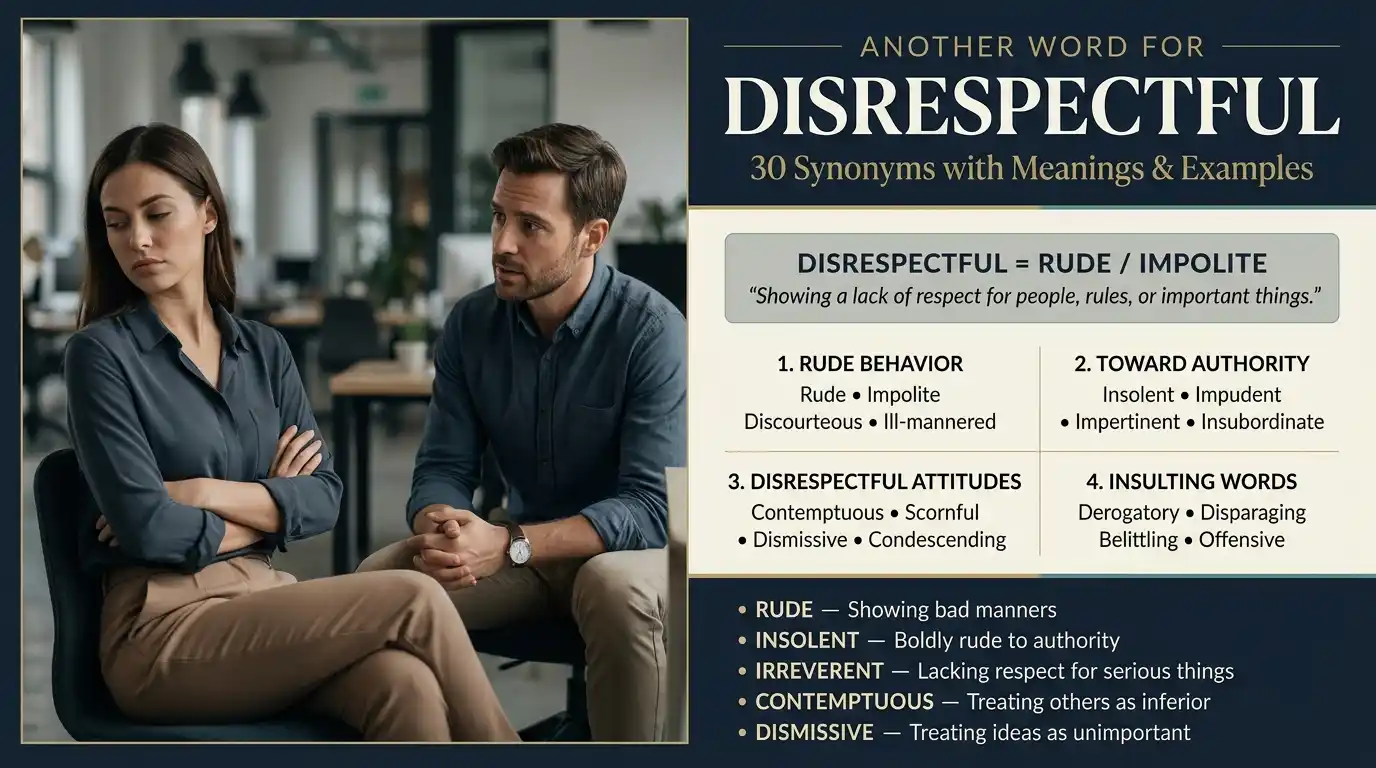
The closest everyday alternatives to “disrespectful” are rude, impolite, and discourteous. If someone is disrespectful to a person in charge, insolent or impertinent can fit better. For disrespect toward serious or holy things, irreverent is the usual choice.
The best alternative depends on who or what is being treated without respect. “Disrespectful” can describe bad manners, defiance of authority, a joke about something serious, a belittling attitude, or a lack of care for someone’s time and feelings. Each of these has its own best word.
Quick list: rude, impolite, discourteous, insolent, impertinent, irreverent, contemptuous, dismissive, inconsiderate, derogatory
This article looks at 30 alternatives. Each has a definition, IPA, a usage note, and an example, so you can match the word to the situation.
At a Glance: Disrespectful Synonyms and Related Alternatives
| Alternative | Part of Speech | Meaning | Register / Tone | Ideal Context |
| Rude | Adjective | Not polite; showing bad manners | Neutral, everyday | Daily behavior, speech |
| Impolite | Adjective | Not showing good manners | Neutral, mild | Etiquette, social situations |
| Discourteous | Adjective | Lacking courtesy | Formal | Service, business, complaints |
| Insolent | Adjective | Boldly rude to someone of higher rank | Formal, strong | Students, workers, children |
| Impertinent | Adjective | Rudely overstepping what is proper | Formal, slightly old-fashioned | Remarks, questions |
| Irreverent | Adjective | Not respecting what is usually taken seriously | Neutral to formal | Jokes, traditions, ceremonies |
| Contemptuous | Adjective | Showing that you think someone is worthless | Strong | Attitudes, looks, tone |
| Dismissive | Adjective | Treating something as unimportant | Neutral | Ideas, concerns, opinions |
| Inconsiderate | Adjective | Not thinking about others’ needs | Neutral, mild | Noise, lateness, shared spaces |
| Derogatory | Adjective | Showing a low opinion; insulting | Formal | Remarks, terms, comments |
Which Word Should You Use?
| If you want to… | Use | Why |
| Say someone has bad manners in a simple way | Rude | It is the most common and easiest word. |
| Describe poor behavior in a formal or business setting | Discourteous | It sounds measured and professional. |
| Describe a child or student who answers back boldly | Insolent (or cheeky if it is light) | It suggests boldness toward someone in charge. |
| Describe an employee who refuses orders | Insubordinate | It points to disobeying authority, not only bad manners. |
| Describe jokes about serious or holy things | Irreverent (or sacrilegious if holy) | It names the lack of respect for something serious. |
| Describe someone who acts as if others are beneath them | Contemptuous | It shows a strong attitude of looking down on people. |
| Describe someone who ignores another person’s ideas | Dismissive | It shows the ideas were treated as unimportant. |
| Describe an insulting comment about a person or group | Derogatory | It fits words and remarks that show a low opinion. |
Exploring the Multiple Meanings of “Disrespectful”
1. Rude or Impolite Toward a Person
- Meaning: Showing a lack of respect for someone; rude.
- Explanation: This is the most common sense. It applies to speech, tone, and behavior, such as interrupting or ignoring someone.
- Example: It is disrespectful to ignore someone who is speaking to you.
2. Lacking Respect for Authority
- Meaning: Showing a lack of respect for a person in charge, such as a teacher, parent, or boss.
- Explanation: This sense often involves talking back, mocking, or ignoring rules. It is the sense most often used about children, students, and workers.
- Example: The student was sent out of class for being disrespectful to the teacher.
3. Irreverent Toward Serious or Sacred Things
- Meaning: Showing a lack of respect for something serious, holy, or valued.
- Explanation: This sense covers traditions, symbols, ceremonies, and the dead. Here the object is not a person but something that deserves care.
- Example: Laughing during the ceremony was disrespectful to the family.
4. Contemptuous or Belittling
- Meaning: Treating someone as unimportant or not worth attention.
- Explanation: This kind of disrespect is not always loud. An eye roll, a sneer, or a cold tone can all be disrespectful.
- Example: Her disrespectful tone made the new worker feel small.
5. Inconsiderate of Time, Feelings, or Boundaries
- Meaning: Not caring about another person’s time, feelings, or limits.
- Explanation: In modern English, people often say that something is “disrespectful of my time” or “of my feelings.” This is a milder sense than open rudeness.
- Example: Arriving an hour late without a call is disrespectful of everyone’s time.
Sources: Merriam-Webster (disrespectful); Collins English Dictionary (disrespectful); Dictionary.com (disrespectful); Etymonline (disrespectful)
Analyzing 30 Disrespectful Alternatives in Detail
Some alternatives below are close synonyms of “disrespectful,” while others are related words that fit only one sense, such as defiance, mockery, or carelessness.
Everyday Words for Rude Behavior
1. Rude
IPA: (US and UK) /ruːd/
Definition: Not polite; showing bad manners.
- Usage: The closest everyday synonym. “Rude” is about bad manners in general, while “disrespectful” stresses a lack of respect for a person’s worth or position.
- Example: It was rude to answer your phone during dinner.
2. Impolite
IPA: (US and UK) /ˌɪmpəˈlaɪt/
Definition: Not showing good manners.
- Usage: A close synonym that is milder than “rude.” It suits small social mistakes.
- Example: It is impolite to talk with your mouth full.
3. Discourteous
IPA: US /dɪsˈkɜːrtiəs/ · UK /dɪsˈkɜːtiəs/
Definition: Showing a lack of courtesy or good manners.
- Usage: A formal synonym. It is common in complaints about service and in business writing.
- Example: The customer complained about discourteous staff.
4. Uncivil
IPA: (US and UK) /ʌnˈsɪvl/
Definition: Not polite; failing to follow the usual rules of respectful behavior.
- Usage: A formal synonym that Etymonline lists among the meanings of “disrespectful.” It is often used for public debate and meetings.
- Example: The meeting turned uncivil when two members began shouting.
5. Ill-mannered
IPA: US /ˌɪl ˈmænərd/ · UK /ˌɪl ˈmænəd/
Definition: Having bad manners.
- Usage: A related alternative that describes a person’s habits more than one act.
- Example: His ill-mannered remarks upset the host.
6. Uncouth
IPA: (US and UK) /ʌnˈkuːθ/
Definition: Lacking good manners or refinement; coarse.
- Usage: A related alternative that stresses rough or crude behavior. It can sound a little snobbish.
- Example: Some guests thought his loud jokes were uncouth.
Disrespect Toward Authority
7. Insolent
IPA: (US and UK) /ˈɪnsələnt/
Definition: Boldly rude, especially toward someone of higher rank.
- Usage: A close synonym for the authority sense. It is stronger than “rude.”
- Example: The student gave an insolent answer to the teacher.
8. Impudent
IPA: (US and UK) /ˈɪmpjədənt/
Definition: Shamelessly bold and rude.
- Usage: A close, formal, slightly old-fashioned synonym. It adds the idea of having no shame.
- Example: The impudent boy stuck out his tongue at the guard.
9. Impertinent
IPA: US /ɪmˈpɜːrtnənt/ · UK /ɪmˈpɜːtɪnənt/
Definition: Rude by not showing proper respect, especially by being too bold.
- Usage: A close synonym for remarks and questions that go too far. In formal writing it can also mean “not relevant,” which is a different meaning.
- Example: She apologized for her impertinent question.
10. Insubordinate
IPA: US /ˌɪnsəˈbɔːrdnət/ · UK /ˌɪnsəˈbɔːdɪnət/
Definition: Refusing to obey authority.
- Usage: A related alternative for the workplace, school, or military. It describes disobeying orders, not only bad manners.
- Example: The worker was fired for insubordinate behavior.
11. Cheeky
IPA: (US and UK) /ˈtʃiːki/
Definition: Slightly rude in a bold or playful way.
- Usage: A related informal word, common in British English. It is milder and can be affectionate, so it is not right for serious disrespect.
- Example: The cheeky child asked for a second dessert.
12. Defiant
IPA: (US and UK) /dɪˈfaɪənt/
Definition: Openly refusing to obey or accept authority.
- Usage: A related alternative that is about resistance, not bad manners. Depending on the situation, it can sound brave instead of rude.
- Example: The teenager gave her parents a defiant look.
Irreverent Toward Serious or Sacred Things
13. Irreverent
IPA: (US and UK) /ɪˈrɛvərənt/
Definition: Lacking respect for things that are usually treated seriously.
- Usage: A close synonym for the “serious things” sense. Etymonline lists it among the meanings of “disrespectful.” It can also describe humor that is playful, not hurtful.
- Example: The comedian is known for his irreverent jokes.
14. Flippant
IPA: (US and UK) /ˈflɪpənt/
Definition: Not showing proper seriousness or respect about something serious.
- Usage: A related alternative that suggests a careless, joking attitude. It is often used for comments and replies.
- Example: Her flippant reply made the situation worse.
15. Sacrilegious
IPA: US /ˌsækrəˈlɪdʒəs/ · UK /ˌsækrɪˈlɪdʒəs/
Definition: Showing disrespect for something holy.
- Usage: A related, strong alternative for sacred places, objects, or beliefs. It is sometimes used in jest for small things.
- Example: Damaging the old temple was seen as sacrilegious.
16. Blasphemous
IPA: (US and UK) /ˈblæsfəməs/
Definition: Speaking about God or holy things with disrespect.
- Usage: A related religious term, narrower than “sacrilegious.” It usually describes words or art.
- Example: Some leaders called the film blasphemous.
Contemptuous or Dismissive Attitudes
17. Contemptuous
IPA: (US and UK) /kənˈtɛmptʃuəs/
Definition: Showing that you think someone or something is worthless.
- Usage: A related alternative that names a strong attitude, not just bad manners.
- Example: He gave the team a contemptuous look.
18. Scornful
IPA: US /ˈskɔːrnfəl/ · UK /ˈskɔːnfʊl/
Definition: Showing strong dislike and lack of respect for someone or something.
- Usage: A related alternative that is close to “contemptuous.” It is often shown by a laugh, a look, or a comment.
- Example: She gave a scornful laugh.
19. Dismissive
IPA: (US and UK) /dɪsˈmɪsɪv/
Definition: Showing that something or someone is unimportant or not worth attention.
- Usage: A related alternative for a quiet kind of disrespect, such as brushing off someone’s ideas.
- Example: He was dismissive of her ideas.
20. Condescending
IPA: US /ˌkɑːndɪˈsɛndɪŋ/ · UK /ˌkɒndɪˈsɛndɪŋ/
Definition: Acting as if you are better or smarter than other people.
- Usage: A related alternative for talking down to someone. It is about attitude, not about open rudeness.
- Example: Her condescending tone made the new hires feel small.
21. Mocking
IPA: US /ˈmɑːkɪŋ/ · UK /ˈmɒkɪŋ/
Definition: Making fun of someone or something in an unkind way.
- Usage: A related alternative that adds teasing or ridicule. A person can be disrespectful without mocking.
- Example: The crowd answered with mocking laughter.
Inconsiderate Behavior
22. Inconsiderate
IPA: (US and UK) /ˌɪnkənˈsɪdərət/
Definition: Not thinking about the feelings or needs of others.
- Usage: A close alternative for the “time, feelings, and boundaries” sense. It is milder and often means careless.
- Example: It was inconsiderate to play loud music late at night.
23. Thoughtless
IPA: (US and UK) /ˈθɔːtləs/
Definition: Not thinking about how your words or actions affect others.
- Usage: A related alternative that suggests a lack of thought, not a wish to hurt. It is milder than “disrespectful.”
- Example: Her thoughtless comment hurt his feelings.
24. Tactless
IPA: (US and UK) /ˈtæktləs/
Definition: Lacking skill in speaking or acting without upsetting others.
- Usage: A related alternative for careless words. A tactless person may not mean to show disrespect.
- Example: It was tactless to ask about her weight.
25. Boorish
IPA: US /ˈbʊrɪʃ/ · UK /ˈbʊərɪʃ/
Definition: Rude and rough in manner.
- Usage: A related alternative that describes a coarse, insensitive person. It is stronger than “inconsiderate.”
- Example: His boorish behavior at the party embarrassed his friends.
Insulting and Belittling Words
26. Derogatory
IPA: US /dɪˈrɑːɡətɔːri/ · UK /dɪˈrɒɡətri/
Definition: Showing a low opinion of someone or something; insulting.
- Usage: A close, formal alternative for remarks, terms, and comments. It is not normally used to describe a person.
- Example: The company apologized for the derogatory comment.
27. Disparaging
IPA: (US and UK) /dɪˈspærɪdʒɪŋ/
Definition: Speaking about someone in a way that shows you think they have little value.
- Usage: A related formal alternative for words. It suggests running someone or something down.
- Example: He made disparaging remarks about her work.
28. Belittling
IPA: (US and UK) /bɪˈlɪtlɪŋ/
Definition: Making someone or something seem less important.
- Usage: A related alternative that focuses on the effect on the other person.
- Example: Belittling a child’s efforts can hurt confidence.
29. Insulting
IPA: (US and UK) /ɪnˈsʌltɪŋ/
Definition: Speaking or acting in a way that offends or hurts someone.
- Usage: A close alternative that is more direct and stronger than “disrespectful.”
- Example: She found the question insulting.
30. Offensive
IPA: (US and UK) /əˈfɛnsɪv/
Definition: Causing anger, hurt, or insult.
- Usage: A related alternative with a wider meaning. Something can be offensive without being aimed at one person, and it can also mean unpleasant or, in sports, attacking.
- Example: The joke was offensive to many people.
Sources: Merriam-Webster; Collins English Dictionary; Dictionary.com; Oxford Learner’s Dictionaries; Cambridge Dictionary
Disrespectful vs. Rude vs. Insolent vs. Irreverent vs. Contemptuous
These words overlap, but each one points to a different kind of lack of respect. Etymonline defines “disrespectful” as showing disrespect or lacking respect, and lists “irreverent” and “uncivil” among its meanings.
| Word | Main Idea | Usually Directed At | Example |
| Disrespectful | Not showing respect | People, rules, traditions | He was disrespectful to his elders. |
| Rude | Bad manners | Anyone | It is rude to interrupt. |
| Insolent | Boldness toward a higher rank | A teacher, parent, or boss | The insolent reply shocked the class. |
| Irreverent | No respect for serious things | Ceremonies, symbols, traditions | The speech had an irreverent tone. |
| Contemptuous | Thinking someone is worthless | A person or group | He wore a contemptuous smile. |
“Rude” is about manners. “Disrespectful” is about not showing proper regard for a person or thing. A person can be rude by accident, but disrespect is usually about attitude. “Insolent” adds a sense of boldness toward authority, “irreverent” is about serious or sacred things, and “contemptuous” is about looking down on someone.
Sources: Etymonline (disrespectful); Merriam-Webster (disrespectful, rude, insolent); Collins English Dictionary (irreverent, contemptuous)
Disrespectful and Opposite/Paired Word Pairs
| Word | Paired Word | Note |
| Disrespectful | Respectful | The clearest opposite. |
| Disrespectful | Polite | The opposite for the manners sense. |
| Disrespectful | Courteous | A more formal opposite of “discourteous” and “disrespectful.” |
| Disrespectful | Deferential | Describes someone who shows respect by yielding to others. |
| Irreverent | Reverent | The opposite for serious or sacred things. |
| Insolent | Obedient | The opposite for the authority sense. |
| Disrespectful | Considerate | The opposite for the “time and feelings” sense. |
“Respectful” is the main opposite, but the best opposite changes with the meaning. For rude behavior, use “polite” or “courteous.”
Sources: Merriam-Webster Thesaurus; Collins Thesaurus; Dictionary.com (disrespectful)
Common Word Partners of “Disrespectful”
| Pattern | Common Partners | Example |
| disrespectful + noun | tone, behavior, attitude, remark, comment, language, gesture, treatment | She was upset by his disrespectful tone. |
| disrespectful + to / toward / of | to teachers, toward women, of tradition, of others | Their jokes were disrespectful of local traditions. |
| be / seem / come across as + disrespectful | seem disrespectful, come across as disrespectful | Checking your phone may come across as disrespectful. |
| adverb + disrespectful | deeply, extremely, openly, highly | The comment was deeply disrespectful. |
| it is disrespectful to + verb | interrupt, ignore, be late, talk over | It is disrespectful to talk over others. |
| verb + disrespectfully | speak, behave, treat, talk | Nobody should treat staff disrespectfully. |
Sources: Oxford Learner’s Dictionaries (disrespectful); Collins English Dictionary (disrespectful); Cambridge Dictionary (disrespectful); Merriam-Webster (disrespectful)
Idiomatic Phrases Featuring “Disrespectful”
The adjective “disrespectful” appears in few fixed phrases. The three expressions below use its root words “respect” and “disrespect” and are common in daily speech.
1. No disrespect
- Meaning: A phrase used to soften what you are about to say, usually before disagreeing. It is often said as “no disrespect, but…” or “I mean no disrespect.”
- Example: No disrespect, but I think the old plan worked better.
2. With all due respect
- Meaning: A polite phrase used before disagreeing with someone. It is recorded in the 1670s. It can sound sarcastic when the speaker does not mean it.
- Example: With all due respect, I don’t think that is correct.
3. Diss
- Meaning: An informal slang word meaning to show disrespect to someone, shortened from “disrespect.” It is more common in speech.
- Example: He felt dissed when nobody said hello.
Sources: Etymonline (respect, disrespect); Merriam-Webster (diss); Collins English Dictionary (disrespect)
Word Formation of “Disrespectful”
Etymology & Structure
“Disrespectful” has three parts: the prefix “dis-,” the base “respect,” and the ending “-ful.” The prefix “dis-” comes from Latin and can mean “not” or “the opposite of.” “Respect” entered English in the late 1300s from Old French and Latin respectus, which comes from respicere, meaning to look back at or consider. So the word describes someone who does not give proper regard.
Date and History
“Disrespectful” is recorded in the 1670s with the meaning of showing disrespect, being irreverent, or being uncivil. It was formed from “dis-” plus “respectful,” which is recorded in the 1580s. The noun “disrespect” is recorded in the 1630s and the verb in the 1610s. The slang form “diss” dates from about 1980.
Word Class Variations
- Adjective: disrespectful
- Adverb: disrespectfully
- Noun: disrespect; disrespectfulness
- Verb: disrespect, disrespects, disrespected, disrespecting
- Informal verb: diss
Sources: Etymonline (disrespectful, disrespect, respectful, dis-); Merriam-Webster (disrespectful); Collins English Dictionary (disrespectful)
Common Word-Choice Mistakes
- He is disrespect to his teacher: He is disrespectful to his teacher. (Use the adjective, not the noun.)
- She spoke disrespectful: She spoke disrespectfully. (Use the adverb to describe the action.)
- Disrespectful with elders: Disrespectful to (or toward) elders.
- My friend was insubordinate to me: My friend was disrespectful to me. (“Insubordinate” fits workplace or military authority.)
- Her cheeky behavior at the funeral upset everyone: Her disrespectful behavior at the funeral upset everyone. (“Cheeky” is playful and too light for a serious setting.)
- I feel disrespectful by my boss: I feel disrespected by my boss. (“Disrespected” is how you feel when someone treats you without respect.)
- He is a derogatory person: He is a rude person. (“Derogatory” describes words and remarks, not people.)
FAQs
What is the closest synonym for “disrespectful”?
“Rude” is the closest everyday synonym. “Impolite” is milder, and “discourteous” is more formal.
What is another word for disrespectful toward authority?
“Insolent,” “impertinent,” “impudent,” and “insubordinate” fit well. “Insubordinate” is best for refusing to obey orders.
What is another word for disrespectful toward sacred things?
“Irreverent” is the general word. “Sacrilegious” and “blasphemous” are stronger and are used for holy things.
What is the difference between disrespectful and rude?
“Rude” is about bad manners. “Disrespectful” is about not showing proper regard for someone or something. The two overlap a lot in daily speech.
What is the difference between disrespectful and insolent?
“Insolent” adds boldness toward someone of higher rank, such as a teacher or boss. “Disrespectful” is broader.
What is a formal alternative to “disrespectful”?
“Discourteous,” “uncivil,” “impertinent,” and “derogatory” are formal choices. Choose by meaning, not only by tone.
Can “disrespectful” describe words and actions as well as people?
Yes. You can say “a disrespectful tone,” “a disrespectful remark,” or “a disrespectful gesture.”
Is “disrespectful” always negative?
Usually, yes. What counts as disrespectful can change with culture and context, and “irreverent” or “defiant” can sometimes be seen in a positive way.
What is the opposite of “disrespectful”?
“Respectful” is the main opposite. “Polite,” “courteous,” and “deferential” fit narrower situations.
What is the verb form of “disrespectful”?
The verb is “disrespect,” as in “to disrespect someone.” In slang, “diss” is a shorter, informal form.
Conclusion
The closest alternatives to “disrespectful” are “rude,” “impolite,” and “discourteous.” For authority, “insolent” and “impertinent” fit well. For serious or holy things, “irreverent” is the usual choice, and for a looking-down attitude, “contemptuous” and “dismissive” work.
Context matters because “disrespectful” covers different kinds of behavior. It can mean bad manners, talking back, mocking something serious, belittling a person, or ignoring someone’s time. A word that fits one kind, such as “insubordinate” for orders, may not fit another.
To choose the right word, first decide who or what is being treated without respect. Use “rude” for manners, “insolent” or “insubordinate” for authority, “irreverent” for serious things, and “derogatory” for insulting words. If you want a simple, clear word, “disrespectful” or “rude” is usually enough.
Discover More Article

Hy, Sophia is a content writer with 3 years of experience creating engaging, informative, and SEO-friendly articles focused on synonyms, vocabulary, and word meanings.