Another Word for Do: 30 Synonyms, Meanings, and Examples
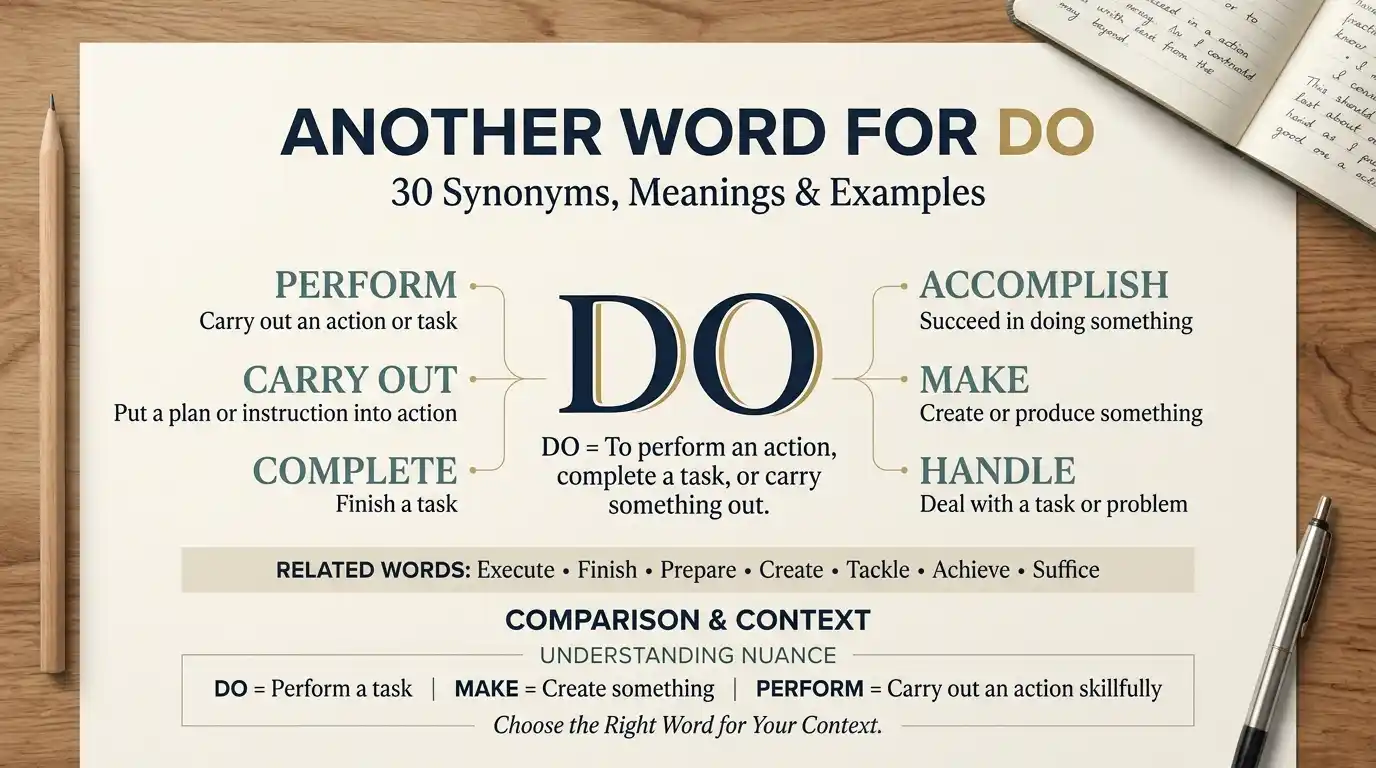
Another word for do depends on what you mean. For a plain action, perform and carry out are the closest everyday alternatives. Complete or finish fit when a task reaches its end, and handle or tackle fit when you deal with a problem. No single word replaces do everywhere, because it is one of the most flexible verbs in English.
Do can mean to carry out an action, to finish something, to make or prepare something, to be enough, or to get on well or badly. It also works as a helping verb (“Do you know?”), and that use has no true synonym. The alternatives below are grouped by these meanings.
Quick list: perform, carry out, complete, accomplish, make, handle, tackle, execute, undertake, suffice
This article looks at 30 alternatives. Each one has a meaning, IPA, a usage note, and an example. Some are direct synonyms of do, and others only work in certain contexts. Each entry says which.
At a Glance: Do Synonyms and Related Alternatives
| Alternative | Part of Speech | Meaning | Register / Tone | Ideal Context |
| Perform | Verb | Carry out an action or task | Neutral to formal | Duties, tests, skilled tasks |
| Carry out | Phrasal verb | Do a planned task or order | Neutral | Plans, instructions, studies |
| Execute | Verb | Put a plan or order into action | Formal | Plans, orders, strategies |
| Complete | Verb | Finish a task | Neutral | Forms, tasks, projects |
| Accomplish | Verb | Succeed in doing something | Neutral to formal | Goals, difficult tasks |
| Make | Verb | Create or produce | Neutral | Objects, meals, decisions |
| Handle | Verb | Deal with something | Neutral | Problems, tasks, people |
| Tackle | Verb | Start dealing with a hard task | Neutral, energetic | Problems, chores, challenges |
| Suffice | Verb | Be enough | Formal | Amounts, answers, explanations |
| Fare | Verb | Get on well or badly | Formal, slightly literary | Results, progress |
Which Word Should You Use?
| If you want to… | Use | Why |
| Describe doing a task in a neutral way | Carry out | It sounds natural and fits most tasks and instructions. |
| Follow a plan, order, or instruction | Execute | It stresses putting a decision into action. |
| Do something that needs skill or an audience | Perform | It fits skilled work, duties, and public shows. |
| Reach the end of a job | Complete or finish | They show the task is no longer unfinished. |
| Succeed at something difficult | Accomplish or achieve | They stress the result, not just the action. |
| Deal with a problem | Handle or tackle | They suggest managing or facing something. |
| Say something is enough | Suffice or serve | They match “That will do.” |
| Describe how someone is getting on | Fare | It matches “How did she do?” in careful writing. |
| Describe a wrong act | Commit | It is the usual verb with crimes and mistakes of conduct. |
Exploring the Multiple Meanings of “Do”
1. Carry Out an Action
- Meaning: To perform an act, task, or activity.
- Explanation: This is the main sense. Do is general and neutral, so it can stand for almost any action. Alternatives such as perform and carry out are more specific or more formal.
- Example: She did the work before lunch.
2. Finish or Complete
- Meaning: To bring a task to an end.
- Explanation: In this sense do often appears as done (“The report is done”). Complete and finish are the clearest alternatives.
- Example: I did my taxes last week.
3. Make, Prepare, or Arrange
- Meaning: To produce something or get it ready.
- Explanation: This sense is common with food, hair, and creative work. It is often informal. Many phrases only work with do and not with make, so the verbs are not always interchangeable.
- Example: He did a drawing of the old house.
4. Be Enough or Suitable
- Meaning: To meet a need or serve a purpose.
- Explanation: This sense appears in phrases like “That will do.” Suffice is the closest formal match, and serve works when the focus is use.
- Example: A small bag will do for the trip.
5. Get On or Fare
- Meaning: To progress or have a result, well or badly.
- Explanation: This sense usually comes with an adverb such as well or badly. It is often used in questions about how someone is getting on.
- Example: How did she do on the exam?
6. Helping Verb
- Meaning: A grammar word used in questions, negatives, and emphasis.
- Explanation: In “Do you like tea?” and “I do not know,” do has no lexical meaning, so no synonym can replace it. Do can also stand in for a verb already used (“She sings better than I do”).
- Example: I do want to help.
Sources: Etymonline, “do”; Merriam-Webster, “do”; Collins English Dictionary, “do”.
Analyzing 30 Do Alternatives in Detail
Some of these words are direct synonyms of do, while others only work in certain contexts. The usage notes say which is which.
Core Alternatives for Carrying Out an Action
1. Perform
IPA: US /pərˈfɔːrm/ · UK /pəˈfɔːm/
Definition: To carry out an action, task, or function.
- Usage: A close synonym of do in its main sense. It is more formal than do and suits skilled work, duties, and tests. It can also mean to give a show, which do does not usually mean.
- Example: Nurses perform many tasks during a single shift.
2. Carry out
IPA: /ˌkæri ˈaʊt/ (US and UK)
Definition: To do or complete something that has been planned or ordered.
- Usage: A close, neutral synonym. It fits plans, instructions, studies, and checks. It is less natural for small, casual actions, so “carry out the dishes” does not work.
- Example: The team will carry out the survey in May.
3. Execute
IPA: /ˈeksɪkjuːt/ (US and UK)
Definition: To put a plan, order, or action into effect.
- Usage: A formal synonym of do for plans, orders, and strategies. It is more specific than do and sounds stiff for everyday chores. It also has other senses, such as carrying out a legal sentence, so context matters.
- Example: The manager executed the plan exactly as written.
4. Conduct
IPA: /kənˈdʌkt/ (US and UK)
Definition: To organize and carry out an activity.
- Usage: A related alternative, not an exact synonym. It works with organized activities such as surveys, tests, interviews, and business. It does not work with everyday tasks like “conduct the laundry.”
- Example: Researchers conducted the experiment twice.
5. Undertake
IPA: US /ˌʌndərˈteɪk/ · UK /ˌʌndəˈteɪk/
Definition: To take on a task or responsibility and begin it.
- Usage: A formal, related alternative. It stresses accepting a task, often a large or serious one, rather than just doing it.
- Example: The city will undertake a major road repair this year.
Finishing and Achieving
6. Complete
IPA: /kəmˈpliːt/ (US and UK)
Definition: To finish making or doing something.
- Usage: A direct synonym for the “finish” sense of do. It is neutral and common in forms, tasks, and projects.
- Example: Please complete the form before you leave.
7. Accomplish
IPA: US /əˈkɑːmplɪʃ/ · UK /əˈkɒmplɪʃ/
Definition: To succeed in doing or finishing something.
- Usage: A related alternative that stresses success. It works with goals and difficult tasks, not small routines. You would not “accomplish the dishes.”
- Example: She accomplished more in one week than expected.
8. Achieve
IPA: /əˈtʃiːv/ (US and UK)
Definition: To reach a goal or result through effort.
- Usage: A related alternative, not an exact synonym. It focuses on the result and does not fit ordinary tasks. People achieve goals, results, and success, but they do not “achieve a task” in everyday speech.
- Example: The students achieved excellent scores.
9. Fulfill
IPA: /fʊlˈfɪl/ (US and UK; spelled fulfil in British English)
Definition: To carry out a duty, promise, or requirement.
- Usage: A related, fairly formal alternative. It fits promises, duties, roles, and needs. It is narrower than do.
- Example: He fulfilled his promise and returned the book.
10. Finish
IPA: /ˈfɪnɪʃ/ (US and UK)
Definition: To bring something to an end.
- Usage: A direct, everyday synonym for the “complete” sense of do. It is less formal than complete, and it can also mean to stop or to use up.
- Example: I will finish my homework after dinner.
Making and Preparing
11. Make
IPA: /meɪk/ (US and UK)
Definition: To create or produce something.
- Usage: A close synonym only in the “produce” sense of do. In many phrases the two verbs are not interchangeable, so you “do homework” but “make a decision.”
- Example: She made a cake for the party.
12. Produce
IPA: US /prəˈduːs/ · UK /prəˈdjuːs/
Definition: To make something or bring it into being.
- Usage: A related, more formal alternative. It fits goods, results, and creative work, and it is less natural for everyday actions.
- Example: The studio produces two films a year.
13. Prepare
IPA: US /prɪˈper/ · UK /prɪˈpeə/
Definition: To make something ready for use.
- Usage: A good alternative when do means to get something ready, as in “do dinner” or “do the report.” It is neutral and clear.
- Example: He prepared a short talk for the meeting.
14. Create
IPA: /kriˈeɪt/ (US and UK)
Definition: To bring something new into existence.
- Usage: A related alternative for the creative sense of do. It stresses making something new, so it is not a general replacement.
- Example: The artist created a mural for the school.
15. Style
IPA: /staɪl/ (US and UK)
Definition: To arrange or shape something, especially hair, in a chosen way.
- Usage: A context-specific alternative. It replaces do only in phrases like “do her hair.” It does not work as a general synonym.
- Example: She styled her hair before the interview.
Acting and Handling
16. Act
IPA: /ækt/ (US and UK)
Definition: To take action or behave in a certain way.
- Usage: A related alternative. It stresses doing something in response to a situation, often without naming the action. It does not take a direct object the way do does.
- Example: The staff must act quickly in an emergency.
17. Behave
IPA: /bɪˈheɪv/ (US and UK)
Definition: To act in a particular way, especially in front of others.
- Usage: A limited related alternative. It replaces do only when the focus is on how someone acts. It does not mean to perform a task.
- Example: The children behaved well during the trip.
18. Tackle
IPA: /ˈtækəl/ (US and UK)
Definition: To begin dealing with a hard task or problem with effort.
- Usage: A good alternative for do when the task is difficult or has been avoided. It sounds energetic and suggests facing a challenge.
- Example: We will tackle the garden this weekend.
19. Handle
IPA: /ˈhændl/ (US and UK)
Definition: To deal with or manage something.
- Usage: A close synonym when do means to take care of a task, problem, or person. It is neutral and common.
- Example: She handled the complaint calmly.
20. Engage in
IPA: /ɪnˈɡeɪdʒ ɪn/ (US and UK)
Definition: To take part in an activity.
- Usage: A related, fairly formal alternative. It fits activities, talks, and sports. It is wordier than do and sounds formal in casual speech.
- Example: Children should engage in physical activity every day.
Sufficing and Faring
21. Suffice
IPA: /səˈfaɪs/ (US and UK)
Definition: To be enough for a need or purpose.
- Usage: A direct, formal synonym for the “be enough” sense of do. It matches “That will do.”
- Example: A short note will suffice.
22. Serve
IPA: US /sɝːv/ · UK /sɜːv/
Definition: To be useful or suitable for a purpose.
- Usage: A related alternative to the “be suitable” sense of do. It suggests a use, as in “This will serve.”
- Example: An old box can serve as a table.
23. Fare
IPA: US /fer/ · UK /feə/
Definition: To get on or progress, well or badly.
- Usage: A direct but formal synonym for the “get on” sense of do. It is common with well, badly, and better. It is less common in everyday speech.
- Example: The team fared well in the second half.
24. Get by
IPA: /ɡet ˈbaɪ/ (US and UK)
Definition: To manage with limited means.
- Usage: A related, informal alternative. It matches the idea of make do, but it does not replace do in other senses.
- Example: They got by on very little money.
25. Work
IPA: US /wɝːk/ · UK /wɜːk/
Definition: To function well or be effective.
- Usage: A related, informal alternative to “That will do.” It stresses that something is effective, not just enough.
- Example: This plan should work for everyone.
Formal and Contextual Alternatives
26. Effect
IPA: /ɪˈfekt/ (US and UK)
Definition: To bring about a result or change.
- Usage: A formal, related alternative that is limited to results and changes. Do not confuse it with affect, which means to influence.
- Example: The new law will effect real change.
27. Commit
IPA: /kəˈmɪt/ (US and UK)
Definition: To do something wrong or illegal.
- Usage: A context-specific alternative. It replaces do only with crimes, errors of conduct, and similar acts. It is not a general synonym.
- Example: He committed a serious mistake.
28. Discharge
IPA: US /dɪsˈtʃɑːrdʒ/ · UK /dɪsˈtʃɑːdʒ/
Definition: To perform a duty or responsibility.
- Usage: A formal, narrow alternative. It fits duties, tasks, and obligations. It also has other senses, such as to release someone or something.
- Example: She discharged her duties with care.
29. Render
IPA: US /ˈrendər/ · UK /ˈrendə/
Definition: To give or provide a service or help.
- Usage: A formal, narrow alternative. It replaces do in phrases like “do a service” or “do a favor.” It does not suit routine actions.
- Example: The volunteers rendered help after the storm.
30. Enact
IPA: /ɪˈnækt/ (US and UK)
Definition: To make a law, or to act out a part or event.
- Usage: A formal, narrow alternative. It does not mean the general act of doing something.
- Example: The council will enact the new rule next month.
Sources: Merriam-Webster; Collins English Dictionary; Collins Thesaurus.
Do vs. Make vs. Perform
These three verbs are often confused. Do names an activity or task, make stresses creating or producing something, and perform is more formal and often implies skill or an audience.
| Word | Main Idea | Typical Partners | Example |
| Do | General activity or task | homework, the dishes, business, a favor | She did her homework. |
| Make | Creating or producing | a cake, a decision, a mistake, a plan | He made a decision. |
| Perform | Skilled or formal action | a task, an operation, a test, a play | The surgeon performed the operation. |
The choice is partly set by habit. You “do” a favor but “make” a mistake, and you “do” research but “make” progress.
Sources: Merriam-Webster, “do,” “make,” “perform”; Collins English Dictionary.
Do and Opposite/Paired Word Pairs
| Word | Paired Word | Note |
| Do | Undo | Undo reverses an action. |
| Do | Don’t | Used in “dos and don’ts,” meaning rules for what to do and avoid. |
| Do | Refrain from | A formal opposite of choosing to do something. |
| Do | Neglect | Means to fail to do something that should be done. |
| Say | Do | A common pair for words versus actions. |
| Do | Make | A contrast in use, not an opposite. |
Do has no single opposite. The nearest ideas are reversing an action (undo), choosing not to act (refrain from), and failing to act (neglect). The say–do and do–make pairs are contrasts that help learners.
Sources: Merriam-Webster; Collins English Dictionary.
Common Word Partners of “Do”
| Pattern | Common Partners | Example |
| do + household task | the dishes, the laundry, housework | I will do the dishes tonight. |
| do + school or work task | homework, research, a project | They did research for the report. |
| do + good or bad effect | good, harm, damage | Fresh air will do you good. |
| do + favor | someone a favor | Could you do me a favor? |
| do + exercise | exercise, yoga | She does yoga every morning. |
| do + appearance | your hair, your nails, makeup | He did her hair for the wedding. |
| do + effort | your best, your duty | Just do your best. |
| do + adverb | well, badly, better | The team did well this season. |
Sources: Merriam-Webster, “do”; Collins English Dictionary, “do.”
Idiomatic Phrases Featuring “Do”
1. Do away with
- Meaning: To get rid of something or end it.
- Example: The school decided to do away with the old rule.
2. Do or die
- Meaning: To make a final, serious effort when failure would be costly.
- Example: It was do or die for the team in the last game.
3. Make do
- Meaning: To manage with what you have, even if it is not ideal.
- Example: We had no table, so we made do with a box.
4. To-do
- Meaning: A fuss or commotion. As a compound, a “to-do list” is a list of tasks.
- Example: There was a big to-do over the missing keys.
Sources: Etymonline, “do,” “to-do”; Merriam-Webster; Collins English Dictionary.
Word Formation of “Do”
Etymology & Structure
Do comes from Old English dōn, meaning “make, act, perform, cause” and also “to put, to place.” It goes back to a West Germanic form and, further back, to the Proto-Indo-European root *dhe-, “to set, put, place.” Related forms in other Germanic languages include Dutch doen and German tun. The old sense “to put” survives in do away with, and the vestige of an old prefix survives in ado, which came from “much to do.”
Date and History
Do goes back to Old English, the earliest stage of the language. Use as a helping verb began in Middle English. Etymonline records the phrase have to do with from the late 13th century, do or die from the 1620s, and do without from 1713. The noun doing is recorded from the early 13th century, and to-do as “fuss” from the 1570s.
Word Class Variations
- Verb: do, does, did, done, doing (the past tense did comes from an old reduplicated form, and does from a Northumbrian variant)
- Noun: doing (“a thing done,” usually doings); do in British informal use for a party; doer
- Adjective: done (“finished”); doable
- Derived verbs: undo, redo, overdo, outdo
Sources: Etymonline, “do,” “does,” “doing,” “done,” “to-do.”
Common Word-Choice Mistakes
- Make homework: do homework.
- Do a mistake: make a mistake.
- Make a favor: do a favor.
- Do a decision: make a decision.
- Do a party: have, host, or throw a party.
- Perform your homework: do your homework (perform is too formal for everyday tasks).
- Accomplish the dishes: do the dishes (accomplish needs a goal, not a chore).
FAQs
What is the closest synonym for do?
Perform and carry out are the closest everyday synonyms when do means to carry out an action.
What is a formal alternative to do?
Execute, undertake, and discharge are formal choices, depending on the context.
What is the difference between do and make?
Do usually names an activity or task, while make usually means to create or produce. Many pairings are fixed, such as do homework and make a mistake.
What is the difference between do and perform?
Perform is more formal and often suggests skill or an audience. Do is general and used in everyday speech.
What is a casual alternative to do?
Take care of, handle, and get done are common informal options.
Which word can replace do in “That will do”?
Suffice is the closest formal match, and serve or work also fit.
Which word replaces do in “How did she do?”
Fare works in careful writing, as in “How did she fare?” In everyday speech people usually keep do.
Does do have an opposite?
Not a single one. Undo, refrain from, and neglect each cover a different idea.
Can do be replaced when it is a helping verb?
No. In “Do you like it?” it is a grammar word with no synonym.
Is does the same as do?
Does is the third-person singular present form of do, used with he, she, and it. According to Etymonline, it began as a Northumbrian variant.
Conclusion
The closest alternatives to do are perform and carry out, with complete and finish for ending a task. Handle and tackle fit problems, suffice fits “enough,” and fare fits how someone gets on. More formal choices include execute, undertake, and discharge.
Context decides the right word. Do is general, so its alternatives are narrower, and each one adds a shade of meaning. Some, like make and commit, work only with certain partners.
To choose, ask what do means in your sentence: carrying out, finishing, making, being enough, or getting on. Then pick the word that fits that meaning and the level of formality you need.
Discover More Article

Hello,I’m Natalia, a professional content writer with three years of experience. My niche is Another Word for, where I create clear, engaging, and SEO-friendly content about words, meanings, synonyms, phrases, and language. I turn complex word-related topics into simple, useful content for readers.