30 Another Word for War: Synonyms With Examples & Meaning
The most common another word for war is conflict. Warfare names the activity of fighting a war, combat and fighting describe the fighting itself, and hostilities is a formal word used in news and law. In everyday writing, these four are the safest choices.
The best alternative depends on size, scale, and context. A war can be a long conflict between countries, a single battle, a war inside one country, or a figurative struggle against something like poverty. Each of these needs a different word.
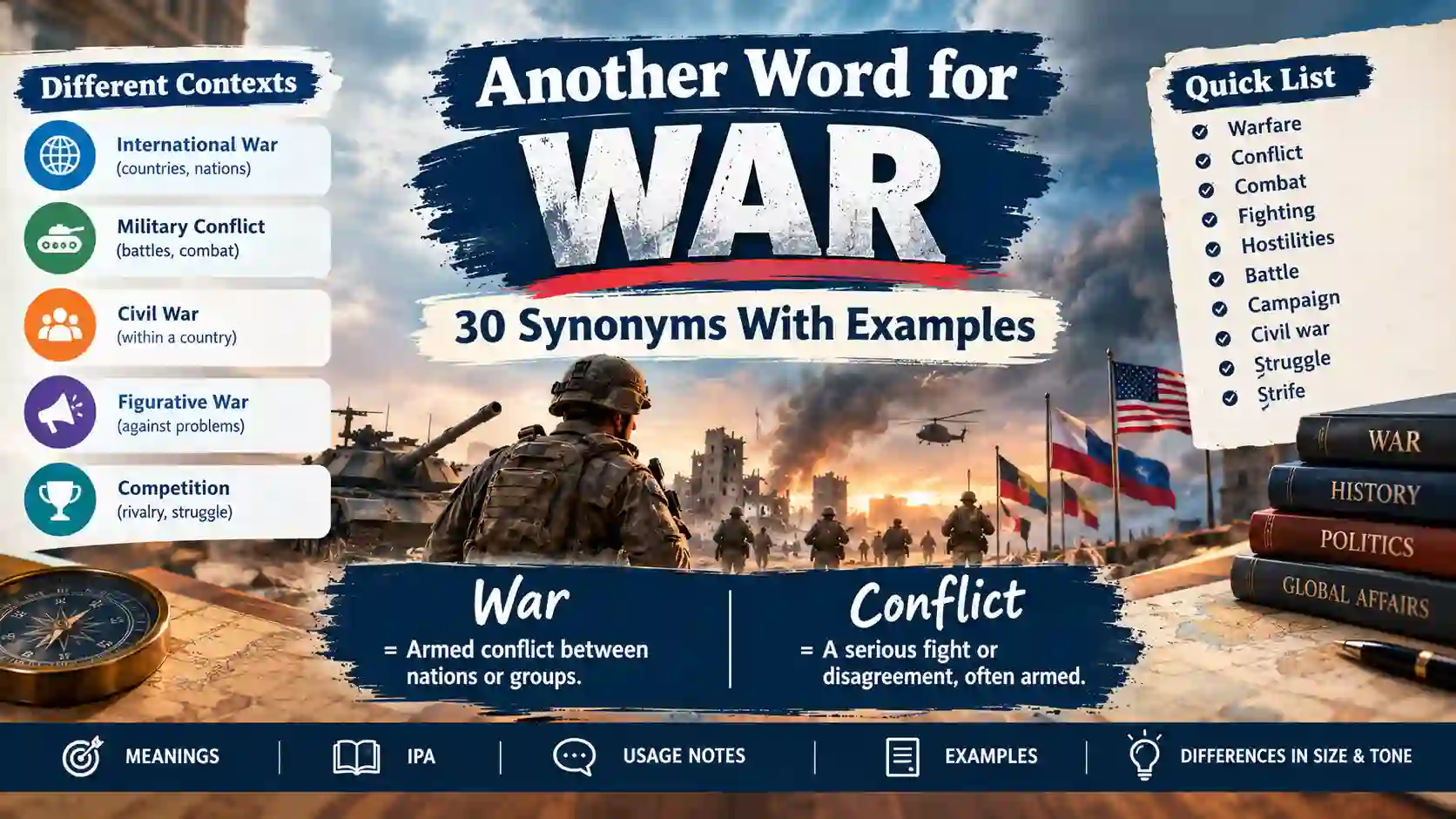
Quick list: warfare, conflict, combat, fighting, hostilities, battle, struggle, strife, civil war
This article examines 30 alternatives, each with its meaning, IPA, usage note, and example. It also shows how the words differ in size and tone, so you can pick the one that fits.
At a Glance: War Synonyms and Related Alternatives
| Alternative | Part of Speech | Meaning | Register / Tone | Ideal Context |
| Warfare | noun | The activity or methods of fighting a war | Neutral to formal | Military and history writing |
| Conflict | noun | A serious fight or disagreement, often armed | Neutral | News, politics, general writing |
| Combat | noun | Fighting between armed forces | Neutral | Military settings |
| Fighting | noun | The act of fighting, especially by armed groups | Plain, everyday | News reports |
| Hostilities | noun (plural) | Acts of war between enemies | Formal | Law, diplomacy, news |
| Battle | noun | A fight between armed forces, often one part of a war | Neutral | History, news |
| Campaign | noun | A planned series of military actions | Neutral to formal | Military history |
| Civil war | noun | War between groups inside one country | Neutral | History, politics |
| Struggle | noun | A long, hard fight or effort | Neutral | Political and social causes |
| Strife | noun | Bitter conflict or fighting | Formal to literary | Writing about unrest |
Which Word Should You Use?
| If you want to… | Use | Why |
| Talk about the activity or methods of war | Warfare | It describes how wars are fought, not one event. |
| Use a neutral, widely understood word | Conflict | It is common in news and also covers non-military fights. |
| Describe direct fighting between forces | Combat or fighting | They focus on the fighting, not the whole war. |
| Name one fight within a war | Battle | A battle is usually only one part of a war. |
| Describe a planned series of operations | Campaign | It suggests a goal and a plan. |
| Describe war inside a country | Civil war | It names the exact type of war. |
| Write formally about acts of war | Hostilities | It is used in law, diplomacy, and news. |
| Describe a fight against a problem | Struggle or crusade | They fit causes such as poverty or corruption. |
Exploring the Multiple Meanings of “War”
1. Armed Conflict Between Nations or Groups
- Meaning: A state of fighting between countries, states, or armed groups.
- Explanation: This is the main meaning. A war is usually large, lasts for some time, and involves organized armed forces.
- Example: The war lasted six years and changed the map of the region.
2. A State of Hostility
- Meaning: A condition of active opposition or ill will between people or groups.
- Explanation: The word can describe hostility with no actual fighting, as in “a war of words” or a cold war. Etymonline notes that this sense is old: by the late 12th century, war already meant active hostility between communities or people.
- Example: The two neighbors were at war over the fence for years.
3. An Organized Effort Against Something Harmful
- Meaning: A determined campaign to fight a problem or threat.
- Explanation: This figurative sense is common in speeches and news. It treats a social problem like an enemy.
- Example: The city announced a new war on litter.
4. Fighting as an Activity or Art
- Meaning: The practice or study of fighting, as a general activity.
- Explanation: Etymonline notes that this sense dates from the mid-14th century and appears in terms like man-of-war. It is close in meaning to warfare.
- Example: The book is a study of the art of war.
5. Fierce Competition
- Meaning: An intense struggle between companies, groups, or rivals.
- Explanation: It is usually part of a compound, such as price war or turf war, and describes competition, not violence.
- Example: The two airlines are in a price war.
Sources: Etymonline (war); Merriam-Webster; Dictionary.com
Analyzing 30 War Alternatives in Detail
Some of these words are direct synonyms of war, while others are related alternatives that fit only certain situations. The usage notes say which is which.
Core Synonyms
1. Warfare
IPA: US /ˈwɔːrfɛr/ · UK /ˈwɔːfeə/
Definition: The activity of fighting a war, especially the methods used.
- Usage: This is the closest synonym for the “activity of war” sense. It is mostly uncountable and neutral to formal. It is common in phrases like “modern warfare.”
- Example: Drones have changed modern warfare.
2. Conflict
IPA: US /ˈkɑːnflɪkt/ · UK /ˈkɒnflɪkt/
Definition: A serious fight or disagreement, often involving armed forces.
- Usage: This is the most common neutral alternative. It is broader than war because it can also mean a non-violent disagreement. News reports often use it as a softer or more general word.
- Example: The conflict began over a border dispute.
3. Combat
IPA: US /ˈkɑːmbæt/ · UK /ˈkɒmbæt/
Definition: Fighting between armed forces.
- Usage: This is a related alternative. It focuses on the fighting itself, not the whole war, and it is common in military settings.
- Example: He saw combat in his first year as a soldier.
4. Fighting
IPA: /ˈfaɪtɪŋ/ (US and UK)
Definition: The act of fighting, especially between armed groups.
- Usage: This is a plain, everyday word. It describes ongoing violence, whether or not war has been declared.
- Example: Fighting continued in the east despite the talks.
5. Hostilities
IPA: US /hɑːˈstɪlətiz/ · UK /hɒˈstɪlɪtiz/
Definition: Acts of war, or fighting between enemies.
- Usage: This is a formal word that is almost always plural. It is common in law, diplomacy, and news, as in “the outbreak of hostilities.”
- Example: Hostilities ended when both sides signed the agreement.
Specific Fights and Military Actions
6. Battle
IPA: /ˈbætəl/ (US and UK)
Definition: A fight between armed forces, usually as part of a larger war.
Usage: Battle refers to one specific fight, while war describes a larger period of armed conflict. It is best used when talking about a particular military encounter.
Example: The battle lasted three days.
7. Skirmish
IPA: US /ˈskɜːrmɪʃ/ · UK /ˈskɜːmɪʃ/
Definition: A brief fight between small groups of soldiers or armed forces.
Usage: Skirmish describes a smaller and shorter clash than a typical battle. It may happen during a larger war or develop into a more serious conflict.
Example: A skirmish broke out near the border.
8. Campaign
IPA: /kæmˈpeɪn/ (US and UK)
Definition: A planned series of military operations carried out to achieve a specific goal.
Usage: Campaign refers to a group of related military actions, often forming one part of a larger war. It can also describe organized efforts outside the military, such as a political campaign.
Example: The army’s winter campaign ended in the mountains.
9. Offensive
IPA: /əˈfɛnsɪv/ (US and UK)
Definition: A planned, large-scale attack by armed forces.
Usage: Offensive describes an attack intended to gain control, capture territory, or weaken an opponent. Unlike war, it refers to a specific military action. As an adjective, it can also mean rude or insulting.
Example: The offensive began at dawn.
10. Siege
IPA: /siːdʒ/ (US and UK)
Definition: A military operation in which forces surround a place to force it to surrender.
Usage: Siege describes a particular type of military action, often involving a city, fortress, or other defended location. It can also be used figuratively to describe prolonged pressure or demands.
Example: The siege of the city lasted a year.
11. Invasion
IPA: /ɪnˈveɪʒən/ (US and UK)
Definition: The entry of armed forces into another country or territory to occupy it or take control.
Usage: Invasion describes the act of entering a territory with military force. It may trigger a war or form part of an ongoing conflict, but it does not mean the entire war.
Example: The invasion took the country by surprise.
Large-Scale and Political Conflicts
12. Civil war
IPA: US /ˌsɪvəl ˈwɔːr/ · UK /ˌsɪvəl ˈwɔː/
Definition: A war between groups of people living in the same country.
- Usage: This is a specific type of war, not a general synonym. It should not be used for a war between two countries.
- Example: The civil war divided families and towns.
13. Insurgency
IPA: US /ɪnˈsɜːrdʒənsi/ · UK /ɪnˈsɜːdʒənsi/
Definition: An organized armed uprising against a government, often fought over a long time.
- Usage: This is a related alternative. It describes irregular fighting by a group, not a war between two states.
- Example: The insurgency continued in remote regions.
14. Rebellion
IPA: /rɪˈbɛljən/ (US and UK)
Definition: Open, organized resistance to a government or authority.
- Usage: This is a related alternative. A rebellion can grow into a civil war, but it is not always as large as a war.
- Example: The rebellion spread across the northern provinces.
15. Strife
IPA: /straɪf/ (US and UK)
Definition: Angry or bitter conflict, or fighting.
- Usage: This is a formal to literary alternative. It is mostly uncountable and fits unrest inside a country or group.
- Example: Years of strife left the country poor.
16. Bloodshed
IPA: /ˈblʌdʃɛd/ (US and UK)
Definition: The killing or injuring of people, especially in war.
- Usage: This is a related alternative. It stresses the violence and loss of life, not the political side of the war.
- Example: Leaders called for an end to the bloodshed.
Formal and Literary Alternatives
17. Conflagration
IPA: US /ˌkɑːnfləˈɡreɪʃən/ · UK /ˌkɒnfləˈɡreɪʃən/
Definition: A large, destructive fire, or, figuratively, a large and destructive war.
- Usage: This is a literary alternative. The war meaning is figurative and usually describes a conflict that grows and spreads.
- Example: The small border dispute grew into a conflagration across the region.
18. Engagement
IPA: /ɪnˈɡeɪdʒmənt/ (US and UK)
Definition: A battle or fight between armed forces.
- Usage: This is a formal military term and narrower than war. Engagement also has other meanings, such as a promise to marry, so context matters.
- Example: The engagement lasted only two hours.
19. Fray
IPA: /freɪ/ (US and UK)
Definition: A fight or lively contest, often in the phrase “the fray.”
- Usage: This is a literary, figurative alternative. It suggests a busy, confusing fight and is often used with “join” or “enter.”
- Example: More countries joined the fray.
20. Belligerency
IPA: /bəˈlɪdʒərənsi/ (US and UK)
Definition: The state of being at war, or a warlike attitude.
- Usage: This is a related, formal alternative. It is most common in legal and diplomatic writing about the status of nations at war.
- Example: The two nations’ belligerency lasted until the treaty was signed.
21. Aggression
IPA: /əˈɡrɛʃən/ (US and UK)
Definition: Hostile or forceful action, especially an attack by one country on another.
- Usage: This is a related alternative. It names the act that may start a war, not the war itself, as in “an act of aggression.”
- Example: The treaty condemns aggression against neighboring states.
Figurative and Non-Military Alternatives
22. Struggle
IPA: /ˈstrʌɡəl/ (US and UK)
Definition: A long, hard fight or effort.
- Usage: This is a related alternative. It suits political, social, or personal fights, and it often sounds more serious than conflict.
- Example: The struggle for independence lasted decades.
23. Crusade
IPA: /kruːˈseɪd/ (US and UK)
Definition: A determined campaign for or against something. It was also the name for medieval religious wars.
- Usage: This is a figurative alternative for the “fight against a problem” sense. The tone is strong and moral.
- Example: He began a crusade against corruption.
24. Feud
IPA: /fjuːd/ (US and UK)
Definition: A long, bitter quarrel between people or groups.
- Usage: This is a related alternative. It describes a personal or family fight, not a fight between countries.
- Example: The two families kept up a feud for years.
25. Rivalry
IPA: /ˈraɪvəlri/ (US and UK)
Definition: Competition between people or groups.
- Usage: This is a related alternative. It is much milder than war and is common in sports and business.
- Example: The rivalry between the two companies is fierce.
26. Clash
IPA: /klæʃ/ (US and UK)
Definition: A fight or serious disagreement.
- Usage: This is a related alternative. It describes a short event, not a long war.
- Example: A clash broke out between rival groups.
Hostile Relations and Standoffs
27. Enmity
IPA: US /ˈɛnməti/ · UK /ˈɛnmɪti/
Definition: Deep hatred or hostility between people or groups.
- Usage: This is a formal, related alternative. It describes the feeling or state, not the fighting.
- Example: Centuries of enmity kept the two nations apart.
28. Antagonism
IPA: /ænˈtæɡənɪzəm/ (US and UK)
Definition: Active opposition or hostility.
- Usage: This is a related alternative and milder than war. It often describes relationships between people or groups.
- Example: There was open antagonism between the two leaders.
29. Standoff
IPA: US /ˈstændɔːf/ · UK /ˈstændɒf/
Definition: A situation in which neither side will give way.
- Usage: This is a related alternative. It describes a tense pause, often before or after fighting.
- Example: The standoff lasted a week without any shooting.
30. Cold war
IPA: US /ˌkoʊld ˈwɔːr/ · UK /ˌkəʊld ˈwɔː/
Definition: A state of tension between countries without direct fighting.
- Usage: This is a related alternative. With a capital C and W, “the Cold War” usually means the tense period between the United States and the Soviet Union after World War II.
- Example: Relations slid into a cold war after the talks failed.
Sources: Merriam-Webster; Dictionary.com; Collins Dictionary; Etymonline
War vs. Conflict vs. Campaign vs. Battle: Scale and Scope
Many of the words above describe different sizes of fighting. The table below shows how they fit together.
| Word | Scale | Main Idea | Example |
| War | Largest | The whole state of fighting | The war lasted six years. |
| Conflict | Broad | Any serious fight or disagreement, armed or not | The conflict began over land. |
| Campaign | Medium | A planned series of military actions within a war | The summer campaign took the port. |
| Battle | Smaller | One fight between forces | The battle ended at nightfall. |
| Skirmish | Smallest | A short fight between small groups | A skirmish broke out near the road. |
A good rule is that a war contains campaigns, a campaign contains battles, and a battle may contain skirmishes. This is a guide, not a strict rule, and writers sometimes use the words more loosely.
Sources: Merriam-Webster; Dictionary.com
War and Opposite/Paired Word Pairs
| Word | Paired Word | Note |
| War | Peace | The main opposite, often used together as “war and peace.” |
| War | Truce | A temporary agreement to stop fighting. |
| War | Ceasefire | A pause in fighting, not necessarily the end of the war. |
| War | Armistice | A formal agreement to stop fighting. |
| War | Diplomacy | Contrasts fighting with solving problems by talks. |
| Fighting | Negotiation | Contrasts armed action with discussion. |
Peace is the true opposite of war, but the other words are not exact opposites. A truce and a ceasefire only pause fighting, and an armistice is a formal agreement to stop it. Etymonline records the pairing “in war and peace,” meaning at all times, from the late 14th century.
Sources: Etymonline (war); Merriam-Webster
Common Word Partners of “War”
| Pattern | Common Partners | Example |
| verb + war | declare, wage, fight, win, lose, end | The country declared war after the attack. |
| adjective + war | civil, nuclear, world, total, long | The long war drained the country’s money. |
| war + preposition | war on (poverty, drugs), war against, war between, war over; at war with | The war between the two states lasted six years. |
| noun + war | price, trade, turf, bidding, culture | A trade war raised prices on both sides. |
| war + noun | crime, zone, effort, memorial, veteran | The town built a memorial for the war dead. |
Sources: Merriam-Webster; Dictionary.com; Etymonline (war)
Idiomatic Phrases Featuring “War”
War appears in many fixed expressions. The ones below are well established.
1. A war of words
- Meaning: A bitter argument carried out in speech or writing, not with weapons.
- Example: The two leaders fought a war of words on television.
2. All’s fair in love and war
- Meaning: A saying that people may use any methods to win in love or in war.
- Example: She took the last ticket first, saying, “All’s fair in love and war.”
3. War chest
- Meaning: A fund of money saved for a fight, such as a campaign or a business battle. Etymonline notes that the term is now usually figurative.
- Example: The company built a large war chest before entering the new market.
4. War is hell
- Meaning: A saying meaning that war is terrible and brings great suffering. Etymonline notes that it was in use by 1850 and is commonly attributed to a U.S. Civil War general.
- Example: After years at the front, he said only, “War is hell.”
Sources: Etymonline (war); Merriam-Webster
Word Formation of “War”
Etymology & Structure
War is a short, one-syllable root word. Etymonline traces it through Old North French werre, a variant of Old French guerre, back to a Germanic source. Etymonline also notes that there seems to have been no common Germanic word for “war” at the start of historical times. The Latin word for war, bellum, is not the source of war. It gave English words such as bellicose, and Etymonline says its own origin is uncertain.
Date and History
Etymonline records the noun in Middle English. It had the sense of active hostility between communities or people by the late 12th century and was used for specific wars by about 1200. The sense of fighting as an activity or profession dates from the mid-14th century. The phrase make war dates from about 1200, at war from the late 14th century, and go to war from the mid-15th century. War crime is attested from 1906, war zone from 1914, and war chest from 1901.
Word Class Variations
- Noun: war, wars
- Verb: war (warred, warring), a rare and literary use meaning to wage war
- Adjective: warring (as in “warring groups”), warlike
- Related derivatives and compounds: warfare, wartime, warlord, postwar, prewar, antiwar
Sources: Etymonline (war); Merriam-Webster
Common Word-Choice Mistakes
- He made a war on his neighbor: He waged war on his neighbor, or he went to war with him.
- The country is in war: The country is at war.
- Many warfares changed the region: Many wars changed the region (warfare is uncountable).
- The battle lasted six years: The war lasted six years (a battle is only one part of a war).
- A hostility broke out between the armies: Hostilities broke out between the armies (in this sense the word is plural).
- The region suffered many strifes: The region suffered much strife (strife is uncountable).
- The civil war between France and Germany: The war between France and Germany (a civil war is inside one country).
FAQs
What is the closest synonym for war?
Conflict is the most common neutral synonym. Warfare is closest when you mean the activity of fighting.
What is the difference between war and warfare?
War is a state of fighting, and you can count wars. Warfare is the activity or methods of fighting and is uncountable.
What is the difference between war and battle?
A war is the whole conflict, and a battle is usually one fight within it.
What is a formal alternative to war?
Hostilities and armed conflict are common formal choices.
What is a literary alternative to war?
Conflagration and fray are good literary choices.
What is the opposite of war?
Peace is the main opposite. Truce and ceasefire describe pauses in fighting.
Can war be used for non-military things?
Yes. People say “a war of words,” “a price war,” or “a war on poverty” to describe strong opposition or competition.
Is conflict the same as war?
Not always. A conflict can be a war, but it can also be a disagreement with no fighting.
What is a civil war?
A civil war is a war between groups inside one country.
Can war be a verb?
Yes, but it is rare and literary. You may see “warring factions” or “nations that warred for years.”
Conclusion
The closest alternatives to war are conflict, warfare, combat, fighting, and hostilities. Battle, campaign, and skirmish describe smaller parts of a war, and civil war and insurgency describe specific kinds of conflict.
Context and scale decide the right word. Some alternatives mean the whole war, while others mean one fight or one action. A few are figurative and describe struggles or rivalries that involve no weapons.
To choose well, think about what you want to describe. For the whole state of fighting, use war or conflict. For one fight, use battle.
Discover More Article

Hy, Sophia is a content writer with 3 years of experience creating engaging, informative, and SEO-friendly articles focused on synonyms, vocabulary, and word meanings.