Another Word for Manage: 30 Synonyms With Examples
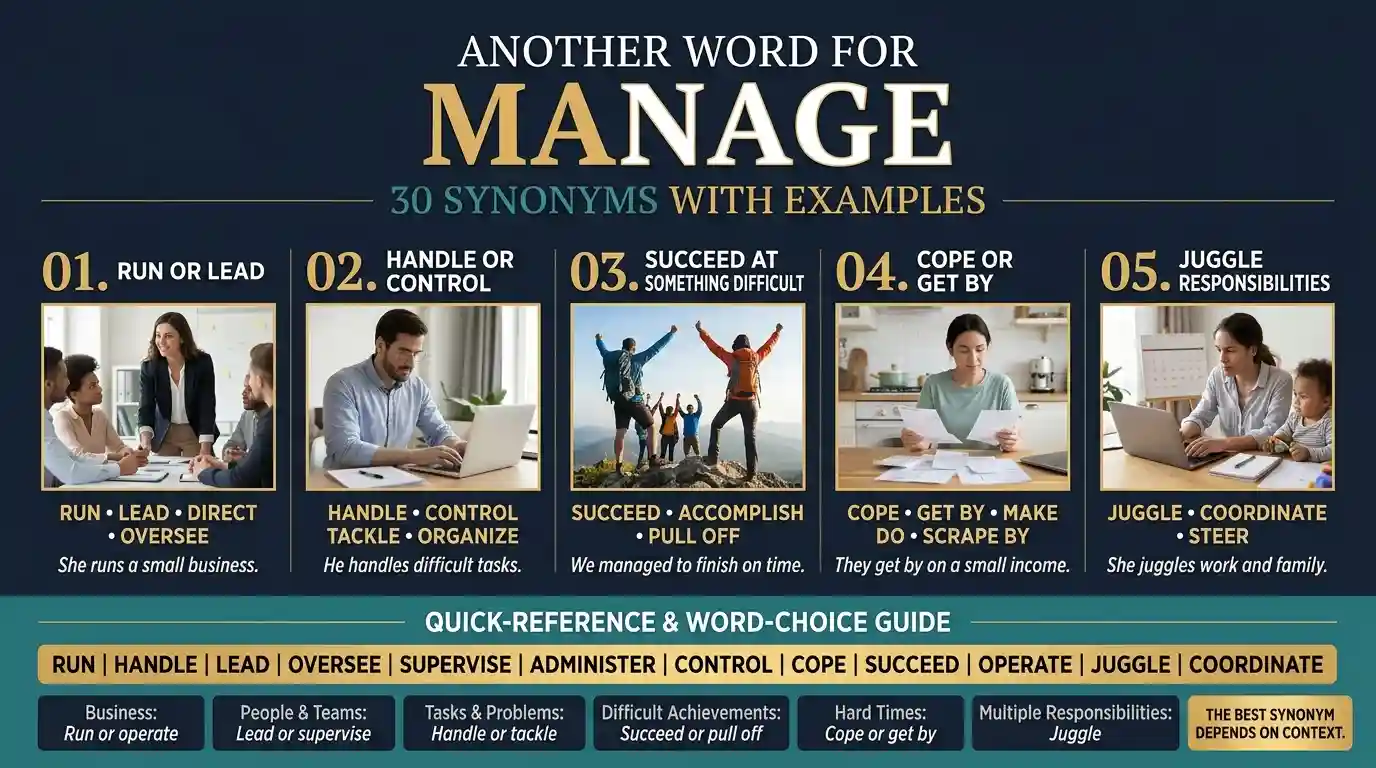
The closest everyday alternatives to “manage” are run, handle, oversee, and supervise. “Run” fits a business or shop. “Handle” fits a task or problem. “Oversee” and “supervise” fit watching over people or work.
“Manage” also has other meanings. In “She managed to finish,” it means succeed. In “We can manage on one income,” it means get by. This article covers each area, from leading a team to coping with hard times.
Quick list: run, handle, oversee, supervise, direct, lead, cope, succeed, get by
This article examines 30 alternatives to “manage.” Each one comes with its meaning, IPA, a usage note, an example sentence, and notes on context.
At a Glance: Manage Synonyms and Related Alternatives
| Alternative | Part of Speech | Meaning | Register / Tone | Ideal Context |
| Run | verb | to be in charge of a business or place | neutral, everyday | shops, restaurants, small companies |
| Lead | verb | to guide and be in charge of a group | neutral, positive | teams, projects |
| Oversee | verb | to watch over and be responsible for work | formal | departments, projects |
| Supervise | verb | to watch and direct people or work | neutral to formal | staff, students, workers |
| Administer | verb | to manage the affairs of a system | formal | offices, funds, programs |
| Handle | verb | to deal with a task, person, or problem | neutral | tasks, complaints, crises |
| Control | verb | to have power over or keep within limits | neutral to formal | spending, symptoms, risks |
| Cope | verb | to deal with a difficulty | neutral | stress, loss, hard times |
| Succeed | verb | to reach a goal | neutral | “managed to” sentences |
| Juggle | verb | to manage several tasks at once | informal, vivid | work, family, study |
Which Word Should You Use?
| If you want to… | Use | Why |
| Describe being in charge of a business | run | It is the most natural everyday word. |
| Describe guiding a team or project | lead or direct | Both suggest guiding people toward a goal. |
| Describe watching over people’s work | supervise or oversee | Both focus on watching and checking. |
| Describe official or system-level work | administer | It suits offices, funds, and programs. |
| Describe dealing with a problem | handle or tackle | “Handle” is calm, and “tackle” suggests effort. |
| Describe keeping something under control | control or regulate | Both suggest limits, such as spending or temperature. |
| Describe doing several tasks at once | juggle | It paints a clear picture of many tasks in the air. |
| Describe doing something difficult | succeed or pull off | They replace “managed to” with a clearer result. |
| Describe getting through hard times | cope or get by | They replace the “manage on” and “manage with” senses. |
Exploring the Multiple Meanings of “Manage”
1. To Run or Lead a Business, Team, or Place
- Meaning: To be in charge of a business, organization, team, or place.
- Explanation: This is the most common sense. It includes planning, making decisions, and directing people. Etymonline dates this extended sense, “to control or direct by administrative skill,” to the 1570s.
- Example: She manages a small hotel by the sea.
2. To Handle or Control Something
- Meaning: To deal with a task, resource, or situation and keep it under control.
- Explanation: This sense covers time, money, stress, risk, and even health conditions. It does not always involve leading people.
- Example: He manages his money carefully.
3. To Succeed in Doing Something Difficult
- Meaning: To succeed in doing something that takes effort or skill.
- Explanation: This sense uses “manage to” plus a verb. It suggests effort or difficulty. Etymonline dates “accomplish by effort,” hence “succeed in accomplishing,” to 1732.
- Example: We managed to catch the last bus.
4. To Cope or Get By
- Meaning: To get along or survive, often with limited resources or help.
- Explanation: This sense is often used without an object, as in “I can manage.” It often goes with “with,” “without,” or “on.” Etymonline notes that this intransitive sense was suggested in the 1650s and became frequent from the mid-19th century.
- Example: They managed on a small income for years.
5. To Handle Something by Hand
- Meaning: To handle or control a tool, object, or animal physically.
- Explanation: This is the oldest root sense. Etymonline dates “handle (a tool or object) by hand” to the 1580s, and the earliest uses were about training and handling horses. Today, the sense appears in phrases such as “couldn’t manage the heavy bag.”
- Example: I can’t manage all these bags by myself.
Sources: Merriam-Webster; Collins Dictionary; Dictionary.com; Etymonline
Analyzing 30 Manage Alternatives in Detail
Some of these words are close synonyms of “manage,” while others are related alternatives that fit only one meaning or situation, and each Usage note says which is which.
Running and Leading Alternatives
1. Run
IPA: /rʌn/ (US and UK)
Definition: To be in charge of or operate a business, shop, or organization.
- Usage: This is a close synonym for the “run a business” sense. It is neutral and very common in everyday speech.
- Example: She runs a small bakery on Main Street.
2. Lead
IPA: /liːd/ (US and UK)
Definition: To be in charge of a group or project and guide it.
- Usage: This is a close synonym when “manage” means guiding people. It suggests direction and vision more than daily detail.
- Example: He leads a team of ten engineers.
3. Direct
IPA: US /dəˈrɛkt/ · UK /dɪˈrɛkt/
Definition: To control or guide the work of people or activities.
- Usage: This is a close synonym in more formal use. It fits departments, projects, and programs. It also means “point toward” or “tell the way,” which are different senses.
- Example: She directs the research department.
4. Head
IPA: /hɛd/ (US and UK)
Definition: To be in charge of a group, department, or organization.
- Usage: This is a related alternative. As a verb it is formal and often used for senior roles.
- Example: He heads the finance department.
5. Oversee
IPA: US /ˌoʊvərˈsiː/ · UK /ˌəʊvəˈsiː/
Definition: To watch over work and be responsible for it.
- Usage: This is a close synonym in formal writing. It suggests responsibility from above, not daily hands-on work.
- Example: She oversees all new hires.
Supervising and Administering
6. Supervise
IPA: US /ˈsuːpərvaɪz/ · UK /ˈsuːpəvaɪz/
Definition: To watch and direct people or work to make sure it is done properly.
- Usage: This is a related alternative, narrower than “manage.” It focuses on watching staff, students, or children, not on planning or budgets.
- Example: A teacher supervised the students on the trip.
7. Administer
IPA: US /ədˈmɪnɪstər/ · UK /ədˈmɪnɪstə/
Definition: To manage the affairs of an organization or system; also, to give a medicine or a test.
- Usage: This is a formal synonym for official and organizational work. It also has the meaning “give,” so check the context.
- Example: The office administers the scholarship fund.
8. Coordinate
IPA: US /koʊˈɔːrdɪneɪt/ · UK /kəʊˈɔːdɪneɪt/
Definition: To organize different people or parts so they work well together.
- Usage: This is a related alternative. It focuses on bringing parts together, not on being the boss.
- Example: She coordinates the volunteers on weekends.
9. Organize
IPA: US /ˈɔːrɡənaɪz/ · UK /ˈɔːɡənaɪz/
Definition: To arrange or plan something so it works well.
- Usage: This is a related alternative. It describes setting things in order, as in “organize a schedule,” and does not suggest authority.
- Example: He organized the school fair.
10. Govern
IPA: US /ˈɡʌvərn/ · UK /ˈɡʌvən/
Definition: To control and direct a country, city, or group with authority.
- Usage: This is a related, formal alternative. It suits countries and large groups, and it sounds too strong for a small shop.
- Example: A council governs the town.
Handling Tasks and Problems
11. Handle
IPA: /ˈhændəl/ (US and UK)
Definition: To deal with or take care of a person, task, or situation.
- Usage: This is a close synonym for tasks, problems, and people. It is neutral and common. It also means to hold something with the hands.
- Example: She handled the complaint calmly.
12. Tackle
IPA: /ˈtækəl/ (US and UK)
Definition: To begin dealing with a difficult problem with effort.
- Usage: This is a related alternative. It suggests active effort and difficulty, and it focuses on the start of the effort.
- Example: The city is tackling the traffic problem.
13. Address
IPA: /əˈdrɛs/ (US and UK)
Definition: To deal with a problem or issue.
- Usage: This is a related, formal alternative. It suits issues, concerns, and policies. As a verb, it also means to speak to someone.
- Example: The manager addressed the safety concerns.
14. Control
IPA: US /kənˈtroʊl/ · UK /kənˈtrəʊl/
Definition: To have power over something, or to keep it within limits.
- Usage: This is a related alternative, stronger than “manage.” It suggests firm limits, as in controlling spending or symptoms.
- Example: He controls the company’s spending.
15. Regulate
IPA: US /ˈrɛɡjəleɪt/ · UK /ˈrɛɡjʊleɪt/
Definition: To control the amount, speed, or level of something; also, to make rules for it.
- Usage: This is a related alternative for keeping a level steady, such as heat, flow, or sugar. It does not suit managing people.
- Example: The thermostat regulates the heat.
Alternatives for Succeeding at Something Difficult
16. Succeed
IPA: /səkˈsiːd/ (US and UK)
Definition: To reach a goal or do what you tried to do.
- Usage: This is a close synonym for the “manage to” sense, usually as “succeed in” plus an -ing verb. It states the result more clearly than “manage.”
- Example: She succeeded in opening the stuck door.
17. Accomplish
IPA: US /əˈkɑːmplɪʃ/ · UK /əˈkʌmplɪʃ/
Definition: To finish something successfully.
- Usage: This is a close synonym for “manage to” when a task is completed. It is neutral to formal.
- Example: We accomplished a lot today.
18. Contrive
IPA: /kənˈtraɪv/ (US and UK)
Definition: To succeed in doing something, often by a clever or tricky plan.
- Usage: This is a formal, related alternative. It can suggest scheming, so it does not fit every “managed to” sentence.
- Example: He contrived to meet her at the station.
19. Engineer
IPA: US /ˌɛndʒəˈnɪr/ · UK /ˌɛndʒɪˈnɪə/
Definition: To plan and bring something about skillfully, often secretly.
- Usage: This is a related alternative. It suggests careful planning, not simple effort. It can sound negative if the plan is secret.
- Example: She engineered a deal between the two firms.
20. Pull off
IPA: US /ˌpʊl ˈɔːf/ · UK /ˌpʊl ˈɒf/
Definition: To succeed in doing something difficult.
- Usage: This is an informal phrasal verb and a close synonym for “managed to” in a difficult case. It suggests surprise at the success.
- Example: They pulled off a surprise party.
Coping and Getting By
21. Cope
IPA: US /koʊp/ · UK /kəʊp/
Definition: To deal with a difficult situation, often successfully.
- Usage: This is a close synonym for the “get by” sense. It usually takes “with,” as in “cope with stress.”
- Example: She coped well with the stress.
22. Get by
IPA: /ˌɡɛt ˈbaɪ/ (US and UK)
Definition: To manage to live or do something with only the basics.
- Usage: This is an informal phrasal verb and a close synonym for “manage” in the “survive” sense. It suggests having just enough.
- Example: He gets by on a small salary.
23. Make do
IPA: /ˌmeɪk ˈduː/ (US and UK)
Definition: To manage with what you have, even if it is not ideal.
- Usage: This is an informal phrase. It usually takes “with,” as in “make do with less.”
- Example: We made do with one car for years.
24. Scrape by
IPA: /ˌskreɪp ˈbaɪ/ (US and UK)
Definition: To manage with great difficulty, barely having enough.
- Usage: This is an informal phrase. It is stronger than “get by” and suggests real hardship.
- Example: They scraped by on very little money.
25. Muddle through
IPA: /ˌmʌdəl ˈθruː/ (US and UK)
Definition: To manage to get something done without much skill or planning.
- Usage: This is an informal phrase. It suggests a clumsy but successful effort.
- Example: We muddled through the first week.
Physical Handling, Guiding, and Balancing
26. Operate
IPA: US /ˈɑːpəreɪt/ · UK /ˈɒpəreɪt/
Definition: To control or run a machine, business, or system.
- Usage: This is a close synonym for running a business or machine. It is neutral to formal. It also means “perform surgery,” which is a different sense.
- Example: He operates a food truck in the city.
27. Maneuver
IPA: US /məˈnuːvər/ · UK /məˈnuːvə/
Definition: To move or guide something skillfully; also, to handle a situation cleverly.
- Usage: This is a related alternative for skillful, careful control. In British English it is spelled “manoeuvre.” It can also suggest clever tricks.
- Example: She maneuvered the car into a tight space.
28. Wield
IPA: /wiːld/ (US and UK)
Definition: To hold and use a tool, weapon, or power.
- Usage: This is a related alternative for tools and power. It is common in “wield power” and “wield influence,” and it does not suit tasks.
- Example: The mayor wields great power in the city.
29. Steer
IPA: US /stɪr/ · UK /stɪə/
Definition: To guide the direction of a vehicle, a group, or a process.
- Usage: This is a related alternative for guiding a process or an organization. It suggests control over direction, not daily operation.
- Example: She steered the company through a hard year.
30. Juggle
IPA: /ˈdʒʌɡəl/ (US and UK)
Definition: To manage several tasks or demands at the same time.
- Usage: This is an informal, related alternative. It is a vivid word for balancing many duties, often “work and family.”
- Example: She juggles work, study, and two children.
Sources: Merriam-Webster; Collins Dictionary / Collins Thesaurus; Dictionary.com
Manage + Noun, Manage To, and Manage With: How the Meaning Changes
The meaning of “manage” changes with the words that follow it. Each pattern points to a different alternative.
| Pattern | Meaning | Possible Alternative | Example |
| manage + noun (business, team) | to run or lead | run, lead, oversee | She manages a restaurant. |
| manage + noun (money, time, stress) | to handle and keep under control | handle, control, regulate | He manages his time well. |
| manage to + verb | to succeed after some effort | succeed in, pull off | We managed to finish early. |
| manage with / without / on | to get by | get by, make do, cope | They manage on one income. |
| can / could manage (alone) | to be able to deal with it | handle, cope | I can manage, thanks. |
“Manage to” suggests that something was hard but worked. If you say “I managed to open the jar,” you suggest it was not easy. Etymonline’s quoted Century Dictionary entry describes the essential idea of “manage” as “constant attention to details,” which fits the business and control senses.
Sources: Merriam-Webster; Collins Dictionary; Etymonline (quoting the Century Dictionary)
Manage and Opposite/Paired Word Pairs
| Word | Paired Word | Note |
| Manage | Mismanage | The direct opposite in quality: to manage badly |
| Manage | Neglect | To fail to take care of something |
| Manage | Fail | The opposite of the “managed to” sense |
| Manage | Struggle | A contrast for the “cope” sense, meaning to have great difficulty |
| Micromanage | Delegate | “Micromanage” means to control every small detail, and “delegate” means to give tasks to others |
| Manager | Employee | A natural pair describing roles at work |
“Manage” does not have one perfect opposite, because it has many meanings. “Mismanage” and “neglect” fit the business and handling senses. “Fail” and “struggle” fit the “managed to” and “get by” senses. “Micromanage” and “delegate” form a useful pair for talking about leadership style.
Sources: Merriam-Webster; Collins Thesaurus; Dictionary.com
Common Word Partners of “Manage”
| Pattern | Common Partners | Example |
| manage + noun | money, time, stress, risk, a team, a business, a project, pain, a budget | She manages a team of eight. |
| manage to + verb | finish, escape, get, survive, convince | He managed to escape through the window. |
| adverb + manage | barely, just, somehow, easily, successfully | We just managed to arrive on time. |
| manage + preposition | with, without, on | They manage on a small salary. |
| well- / poorly managed | well-managed, badly managed, poorly managed | It is a well-managed company. |
| can / could manage | can manage, could you manage | I think I can manage alone. |
Sources: Merriam-Webster; Collins Dictionary; Oxford Learner’s Dictionaries
Idiomatic Phrases Featuring “Manage”
“Manage” appears in very few true idioms. The items below are established expressions and set phrases, not figurative idioms.
1. Manage expectations
- Meaning: To help people expect realistic results so they are not disappointed. It is common in business and everyday talk.
- Example: The coach tried to manage expectations before the big game.
2. Managed care
- Meaning: A US term for a health-care system that controls costs and limits which doctors and services patients can use.
- Example: Her insurance is part of a managed care plan.
3. Managed economy
- Meaning: An economy in which the government directs or controls important decisions. Etymonline records the phrase from 1933.
- Example: The country had a managed economy for decades.
4. I’ll manage
- Meaning: A common polite reply meaning “I can do it myself” or “I don’t need help.”
- Example: “Do you need help with that bag?” “No, thanks. I’ll manage.”
Sources: Merriam-Webster; Cambridge Dictionary; Collins Dictionary; Etymonline
Word Formation of “Manage”
Etymology & Structure
“Manage” comes from Italian maneggiare, meaning “to handle, touch,” especially “to control a horse.” Etymonline traces it through Old French manège, “horsemanship,” and Italian maneggio to the Latin noun manus, “hand,” from a Proto-Indo-European root meaning “hand.” The idea of handling something with the hand is still in the word. The English verb comes from an obsolete English noun manage, which meant “the handling or training of a horse.”
Date and History
Etymonline dates “manage” to the 1560s, with the meaning “handle, train, or direct” a horse. The extended sense, “to control or direct by administrative skill,” appears in the 1570s, and “to handle (a tool or object) by hand” in the 1580s. The meaning “accomplish by effort,” hence “succeed in accomplishing,” is from 1732. The related noun manager, meaning “one who directs or controls,” is from the 1580s. Manageable is from the 1590s, first meaning “capable of being handled,” and around 1600, “capable of being governed or controlled.” The phrase “managed economy” is from 1933.
Word Class Variations
- Verb: manage, manages, managed, managing; mismanage; micromanage
- Noun: management, manager, manageress (dated), mismanagement
- Adjective: manageable, unmanageable, managerial, managed
- Adverb: manageably
- Related word: manège (a modern revival of the old noun, meaning a riding school or the art of horsemanship)
Sources: Etymonline (entries for manage, manager, manageable, and manege); Merriam-Webster
Common Word-Choice Mistakes
- Wrong: “He managed finishing the report.” Correct: “He managed to finish the report.” “Manage” takes “to” plus a base verb, not an -ing form.
- Wrong: “How do you manage with stress?” Correct: “How do you manage stress?” or “How do you cope with stress?”
- Wrong: “The company is badly managing.” Correct: “The company is badly managed.” Use the passive adjective for a business.
- Wrong: “I managed the exam.” Correct: “I passed the exam,” or “I managed to pass the exam.”
- Wrong: “I manage to speak English.” Correct: “I can speak English.” “Manage to” suggests effort and a one-time success.
- Wrong: “She directs a small shop.” Correct: “She runs a small shop.” “Direct” suits departments, films, and large programs.
- Wrong: “She is the manageress of the team.” Correct: “She is the manager of the team.” “Manageress” now sounds old-fashioned.
FAQs
What is the closest synonym for manage?
It depends on the meaning. “Run” is closest for a business, and “handle” is closest for a task or problem.
What is a formal alternative to manage?
“Administer,” “oversee,” and “direct” are common in formal writing. “Administer” suits official systems, and “oversee” suits responsibility from above.
What is another word for manage on a resume?
“Led,” “oversaw,” “supervised,” “directed,” and “coordinated” are common choices. Pick the word that matches what you actually did.
What is the difference between manage and supervise?
“Supervise” focuses on watching people or work. “Manage” is broader and can include planning, budgets, and decisions.
What is the difference between manage and handle?
“Handle” means to deal with a task or problem. “Manage” can also mean to run a whole business or team.
What is another word for “managed to”?
“Succeeded in,” “pulled off,” and “accomplished” work well. “Pulled off” is informal and suggests a difficult success.
What is another word for manage when it means cope?
“Cope,” “get by,” and “make do” are the main choices. “Scrape by” suggests real hardship.
What is the opposite of manage?
“Mismanage” and “neglect” are common opposites for the business and handling senses. “Fail” fits the “managed to” sense.
Can “manage” be used for things as well as people?
Yes. People manage teams, but they also manage time, money, stress, and even health conditions.
Is “manage” related to the word “hand”?
Yes. Etymonline traces it through Italian maneggiare (“to handle”) to Latin manus, which means “hand.”
Conclusion
The closest alternatives to “manage” are “run,” “handle,” “oversee,” and “supervise.” “Lead” and “direct” fit guiding people, “cope” and “get by” fit hard times, and “succeed” and “pull off” fit “managed to.” “Juggle” is a vivid choice for doing many tasks at once.
Context and meaning decide the best word. “Manage” can mean running, handling, succeeding, coping, or handling something by hand, and each sense has its own alternatives. Related words such as “control,” “govern,” and “operate” overlap with “manage” but are stronger or narrower, so using them as exact synonyms can change the message.
To choose the right word, first decide which sense you mean. Then think about the setting, such as a business, a problem, or a hard time, and about how formal the writing is. When you are unsure, “run” for a business and “handle” for tasks are safe choices.
Discover More Article

Hy, Rose is a professional content writer with 3 years of experience creating engaging, informative, and SEO-friendly content. She specializes in crafting clear, reader-focused articles that deliver value, improve online visibility, and help websites grow.