30 Another Word for Location: Synonyms With Examples & Meaning
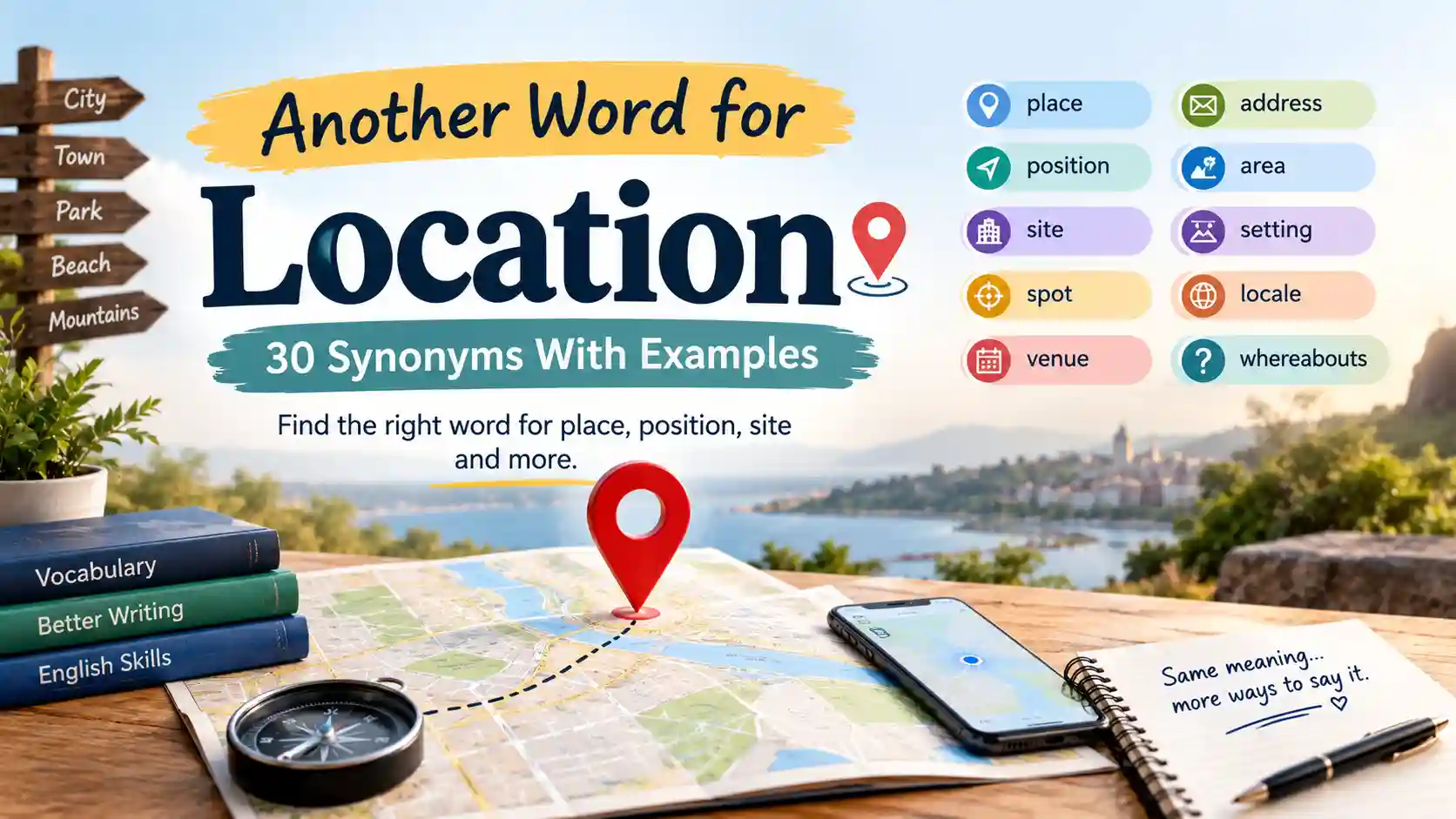
The closest everyday alternatives to location are place, position, site, and spot. Venue fits the place where an event happens, address names the details used to find a place, and whereabouts is used when you ask where someone or something is.
The best word depends on what kind of place you mean. Location can describe a spot on a map, a business branch, a place where a film is shot, or the act of finding something. Each sense has its own natural alternatives, and the tone ranges from casual to formal.
Quick list: place, position, site, spot, venue, address, area, setting, whereabouts
This article examines 30 alternatives. For each one, you will find its meaning, IPA, a usage note, and an example, so you can choose the word that fits your sentence.
At a Glance: Location Synonyms and Related Alternatives
| Alternative | Part of Speech | Meaning | Register / Tone | Ideal Context |
| Place | noun | A particular point or area in space | Plain, everyday | General use |
| Position | noun | Where something is, often in relation to other things | Neutral | Maps, directions, ships |
| Site | noun | The place where something is, was, or will be | Neutral | Building, history, events |
| Spot | noun | A particular, often small place | Informal to neutral | Casual talk |
| Whereabouts | noun (plural in form) | The place where a person or thing is | Neutral to formal | Missing people or objects |
| Venue | noun | The place where an event happens | Neutral | Concerts, meetings, weddings |
| Address | noun | The details that tell where a building can be found | Neutral | Mail, directions, websites |
| Area | noun | A part of a place, town, or space | Neutral | General, broad use |
| Setting | noun | The place and time where a story or event happens | Neutral | Stories, films, scenes |
| Locale | noun | A place, with its surroundings or events | Formal to literary | Stories, news, travel writing |
Which Word Should You Use?
| If you want to… | Use | Why |
| Say where something is in a general way | Place or position | They are simple and widely understood. |
| Name where a building or project will go | Site | It suits construction, history, and planning. |
| Name where an event happens | Venue | It is the standard word for concerts, meetings, and weddings. |
| Name a shop or office of a company | Branch or outlet | They describe a business place, not just any place. |
| Give an exact point on a map | Coordinates or address | They show precise details. |
| Describe the area around a place | Neighborhood or vicinity | They describe surroundings, not one point. |
| Describe where a story or scene happens | Setting or locale | They fit books, films, and travel writing. |
| Describe a piece of land | Plot, lot, or parcel | They are used for land and property. |
Exploring the Multiple Meanings of “Location”
1. A Place Where Something Is
- Meaning: The place or position where someone or something is, or can be found.
- Explanation: This is the main sense. Etymonline records location from the 1590s, meaning “position, place; fact or condition of being in a particular place.”
- Example: The hotel’s location is perfect for sightseeing.
2. A Place of Business
- Meaning: A specific place where a business operates, such as a shop, office, or branch.
- Explanation: In everyday American English, a company may say it has several locations. Here the word names the place itself, not just its position.
- Example: The chain opened a new location downtown.
3. A Place Outside a Studio Where a Film Is Shot
- Meaning: A real place, not a studio, where filming or recording takes place.
- Explanation: This sense is common in film and television. It appears in the phrase on location.
- Example: The movie was filmed at a location in the mountains.
4. The Act of Finding or Placing Something
- Meaning: The act or process of finding where something is, or of putting it in a place.
- Explanation: This older sense follows the Latin root, meaning “a placing.” It is now less common and mostly appears in formal or technical writing.
- Example: The location of the missing hiker took three days.
5. A Digital Address or Position
- Meaning: The place where a file, device, or person can be found in a digital system.
- Explanation: This modern sense covers things like file paths and phone tracking. It is closely tied to geolocation.
- Example: Please check the file location in the address bar.
Sources: Etymonline (location, locate); Merriam-Webster; Dictionary.com
Analyzing 30 Location Alternatives in Detail
Some of these words are direct synonyms of location, while others are related alternatives that fit only certain situations. The usage notes say which is which.
Core Synonyms for Place and Position
1. Place
IPA: /pleɪs/ (US and UK)
Definition: A particular point, area, or position in space.
- Usage: This is the closest everyday synonym. It is broader and plainer than location, and it does not always suggest a precise spot.
- Example: This is a good place to park the car.
2. Spot
IPA: US /spɑːt/ · UK /spɒt/
Definition: A particular place, often a small or exact one.
- Usage: This is a close synonym with an informal tone. It suggests a small, chosen place.
- Example: Let’s find a quiet spot by the lake.
3. Position
IPA: /pəˈzɪʃən/ (US and UK)
Definition: The place where someone or something is, especially in relation to other things.
- Usage: This is a close synonym. It stresses where something is compared with its surroundings, as in “the ship’s position.”
- Example: The ship’s position was marked on the map.
4. Site
IPA: /saɪt/ (US and UK)
Definition: The place where something is, was, or will be, such as a building or event.
- Usage: This is a close synonym for a place with a purpose, such as construction, history, or archaeology. Site is also a short form of website, which is a different sense.
- Example: The site of the new school is near the river.
5. Whereabouts
IPA: US /ˈwɛrəˌbaʊts/ · UK /ˈweərəbaʊts/
Definition: The place where a person or thing is, often when it is not known.
- Usage: This is a close alternative with a neutral to formal tone. It is plural in form and mostly used for missing or hidden people and objects.
- Example: The police do not know his whereabouts.
Places for Business and Events
6. Address
IPA: US /ˈædrɛs/ · UK /əˈdrɛs/
Definition: The details, such as number and street, that tell where a building or person can be found.
- Usage: This is a related alternative. It is the written form used to find a place, not the place itself.
- Example: Please send us your address by email.
7. Premises
IPA: /ˈprɛmɪsɪz/ (US and UK)
Definition: A building and the land around it, especially one used by a business.
- Usage: This is a related, formal alternative. It is plural in form and common in signs, contracts, and legal writing.
- Example: Smoking is not allowed on the premises.
8. Venue
IPA: /ˈvɛnjuː/ (US and UK)
Definition: The place where an event, such as a concert or meeting, takes place.
- Usage: This is a close alternative for the event sense. It is narrower than location and always connected to an event.
- Example: The venue holds up to five hundred guests.
9. Branch
IPA: US /bræntʃ/ · UK /brɑːntʃ/
Definition: A local office or shop belonging to a larger organization.
- Usage: This is a related alternative for the business sense of location. It suggests a company with many sites, such as a bank or library.
- Example: The bank opened a new branch downtown.
10. Outlet
IPA: /ˈaʊtlɛt/ (US and UK)
Definition: A store or place that sells a company’s products.
- Usage: This is a related alternative for retail. It describes a place that sells goods, not any kind of location.
- Example: The brand has outlets in ten cities.
Areas and Surroundings
11. Area
IPA: US /ˈɛriə/ · UK /ˈeəriə/
Definition: A part of a place, town, or space.
- Usage: This is a related alternative. It is broader than location and does not point to one exact spot.
- Example: They live in a quiet area outside the city.
12. Locality
IPA: US /loʊˈkæləti/ · UK /ləʊˈkælɪti/
Definition: A particular place or area and its surroundings.
- Usage: This is a formal alternative. It is often used in news, government, and planning, usually with “in the locality.”
- Example: Several families in the locality were affected by the flood.
13. Vicinity
IPA: US /vəˈsɪnəti/ · UK /vɪˈsɪnɪti/
Definition: The area near a particular place.
- Usage: This is a formal, related alternative. It is almost always used in the phrase “in the vicinity of,” and it describes nearness more than an exact spot.
- Example: There are no shops in the vicinity.
14. Neighborhood
IPA: US /ˈneɪbərˌhʊd/ · UK /ˈneɪbəhʊd/
Definition: A part of a town where people live, usually with its own character.
- Usage: This is a related alternative. The British spelling is neighbourhood. It describes a residential area, not a point on a map.
- Example: The neighborhood has good schools and a small park.
15. Region
IPA: /ˈriːdʒən/ (US and UK)
Definition: A large area of land with shared features.
- Usage: This is a related alternative. It is much broader than location and suits countries, climates, and cultures.
- Example: The region is known for its wine.
Exact Position and Placement
16. Placement
IPA: /ˈpleɪsmənt/ (US and UK)
Definition: The act of putting something in a place, or the place where it is put.
- Usage: This is a related alternative. It focuses on the choice of where to put something.
- Example: The placement of the sign makes it easy to see.
17. Coordinates
IPA: US /koʊˈɔːrdənəts/ · UK /kəʊˈɔːdɪnəts/
Definition: A set of numbers, such as latitude and longitude, that show an exact place on a map.
- Usage: This is a related alternative for exact location. It is almost always plural and technical in tone.
- Example: She sent the coordinates of the campsite.
18. Situation
IPA: /ˌsɪtʃuˈeɪʃən/ (US and UK)
Definition: The place or position of a building or town, especially in relation to its surroundings.
- Usage: This is an older, formal sense. Etymonline records situation in the early 15th century as “place, position, or location.” Today the word mostly means “circumstances,” so it can confuse readers.
- Example: The house has a fine situation overlooking the bay.
19. Point
IPA: /pɔɪnt/ (US and UK)
Definition: A particular place or spot in space.
- Usage: This is a related alternative. It is common in compounds such as meeting point and starting point.
- Example: Meet me at the starting point of the trail.
20. Geolocation
IPA: US /ˌdʒioʊloʊˈkeɪʃən/ · UK /ˌdʒiːəʊləʊˈkeɪʃən/
Definition: The identification of the real-world position of a person or device, often by GPS or the internet.
- Usage: This is a technical alternative for the digital sense. It describes tracking or finding a position, not a place in general.
- Example: The app uses geolocation to find nearby cafés.
Settings and Scenes
21. Setting
IPA: /ˈsɛtɪŋ/ (US and UK)
Definition: The place and time in which a story or event happens.
- Usage: This is a close alternative for the film and story sense. It describes the whole surroundings, not just a point on a map.
- Example: The story’s setting is a small fishing village.
22. Locale
IPA: US /loʊˈkæl/ · UK /ləʊˈkɑːl/
Definition: A place, especially with reference to its surroundings or events that happen there.
- Usage: This is a close alternative with a formal or literary tone. Etymonline records it from 1816, from French. In computing, locale has a different meaning: a language and region setting.
- Example: The film uses a remote island as its locale.
23. Scene
IPA: /siːn/ (US and UK)
Definition: The place where something happens or happened.
- Usage: This is a related alternative. It is common in phrases like “the scene of the crime.”
- Example: Police arrived at the scene within minutes.
24. Backdrop
IPA: US /ˈbækdrɑːp/ · UK /ˈbækdrɒp/
Definition: The scenery behind an event or a person, or the general setting for something.
- Usage: This is a related alternative with a descriptive tone. It suggests what can be seen behind or around the main action.
- Example: The mountains made a beautiful backdrop for the wedding.
25. Haunt
IPA: /hɔːnt/ (US and UK)
Definition: A place that a person often visits.
- Usage: This is a related alternative with an informal or literary tone. It suggests a favorite spot, not just any location.
- Example: The café is a favorite haunt of local artists.
Land and Property Terms
26. Plot
IPA: US /plɑːt/ · UK /plɒt/
Definition: A small piece of land used or marked for a purpose.
- Usage: This is a related alternative for land. It suits gardens, graves, and building land.
- Example: They bought a plot of land near the river.
27. Lot
IPA: US /lɑːt/ · UK /lɒt/
Definition: A piece of land, especially one for building or parking.
- Usage: This is a related alternative, used mostly in American English. It is common in real estate.
- Example: The new house sits on a corner lot.
28. Parcel
IPA: US /ˈpɑːrsəl/ · UK /ˈpɑːsəl/
Definition: A piece of land, especially one that is part of a larger area.
- Usage: This is a formal, related alternative used in law and property records. Parcel also means a wrapped package, which is a different sense.
- Example: The city sold a parcel of land to the builder.
29. Territory
IPA: US /ˈtɛrətɔːri/ · UK /ˈtɛrɪtri/
Definition: An area of land controlled by a person, group, animal, or country.
- Usage: This is a related alternative. It suggests ownership or control, not just a place.
- Example: The wolves guard their territory.
30. Locus
IPA: US /ˈloʊkəs/ · UK /ˈləʊkəs/
Definition: The place where something happens or is centered.
- Usage: This is a formal alternative that comes straight from the Latin word for “place.” The plural is loci. It is also a math term.
- Example: The town became the locus of the protest.
Sources: Merriam-Webster; Dictionary.com; Collins Dictionary; Etymonline (location, locate, locale, situate)
Location vs. Place vs. Position vs. Site vs. Venue: What Each Word Focuses On
These five words often replace one another, but each has a different focus.
| Word | Main Focus | Typical Use | Example |
| Location | Where something is, or a place used for a purpose | General, business, film | The shop has a great location. |
| Place | Any point or area, in a broad sense | Everyday speech | It is a nice place to relax. |
| Position | Where something is compared with other things | Maps, navigation, ships | The boat changed its position. |
| Site | A place with a purpose, such as building or history | Construction, archaeology | The site is ready for building. |
| Venue | A place for a specific event | Concerts, weddings, meetings | The venue was full by seven. |
A simple way to choose is to think about purpose. Use place for a general spot, position when you compare places, site for a project or historical place, and venue for an event. Location works for all of these, which makes it the most flexible but also the least specific.
Sources: Etymonline (location, situate); Merriam-Webster; Dictionary.com
Location and Opposite/Paired Word Pairs
| Word | Paired Word | Note |
| Location | Time | A common pair in event details, as in “date, time, and location.” |
| Location | Destination | In navigation, the first is where you are and the second is where you are going. |
| Location | Relocation | Relocation means moving to a new location. Etymonline records relocate from 1822. |
| Location | Dislocation | Dislocation means being moved out of place. |
| On location | In the studio | A film contrast: real place versus built set. |
Location has no true opposite, because every thing that exists has a place. The pairs above are useful contrasts and common partners, not antonyms.
Sources: Etymonline (locate, relocate); Merriam-Webster
Common Word Partners of “Location”
| Pattern | Common Partners | Example |
| adjective + location | ideal, perfect, prime, central, convenient, remote, exact, current | The cabin is in a remote location. |
| verb + location | find, share, reveal, track, choose, change | Please share your location with the group. |
| location + noun | data, services, tracking, scout, manager | The app asks for access to location services. |
| noun + location | storage, filming, meeting, business | The meeting location is the library. |
| preposition + location | at, in, from; location of | The exact location of the crash is unknown. |
Sources: Merriam-Webster; Dictionary.com
Idiomatic Phrases Featuring “Location”
Location has few true idioms. The phrases below are established expressions.
1. On location
- Meaning: Working or filming at a real place, not in a studio.
- Example: The crew spent three weeks on location in the desert.
2. Location, location, location
- Meaning: A saying meaning that where a property is matters more than anything else when buying or renting it.
- Example: The house is small, but with its views, it is a case of location, location, location.
3. At an undisclosed location
- Meaning: A fixed expression for a place kept secret, often for safety, often used in news reports.
- Example: The leaders met at an undisclosed location.
Sources: Merriam-Webster; Dictionary.com
Word Formation of “Location”
Etymology & Structure
Location is the verb locate plus the noun ending -ion. According to Etymonline, it comes from Latin locationem (nominative locatio), meaning “a placing.” That word comes from locare, “to place, put, set,” from locus, “a place.” Etymonline notes that locus comes from Old Latin stlocus, a word of uncertain origin.
Date and History
Etymonline dates location to the 1590s, meaning “position, place; fact or condition of being in a particular place.” The verb locate is recorded from the 1650s, first meaning “establish oneself in a place.” The sense of fixing something in a place is from 1739 in American English, originally in land surveys. The sense “find out the exact place of” is from 1882, also American English. Locale appears in 1816, from French. Relocate is recorded from 1822, and echolocation from 1944.
Word Class Variations
- Noun: location, locations; locale; locus
- Verb: locate (located, locating); relocate; dislocate
- Adjective: located; local
- Related derivatives: relocation, dislocation, geolocation, echolocation
Sources: Etymonline (location, locate, locale, locus, relocate)
Common Word-Choice Mistakes
- The restaurant is located at near the station: The restaurant is located near the station.
- The film was shot in location: The film was shot on location.
- Please share your localization: Please share your location (localization means adapting something for a region or language).
- The hotel has a good situation: The hotel has a good location (situation usually means circumstances today).
- I do not know his whereabout: I do not know his whereabouts.
- The premise is closed on Sundays: The premises are closed on Sundays (premise means an idea or starting point).
- The wedding was in a beautiful local: The wedding was in a beautiful locale (local is an adjective or a nearby resident).
FAQs
What is the closest synonym for location?
Place is the closest everyday synonym. Position and site are also close, depending on the meaning.
What is the difference between location and locale?
Location names where something is. Locale is a more formal or literary word that suggests a place together with its surroundings or events.
What is a formal alternative to location?
Locality, vicinity, and locus are formal choices, depending on the sense.
What is a good word for a business location?
Branch, outlet, and premises are common choices, depending on the type of business.
What is a word for an exact location?
Coordinates, address, and position all show precise details. For tracking by phone or GPS, geolocation is the technical term.
What is another word for a filming location?
Setting, locale, and backdrop fit, and on location is the standard phrase in film.
What is the opposite of location?
There is no true opposite. In film, on location contrasts with working in a studio.
Is whereabouts singular or plural?
It is plural in form, so people often write “his whereabouts are unknown.” Some dictionaries also allow it to be used as singular.
Is location the same as address?
Not exactly. An address is a set of details used to find a place, while a location is the place itself.
Is location countable or uncountable?
It is usually countable, as in “three locations.” It can also be used in an uncountable way, as in “a matter of location.”
Conclusion
The closest alternatives to location are place, position, site, and spot. Venue, address, area, setting, and whereabouts are strong choices when you want a more exact meaning.
Context and meaning decide the right word. Some alternatives name a point, some name an area, and some name a place with a purpose, such as an event, a business, or a film. A few words, like situation and locale, have extra meanings that can confuse readers, so they need extra care.
To choose well, ask what you want to describe. For a general place, use place or position.
Discover More Article

Hello,I’m Natalia, a professional content writer with three years of experience. My niche is Another Word for, where I create clear, engaging, and SEO-friendly content about words, meanings, synonyms, phrases, and language. I turn complex word-related topics into simple, useful content for readers.