30 Another Word for Loud: Synonyms, Meanings and Usage
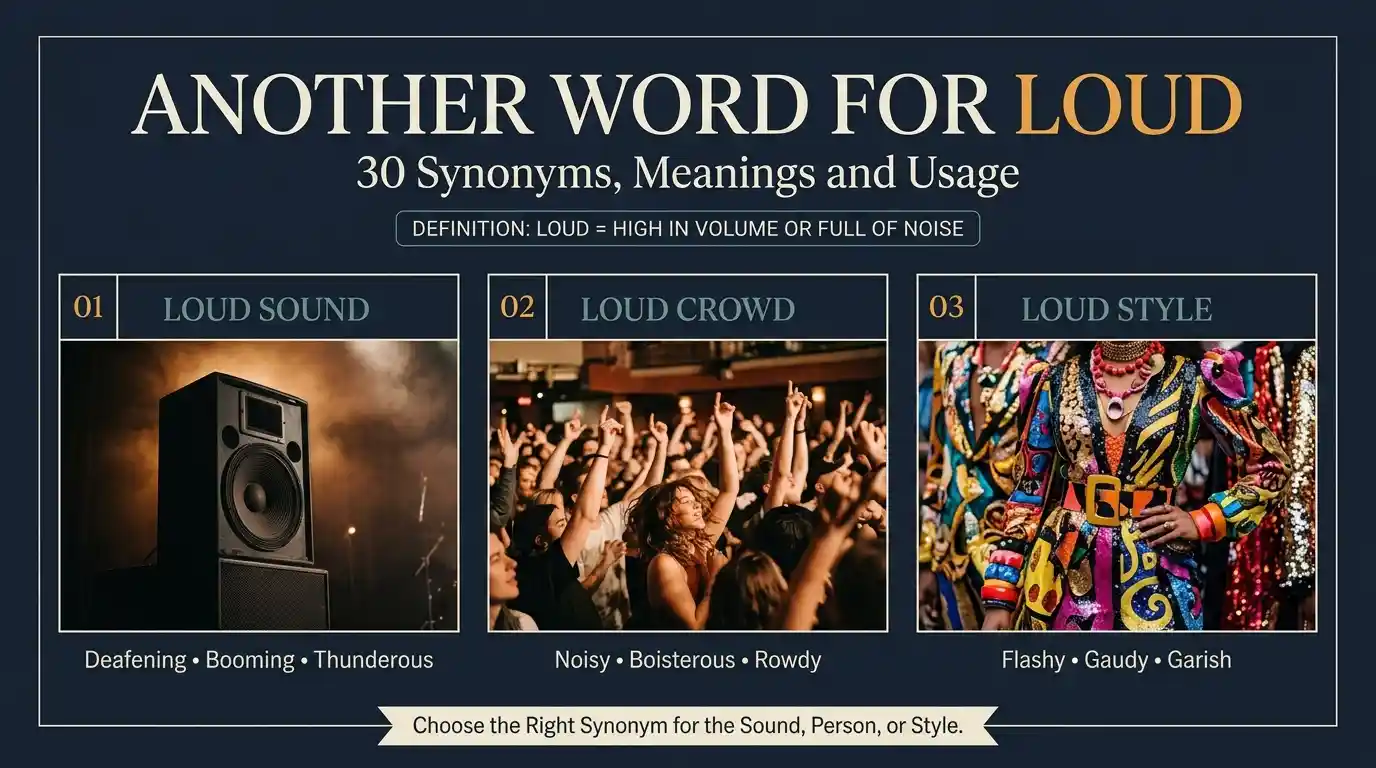
Another word for loud is noisy, deafening, booming, or thunderous. Noisy is the closest everyday choice, deafening describes extreme volume, and booming and thunderous fit deep, powerful sounds. In some contexts, loud means something else, so you may also want a word like rowdy, vociferous, or flashy.
The best alternative depends on what is loud. A sound can be loud, a crowd can be loud, an opinion can be loud, and even a shirt can be loud. Each use has its own set of words, and the choice also changes the tone, from neutral and descriptive to critical or humorous.
Quick list: noisy, deafening, booming, thunderous, ear-splitting, shrill, boisterous, rowdy, vociferous, flashy
Below are 30 alternatives with meanings, IPA, usage notes, examples, and context. Some are close synonyms and some fit only one meaning of loud, and each usage note says which.
At a Glance: Loud Synonyms and Related Alternatives
| Alternative | Part of Speech | Meaning | Register / Tone | Ideal Context |
| Noisy | adjective | Making a lot of noise | Neutral | Crowds, streets, children, rooms |
| Deafening | adjective | So loud it is hard to hear anything else | Neutral to dramatic | Explosions, engines, cheering |
| Booming | adjective | Deep, loud, and carrying | Neutral | Voices, drums, thunder |
| Ear-splitting | adjective | So loud it hurts the ears | Informal to neutral | Screams, alarms, sirens |
| Shrill | adjective | High-pitched and sharp | Neutral, often negative | Whistles, voices, alarms |
| Boisterous | adjective | Noisy, energetic, and cheerful | Neutral to positive | Groups, parties, children |
| Rowdy | adjective | Noisy and rough | Informal, negative | Crowds, fans, parties |
| Vociferous | adjective | Loud and forceful in expressing opinions | Formal | Critics, protests, campaigns |
| Flashy | adjective | Bright and showy | Informal | Clothes, cars, style |
| Loudly | adverb | In a loud way | Neutral | Speaking, playing, knocking |
Which Word Should You Use?
| If you want to… | Use | Why |
| Describe a room or crowd full of sound | noisy | It covers many sounds at once. |
| Describe painfully loud sound | deafening, ear-splitting | They show extreme volume. |
| Describe a deep, powerful voice or drum | booming | It suggests depth as well as volume. |
| Describe a high, sharp sound | shrill, piercing | They focus on pitch and sharpness. |
| Describe a cheerful, lively group | boisterous | It sounds energetic and friendly. |
| Describe a rough, unruly crowd | rowdy | It suggests noise plus bad behavior. |
| Describe forceful public opinions | vociferous | It shows strong, loud expression. |
| Describe bright, attention-seeking colors or clothes | flashy, garish | They match the “showy” sense of loud. |
| Say music is turned to maximum volume | at full blast | It is a common phrase for music and engines. |
Exploring the Multiple Meanings of “Loud”
1. High in Volume
- Meaning: Strongly audible, with great volume or intensity.
- Explanation: This is the main meaning. It can describe thunder, music, a voice, or any other sound.
- Example: The thunder was so loud that the dog hid under the bed.
2. Noisy or Rowdy
- Meaning: Making or filled with a lot of noise, often in a disturbing way.
- Explanation: This sense describes places, events, and people. It suggests a general racket, not one sharp sound.
- Example: The party next door was too loud for us to sleep.
3. Emphatic or Insistent
- Meaning: Strong and forceful in expressing a view or demand.
- Explanation: Here the word describes opinions, protests, and complaints. It does not always mean the sound is high in volume.
- Example: There was a loud protest against the new rules.
4. Showy or Flashy
- Meaning: Too bright or eye-catching, especially in clothes or colors.
- Explanation: This figurative sense often carries mild criticism. It treats color or style as if it were “shouting” for attention.
- Example: He wore a loud red tie to the meeting.
5. In a Loud Way (Adverb)
- Meaning: At high volume.
- Explanation: Loud is used as an informal adverb after verbs such as talk, speak, and play. The standard adverb is loudly.
- Example: Don’t talk so loud in the library.
Sources: Merriam-Webster; Collins English Dictionary; Dictionary.com; Cambridge Dictionary
Analyzing 30 Loud Alternatives in Detail
Some alternatives below are direct synonyms for high volume, while others fit only certain meanings, such as rowdy behavior or showy style. The usage notes mark which is which.
Group 1: Core Synonyms for High Volume
1. Noisy
IPA: /ˈnɔɪzi/ (US and UK)
Definition: Making a lot of noise, or full of noise.
- Usage: The closest everyday synonym. It suggests many sounds or constant sounds, often annoying ones, more than a single strong sound.
- Example: The children were noisy during dinner.
2. Deafening
IPA: /ˈdɛfənɪŋ/ (US and UK)
Definition: So loud that it is hard to hear anything else.
- Usage: A direct synonym, but stronger than loud. It describes extreme volume.
- Example: The crowd’s cheering was deafening.
3. Booming
IPA: /ˈbuːmɪŋ/ (US and UK)
Definition: Having a deep, loud, and carrying sound.
- Usage: A related alternative. It stresses depth and power as well as volume, and it fits voices, drums, and thunder.
- Example: A booming voice filled the hall.
4. Thunderous
IPA: /ˈθʌndərəs/ (US and UK)
Definition: Very loud, like thunder.
- Usage: A related alternative with a dramatic tone. It is common with applause, cheering, and footsteps.
- Example: The team was greeted with thunderous applause.
5. Resounding
IPA: /rɪˈzaʊndɪŋ/ (US and UK)
Definition: Loud and echoing; also, clear and complete.
- Usage: A related alternative. It fits cheers, applause, and noises that echo. Note that “resounding success” uses a different meaning, “complete.”
- Example: A resounding cheer rose from the stadium.
Group 2: Harsh, Sharp, and Painful Sounds
6. Ear-splitting
IPA: US /ˈɪrˌsplɪtɪŋ/ · UK /ˈɪəˌsplɪtɪŋ/
Definition: So loud that it hurts the ears.
- Usage: A close, strong synonym. It focuses on pain and discomfort, so use it for screams, alarms, and sirens.
- Example: An ear-splitting scream came from upstairs.
7. Piercing
IPA: US /ˈpɪrsɪŋ/ · UK /ˈpɪəsɪŋ/
Definition: Sharp and loud, and hard to ignore.
- Usage: A related alternative. It describes a sharp, high sound more than sheer volume.
- Example: A piercing whistle stopped the game.
8. Shrill
IPA: /ʃrɪl/ (US and UK)
Definition: High-pitched and unpleasantly sharp.
- Usage: A related alternative. It describes pitch, so a shrill sound is not always very loud.
- Example: The shrill alarm woke everyone.
9. Blaring
IPA: US /ˈblerɪŋ/ · UK /ˈbleərɪŋ/
Definition: Making a loud, harsh sound.
- Usage: A close alternative, often used for machines such as horns, radios, TVs, and sirens.
- Example: A blaring horn startled the cyclist.
10. Strident
IPA: /ˈstraɪdənt/ (US and UK)
Definition: Loud and harsh in an unpleasant way.
- Usage: A related, formal alternative. It describes voices, noises, and sometimes forceful opinions.
- Example: Her strident voice carried across the room.
Group 3: Noisy Crowds and Lively Groups
11. Boisterous
IPA: /ˈbɔɪstərəs/ (US and UK)
Definition: Noisy, energetic, and cheerful.
- Usage: A related alternative for people and groups. It is friendly and lively, so it is less negative than rowdy.
- Example: A boisterous crowd filled the pub.
12. Rowdy
IPA: /ˈraʊdi/ (US and UK)
Definition: Noisy and rough, likely to cause trouble.
- Usage: A related, informal alternative. It adds bad behavior to the noise.
- Example: Rowdy fans were asked to leave the stadium.
13. Raucous
IPA: /ˈrɔːkəs/ (US and UK)
Definition: Loud and harsh; also, rowdy and lively.
- Usage: A related alternative for rough sounds or noisy gatherings. It is mildly negative.
- Example: Raucous laughter came from the kitchen.
14. Clamorous
IPA: /ˈklæmərəs/ (US and UK)
Definition: Making a loud, continuous noise, often while demanding something.
- Usage: A related, formal alternative. It is uncommon in everyday speech and fits crowds or protests.
- Example: A clamorous crowd gathered outside the court.
15. Uproarious
IPA: /ʌpˈrɔːriəs/ (US and UK)
Definition: Very noisy, especially with laughter.
- Usage: A related alternative. It is mostly used for laughter and fun, so it does not fit harsh noise.
- Example: The comedian got uproarious laughter from the audience.
Group 4: Forceful Voices and Opinions
16. Vociferous
IPA: US /voʊˈsɪfərəs/ · UK /vəʊˈsɪfərəs/
Definition: Expressing opinions in a loud and forceful way.
- Usage: A related, formal alternative for people, critics, and protests. It describes forceful expression, not literal volume, so do not use it for noises.
- Example: She was a vociferous critic of the plan.
17. Stentorian
IPA: /stɛnˈtɔːriən/ (US and UK)
Definition: Having a very loud, powerful voice.
- Usage: A formal or literary alternative, used almost only for voices. The word comes from Stentor, a loud-voiced herald in Homer’s Iliad.
- Example: The captain gave orders in a stentorian voice.
18. Emphatic
IPA: /ɪmˈfætɪk/ (US and UK)
Definition: Said or done with force and clear stress.
- Usage: A related alternative for the “forceful” sense of loud. It does not mean high volume.
- Example: She gave an emphatic no.
19. Insistent
IPA: /ɪnˈsɪstənt/ (US and UK)
Definition: Firmly repeating a demand, and hard to ignore.
- Usage: A related alternative. It describes demands, calls, and sounds that keep coming, such as knocking or a ringing phone.
- Example: The insistent ring of the phone woke him.
20. Loud-mouthed
IPA: /ˌlaʊdˈmaʊðd/ (US and UK)
Definition: Talking in a loud, annoying, or boastful way.
- Usage: An informal, negative alternative that describes people only. Avoid it in polite or formal writing.
- Example: A loud-mouthed customer argued with the staff.
Group 5: Showy and Flashy Alternatives
21. Flashy
IPA: /ˈflæʃi/ (US and UK)
Definition: Bright and showy in a way meant to impress.
- Usage: A related alternative for the “showy” sense of loud. It is informal and often mildly critical.
- Example: He drives a flashy red car.
22. Showy
IPA: US /ˈʃoʊi/ · UK /ˈʃəʊi/
Definition: Attracting attention by being bright or fancy.
- Usage: A related alternative. It can be neutral or mildly negative.
- Example: The showy flowers filled the garden.
23. Gaudy
IPA: /ˈɡɔːdi/ (US and UK)
Definition: Too bright and showy in a cheap-looking way.
- Usage: A related, negative alternative. It criticizes taste.
- Example: The room was full of gaudy decorations.
24. Garish
IPA: US /ˈɡɛrɪʃ/ · UK /ˈɡeərɪʃ/
Definition: Unpleasantly bright and harsh to look at.
- Usage: A related, negative alternative for colors and lights. It describes how things look, not sounds.
- Example: The shop had garish neon signs.
25. Lurid
IPA: US /ˈlʊrɪd/ · UK /ˈlʊərɪd/
Definition: Shockingly bright or vivid.
- Usage: A related, dramatic alternative for strong colors. It also describes shocking details in stories.
- Example: She wore a lurid green scarf.
Group 6: Adverbs and Phrases for Speaking and Playing Loudly
26. Loudly
IPA: /ˈlaʊdli/ (US and UK)
Definition: In a way that makes a lot of noise.
- Usage: The standard adverb form of loud. Use it in formal and neutral writing.
- Example: He knocked loudly on the door.
27. At full blast
IPA: US /æt ˌfʊl ˈblæst/ · UK /æt ˌfʊl ˈblɑːst/
Definition: At the greatest volume or power.
- Usage: An informal phrase for music, radios, TVs, and engines.
- Example: The radio was playing at full blast.
28. At the top of your voice
IPA: US /æt ðə ˌtɑːp əv jɔːr ˈvɔɪs/ · UK /æt ðə ˌtɒp əv jɔː ˈvɔɪs/
Definition: As loudly as you can speak or shout.
- Usage: A related phrase for shouting and singing. It focuses on effort, not just volume.
- Example: She sang at the top of her voice.
29. Full-throated
IPA: US /ˌfʊl ˈθroʊtɪd/ · UK /ˌfʊl ˈθrəʊtɪd/
Definition: Loud, strong, and without holding back.
- Usage: A related, energetic alternative for singing, cheering, and laughing.
- Example: The fans gave a full-throated cheer.
30. Aloud
IPA: /əˈlaʊd/ (US and UK)
Definition: In a way that can be heard.
- Usage: A related alternative with a limit. It means “audibly,” not “at high volume,” so reading aloud can be done quietly.
- Example: She read the poem aloud.
Sources: Merriam-Webster; Collins English Dictionary and Thesaurus; Dictionary.com; Cambridge Dictionary
Loud vs. Noisy vs. Raucous vs. Deafening
These four words all describe strong sound, but each puts the focus in a different place.
| Word | Main Focus | Often Describes | Example |
| Loud | Strong volume | Voices, laughs, thunder, music | She has a loud laugh. |
| Noisy | Many sounds, often annoying | Crowds, streets, children | The street was noisy at night. |
| Raucous | Harsh, rough, and lively | Laughter, crowds, parties | The raucous crowd sang along. |
| Deafening | Extreme volume | Explosions, engines, cheering | The explosion was deafening. |
Dictionary.com explains the main difference: loud describes a full, powerful sound, while noisy suggests a series of sounds that are disturbing, discordant, or constant. A single drum can be loud, while a busy classroom is noisy. Raucous adds a rough or rowdy feeling, and deafening is the strongest of the four.
Sources: Dictionary.com; Merriam-Webster; Collins English Dictionary
Loud and Opposite/Paired Word Pairs
| Word | Paired Word | Note |
| Loud | Quiet | The most common opposite. It works for sound, people, and places. |
| Loud | Soft | Fits sound level, as in a soft voice. |
| Loud | Silent | Means no sound at all, so it is stronger than quiet. |
| Loud | Muted | Fits both sound and color. |
| Loud | Subdued | Fits colors, clothes, and moods. |
| Loud | Understated | Fits style and design. |
| Loud | Gentle | Fits tone and manner, as in a gentle voice. |
Quiet is the standard opposite for sound, and soft often fits voices and music. For the “showy” sense of loud, muted, subdued, and understated are better opposites, because they describe colors and style rather than noise.
Sources: Dictionary.com; Merriam-Webster; Collins English Dictionary
Common Word Partners of “Loud”
| Pattern | Common Partners | Example |
| loud + noun (sound) | noise, bang, crash, voice, music, cheer, applause, knock | A loud bang shook the windows. |
| adverb + loud | too, very, extremely, incredibly, so | The music was so loud that we could not talk. |
| verb + louder | get, grow, become | The storm grew louder through the night. |
| loud + enough + to | loud enough to wake, loud enough to hear | Her voice was loud enough to reach the back row. |
| loud + noun (style) | tie, shirt, print, pattern, colors | He wore a loud tie with yellow stripes. |
| loud + noun (person or behavior) | laugh, person, complaint | She has a loud laugh that everyone recognizes. |
Sources: Collins English Dictionary; Cambridge Dictionary; Merriam-Webster
Idiomatic Phrases Featuring “Loud”
1. Loud and clear
- Meaning: Clearly and fully understood, used when a message has been received.
- Example: I hear you loud and clear, so I’ll start on it today.
2. Out loud
- Meaning: In a voice that can be heard, not silently. It is common in phrases like “laugh out loud,” “think out loud,” and “read out loud.”
- Example: She said her answer out loud so everyone could hear.
3. For crying out loud
- Meaning: An informal phrase that shows annoyance, surprise, or impatience.
- Example: For crying out loud, I asked you to clean your room an hour ago.
4. Loud and proud
- Meaning: Openly and confidently, without hiding or feeling ashamed. It is informal.
- Example: The fans sang the anthem loud and proud.
Sources: Collins English Dictionary; Cambridge Dictionary; Dictionary.com
Word Formation of “Loud”
Etymology & Structure
Loud comes from Middle English, which took it from Old English hlūd, meaning “noisy” or “producing sound.” According to Etymonline, it goes back to Proto-Germanic *hludaz, meaning “heard,” and further to a Proto-Indo-European root meaning “to hear.” So the word first described something that could be heard. Related words in other languages include Dutch luid and German laut.
Date and History
Loud is an old Germanic word that goes back to Old English. Etymonline notes that it was applied to noisy places by the 1590s, and the “showy, flashy” sense for colors and clothes is recorded from 1849. The adverb loudly appears around 1400.
Word Class Variations
- Adjective: loud (comparative: louder, superlative: loudest)
- Adverb: loud (informal), loudly
- Noun: loudness
- Related compounds: loud-mouthed, loudmouth, loudspeaker
Sources: Etymonline; Merriam-Webster; Collins English Dictionary
Common Word-Choice Mistakes
- Wrong: “She laughed loud out.” Correct: “She laughed out loud.”
- Wrong: “Please read the text loud.” Correct: “Please read the text aloud.” (Or “out loud.”)
- Wrong: “The loud of the traffic kept me awake.” Correct: “The noise of the traffic kept me awake.” (Loud is an adjective, not the usual noun.)
- Wrong: “Turn the volume loud.” Correct: “Turn the volume up.”
- Wrong: “A vociferous noise came from the street.” Correct: “A loud noise came from the street.” (Vociferous describes forceful expression by people, not noises.)
- Wrong: “The garish music hurt my ears.” Correct: “The blaring music hurt my ears.” (Garish describes how things look.)
- Wrong: “The stentorian music filled the room.” Correct: “The booming music filled the room.” (Stentorian describes voices.)
FAQs
1. What is the closest synonym for loud?
Noisy is the closest everyday synonym. Deafening is a stronger choice for extreme volume.
2. What is the difference between loud and noisy?
Loud describes strong volume, while noisy suggests many sounds or constant, annoying sound. One drum can be loud, but a busy playground is noisy.
3. What is a formal word for loud?
Clamorous, vociferous, stentorian, and strident are formal. Each fits a different context, so check the usage notes above.
4. What word describes a loud voice?
Booming fits a deep, strong voice, and stentorian is a formal option. Shrill and piercing describe high, sharp voices.
5. What word describes loud colors?
Garish, gaudy, flashy, and lurid all fit. Garish and gaudy are negative, while flashy is more informal.
6. What word describes a loud person?
Boisterous is friendly and lively, rowdy suggests rough behavior, and loud-mouthed is negative and informal.
7. What is the opposite of loud?
Quiet and soft are the most common opposites for sound. For colors and style, muted, subdued, and understated work better.
8. Can loud mean “showy”?
Yes. Dictionaries list “showy or flashy” as a meaning, especially for clothes and colors, as in “a loud tie.”
9. Is loud an adverb?
Yes, but only informally, as in “Don’t talk so loud.” In formal writing, use loudly.
10. Does “out loud” mean the same as loud?
No. Out loud means “in a voice that can be heard,” so you can read out loud in a quiet voice.
Conclusion
The closest alternatives to loud are noisy, deafening, booming, and thunderous. Ear-splitting, piercing, and shrill describe harsh sounds, while boisterous and rowdy describe lively crowds. Vociferous and emphatic fit forceful opinions, and flashy and garish fit colors and clothes.
Context matters because loud covers several meanings, including volume, noise, forceful expression, and showy style. Words like shrill, vociferous, and garish look similar to loud but describe pitch, opinion, or appearance, so they do not always fit.
To choose the right word, first decide what is being described: a sound, a crowd, an opinion, or a style. Then decide how strong and how negative you want to sound. When you are unsure, loud and noisy are clear choices, and the alternatives above can add detail.
Discover more Article

Hello,I’m Natalia, a professional content writer with three years of experience. My niche is Another Word for, where I create clear, engaging, and SEO-friendly content about words, meanings, synonyms, phrases, and language. I turn complex word-related topics into simple, useful content for readers.