30 Another Word for Secure: Synonyms With Meaning & Examples
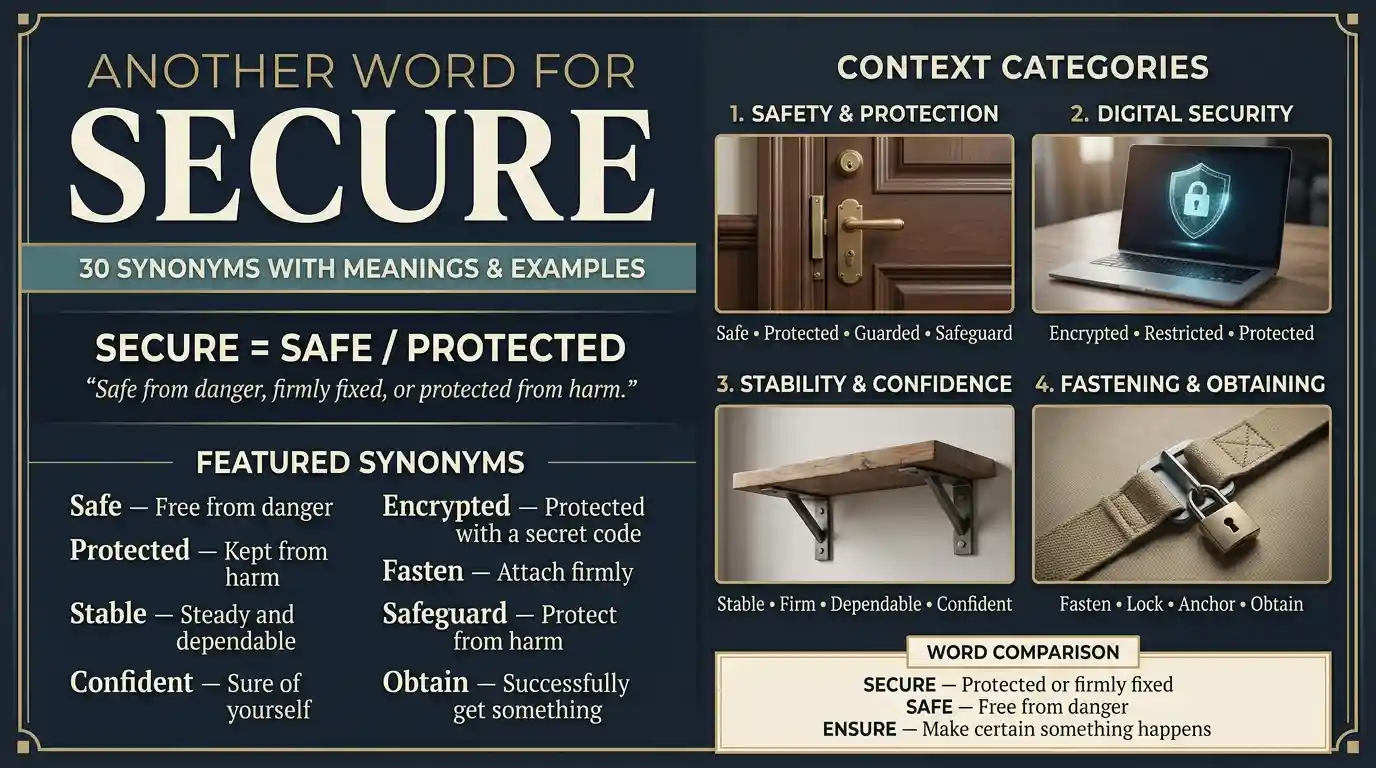
The closest everyday alternative to “secure” is safe. Other common choices are protected, stable, firm, and confident. As a verb, “secure” is often replaced by fasten, safeguard, obtain, or guarantee.
The best alternative depends on what “secure” means in your sentence. It can mean safe from danger, protected from unauthorized access, firmly fixed, or free from worry. As a verb, it can mean to fasten, to protect, or to get something you wanted.
Quick list: safe, protected, stable, firm, confident, fasten, safeguard, obtain, get, guarantee
This article looks at 30 alternatives. Each has a definition, IPA, a usage note, and an example, so you can match the word to the situation.
At a Glance: Secure Synonyms and Related Alternatives
| Alternative | Part of Speech | Meaning | Register / Tone | Ideal Context |
| Safe | Adjective | Free from danger or harm | Neutral | Places, people, things |
| Protected | Adjective | Kept from harm, loss, or attack | Neutral | Data, property, rights |
| Stable | Adjective | Not likely to change or fail | Neutral | Jobs, income, relationships |
| Firm | Adjective | Solid and steady | Neutral | Physical objects, ground |
| Confident | Adjective | Sure of yourself or the result | Neutral | Feelings and beliefs |
| Encrypted | Adjective | Turned into a secret code | Technical | Messages, files, payments |
| Fasten | Verb | To attach or close firmly | Neutral | Belts, lids, straps |
| Safeguard | Verb | To protect from harm or loss | Formal | Rights, data, health |
| Obtain | Verb | To get something, often with effort | Formal | Loans, permits, jobs |
| Guarantee | Verb | To promise or make certain | Neutral to formal | Contracts, loans, results |
Which Word Should You Use?
| If you want to… | Use | Why |
| Say a place or thing is free from danger | Safe | It is the simplest and most common choice. |
| Say messages or data cannot be read by others | Encrypted | It names the exact way the data is protected. |
| Say a job or income is not likely to end | Stable | It points to steadiness over time. |
| Say an object is firmly attached | Fixed | It shows the object will not move. |
| Say someone feels calm and free from worry | At ease | It describes the feeling in plain words. |
| Close a door or bike with a key | Lock | It names the action clearly. |
| Protect rights, data, or health | Safeguard | It sounds careful and formal. |
| Get a job, loan, or win | Get (casual), obtain (formal), clinch (final win) | Each one fits a different tone. |
Exploring the Multiple Meanings of “Secure”
1. Safe From Danger or Harm (Adjective)
- Meaning: Free from danger, harm, or attack.
- Explanation: This is the most common sense. It can describe a place, a person, or a thing. It often suggests that something has been done to protect it, such as a lock or a guard.
- Example: The baby is secure in her crib.
2. Protected From Unauthorized Access (Adjective)
- Meaning: Safe from being entered, copied, or listened to by people without permission.
- Explanation: This sense is common for networks, websites, passwords, phone lines, and buildings.
- Example: Always use a secure connection when you pay online.
3. Firmly Fixed or Stable (Adjective)
- Meaning: Firm, steady, and not likely to fail, move, or be lost.
- Explanation: It can describe objects, such as a ladder, and also jobs, incomes, and investments.
- Example: He wanted a secure job with steady pay.
4. Free From Worry (Adjective)
- Meaning: Calm and confident, not afraid or anxious.
- Explanation: This sense describes feelings, as in “feel secure” or “emotionally secure.” It is about a general sense of calm, not certainty about one result.
- Example: Children feel secure when they know what to expect.
5. To Fasten or Protect (Verb)
- Meaning: To fasten something firmly, or to make something safe from attack or loss.
- Explanation: The object is usually a thing, such as a door, a rope, or a border.
- Example: Secure the ladder before you climb.
6. To Obtain or Guarantee (Verb)
- Meaning: To get something, often with effort, or to guarantee a debt with a pledge.
- Explanation: This sense is common with jobs, funding, wins, and deals. In finance, a “secured loan” is backed by property or another asset.
- Example: The school secured funding for a new library.
Sources: Dictionary.com lists several senses of “secure,” including safe, firm, free from care, and safe from unauthorized access, plus verb senses such as to obtain and to fasten. Also Merriam-Webster (secure); Collins English Dictionary (secure)
Analyzing 30 Secure Alternatives in Detail
Some alternatives below are close synonyms of “secure,” while others are related words that fit only one meaning, such as fastening, protecting, or getting something.
Safe and Protected (Adjectives)
1. Safe
IPA: (US and UK) /seɪf/
Definition: Free from danger or harm.
- Usage: The closest everyday synonym of the adjective “secure.” It is simpler and more general. “Secure” often suggests protection that someone has put in place.
- Example: The children are safe at home.
2. Protected
IPA: (US and UK) /prəˈtɛktɪd/
Definition: Kept from harm, loss, or attack.
- Usage: A close synonym when you want to show that something defends the thing. It is often followed by “by” or “from.”
- Example: The files are protected from loss by daily backups.
3. Guarded
IPA: US /ˈɡɑːrdɪd/ · UK /ˈɡɑːdɪd/
Definition: Watched over and kept under protection.
- Usage: A related alternative. It suggests that people or devices are watching. “Guarded” can also mean careful in speech, as in “a guarded answer,” which is a different meaning.
- Example: The gold is kept in a guarded room.
4. Sheltered
IPA: US /ˈʃɛltərd/ · UK /ˈʃɛltəd/
Definition: Protected from weather or danger.
- Usage: A related alternative for places that block wind, rain, or trouble. “A sheltered life” means a life with little contact with hard things, which is a different meaning.
- Example: The boats stay in a sheltered bay.
5. Impregnable
IPA: (US and UK) /ɪmˈprɛɡnəbəl/
Definition: Impossible to enter or capture by force.
- Usage: A related, stronger and formal alternative. It fits forts, walls, and strong positions. It is much stronger than “secure.”
- Example: The old fort seemed impregnable.
Technology and Access
6. Encrypted
IPA: (US and UK) /ɪnˈkrɪptɪd/
Definition: Changed into a secret code so that people without permission cannot read it.
- Usage: A related alternative for the technology sense only. “Secure” is broader, because a secure system can include many protections besides encryption.
- Example: All messages in the app are encrypted.
7. Tamper-proof
IPA: US /ˈtæmpər pruːf/ · UK /ˈtæmpə pruːf/
Definition: Made so that it cannot be changed on purpose, or so that any attempt shows.
- Usage: A related alternative for seals, packaging, and software. It focuses on stopping changes, not on all kinds of danger.
- Example: The medicine comes in tamper-proof packaging.
8. Restricted
IPA: (US and UK) /rɪˈstrɪktɪd/
Definition: Limited to certain people.
- Usage: A related alternative for places and information that only some people may use, as in “a secure area.” It does not say the place is safe.
- Example: Only staff may enter the restricted area.
Firm, Stable, and Dependable
9. Stable
IPA: (US and UK) /ˈsteɪbəl/
Definition: Not likely to change, fail, or fall.
- Usage: A close synonym for “secure” when it means steady, as with a job, income, or relationship.
- Example: She found a stable job with good pay.
10. Firm
IPA: US /fɜːrm/ · UK /fɜːm/
Definition: Solid and steady; not easily moved.
- Usage: A related alternative for the physical sense of “secure.” It describes ground, grips, and supports.
- Example: Make sure the ladder stands on firm ground.
11. Sturdy
IPA: US /ˈstɜːrdi/ · UK /ˈstɜːdi/
Definition: Strong and well made; not easily broken.
- Usage: A related alternative that describes how strong an object is. It does not mean the object is locked or guarded.
- Example: He built a sturdy shelf for the books.
12. Fixed
IPA: (US and UK) /fɪkst/
Definition: Firmly attached or placed so that it does not move.
- Usage: A close synonym for the physical sense. It is common in “fixed in place” and “fixed to the wall.”
- Example: The shelf is fixed to the wall.
13. Dependable
IPA: (US and UK) /dɪˈpɛndəbəl/
Definition: Able to be trusted to do what is needed.
- Usage: A related alternative for things people rely on, such as an income or a support. It does not mean protected.
- Example: The farm gives the family a dependable income.
Free From Worry or Doubt
14. Confident
IPA: US /ˈkɑːnfɪdənt/ · UK /ˈkɒnfɪdənt/
Definition: Sure of yourself or of what will happen.
- Usage: A related alternative for the feeling sense. It is closer to certainty about a result than to a general sense of calm.
- Example: She felt confident about the interview.
15. Assured
IPA: US /əˈʃʊrd/ · UK /əˈʃɔːd/
Definition: Certain or confident; also guaranteed.
- Usage: A related, slightly formal alternative. It fits a person who feels sure or a result that seems sure.
- Example: With three goals ahead, the win seemed assured.
16. Certain
IPA: US /ˈsɜːrtn/ · UK /ˈsɜːtn/
Definition: Completely sure that something is true or will happen.
- Usage: A related alternative. It matches the older sense “secure of victory,” but it is not about feeling calm or protected.
- Example: He is certain that the plan will work.
17. At ease
IPA: (US and UK) /æt ˈiːz/
Definition: Relaxed and free from worry.
- Usage: A related phrase for the feeling sense. It is warm and plain, and it fits people better than objects.
- Example: She felt at ease in her new home.
Verbs for Fastening and Protecting
18. Fasten
IPA: US /ˈfæsn/ · UK /ˈfɑːsn/
Definition: To attach or close something firmly.
- Usage: A direct synonym for the verb “secure” in the physical sense.
- Example: Please fasten your seat belt.
19. Tie
IPA: (US and UK) /taɪ/
Definition: To attach or hold something with rope, string, or a similar cord.
- Usage: A direct synonym when a rope or cord is used. It is narrower than “secure.”
- Example: He tied the boat to the dock.
20. Lock
IPA: US /lɑːk/ · UK /lɒk/
Definition: To close or fix something with a key or similar device.
- Usage: A direct synonym for doors, bikes, and gates. It works only when something can be locked.
- Example: Lock the door before you leave.
21. Anchor
IPA: US /ˈæŋkər/ · UK /ˈæŋkə/
Definition: To fix something firmly in place, as a ship with an anchor.
- Usage: A related alternative for ships and for heavy or tall objects that must not move.
- Example: The workers anchored the tower to a concrete base.
22. Safeguard
IPA: US /ˈseɪfɡɑːrd/ · UK /ˈseɪfɡɑːd/
Definition: To protect something from harm or loss.
- Usage: A direct, formal synonym for the “protect” sense. It is common with rights, data, and health.
- Example: The law safeguards workers’ rights.
23. Defend
IPA: (US and UK) /dɪˈfɛnd/
Definition: To protect something from attack.
- Usage: A related alternative. It implies a real attack or threat, while “secure” can be quieter.
- Example: Soldiers defended the bridge for two days.
24. Shield
IPA: (US and UK) /ʃiːld/
Definition: To protect someone or something from harm or danger.
- Usage: A related alternative that suggests a barrier standing in the way. It is also a noun.
- Example: A tall fence shields the yard from the wind.
Verbs for Obtaining and Guaranteeing
25. Get
IPA: (US and UK) /ɡɛt/
Definition: To receive or obtain something.
- Usage: The simplest everyday alternative for “secure a job” or “secure a seat.” It is casual and does not suggest effort the way “secure” does.
- Example: She got a place at a good school.
26. Obtain
IPA: (US and UK) /əbˈteɪn/
Definition: To gain something, often through effort or by following a process.
- Usage: A direct, formal synonym for “secure” in the sense of getting. It fits permits, loans, and approval.
- Example: He obtained a loan from the bank.
27. Win
IPA: (US and UK) /wɪn/
Definition: To gain something through effort or competition.
- Usage: A related alternative for contests, contracts, and prizes. It does not fit things you do not compete for.
- Example: The company won a big contract.
28. Clinch
IPA: (US and UK) /klɪntʃ/
Definition: To settle something for certain, especially a win or a deal.
- Usage: A related, informal alternative. It suggests the final move that makes the result certain.
- Example: A late goal clinched the win.
29. Guarantee
IPA: (US and UK) /ˌɡærənˈtiː/
Definition: To promise that something will happen, or to promise to pay if someone does not.
- Usage: A related alternative that is stronger than “secure.” It is a promise, so it fits contracts, loans, and delivery.
- Example: The company guarantees delivery in two days.
30. Ensure
IPA: US /ɪnˈʃʊr/ · UK /ɪnˈʃɔː/
Definition: To make certain that something happens.
- Usage: A related, formal alternative. It shares the idea of “making sure,” but it is not used for fastening or for getting a job or prize.
- Example: Please ensure that the gate is closed.
Sources: Merriam-Webster; Collins English Dictionary; Dictionary.com; Oxford Learner’s Dictionaries; Cambridge Dictionary
Secure vs. Safe vs. Ensure vs. Assure vs. Insure
Merriam-Webster says that “ensure,” “insure,” “assure,” and “secure” all share the idea of making something or someone sure, and that “secure” suggests taking action to guard against attack or loss. The table shows how they differ.
| Word | Part of Speech | Main Meaning | Example |
| Secure | Adjective, verb | Protected, firm, or free from worry; to fasten, protect, or obtain | The company secured a loan. |
| Safe | Adjective | Free from danger or harm | The street is safe at night. |
| Ensure | Verb | To make certain something happens | Please ensure the gate is closed. |
| Assure | Verb | To tell someone with confidence; to promise | He assured me that help was coming. |
| Insure | Verb | To cover with insurance | She insured her car. |
“Safe” describes a state of being free from harm. “Secure” often points to the protection behind that state, such as a lock or a password. A bike can be safe because nobody is near it, but it is secure only if it is locked.
Sources: Merriam-Webster (secure, Choose the Right Synonym); Dictionary.com (secure); Cambridge Dictionary (ensure, assure, insure)
Secure and Opposite/Paired Word Pairs
| Word | Paired Word | Note |
| Secure | Insecure | The clearest opposite. It fits both feelings and weak protection. |
| Secure | Unsafe | The opposite of the “safe from danger” sense. |
| Secure | Vulnerable | The opposite when something can be hurt or attacked easily. |
| Secure | Exposed | The opposite when something is open to danger or view. |
| Secure | Unstable | The opposite of the “firm and steady” sense. |
| Secure (verb) | Unfasten / loosen | The opposite of fastening something. |
| Secure (verb) | Lose | The opposite of getting something, as with a job or a deal. |
| Safe | Secure | A common pair in the phrase “safe and secure.” |
“Secure” has several opposites because it has several meanings. For danger, it is “unsafe” or “vulnerable.” For fastening, it is “loosen.”
Sources: Dictionary.com (secure, antonyms); Merriam-Webster Thesaurus; Collins Thesaurus
Common Word Partners of “Secure”
| Pattern | Common Partners | Example |
| secure + noun | connection, password, network, building, location, foundation, area | You are entering a secure area. |
| feel / be + secure | feel secure, feel secure in, financially secure, emotionally secure | She feels secure in her job. |
| secure + from / against | secure from theft, secure against attack | The village is secure against floods. |
| secure + noun (verb) | a loan, funding, a job, a victory, a deal, the borders | The team secured a spot in the final. |
| secure + to | secure it to the wall, secure a bike to a tree | Secure the shelf to the wall. |
| securely + verb | securely fastened, securely attached, securely locked | The box was securely tied. |
| secure in the knowledge | secure in the knowledge that help was near | They slept secure in the knowledge that help was near. |
Sources: Merriam-Webster (secure, example sentences); Dictionary.com (secure); Oxford Learner’s Dictionaries (secure); Collins English Dictionary (secure)
Idiomatic Phrases Featuring “Secure”
“Secure” has few true idioms. The four items below are established expressions, not figurative idioms.
1. Safe and secure
- Meaning: Completely protected from danger or harm. It is a fixed pair of words.
- Example: The packages arrived safe and secure.
2. Secure in the knowledge that…
- Meaning: Feeling calm because you know something good or reassuring is true.
- Example: She slept well, secure in the knowledge that her family was nearby.
3. Secure the perimeter
- Meaning: To make sure that the outer edge of an area is protected or closed off. It is common in police, military, and security talk.
- Example: The guards secured the perimeter before the event began.
4. Secure for sea
- Meaning: A nautical order to fasten everything on a ship before it leaves port.
- Example: The captain told the crew to secure for sea.
Sources: Merriam-Webster (secure); Dictionary.com (secure); Collins English Dictionary (secure)
Word Formation of “Secure”
Etymology & Structure
“Secure” comes from the Latin word securus. Latin securus meant free from care, and it came from se, meaning free from, plus cura, meaning care. So the word first described a person without worries, not a locked door. The older English form, “siker,” came from Old English sicor, and “sure” is a doublet of “secure.” A doublet is a word that came from the same source by a different route.
Date and History
Etymonline dates the adjective to the 1530s, first in a sense that is now archaic, meaning without care or fear. It says the meaning “free from danger” for places appeared by about 1600, and the meaning “firmly fixed” for objects by 1841. Merriam-Webster gives about 1545 as the first known use. The verb appeared around 1600 with the meaning “to make safe,” and the meaning “to ensure” or “guarantee” appeared in the 1650s.
Word Class Variations
- Adjective: secure (securer or more secure, securest or most secure)
- Verb: secure, secures, secured, securing
- Adverb: securely
- Noun: security (plural securities in finance)
- Related forms: insecure, insecurity, unsecured
Sources: Etymonline (secure); Merriam-Webster (secure); Dictionary.com (secure)
Common Word-Choice Mistakes
- Lock the door secure: Lock the door securely. (Use an adverb to describe the action.)
- I am secure that you will pass: I am sure (or confident) that you will pass. (“Secure” is about feeling safe or calm, not certainty about a result.)
- Please assure the door is locked: Please ensure the door is locked. (“Assure” needs a person, as in “assure him.”)
- Insure the quality of the work: Ensure the quality of the work. (“Insure” usually means to cover with insurance.)
- The data is safe by a password: The data is protected by a password, or The data is secured with a password.
- The driver secured a speeding ticket: The driver got a speeding ticket. (“Secure” usually suggests a wanted result.)
- The bike is secure to the pole: The bike is secured to the pole. (Use the verb form when something is fastened.)
FAQs
What is the closest synonym for “secure”?
For the adjective, “safe” is the closest everyday synonym. For the verb, the best word depends on the meaning, such as “fasten,” “protect,” or “obtain.”
What is another word for “secure” meaning safe?
“Safe,” “protected,” and “guarded” are common choices. “Impregnable” is a stronger, formal option.
What is another word for “secure” meaning to get something?
“Get” is the simplest, “obtain” is formal, and “clinch” is informal and suggests a final result.
What is another word for “secure” meaning to fasten?
“Fasten,” “tie,” “lock,” and “anchor” all work. Choose by what is being fastened and how.
What is the difference between “secure” and “safe”?
“Safe” means free from danger or harm. “Secure” often suggests that protection is in place, such as a lock or a password.
What is the difference between “secure” and “ensure”?
“Ensure” means to make certain something happens. “Secure” means to fasten, protect, or obtain, so the two are not interchangeable.
What is a formal alternative to “secure”?
“Safeguard” and “obtain” are formal choices for the verb. “Assured” and “impregnable” are formal choices for the adjective.
Can “secure” describe a person’s feelings?
Yes. A person can be “emotionally secure,” which means calm and free from worry. “At ease” and “confident” are close alternatives.
What is the opposite of “secure”?
For the adjective, “insecure,” “unsafe,” and “vulnerable” are common opposites. For the verb, “unfasten,” “loosen,” and “lose” are common opposites.
Can “secure” mean to guarantee a loan?
Yes. A “secured loan” is backed by property or another asset, so the lender can recover money if the borrower does not pay.
Conclusion
The closest alternatives to “secure” are “safe,” “protected,” “stable,” and “firm” for the adjective. For the verb, the common alternatives are “fasten,” “safeguard,” “obtain,” and “get.” Words like “encrypted,” “confident,” and “guarantee” fit narrower meanings.
Context matters because “secure” has many senses. It can mean safe from danger, protected from access, firmly fixed, or free from worry. As a verb, it can mean to fasten, to protect, or to obtain. A word that fits one sense, such as “lock,” may not fit another.
To choose the right word, first decide which meaning you need. Use “safe” or “protected” for danger, “stable” for jobs and income, “fasten” for physical fixing, and “obtain” or “get” for getting something. If you want to say that something is certain, use “ensure” or “guarantee” instead.
Discover More Article

Hy, Rose is a professional content writer with 3 years of experience creating engaging, informative, and SEO-friendly content. She specializes in crafting clear, reader-focused articles that deliver value, improve online visibility, and help websites grow.