30 Another Word for Smell: Synonyms With Meaning & Examples
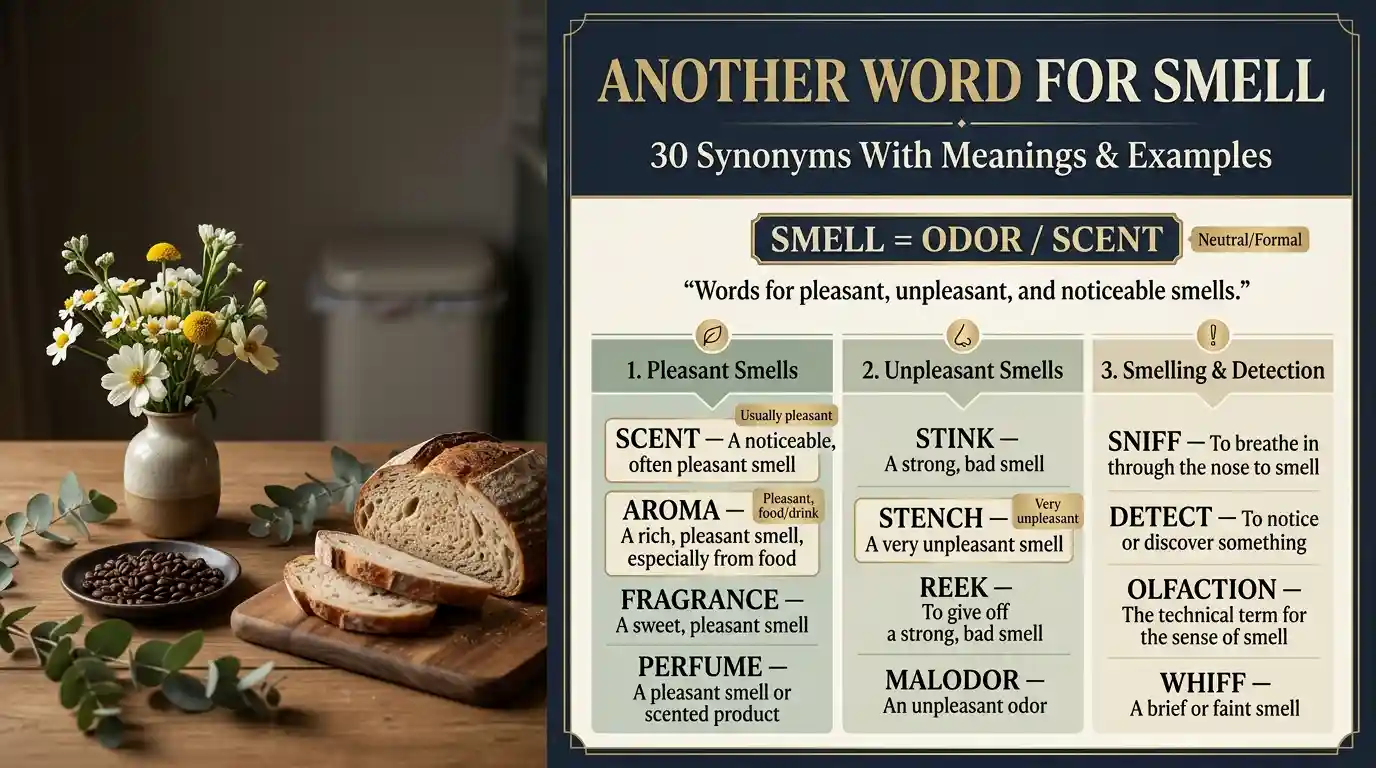
The most common words to use instead of “smell” are odor, scent, and aroma. Odor is a neutral, formal word. Scent usually means a nice smell. Aroma is often used for food and drink. For a bad smell, try stink, stench, or reek.
The best word depends on what “smell” means in your sentence. It can be something your nose notices, like the smell of bread. It can be the sense itself, as in “a good sense of smell.”
Quick list: odor, scent, aroma, fragrance, whiff, stink, stench, reek, sniff, detect
This article covers 30 alternatives. Each one has a meaning, IPA, a usage note, and an example, so you can pick the right word for the moment.
At a Glance: Smell Synonyms and Related Alternatives
| Alternative | Part of Speech | Meaning | Register / Tone | Ideal Context |
| Odor | Noun | A smell you can notice | Neutral, formal | Science, health, product labels |
| Scent | Noun, verb | A smell, usually a nice one | Neutral, gentle | Flowers, soap, light smells |
| Aroma | Noun | A strong, nice smell | Neutral, warm | Food, coffee, wine |
| Fragrance | Noun | A sweet, pleasant smell | Neutral to formal | Flowers, soap, perfume |
| Whiff | Noun, verb | A quick or faint smell | Casual | A short or slight smell |
| Stink | Noun, verb | A strong bad smell | Informal | Everyday bad smells |
| Stench | Noun | A very strong bad smell | Strong | Rot, sewage, smoke |
| Reek | Noun, verb | A strong bad smell; to give one off | Strong | Smoke, sweat, damp |
| Sniff | Verb, noun | To breathe in to smell something | Neutral | Checking food or drink |
| Olfaction | Noun | The sense of smell | Technical | Science and medicine |
Which Word Should You Use?
| If you want to… | Use | Why |
| Name a smell in a neutral, formal way | Odor | It sounds calm and works in reports and labels. |
| Describe a light, nice smell | Scent or fragrance | Both lean positive. They fit flowers, soap, and perfume. |
| Describe the smell of food or drink | Aroma | It suggests a strong, pleasant smell, like coffee or bread. |
| Mention a quick or faint smell | Whiff | It shows the smell was short or slight. |
| Describe a very bad smell | Stench (or stink in casual speech) | Both are clearly negative. Stench is stronger. |
| Say you smelled something on purpose | Sniff | It shows you took short breaths to smell it. |
| Talk about the sense itself in science | Olfaction | It is the scientific word for the sense of smell. |
| Say you think something is wrong | Suspect | It keeps the idea of doubt without using the nose. |
Exploring the Multiple Meanings of “Smell”
1. Something You Can Smell (Noun)
- Meaning: A quality of something that your nose can notice.
- Explanation: This is the widest and most neutral meaning. The smell can be good or bad. An adjective usually tells which, as in “sweet smell” or “burning smell.”
- Example: The smell of fresh bread came from the kitchen.
2.An Act of Smelling
- Meaning: The ability to notice smells with your nose.
- Explanation: Here “smell” is a body sense, like sight or hearing. It usually appears in the phrase “sense of smell.”
- Example: Dogs have a much better sense of smell than people.
3. A Bad Smell
- Meaning: An unpleasant odor.
- Explanation: When there is no adjective, “smell” often means a bad smell. “What’s that smell?” usually asks about an unpleasant one.
- Example: There was a smell in the fridge, so I cleaned it out.
4. To Notice a Smell (Verb)
- Meaning: To notice a smell with your nose.
- Explanation: In daily English, this meaning often comes with “can,” as in “I can smell smoke.”
- Example: I can smell something burning.
5. To Give Off a Smell (Verb)
- Meaning: To have a certain smell.
- Explanation: Here “smell” links the subject to a description. It is followed by an adjective (smells good) or by “of” or “like.”
- Example: The kitchen smells of garlic.
6. To Suspect Something (Figurative)
- Meaning: To sense or suspect something, as if by smell.
- Explanation: This meaning appears in phrases like “smell trouble” and “smell a bargain.” It is not always negative.
- Example: Smart shoppers can smell a bargain.
Sources: Dictionary.com (smell); Merriam-Webster (smell); Collins English Dictionary (smell)
Analyzing 30 Smell Alternatives in Detail
Some words below are direct synonyms of “smell.” Others are related words that fit only one meaning, such as a bad smell or the sense of smell.
Everyday Synonyms
1. Odor
IPA: US /ˈoʊdər/ · UK /ˈəʊdə/
Definition: A smell, especially one you can easily notice.
- Usage: This is the closest neutral synonym of the noun “smell.” It is more formal and common in science, health, and labels. In daily speech it often sounds unpleasant, as in “body odor.” The British spelling is “odour.”
- Example: This cleaner removes cooking odors from carpets.
2. Scent
IPA: (US and UK) /sɛnt/
Definition: A smell, especially a pleasant one; also the smell trail left by an animal or person.
- Usage: A direct synonym for nice or gentle smells. It is also a verb. A dog can follow a scent.
- Example: The scent of lavender filled the room.
3. Aroma
IPA: US /əˈroʊmə/ · UK /əˈrəʊmə/
Definition: A strong, pleasant smell, especially of food or drink.
- Usage: A direct synonym, but only for nice smells. It fits coffee, spices, bread, and wine.
- Example: The aroma of fresh coffee drifted down the hall.
4. Whiff
IPA: (US and UK) /wɪf/
Definition: A quick or faint smell.
- Usage: A direct synonym when the smell is short or slight. It can be good or bad. It is also a verb.
- Example: I caught a whiff of smoke as I walked past the house.
Pleasant Smells
5. Fragrance
IPA: (US and UK) /ˈfreɪɡrəns/
Definition: A sweet or pleasant smell; also a product made to smell nice.
- Usage: A direct synonym for nice smells, especially flowers and soap. It is a little more formal than “scent.” It is also a common word on product labels.
- Example: The garden was full of the fragrance of roses.
6. Perfume
IPA: US /ˈpɜːrfjuːm/ · UK /ˈpɜːfjuːm/
Definition: A sweet smell; also a liquid made to smell nice.
- Usage: A related alternative. As “a sweet smell,” it sounds poetic. In daily English, it usually means the product.
- Example: The perfume of orange blossoms hung over the street.
7. Bouquet
IPA: (US and UK) /buːˈkeɪ/
Definition: The special smell of a wine; also a pleasant smell in general.
- Usage: A related alternative that fits mainly wine. It also means a bunch of flowers, so the context should be clear.
- Example: The red wine has a rich bouquet of cherry and oak.
8. Redolence
IPA: (US and UK) /ˈrɛdələns/
Definition: A strong, pleasant smell; also a quality that reminds you of something.
- Usage: A formal, literary synonym for a nice smell. The adjective “redolent” is more common. It is usually followed by “of.”
- Example: The redolence of pine and wood smoke filled the cabin.
Bad Smells: Everyday Words
9. Stink
IPA: (US and UK) /stɪŋk/
Definition: A strong, unpleasant smell.
- Usage: A direct synonym for a bad smell. It is informal and common. It is also a verb. “Make a stink” means to complain, which is a different meaning.
- Example: The stink from the garbage bin made us close the window.
10. Stench
IPA: (US and UK) /stɛntʃ/
Definition: A strong, very unpleasant smell.
- Usage: A direct synonym for a bad smell. It is stronger than “stink” and often suggests something rotten.
- Example: The stench of rotten eggs hung over the pond.
11. Reek
IPA: (US and UK) /riːk/
Definition: A strong, unpleasant smell; as a verb, to give off such a smell.
- Usage: A direct synonym for a bad smell. As a verb, it is usually followed by “of.” It works well for smoke, sweat, or damp.
- Example: The old basement reeked of damp and mold.
12. Pong
IPA: US /pɑːŋ/ · UK /pɒŋ/
Definition: A bad smell (British informal).
- Usage: A direct synonym for a bad smell. It is mainly British and casual. It often sounds light or funny.
- Example: There is a terrible pong coming from the bins.
13. Funk
IPA: (US and UK) /fʌŋk/
Definition: A strong, unpleasant smell (informal).
- Usage: A direct synonym in casual speech. It is often used for sweat or stale air. “Funk” also means a sad mood or a type of music, but those meanings are unrelated.
- Example: The funk in the gym locker room was hard to ignore.
Bad Smells: Formal and Literary Words
14. Fetor
IPA: US /ˈfiːtər/ · UK /ˈfiːtə/
Definition: A strong, very bad smell.
- Usage: A formal, literary synonym for a bad smell. It is rare in conversation. The adjective is “fetid.”
- Example: The fetor of the swamp made the hikers turn back.
15. Malodor
IPA: US /mælˈoʊdər/ · UK /mælˈəʊdə/
Definition: A bad smell.
- Usage: A formal synonym, used mostly in technical or product writing. The adjective is “malodorous.” The British spelling is “malodour.”
- Example: The plant uses filters to control malodor.
16. Miasma
IPA: US /maɪˈæzmə/ · UK /miˈæzmə/
Definition: An unpleasant, unhealthy-seeming vapor or smell, often rising from rotting matter.
- Usage: A literary related alternative. Long ago, people believed such vapors caused disease. Today it can also mean a gloomy mood or atmosphere.
- Example: A miasma rose from the marsh at dusk.
17. Effluvium
IPA: (US and UK) /ɪˈfluːviəm/
Definition: A gas, vapor, or smell that something gives off, usually an unpleasant one.
- Usage: A formal related alternative. It focuses on what comes out of something, not on the smell you notice. The plural is “effluvia.”
- Example: An effluvium of garbage and diesel filled the alley.
Verbs for Noticing a Smell
18. Sniff
IPA: (US and UK) /snɪf/
Definition: To breathe in through the nose in short breaths, often to smell something.
- Usage: A related alternative for the verb “smell.” It shows you did it on purpose. You can “smell” something without trying.
- Example: She sniffed the milk to check that it was fresh.
19. Inhale
IPA: (US and UK) /ɪnˈheɪl/
Definition: To breathe in air, smoke, or a smell.
- Usage: A related alternative, not an exact synonym. It names the act of breathing in, not the act of noticing a smell.
- Example: He closed his eyes and inhaled the scent of pine.
20. Detect
IPA: (US and UK) /dɪˈtɛkt/
Definition: To notice or find something that is hard to see or sense.
- Usage: A related alternative. It fits a faint smell that is hard to notice. It is neutral to formal and is not only for smell.
- Example: Alarms can detect gas before people can smell it.
21. Nose out
IPA: US /noʊz ˈaʊt/ · UK /nəʊz ˈaʊt/
Definition: To find something by searching, as if by smell.
- Usage: An informal related alternative. It is mostly used for finding news or bargains, not for real smelling.
- Example: The reporter nosed out the story before anyone else.
Words for Giving Off and Spreading Smells
22. Give off
IPA: US /ɡɪv ˈɔːf/ · UK /ɡɪv ˈɒf/
Definition: To send out something such as a smell, light, or heat.
- Usage: A related alternative for the verb “smell” when the thing makes the smell. It can often replace “smell of.”
- Example: The candle gives off a soft vanilla scent.
23. Waft
IPA: US /wɑːft/ · UK /wɒft/
Definition: To float gently through the air.
- Usage: A related alternative that shows how a smell travels. It does not mean “to have a smell.”
- Example: The smell of baking bread wafted down the street.
24. Fumes
IPA: (US and UK) /fjuːmz/
Definition: Gas, smoke, or vapor, often with a strong smell.
- Usage: A related noun, usually plural. It names the gas itself, which is often strong or harmful, not just the smell.
- Example: Paint fumes made the small room hard to stay in.
Smell vs. Odor vs. Scent vs. Aroma vs. Stench
These words all name a smell, but most of them also show a feeling. Only “smell” is fully neutral.
| Word | Usual Tone | Typical Use | Example |
| Smell | Neutral | Any smell, the sense, or the verb | The smell of rain filled the yard. |
| Odor | Neutral to negative | Formal, scientific, product writing | The spray reduces pet odors. |
| Scent | Usually pleasant | Light smells; animal trails | The scent of pine hung in the air. |
| Aroma | Pleasant and strong | Food and drink | The aroma of toast woke me up. |
| Fragrance | Pleasant and sweet | Flowers, soap, perfume | The soap has a light fragrance. |
| Stench | Very unpleasant | Strong rotten or dirty smells | The stench from the drain was awful. |
Because the other words already show a feeling, “smell” often needs an adjective. Without one, “It smells” usually suggests something bad. Dictionary.com also notes that telling someone “You smell” is not a compliment.
Sources: Dictionary.com (smell); Merriam-Webster (odor, scent, aroma, fragrance, stench)
Smell and Opposite/Paired Word Pairs
| Word | Paired Word | Note |
| Smell | Taste | The two senses are often named together because smell affects flavor. |
| Smell | Sight / Hearing / Touch | The other senses. Smell is one of the five. |
| Smell | Odorless | Describes something with no smell. It is the nearest thing to an opposite. |
| Sweet smell | Foul smell | The most common good-versus-bad pair. |
| Fragrance | Stench | A natural contrast between a nice smell and a very bad one. |
| Sense of smell | Anosmia | The medical word for losing the sense of smell. |
English has no single true opposite of “smell.” The closest ideas are “odorless” (no smell) and the contrast between words like “fragrance” and “stench.” As a sense, smell is often paired with taste and the other senses.
Sources: Merriam-Webster (odorless, anosmia); National Institute on Deafness and Other Communication Disorders (NIDCD), smell and taste; Collins Thesaurus
Common Word Partners of “Smell”
| Pattern | Common Partners | Example |
| adjective + smell | sweet, strong, faint, pleasant, foul, musty, familiar | A faint smell of smoke hung in the hall. |
| smell + of | smoke, gas, garlic, fish, fresh bread | The room smelled of paint. |
| smell + like | rain, flowers, a hospital | It smells like rain. |
| smell + adjective | good, bad, sweet, strange, fresh, awful | The soup smells wonderful. |
| verb + smell | notice, detect, catch, hide, get rid of | We opened the windows to get rid of the smell. |
| smell + verb | lingers, drifts, fills (the room) | The smell of coffee lingered all morning. |
| sense of smell | keen, strong, poor, lose your | Dogs have a keen sense of smell. |
Sources: Oxford Learner’s Dictionaries (smell); Collins English Dictionary (smell); Cambridge Dictionary (smell)
Idiomatic Phrases Featuring “Smell”
Most uses of “smell” are ordinary word partners. The four below are real idioms and fixed expressions.
1. Smell a rat
- Meaning: To suspect that something is wrong or dishonest.
- Example: The offer sounded too good to be true, so I began to smell a rat.
2. Stop and smell the roses
- Meaning: To slow down and enjoy life instead of rushing.
- Example: She works hard, but she also makes time to stop and smell the roses.
3. Come out smelling like a rose
- Meaning: To get out of a bad situation and still look good.
- Example: The company was in trouble, but its manager came out smelling like a rose.
4. Pass (or fail) the smell test
- Meaning: To seem believable or acceptable at first look. It is informal.
- Example: The numbers in the report did not pass the smell test.
Sources: Etymonline (smell a rat); Merriam-Webster (idioms); Dictionary.com (smell); Cambridge Dictionary (idioms)
Word Formation of “Smell”
Etymology & Structure
“Smell” is a short word with one syllable. It has no prefix or ending. The same form works as a noun and a verb. Its origin is uncertain. The word is not found in Old English. It may be linked to Middle Dutch and Low German words meaning “to burn slowly,” but the Oxford English Dictionary says it is probably from an Old English word that was never recorded.
Date and History
The verb and the noun both appear in English around the year 1200, as “smellen” and “smel.” The meaning of a bad smell is recorded by the late 1300s. The phrase “smell a rat” appears in the 1540s. Dictionary.com gives a first record between 1125 and 1175 and also says the origin is uncertain.
Word Class Variations
- Verb: smell, smells, smelling; past forms smelled or smelt (smelt is more common in British English)
- Noun: smell, smells
- Adjective: smelly
- Related compound: smelling salts
Sources: Etymonline (smell); Dictionary.com (smell); Oxford English Dictionary (smell, v.); Merriam-Webster (smelly)
Common Word-Choice Mistakes
- The soup smells deliciously: The soup smells delicious. (After “smell,” use an adjective.)
- The room is smell: The room smells, or The room is smelly.
- Its smell is very fragrance: It is very fragrant, or It has a lovely fragrance.
- The bakery had a stench of fresh bread: The bakery had the aroma of fresh bread. (“Stench” is only for very bad smells.)
- The garbage had a lovely aroma: The garbage had a terrible stench. (“Aroma” suggests a nice smell.)
- I can feel the smell of coffee: I can smell coffee.
- She sniffed gas from the next room: She smelled gas from the next room. (“Sniff” means taking short breaths on purpose.)
FAQs
What is the closest synonym for “smell”?
For the noun, “odor” is the closest neutral synonym. “Scent” is closest when the smell is nice.
What is another word for a pleasant smell?
Common choices are “scent,” “aroma,” “fragrance,” and “perfume.” “Bouquet” is used mainly for wine.
What is another word for a bad smell?
“Stink,” “stench,” and “reek” are the most common. “Pong” is British informal. “Fetor” and “malodor” are formal.
What is the difference between “smell” and “odor”?
“Smell” is the everyday word and can be good or bad. “Odor” is more formal and often sounds unpleasant.
What is the difference between “scent” and “aroma”?
“Scent” is a general, often light smell. It can also mean an animal’s trail. “Aroma” is usually strong and nice, especially from food or drink.
What is another word for the sense of smell?
“Olfaction” is the scientific term. “Nose” is an informal option, as in “a dog with a good nose.”
What is another word for smelling something with your nose?
“Sniff” fits smelling on purpose, and “inhale” fits breathing a smell in. “Detect” fits noticing a faint smell.
Can “smell” mean to suspect something?
Yes. In phrases like “smell a rat” or “smell trouble,” it means to suspect a problem.
Is “smell” always a bad word?
No. “Smell” is neutral, as in “the smell of fresh bread.” Without an adjective, though, “It smells” often means a bad smell.
Should I write “smelled” or “smelt”?
Both are correct. “Smelt” is more common in British English.
Conclusion
The closest alternatives to “smell” are “odor” and “scent.” “Aroma” and “fragrance” fit nice smells. “Stink,” “stench,” and “reek” fit bad ones. For the verb, “sniff” and “detect” are good choices. “Olfaction” names the sense itself.
Context matters because most of these words show a feeling that “smell” does not. “Aroma” sounds pleasant, “stench” sounds very bad, and “odor” sounds formal. Some words fit only one meaning, such as “suspect” for the figurative sense.
To choose the right word, first decide if the smell is good, bad, or neutral. Then decide if you need a noun, a verb, or the sense itself. Use “scent” or “aroma” for nice smells, “stench” for strong bad ones, and “sniff” for smelling on purpose.
Discover More Article

Hy, Sophia is a content writer with 3 years of experience creating engaging, informative, and SEO-friendly articles focused on synonyms, vocabulary, and word meanings.