Another Word for Consistent: 30 Synonyms With Examples
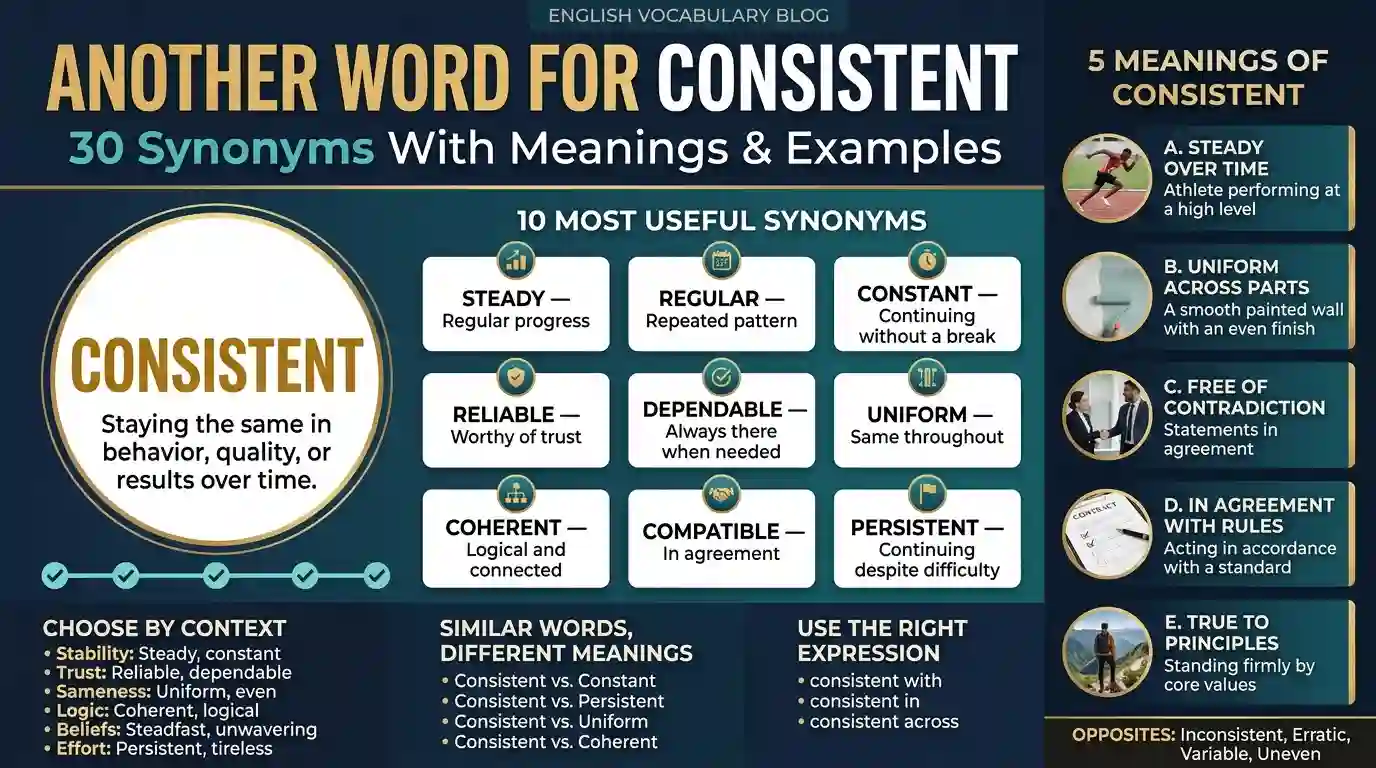
The closest everyday alternatives to “consistent” are steady, regular, and constant. For people and results you can count on, reliable and dependable work well. “Uniform” and “even” fit things that stay the same across their parts.
The best word depends on what you are describing. A player who performs well every time is reliable. A paint color that looks the same everywhere is uniform. An argument with no contradictions is coherent. Facts that match a theory are compatible with it, and a person who never drops their beliefs is steadfast.
Quick list: steady, constant, regular, reliable, dependable, uniform, coherent, compatible, steadfast
This article examines 30 alternatives to “consistent.” Each one comes with its meaning, IPA, a usage note, an example sentence, and notes on context.
At a Glance: Consistent Synonyms and Related Alternatives
| Alternative | Part of Speech | Meaning | Register / Tone | Ideal Context |
| Steady | adjective | continuing in a regular, even way | neutral | progress, pace, income |
| Regular | adjective | happening in an even pattern or at set times | neutral | schedules, habits |
| Constant | adjective | continuing without change or break | neutral to formal | temperature, speed, support |
| Reliable | adjective | able to be trusted to do well each time | neutral, positive | workers, tools, results |
| Dependable | adjective | able to be depended on | warm, positive | people, cars, services |
| Uniform | adjective | the same throughout; not varying | neutral to formal | size, color, quality |
| Coherent | adjective | logical, with parts that fit together | formal to neutral | arguments, plans, stories |
| Compatible | adjective | able to exist together without conflict | neutral to formal | facts, systems, goals |
| Steadfast | adjective | firmly loyal and unchanging in purpose | formal, literary | principles, support |
| Persistent | adjective | continuing firmly despite difficulty | neutral | effort, problems, symptoms |
Which Word Should You Use?
| If you want to… | Use | Why |
| Praise someone who performs well every time | reliable | It shows you can trust them to repeat good work. |
| Describe something that stays the same over time | constant or steady | Both stress staying the same without change. |
| Describe even color, size, or quality | uniform or even | Both describe sameness across parts, not across time. |
| Say an argument has no contradictions | coherent | It suits ideas and arguments that fit together. |
| Say facts match a theory | compatible | It replaces “consistent with” in most contexts. |
| Describe someone who keeps their principles | steadfast or principled | Both suggest loyalty to beliefs. |
| Describe effort that keeps going | persistent or sustained | Both suggest long, repeated effort. |
| Describe a result that can be repeated in science | reproducible | It is the exact word for results that can be repeated. |
Exploring the Multiple Meanings of “Consistent”
1. Steady and Regular Over Time
- Meaning: Staying the same in behavior or performance from one time to the next.
- Explanation: This is the most common sense. It describes a repeated pattern, not nonstop action. A consistent runner is not always running. The runner simply performs at the same level each time.
- Example: She is a consistent player who scores in almost every game.
2. Uniform Across Parts
- Meaning: The same in all parts or all examples.
- Explanation: This sense compares parts of one thing, such as color, taste, or quality, rather than comparing different moments in time.
- Example: The paint has a consistent color across the whole wall.
3. Free of Contradiction
- Meaning: Having parts that do not conflict with each other.
- Explanation: This sense is used for stories, arguments, and statements. A consistent story is one that does not contradict itself. People often say “internally consistent” for this idea.
- Example: The two witnesses gave consistent accounts of the accident.
4. In Agreement With Something
- Meaning: Matching or fitting with something else.
- Explanation: In this sense, “consistent” is almost always followed by “with.” It does not say two things are identical, only that they do not conflict.
- Example: The results are consistent with the theory.
5. True to One’s Own Principles
- Meaning: Acting in line with one’s own beliefs, character, or past behavior.
- Explanation: This sense is used for people and their choices. It can be a compliment, but it can also be neutral or negative if the behavior is bad.
- Example: He has been consistent in his support for the project from the start.
Sources: Merriam-Webster; Collins Dictionary; Dictionary.com; Etymonline
Analyzing 30 Consistent Alternatives in Detail
Some of these words are close synonyms of “consistent,” while others are related alternatives that fit only one sense or situation. Each Usage note says which is which.
Steady and Regular Alternatives
1. Steady
IPA: /ˈstɛdi/ (US and UK)
Definition: Continuing in a regular, even way; not changing quickly or suddenly.
- Usage: This is a close synonym for the “steady over time” sense. It is neutral and common in everyday speech, as in “steady progress” and “a steady job.”
- Example: She has made steady progress all year.
2. Regular
IPA: US /ˈrɛɡjələr/ · UK /ˈrɛɡjʊlə/
Definition: Happening at the same time each time or in an even pattern.
- Usage: This is a close synonym for repeated patterns. It stresses the pattern of timing. Note that “regular” also means “normal” or “ordinary,” which is a different sense.
- Example: He keeps a regular schedule.
3. Constant
IPA: US /ˈkɑːnstənt/ · UK /ˈkɒnstənt/
Definition: Continuing without change or break.
- Usage: This is a close synonym for the “unchanging” idea. It is stronger than “consistent,” because it can mean nonstop. It is also used for faithful people.
- Example: The room stays at a constant temperature.
4. Stable
IPA: /ˈsteɪbəl/ (US and UK)
Definition: Firm and not likely to change, fall, or fail.
- Usage: This is a related alternative. It describes conditions, such as an income or a relationship, that are not likely to change suddenly. It does not mean the same pattern repeats.
- Example: She found a stable job with a good company.
5. Predictable
IPA: /prɪˈdɪktəbəl/ (US and UK)
Definition: Acting or happening in a way that you can expect.
- Usage: This is a related alternative. Consistent behavior is often predictable, but “predictable” can sound negative, as in boring or unsurprising.
- Example: His reactions were predictable.
Reliable Performance and Character
6. Reliable
IPA: /rɪˈlaɪəbəl/ (US and UK)
Definition: Able to be trusted to do well or work well each time.
- Usage: This is a close synonym for the performance sense. It is common in praise of people, tools, and results.
- Example: She is a reliable worker who always meets deadlines.
7. Dependable
IPA: /dɪˈpɛndəbəl/ (US and UK)
Definition: Able to be depended on; trusted to act or work as expected.
- Usage: This is a close synonym that sounds slightly warmer than “reliable.” It fits people, cars, and services.
- Example: He is a dependable friend.
8. Solid
IPA: US /ˈsɑːlɪd/ · UK /ˈsɒlɪd/
Definition: Good and sound, with no big weak points.
- Usage: This is an informal, related alternative. It is common in praise of performance, as in “a solid season.” It says the quality is good, not that it repeats.
- Example: The team had a solid season.
9. Unfailing
IPA: /ʌnˈfeɪlɪŋ/ (US and UK)
Definition: Always present or working; never stopping or weakening.
- Usage: This is a related, formal alternative. It is often used with feelings and support, as in “unfailing kindness.” It is stronger than “consistent.”
- Example: Her unfailing support helped the family through a hard year.
10. Trustworthy
IPA: US /ˈtrʌstˌwɜːrði/ · UK /ˈtrʌstˌwɜːði/
Definition: Able to be trusted; honest and reliable.
- Usage: This is a related alternative. It is about honesty and character, not repeating good performance. A person can be consistent but not trustworthy.
- Example: The shop has a trustworthy reputation.
Uniform and Unchanging Alternatives
11. Uniform
IPA: US /ˈjuːnɪfɔːrm/ · UK /ˈjuːnɪfɔːm/
Definition: Always the same; not varying from one part to another.
- Usage: This is a close synonym for the “same across parts” sense. It is neutral to formal and usually describes things, not people.
- Example: The bricks were uniform in size.
12. Even
IPA: /ˈiːvən/ (US and UK)
Definition: Smooth, level, or equal throughout; not varying.
- Usage: This is a close synonym for color, texture, speed, and quality. In the sense of “same in quality,” it is gentler than “uniform.”
- Example: Spread the paint in an even layer.
13. Unvarying
IPA: US /ʌnˈvɛriɪŋ/ · UK /ʌnˈvɛəriɪŋ/
Definition: Not changing or varying.
- Usage: This is a formal synonym. It is stronger than “consistent,” because it suggests no variation at all.
- Example: He followed an unvarying morning routine.
14. Unchanging
IPA: /ʌnˈtʃeɪndʒɪŋ/ (US and UK)
Definition: Staying the same; not changing.
- Usage: This is a close but stronger synonym for sameness over time. Unlike “consistent,” it can mean there is no change at all.
- Example: The sky stayed an unchanging gray all day.
15. Invariable
IPA: US /ɪnˈvɛriəbəl/ · UK /ɪnˈvɛəriəbəl/
Definition: Never changing; fixed.
- Usage: This is a formal, technical synonym. The adverb “invariably” is much more common than the adjective.
- Example: Her morning routine was invariable.
Logical and Compatible Alternatives
16. Coherent
IPA: US /koʊˈhɪrənt/ · UK /kəʊˈhɪərənt/
Definition: Logical and well organized, with parts that fit together.
- Usage: This is a close synonym for the “free of contradiction” sense. It suits ideas, arguments, and stories. It does not suit numbers or measurements.
- Example: The report gave a coherent plan for the year.
17. Logical
IPA: US /ˈlɑːdʒɪkəl/ · UK /ˈlɒdʒɪkəl/
Definition: Following clear reasoning.
- Usage: This is a related alternative. It describes sound reasoning, not the absence of contradictions, though the two often go together.
- Example: Her answer was logical and easy to follow.
18. Compatible
IPA: /kəmˈpætəbəl/ (US and UK)
Definition: Able to exist or work together without conflict.
- Usage: This is a close synonym for the “consistent with” sense. It usually takes “with.”
- Example: The results are compatible with the theory.
19. Congruent
IPA: US /kənˈɡruːənt/ · UK /ˈkɒŋɡruənt/
Definition: Matching or in agreement; also (in geometry) having the same shape and size.
- Usage: This is a formal synonym for the “agreeing” sense. It is common in psychology and academic writing, often followed by “with.”
- Example: His actions are congruent with his words.
20. Consonant
IPA: US /ˈkɑːnsənənt/ · UK /ˈkɒnsənənt/
Definition: In agreement or harmony with something.
- Usage: This is a formal, fairly rare synonym for the “agreeing” sense. It is usually followed by “with.” As a noun, “consonant” also means a speech sound, which is a different meaning.
- Example: The plan is consonant with the company’s values.
Principled and Committed Alternatives
21. Steadfast
IPA: US /ˈstɛdfæst/ · UK /ˈstɛdfɑːst/
Definition: Firmly loyal and not changing in purpose or belief.
- Usage: This is a related alternative for the “true to principles” sense. It is formal or literary and describes people, not things. It is not an exact synonym for “consistent.”
- Example: He remained steadfast in his support.
22. Unwavering
IPA: /ʌnˈweɪvərɪŋ/ (US and UK)
Definition: Not changing or weakening; firm.
- Usage: This is a related alternative that is stronger than “consistent.” It is common in phrases such as “unwavering commitment.”
- Example: She showed unwavering commitment to the team.
23. Faithful
IPA: /ˈfeɪθfəl/ (US and UK)
Definition: Loyal and true to a person, promise, or principle.
- Usage: This is a related alternative. It stresses loyalty, not repetition. Do not use it for sameness of quality.
- Example: He stayed faithful to his principles.
24. Resolute
IPA: /ˈrɛzəluːt/ (US and UK)
Definition: Determined and firm in purpose.
- Usage: This is a related, formal alternative. It describes strong determination, not repeated behavior.
- Example: The team stayed resolute after the loss.
25. Principled
IPA: /ˈprɪnsəpəld/ (US and UK)
Definition: Acting according to firm moral rules.
- Usage: This is a related alternative for the “true to principles” sense. It praises a person’s values, not how often something happens.
- Example: She is a principled leader who does not change her values.
Alternatives for Repeated Effort, Results, and Methods
26. Persistent
IPA: US /pərˈsɪstənt/ · UK /pəˈsɪstənt/
Definition: Continuing firmly despite difficulty; lasting for a long time.
- Usage: This is a related alternative, not an exact synonym. It stresses not giving up or not going away, as in “a persistent cough.”
- Example: A persistent cough kept her awake.
27. Sustained
IPA: /səˈsteɪnd/ (US and UK)
Definition: Continued for a long time without weakening.
- Usage: This is a related alternative for effort and growth. It is common in “sustained effort” and “sustained growth.”
- Example: The team showed sustained effort all season.
28. Reproducible
IPA: US /ˌriːprəˈduːsəbəl/ · UK /ˌriːprəˈdjuːsəbəl/
Definition: Able to be produced again with the same result.
- Usage: This is a technical, related alternative. It is the exact word in science for results that others can repeat.
- Example: The results were reproducible in three labs.
29. Standardized
IPA: US /ˈstændərdaɪzd/ · UK /ˈstændədaɪzd/
Definition: Made to follow the same standard or set of rules.
- Usage: This is a related alternative. It describes something deliberately made the same each time, such as a process or a test.
- Example: The company uses a standardized process for every order.
30. Systematic
IPA: /ˌsɪstəˈmætɪk/ (US and UK)
Definition: Done according to a plan or system.
- Usage: This is a related alternative. It describes an orderly method, not that the results are the same each time.
- Example: We did a systematic check of every room.
Sources: Merriam-Webster; Collins Dictionary / Collins Thesaurus; Dictionary.com
Consistent With, Consistent In, and Consistent Across
Learners often find the prepositions after “consistent” harder than the word itself. Each pattern changes the meaning slightly.
| Pattern | Meaning | Possible Alternative | Example |
| consistent with | agreeing with, not conflicting with | compatible with, in line with | The findings are consistent with earlier studies. |
| consistent in | always the same in a habit or quality | steady in, regular in | He is consistent in his study habits. |
| consistent across | the same in different places or groups | uniform across | The quality is consistent across all our stores. |
| consistent over time | the same from one period to another | steady, constant | Her scores were consistent over time. |
Do not say “consistent to.” The standard pattern for agreement is “consistent with.”
Sources: Merriam-Webster; Collins Dictionary; Oxford Learner’s Dictionaries
Consistent and Opposite/Paired Word Pairs
| Word | Paired Word | Note |
| Consistent | Inconsistent | The standard opposite; it covers both changing behavior and contradiction |
| Consistent | Erratic | Describes behavior or results that change in unpredictable ways |
| Consistent | Variable | Describes something that often changes in amount or quality |
| Consistent | Uneven | Describes quality or performance that is not the same throughout |
| Consistent | Contradictory | The opposite in the “free of contradiction” sense |
| Consistent | Fickle | Describes people who often change their loyalty or mind |
“Inconsistent” is the most direct opposite. Etymonline dates it to the 1640s with the meaning “not agreeing in substance or form,” and to the 1650s with the meaning “self-contradictory.” The other pairs match different senses of “consistent”: “erratic,” “variable,” and “uneven” for changing patterns, “contradictory” for logic, and “fickle” for people.
Sources: Merriam-Webster; Collins Thesaurus; Etymonline (entry for inconsistent)
Common Word Partners of “Consistent”
| Pattern | Common Partners | Example |
| Adverb + consistent | highly, fairly, broadly, remarkably, perfectly | The data is broadly consistent across both groups. |
| Consistent + noun | results, quality, performance, message, approach | We need a consistent message for all customers. |
| Verb + consistent | be, remain, stay, keep (something) | Try to stay consistent with your practice. |
| Consistent + preposition | with, in, across, throughout | The temperature stays consistent throughout the day. |
| Consistent with + noun | findings, evidence, symptoms, policy | The injuries are consistent with a fall. |
| Not + consistent | not consistent, less than consistent | His work has not been consistent lately. |
Sources: Merriam-Webster; Collins Dictionary; Oxford Learner’s Dictionaries
Idiomatic Phrases Featuring “Consistent”
“Consistent” appears in very few true idioms. The items below are established expressions or well-known phrases. The second and third use the related noun “consistency.”
1. Consistent with
- Meaning: In agreement with, or not conflicting with. This is a fixed grammatical pattern, not a figurative idiom.
- Example: The damage is consistent with a storm.
2. Internally consistent
- Meaning: Having no contradictions within its own parts. This phrase is common in logic, science, and writing.
- Example: The theory is internally consistent, but it lacks evidence.
3. Consistency is key
- Meaning: A common saying that steady, repeated effort matters more than occasional big efforts. This phrase uses “consistency,” the noun.
- Example: If you want to learn a language, consistency is key.
4. A foolish consistency
- Meaning: From a line in Ralph Waldo Emerson’s essay “Self-Reliance,” often quoted to suggest that rigidly sticking to old views, just to look consistent, is not wise. It uses the noun “consistency.”
- Example: He changed his mind when new facts appeared, rather than showing a foolish consistency.
Sources: Merriam-Webster; Cambridge Dictionary; Collins Dictionary; Emerson, “Self-Reliance” (1841)
Word Formation of “Consistent”
Etymology & Structure
“Consistent” comes from Latin consistentem, the present participle of consistere, meaning “to stand firm, take a standing position, stop, halt.” That verb combines com- (“with, together”) and sistere (“to place”), which is the causative of stare (“to stand”). Etymonline traces this to a Proto-Indo-European root meaning “to stand, make or be firm.” The English word ends in -ent, a suffix from the Latin present participle.
Date and History
Etymonline dates “consistent” to the 1570s, when it meant “consisting,” a sense that is now obsolete. The sense of “standing together in agreement” appears in the 1640s, and the sense “marked by consistency” is from 1732. The literal, physical sense, standing firm and holding together, survives in the noun “consistency,” which Etymonline dates to the 1590s with the meaning “firmness of matter.”
Word Class Variations
- Adjective: consistent, inconsistent
- Adverb: consistently, inconsistently
- Noun: consistency, inconsistency
- Related verb: consist (as in “consist of”)
Sources: Etymonline (entries for consistent, consistency, and inconsistent); Merriam-Webster
Common Word-Choice Mistakes
- Wrong: “The results are consistent to the theory.” Correct: “The results are consistent with the theory.”
- Wrong: “He consistent arrives late.” Correct: “He consistently arrives late.” Use the adverb to describe a verb.
- Wrong: “The data is consistency.” Correct: “The data is consistent.” “Consistency” is a noun.
- Wrong: “A consistent noise kept us awake all night.” Correct: “A constant noise kept us awake all night.” Use “constant” for something that never stops.
- Wrong: “She has a consistent cough.” Correct: “She has a persistent cough.” Use “persistent” for something that will not go away.
- Wrong: “The two numbers are coherent.” Correct: “The two numbers are consistent.” “Coherent” suits ideas, not numbers.
- Wrong: “The steadfast temperature stayed the same.” Correct: “The steady temperature stayed the same.” “Steadfast” describes people and loyalty, not conditions.
Frequently Asked Questions
What is the closest synonym for consistent?
“Steady” is the closest everyday synonym for something that stays the same over time. “Regular” and “constant” are also close, depending on the meaning.
What is a formal alternative to consistent?
“Uniform,” “invariable,” “congruent,” and “compatible” are common in formal writing. “Congruent” and “compatible” fit best after “with.”
What is the difference between consistent and constant?
“Consistent” means the same pattern repeats, such as a player who scores in most games. “Constant” means continuing without a break, such as a noise that never stops.
What is the difference between consistent and persistent?
“Consistent” stresses sameness. “Persistent” stresses continuing despite difficulty or refusing to go away.
What does “consistent with” mean?
It means agreeing with something or not conflicting with it. For example, “symptoms consistent with a cold” means the symptoms match what a cold would cause.
What is the opposite of consistent?
“Inconsistent” is the standard opposite. “Erratic” and “variable” fit changing behavior, and “contradictory” fits the logic sense.
Can “consistent” describe people?
Yes. A person can be consistent in their habits, their performance, or their opinions. “Reliable” and “dependable” are common alternatives.
Can “consistent” describe texture or color?
Yes. A consistent color or texture is even throughout. “Uniform” and “even” are good alternatives. The noun “consistency” is more common for the thickness of food.
What is another word for consistent on a resume?
“Reliable,” “dependable,” “steady,” and “steadfast” are common choices. Use “reliable” for performance and “steadfast” for commitment.
Is “consistent” always a compliment?
No. It simply means repeating the same way. A person can be consistently late, and “consistent” would then describe a bad habit.
Conclusion
The closest alternatives to “consistent” are “steady,” “regular,” and “constant,” with “reliable” and “dependable” for performance and “uniform” for sameness across parts. For ideas and facts, “coherent” and “compatible” fit best, while “steadfast” and “principled” suit people who keep their beliefs.
Context and meaning decide the best choice. “Consistent” can describe time, parts, logic, agreement, or principles, and each sense has different alternatives. Related words such as “persistent,” “stable,” and “faithful” overlap with “consistent” but do not mean the same thing, so using them as exact synonyms can change the message.
To choose the right word, first ask which sense you mean: repeating over time, matching across parts, avoiding contradiction, agreeing with something, or staying true to values. Then check the register and the preposition that follows. When in doubt, “steady” for patterns and “compatible with” for agreement are safe choices.
Discover More Article

Hello,I’m Natalia, a professional content writer with three years of experience. My niche is Another Word for, where I create clear, engaging, and SEO-friendly content about words, meanings, synonyms, phrases, and language. I turn complex word-related topics into simple, useful content for readers.