30 Another Word for Industry: Synonyms With Meaning & Example
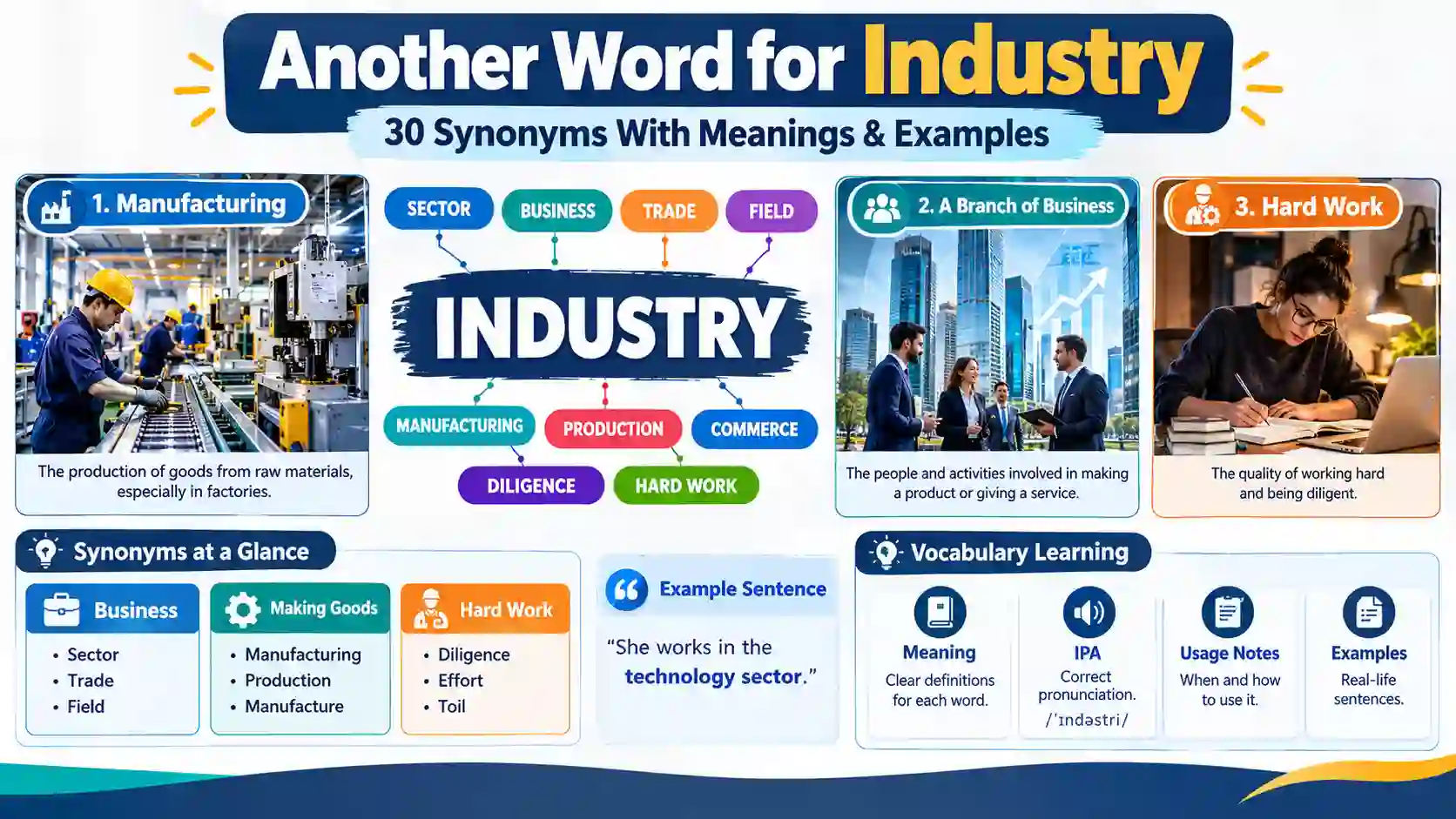
The closest everyday alternatives to industry are sector and business. For factory work, use manufacturing or production. For hard work, use diligence. The right word depends on which meaning of industry you need.
Industry has three main meanings. It can mean making goods in factories. It can mean one branch of business, like the tourism industry. In formal writing, it can also mean hard work. Each meaning has its own alternatives.
Quick list: sector, business, trade, field, manufacturing, production, commerce, line of work, diligence, hard work
This article gives 30 alternatives. Each one has a meaning, IPA, a usage note, and an example. Some words are close synonyms. Others only fit one meaning. Each entry tells you which.
At a Glance: Industry Synonyms and Related Alternatives
| Alternative | Part of Speech | Meaning | Register / Tone | Ideal Context |
| Sector | Noun | A large part of the economy | Neutral, formal | News, reports |
| Business | Noun | A type of work done to earn money | Everyday | General use |
| Trade | Noun | A type of business or skilled work | Neutral | Crafts, selling |
| Field | Noun | An area of work or study | Everyday | Careers |
| Manufacturing | Noun | Making goods in large numbers | Neutral, technical | Factories |
| Production | Noun | The making of goods, crops, or media | Neutral | Factories, farms, film |
| Commerce | Noun | Buying and selling on a large scale | Formal | Economics, law |
| Line of work | Noun phrase | The kind of job someone does | Everyday | Talking about careers |
| Diligence | Noun | Careful, steady effort | Formal | Praise, reviews |
| Hard work | Noun phrase | A lot of effort | Everyday | Daily speech |
Which Word Should You Use?
| If you want to… | Use | Why |
| Name a branch of the economy | Sector | It is clear and common in news. |
| Name a type of work in daily speech | Business or field | They sound natural. |
| Talk about making things in factories | Manufacturing | It names the activity exactly. |
| Talk about buying and selling | Commerce or trade | They stress exchange, not making. |
| Talk about companies as a group | The business world or the private sector | They name the group, not one branch. |
| Ask what someone does for a living | Line of work | It fits a person’s job. |
| Praise careful, steady effort in formal writing | Diligence | It names the quality. |
| Say someone worked very hard | Hard work or elbow grease | They are simple and informal. |
| Name a smaller part of an industry | Segment or niche | They show a smaller piece. |
Exploring the Multiple Meanings of “Industry”
1. Making Goods in Factories
- Meaning: The production of goods from raw materials, especially in factories.
- Explanation: In this meaning, industry is uncountable. You do not say “an industry” or “industries.” It appears in phrases like heavy industry and light industry.
- Example: Cheap energy helped industry grow.
2. A Branch of Business
- Meaning: The people and activities involved in making a product or giving a service.
- Explanation: In this meaning, industry is countable. You can say “the steel industry” or “local industries.” Etymonline records “a particular trade or manufacture” from the 1560s.
- Example: Her father worked in the music industry.
3. Hard Work
- Meaning: The quality of working hard.
- Explanation: Oxford marks this meaning as formal and uncountable. It is the oldest meaning. Etymonline records “habitual diligence, effort” from the 1530s. The word industrious keeps this meaning.
- Example: The team’s industry impressed the manager.
Sources: Oxford Learner’s Dictionaries, “industry”; Etymonline, “industry,” “industrial,” “industrious.”
Analyzing 30 Industry Alternatives in Detail
Some of these words are close synonyms of industry. Others are related words that only fit one meaning. Each usage note says which kind it is.
Alternatives for a Branch of Business
1. Sector
IPA: US /ˈsektər/ · UK /ˈsektə/
Definition: A large part of a country’s economy or of business.
- Usage: Close synonym. It is neutral and common in news. It is often wider than industry, as in public sector and private sector.
- Example: The technology sector hired more workers this year.
2. Business
IPA: /ˈbɪznəs/ (US and UK)
Definition: The activity of making, buying, or selling goods or services.
- Usage: Close synonym in everyday speech, as in “the music business.” It sounds less formal than industry.
- Example: He has worked in the fashion business for twenty years.
3. Trade
IPA: /treɪd/ (US and UK)
Definition: A type of business, or work that needs special skill.
- Usage: Related word. It is narrower than industry and often fits older or smaller fields, such as the book trade. It can also mean buying and selling.
- Example: The building trade needs more workers.
4. Field
IPA: /fiːld/ (US and UK)
Definition: An area of work or study.
- Usage: Close synonym when you talk about careers. It points to the kind of work, not the companies.
- Example: She wants to work in the medical field.
5. Line of business
IPA: /ˌlaɪn əv ˈbɪznəs/ (US and UK)
Definition: The kind of business a company or person does.
- Usage: Close synonym. It is a phrase and sounds a little formal.
- Example: Her company is in the food line of business.
6. Enterprise
IPA: US /ˈentərpraɪz/ · UK /ˈentəpraɪz/
Definition: A business, or a business activity.
- Usage: Related word. It is formal and usually names one company or project, not a whole branch.
- Example: The family runs a small enterprise.
Alternatives for Making Goods
7. Manufacturing
IPA: /ˌmænjuˈfæktʃərɪŋ/ (US and UK)
Definition: The business of making goods in large numbers in factories.
- Usage: Close synonym for the “making goods” meaning. It is more exact than industry because it only covers making things.
- Example: Many jobs in manufacturing moved overseas.
8. Production
IPA: /prəˈdʌkʃn/ (US and UK)
Definition: The making of goods, crops, or media.
- Usage: Related word. It is wider than factory work and also covers farms and films.
- Example: Steel production fell last year.
9. Manufacture
IPA: US /ˌmænjuˈfæktʃər/ · UK /ˌmænjuˈfæktʃə/
Definition: The making of goods in large numbers, usually by machine.
- Usage: Related word. It names the act of making, not the whole branch of business. It is also a verb.
- Example: The manufacture of cars needs thousands of parts.
10. Fabrication
IPA: /ˌfæbrɪˈkeɪʃn/ (US and UK)
Definition: The making of products, especially by cutting and joining materials such as metal.
- Usage: Related, technical word. It also means a made-up story, so check the context.
- Example: The company specializes in metal fabrication.
11. Mass production
IPA: /ˌmæs prəˈdʌkʃn/ (US and UK)
Definition: The making of large numbers of the same product in factories.
- Usage: Related phrase. It describes a method of making goods, not a branch of business.
- Example: Mass production made cars cheaper.
Alternatives for Business as a Whole and Job Areas
12. Commerce
IPA: US /ˈkɑːmɜːrs/ · UK /ˈkɒmɜːs/
Definition: The buying and selling of goods and services on a large scale.
- Usage: Related, formal word. It stresses trade, not making things. Oxford lists commerce and industry as a common pair.
- Example: The port is a center of commerce.
13. The private sector
IPA: US /ðə ˌpraɪvət ˈsektər/ · UK /ðə ˌpraɪvət ˈsektə/
Definition: The part of the economy run by private companies, not the government.
- Usage: Related phrase. It fits when industry means companies as a group, as in “the needs of British industry.”
- Example: The private sector added many jobs.
14. The business world
IPA: US /ðə ˈbɪznəs wɜːrld/ · UK /ðə ˈbɪznəs wɜːld/
Definition: All the people and companies that do business.
- Usage: Related phrase. It is neutral and stresses people and companies, not one field.
- Example: She is well known in the business world.
15. Line of work
IPA: US /ˌlaɪn əv ˈwɜːrk/ · UK /ˌlaɪn əv ˈwɜːk/
Definition: The kind of job a person does.
- Usage: Related phrase. It answers “What industry are you in?” in a more personal way.
- Example: What line of work are you in?
16. Occupation
IPA: US /ˌɑːkjuˈpeɪʃn/ · UK /ˌɒkjuˈpeɪʃn/
Definition: A person’s job.
- Usage: Related word. It is formal and common on forms. It names a job, not a branch of business.
- Example: Please write your name and occupation.
17. Profession
IPA: /prəˈfeʃn/ (US and UK)
Definition: A job that needs special training, such as law or medicine.
- Usage: Related word. It is narrower than industry and only fits trained work.
- Example: Teaching is a respected profession.
Formal Alternatives for Hard Work
18. Diligence
IPA: /ˈdɪlɪdʒəns/ (US and UK)
Definition: Careful and steady effort.
- Usage: Close synonym for the “hard work” meaning. It is formal and positive. Etymonline says industry comes from Latin industria, “diligence.”
- Example: Her diligence earned her a promotion.
19. Industriousness
IPA: /ɪnˈdʌstriəsnəs/ (US and UK)
Definition: The quality of working hard.
- Usage: Close synonym. It is formal and names a person’s habit of working hard.
- Example: His industriousness impressed the team.
20. Assiduity
IPA: US /ˌæsɪˈduːəti/ · UK /ˌæsɪˈdjuːəti/
Definition: Constant and careful attention to work.
- Usage: Related word. It is formal and rare, so use it only in careful writing.
- Example: She studied with great assiduity.
21. Application
IPA: /ˌæplɪˈkeɪʃn/ (US and UK)
Definition: Steady attention to a task.
- Usage: Related, formal word. In this meaning it is rare. It more often means a request form or a use, so check the context.
- Example: His application to his studies led to top grades.
Everyday Alternatives for Hard Work
22. Hard work
IPA: US /ˌhɑːrd ˈwɜːrk/ · UK /ˌhɑːd ˈwɜːk/
Definition: A lot of effort.
- Usage: Close synonym in daily speech. It is the simplest word for this meaning.
- Example: Success takes hard work.
23. Effort
IPA: US /ˈefərt/ · UK /ˈefət/
Definition: The energy you use to do something.
- Usage: Related word. It names the energy used for one task, not a steady habit.
- Example: She put a lot of effort into the project.
24. Labor
IPA: US /ˈleɪbər/ · UK /ˈleɪbə/
Definition: Hard work, especially physical work.
- Usage: Related word. British English spells it labour. It can also mean workers as a group.
- Example: The wall took years of labor.
25. Toil
IPA: /tɔɪl/ (US and UK)
Definition: Long, hard work that tires you out.
- Usage: Related word. It sounds formal or literary and suggests hardship.
- Example: Years of toil built the farm.
26. Elbow grease
IPA: US /ˈelboʊ ɡriːs/ · UK /ˈelbəʊ ɡriːs/
Definition: Hard physical effort, especially in cleaning or polishing.
- Usage: Related, informal phrase. It fits physical jobs and is not used for office work.
- Example: This stain needs some elbow grease.
Alternatives for Parts of an Industry
27. Segment
IPA: /ˈseɡmənt/ (US and UK)
Definition: One part of a larger market or business area.
- Usage: Related word. It names a smaller piece inside an industry.
- Example: Electric cars are a fast-growing segment.
28. Niche
IPA: /niːʃ/ or /nɪtʃ/ (US and UK)
Definition: A small, specialized part of a market.
- Usage: Related word. It names a small area inside an industry, not the whole branch.
- Example: She found a niche selling tea sets online.
29. Subsector
IPA: US /ˈsʌbsektər/ · UK /ˈsʌbsektə/
Definition: A smaller part of a sector.
- Usage: Related, technical word. It is common in economics and business reports.
- Example: Solar power is a subsector of the energy sector.
30. Branch
IPA: US /bræntʃ/ · UK /brɑːntʃ/
Definition: One part of a larger field or system.
- Usage: Related word. It fits phrases like branch of industry. It also means a local office, such as a bank branch.
- Example: Banking is one branch of the finance industry.
Sources: Oxford Learner’s Dictionaries, “industry,” “manufacturing”; Etymonline, “industry.”
Industry vs. Sector vs. Field vs. Business
These four words often overlap. Each one points to something a little different.
| Word | Main Idea | Example |
| Industry | The companies and work that make a product or give a service | The film industry |
| Sector | A large part of the economy, often wider than one industry | The public sector |
| Field | An area of work or study | The medical field |
| Business | The activity of making, buying, or selling | The music business |
Industry names the companies and the work. Sector is often wider and groups several industries. Field is about the kind of work a person does. Business is the simplest word in daily speech.
Sources: Oxford Learner’s Dictionaries, “industry.”
Industry and Opposite/Paired Word Pairs
| Word | Paired Word | Note |
| Industry | Commerce | Oxford lists “commerce and industry” as a common pair. |
| Industry | Agriculture | A common contrast in economics. |
| Industry | Services | Making goods versus giving services. |
| Industry | Government | A common pair in news about policy. |
| Industry (hard work) | Idleness | The opposite of working hard. |
| Industry (hard work) | Laziness | A plain opposite in daily speech. |
Industry has no single opposite for the business meanings. The words above are pairs, not opposites. For the “hard work” meaning, idleness and laziness are true opposites.
Sources: Oxford Learner’s Dictionaries, “industry.”
Common Word Partners of “Industry”
| Pattern | Common Partners | Example |
| the + type + industry | steel, oil, auto, music, film, tourism, banking, food | She worked in the banking industry. |
| in industry / within an industry | in industry, within an industry | She got a job in industry. |
| industry + noun | insiders, analysts, experts | Industry experts expect higher prices. |
| commerce and industry | commerce and industry | The mayor met leaders of commerce and industry. |
| regulation of an industry | regulation of (an) industry | New laws changed the regulation of the industry. |
| verb + industry | stimulate, damage, hurt, destroy | The new tax could damage industry. |
| local + industries | local industries | The town needs to develop local industries. |
Sources: Oxford Learner’s Dictionaries, “industry.”
Idiomatic Phrases Featuring “Industry”
Industry has a few well-known set phrases. They are common in news and business writing.
1. Captain of industry
- Meaning: A powerful and successful business leader.
- Example: The town thanked the captain of industry who built the factory.
2. Cottage industry
- Meaning: A small business run from home.
- Example: Her jam business began as a cottage industry.
3. Smokestack industry
- Meaning: An older kind of heavy industry, such as steel, that uses large factories.
- Example: The city once depended on smokestack industry.
4. Sunset industry
- Meaning: An industry that is getting smaller and losing importance.
- Example: Many call film cameras a sunset industry.
Sources: Oxford Learner’s Dictionaries, “industry.”
Word Formation of “Industry”
Etymology & Structure
Industry comes from Old French industrie, or directly from Latin industria, “diligence, activity, zeal.” Etymonline says industria is the noun use of Latin industrius, “active, diligent.” That word comes from early Latin indostruus, built from indu, “in, within,” and the stem of struere, “to build.”
Date and History
Etymonline records industry in the late 15th century with the meaning “cleverness, skill.” The meaning “habitual diligence, effort” comes from the 1530s. “A particular trade or manufacture” is from the 1560s. “Systematic work” is from the 1610s. The adjective industrious is from the 1550s. The adjective industrial is from 1774, and its main modern meaning, “pertaining to the manufacture of commodities,” is from 1830.
Word Class Variations
- Noun: industry (uncountable), industries (countable plural)
- Adjective: industrial, industrious
- Related noun: industriousness
- Related compound: agro-industry
Sources: Etymonline, “industry,” “industrial,” “industrious”; Oxford Learner’s Dictionaries, “industry.”
Common Word-Choice Mistakes
- The industry of tourism: the tourism industry.
- She works in industry of music: She works in the music industry.
- The Industry Revolution: the Industrial Revolution (use the adjective).
- The industry area of town: the industrial area (use the adjective).
- She is industry: She is industrious (use the adjective for a person).
- A industry: an industry (use an before a vowel sound).
- Her industries impressed us: Her industry impressed us (the “hard work” meaning is uncountable).
FAQs
What is the closest synonym for industry?
Sector and business are the closest everyday synonyms. For factory work, manufacturing is closest.
What is the difference between industry and sector?
Sector is often wider and can group several industries, as in the private sector. Industry usually names one type of business, like the steel industry.
What is the difference between industry and business?
Business is the general word for making, buying, or selling to earn money. Industry names the companies and work in one field.
What is the difference between industry and field?
Field is about an area of work or study. Industry is about the companies and the goods or services they provide.
What is the difference between industry and manufacturing?
Manufacturing is one part of industry. It only covers making goods in large numbers.
Is industry countable?
It can be both. For making goods in general, it is uncountable. For a branch of business, it is countable, so you can say “local industries.”
What is a formal word for industry?
Commerce, enterprise, and sector are formal choices, depending on the meaning.
What is another word for industry meaning hard work?
Diligence, industriousness, and hard work all fit.
Did industry always mean a branch of business?
No. Etymonline records “cleverness, skill” in the late 15th century and “habitual diligence” in the 1530s. The business meaning came in the 1560s.
What is the difference between heavy and light industry?
Heavy industry makes large, heavy goods, such as steel and ships. Light industry makes smaller goods, such as clothing.
Conclusion
The closest alternatives to industry are sector, business, trade, and field. For making goods, use manufacturing or production. For hard work, use diligence or hard work.
The right word depends on the meaning. Industry can mean factory work, a branch of business, or steady effort. Some words are wider, like commerce. Others are narrower, like niche.
To choose well, first ask what you mean: making goods, a type of business, or hard work. Then pick the word that fits that meaning and your tone.
Discover More Article

Hy, Rose is a professional content writer with 3 years of experience creating engaging, informative, and SEO-friendly content. She specializes in crafting clear, reader-focused articles that deliver value, improve online visibility, and help websites grow.