30 Another Word for Multiple: Synonyms With Meaning & Example
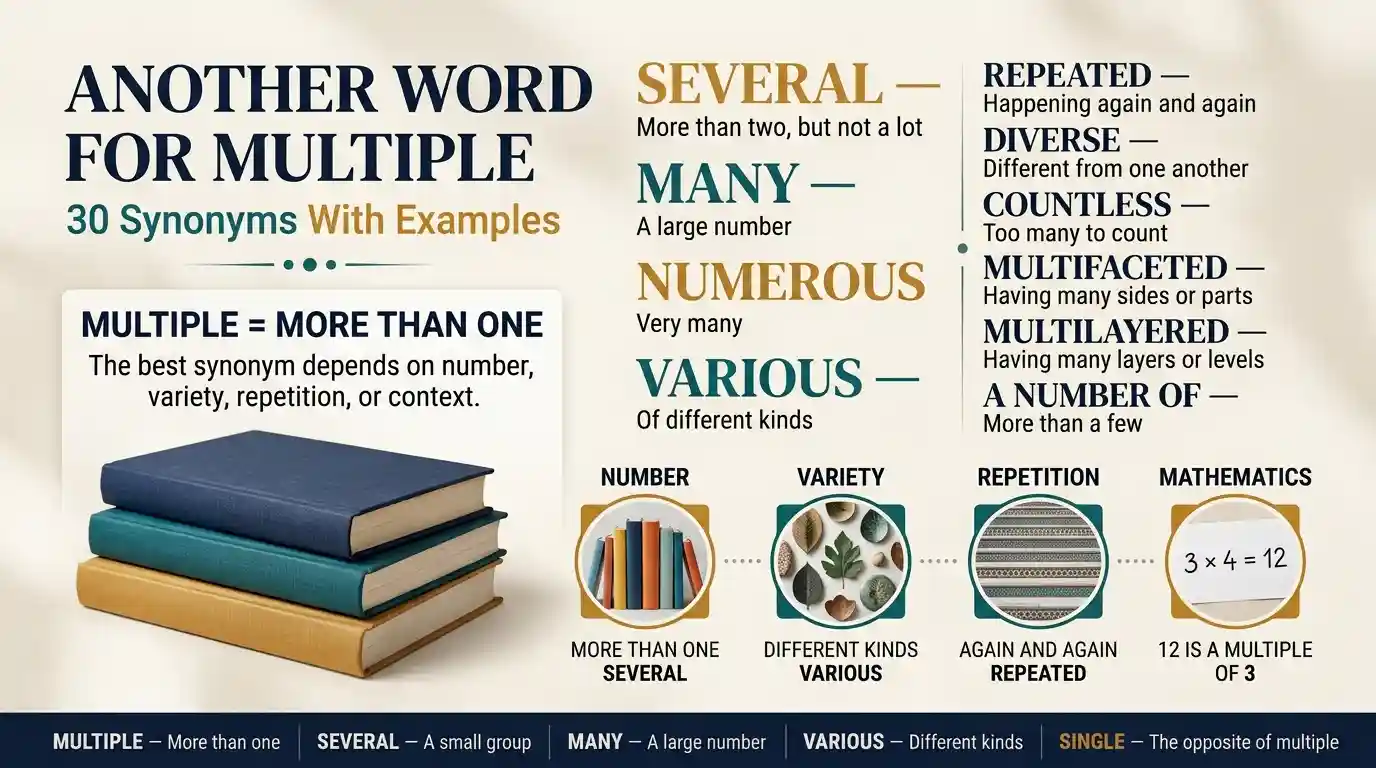
The most common another word for multiple is several. Many, numerous, and various also work. Which one you pick depends on what you want to say. Multiple often just means “more than one,” so more than one is also a close match.
Multiple can talk about how many, how different, how many layers, or how often. In math, it is also a noun, as in “a multiple of three.” Each use needs a different word.
Quick list: several, many, numerous, various, repeated, diverse, countless, a number of, more than one, multifaceted
This article gives 30 alternatives. Each one has a meaning, IPA, a usage note, and an example. Some words are close synonyms. Others only work in one situation. Each entry tells you which.
At a Glance: Multiple Synonyms and Related Alternatives
| Alternative | Part of Speech | Meaning | Register / Tone | Ideal Context |
| Several | Adjective | More than two, but not a lot | Everyday | Small groups |
| Many | Adjective | A large number | Everyday | General use |
| Numerous | Adjective | Very many | Formal | Reports, essays |
| Various | Adjective | Of different kinds | Everyday | Reasons, options |
| Repeated | Adjective | Done again and again | Everyday | Attempts, requests |
| Diverse | Adjective | Very different from each other | Formal | Groups, cultures, ideas |
| Countless | Adjective | Too many to count | Strong | Adding emphasis |
| Multifaceted | Adjective | Having many sides | Formal | Problems, people |
| Plural | Adjective | More than one | Formal, technical | Grammar |
| Product | Noun | The answer to a multiplication | Technical | Math |
Which Word Should You Use?
| If you want to… | Use | Why |
| Say “more than one” in plain words | Several or more than one | They are simple and clear. |
| Say “a lot” in formal writing | Numerous | It sounds formal. |
| Show that things are different | Various or diverse | They stress difference. |
| Say there are too many to count | Countless or innumerable | They are strong words. |
| Describe an idea with many sides | Multifaceted or multilayered | They show it is complex. |
| Describe something that happens again and again | Repeated | It names the repeating. |
| Describe injuries or damage in many places | Extensive or widespread | They show how far it spreads. |
| Talk about numbers in math | Multiple or product | They are the right math words. |
Exploring the Multiple Meanings of “Multiple”
1. More Than One, or Many
- Meaning: More than one. Often many.
- Explanation: This is the most common meaning. It describes sources, copies, and tries. Multiple can mean just two. Many means a lot.
- Example: The report used multiple sources.
2. Many Parts or Levels
- Meaning: Having many parts or sides.
- Explanation: It describes ideas, stories, and problems with many levels. Etymonline lists this as the early meaning, from the 1640s.
- Example: The story works on multiple levels.
3. Hurting Several Parts of the Body
- Meaning: Affecting several parts of the body.
- Explanation: This is a medical use. It goes with injuries, fractures, and organ failure.
- Example: The driver had multiple fractures.
4. A Number Made by Multiplying
- Meaning: A number you get by multiplying another number by a whole number.
- Explanation: This is a noun used in math. Etymonline dates it to the 1680s. Twelve is a multiple of 3. Three is a factor of 12.
- Example: Twelve is a multiple of three.
Sources: Etymonline, “multiple”; Oxford Learner’s Dictionaries, “multiple”; Merriam-Webster, “multiple”; Collins English Dictionary, “multiple”.
Analyzing 30 Multiple Alternatives in Detail
Some of these words are close synonyms of multiple. Others only work in one situation. Each usage note starts by telling you which kind it is.
Core Alternatives for More Than One
1. Several
IPA: /ˈsevrəl/ (US and UK)
Definition: More than two, but not a lot.
- Usage: Close synonym. It sounds natural in everyday speech and points to a small group.
- Example: She checked several sources before she wrote the report.
2. Many
IPA: /ˈmeni/ (US and UK)
Definition: A large number of.
- Usage: Close synonym, but stronger. Multiple can mean just two. Many means a lot.
- Example: Many students joined the club.
3. Numerous
IPA: US /ˈnuːmərəs/ · UK /ˈnjuːmərəs/
Definition: Very many.
- Usage: Close synonym. It is formal and works well in reports and essays.
- Example: The study gives numerous examples.
4. Various
IPA: US /ˈveriəs/ · UK /ˈveəriəs/
Definition: Of different kinds.
- Usage: Close synonym when the things are different from each other.
- Example: She gave various reasons for leaving.
5. Repeated
IPA: /rɪˈpiːtɪd/ (US and UK)
Definition: Done again and again.
- Usage: Related word. It fits events, like attempts and requests. It does not fit objects.
- Example: He made repeated requests for help.
6. A number of
IPA: US /ə ˈnʌmbər əv/ · UK /ə ˈnʌmbə əv/
Definition: Some, or quite a few.
- Usage: Close synonym. It does not give an exact amount.
- Example: A number of guests arrived early.
7. More than one
IPA: US /ˌmɔːr ðən ˈwʌn/ · UK /ˌmɔː ðən ˈwʌn/
Definition: Two or more.
- Usage: Close synonym. It is the plainest way to say it.
- Example: You can apply for more than one job.
Stronger Words for Very Many
8. Countless
IPA: /ˈkaʊntləs/ (US and UK)
Definition: Too many to count.
- Usage: Related word, and stronger than multiple. Use it only when there really are very many.
- Example: Countless people visit the museum each year.
9. Innumerable
IPA: US /ɪˈnuːmərəbl/ · UK /ɪˈnjuːmərəbl/
Definition: Too many to be counted.
- Usage: Related word. It means almost the same as countless, but it sounds more formal.
- Example: The night sky held innumerable stars.
10. Myriad
IPA: /ˈmɪriəd/ (US and UK)
Definition: A very large number.
- Usage: Related word. It sounds formal or literary. It can be an adjective or a noun.
- Example: The city offers myriad ways to spend a weekend.
11. Umpteen
IPA: /ˌʌmpˈtiːn/ (US and UK)
Definition: Very many, with no exact number.
- Usage: Related word. It is informal and often funny.
- Example: I have told you umpteen times.
12. A host of
IPA: US /ə ˈhoʊst əv/ · UK /ə ˈhəʊst əv/
Definition: A large number of.
- Usage: Related word. It sounds a little literary.
- Example: A host of problems slowed the project.
Words for Variety and Layers
13. Diverse
IPA: US /daɪˈvɝːs/ · UK /daɪˈvɜːs/
Definition: Very different from each other.
- Usage: Related word. It is about variety, not number.
- Example: The school has a diverse student body.
14. Varied
IPA: US /ˈverid/ · UK /ˈveərid/
Definition: Of different types.
- Usage: Related word. It stresses that the parts are not the same.
- Example: She has had a varied career.
15. Assorted
IPA: US /əˈsɔːrtɪd/ · UK /əˈsɔːtɪd/
Definition: Of mixed kinds.
- Usage: Related word. It is common for things sold together.
- Example: The box held assorted cookies.
16. Manifold
IPA: US /ˈmænɪfoʊld/ · UK /ˈmænɪfəʊld/
Definition: Many and of different kinds.
- Usage: Close synonym in formal writing. It is rare in speech.
- Example: The benefits of exercise are manifold.
17. Multifaceted
IPA: /ˌmʌltiˈfæsɪtɪd/ (US and UK)
Definition: Having many sides or parts.
- Usage: Related word. It is used for ideas, problems, and people.
- Example: Climate change is a multifaceted problem.
18. Multilayered
IPA: US /ˌmʌltiˈleɪərd/ · UK /ˌmʌltiˈleɪəd/
Definition: Having many layers or levels.
- Usage: Related word. It fits the “many levels” meaning.
- Example: The film has a multilayered plot.
19. A variety of
IPA: /ə vəˈraɪəti əv/ (US and UK)
Definition: Many different kinds of.
- Usage: Related word. It fits options and choices.
- Example: The menu offers a variety of dishes.
Formal and Technical Words
20. Plural
IPA: US /ˈplʊrəl/ · UK /ˈplʊərəl/
Definition: More than one.
- Usage: Related word. It is mostly used in grammar. It also appears in phrases like “plural society.”
- Example: “Books” is a plural noun.
21. Multiplex
IPA: /ˈmʌltɪpleks/ (US and UK)
Definition: Having many parts.
- Usage: Related word. It is formal and technical. Today it more often means a cinema with many screens.
- Example: The system sends multiplex signals.
22. Multitudinous
IPA: US /ˌmʌltɪˈtuːdnəs/ · UK /ˌmʌltɪˈtjuːdɪnəs/
Definition: Very many.
- Usage: Related word. It sounds formal and a little grand.
- Example: The garden held multitudinous flowers.
23. Multifarious
IPA: US /ˌmʌltɪˈferiəs/ · UK /ˌmʌltɪˈfeəriəs/
Definition: Many and of different kinds.
- Usage: Related word. It is formal and close to manifold.
- Example: The job has multifarious duties.
24. Sundry
IPA: /ˈsʌndri/ (US and UK)
Definition: Various.
- Usage: Related word. It is formal and a bit old-fashioned.
- Example: The shop sells sundry goods.
Words for Injuries and Spread
25. Extensive
IPA: /ɪkˈstensɪv/ (US and UK)
Definition: Covering a large area or amount.
- Usage: Related word. It fits injuries or damage that spread wide.
- Example: The fire caused extensive damage.
26. Widespread
IPA: /ˈwaɪdspred/ (US and UK)
Definition: Found over a large area.
- Usage: Related word. It fits damage and disease. It does not count items.
- Example: Widespread flooding closed many roads.
27. Complex
IPA: US /kəmˈpleks/ · UK /ˈkɒmpleks/
Definition: Made of many connected parts.
- Usage: Related word. It fits medical cases, such as “complex injuries.”
- Example: The patient had complex injuries after the crash.
Math Nouns
28. Product
IPA: US /ˈprɑːdʌkt/ · UK /ˈprɒdʌkt/
Definition: The answer to a multiplication.
- Usage: Related word. A multiple of 3 is a product of 3 and a whole number. Product is the wider term.
- Example: The product of 3 and 4 is 12.
29. Multiplier
IPA: US /ˈmʌltɪplaɪər/ · UK /ˈmʌltɪplaɪə/
Definition: The number you multiply by.
- Usage: Related word, not a synonym. A multiplier is what you multiply by. A multiple is the result.
- Example: The multiplier here is 5.
30. Factor
IPA: US /ˈfæktər/ · UK /ˈfæktə/
Definition: A number that divides another number exactly.
- Usage: Not a synonym. It is the reverse of multiple. Three is a factor of 12, and 12 is a multiple of 3.
- Example: Five is a factor of twenty.
Sources: Merriam-Webster; Collins English Dictionary; Collins Thesaurus; Oxford Learner’s Dictionaries.
Multiple vs. Several vs. Many vs. Various
These four words are often mixed up. Each one points to something different.
| Word | Main Idea | Example |
| Multiple | More than one | Multiple attempts failed. |
| Several | A small group | Several people waited. |
| Many | A large number | Many people agreed. |
| Various | Different kinds | Various options exist. |
Multiple is the most flexible. It can mean two or it can mean a lot. Several means a small group. Many means a large group. Various tells you the items are different.
Sources: Merriam-Webster, “multiple,” “several,” “many,” “various”; Collins English Dictionary.
Multiple and Opposite/Paired Word Pairs
| Word | Paired Word | Note |
| Multiple | Single | The closest opposite, as in “single or multiple units.” |
| Multiple | One | Used to compare “more than one” with “exactly one.” |
| Multiple | Sole | A formal opposite, as in “sole owner.” |
| Multiple (math) | Factor | A math pair. 12 is a multiple of 3. Three is a factor of 12. |
| Multiple choice | Open-ended | A test pair. Fixed answers versus free answers. |
Single is the closest opposite. In math, factor is not an opposite, but it is the paired word. In tests, open-ended is the opposite of multiple choice.
Sources: Oxford Learner’s Dictionaries, “multiple”; Merriam-Webster; Collins English Dictionary.
Common Word Partners of “Multiple”
| Pattern | Common Partners | Example |
| multiple + times / attempts | times, attempts, occasions | The shape appears multiple times. |
| multiple + sources / copies / units | sources, copies, units | The study used multiple sources. |
| multiple + levels | levels | The story works on multiple levels. |
| multiple + injuries | injuries, fractures, organ failure | He had multiple injuries. |
| multiple + birth / collision | birth, collision, pile-up | A multiple birth means several babies at once. |
| multiple-entry + visa | visa | She has a multiple-entry visa. |
| multiple + ownership / occupancy | ownership, occupancy | The house is in multiple occupancy. |
| in multiples of | in multiples of ten | The tickets come in multiples of ten. |
Sources: Oxford Learner’s Dictionaries, “multiple”; Merriam-Webster, “multiple”; Collins English Dictionary.
Idiomatic Phrases Featuring “Multiple”
Multiple has very few true idioms. The entries below are set terms that people use often.
1. Multiple choice
- Meaning: A test format where you pick one answer from several. Etymonline records it by 1915.
- Example: The exam has twenty multiple choice questions.
2. Multiple sclerosis
- Meaning: A long-term disease that gets worse over time. Etymonline says the name was in use by 1877, because it occurs in patches.
- Example: The charity raises money for multiple sclerosis research.
3. Multiple exposure
- Meaning: A photo where the same frame of film was exposed more than once. Etymonline records it by 1891.
- Example: The artist made a multiple exposure of the city skyline.
4. A multiple of
- Meaning: A number made by multiplying another number by a whole number.
- Example: Fifteen is a multiple of five.
Sources: Etymonline, “multiple”; Merriam-Webster; Collins English Dictionary.
Word Formation of “Multiple”
Etymology & Structure
Multiple comes from French multiple. French took it from Late Latin multiplus, which means “manifold.” Etymonline says multiplus was built from Latin multi- (“many, much”) and -plus (“-fold”). Oxford Learner’s Dictionaries says multiplus came from Latin multiplex. Etymonline traces the -plex part to a very old root meaning “to plait.”
Date and History
Etymonline records the adjective in the 1640s. The noun for math came in the 1680s. Etymonline dates multiple personality to 1886, multiple exposure to 1891, and multiple choice to 1915.
Word Class Variations
- Adjective: multiple (usually before a noun, as in multiple sources)
- Noun: multiple, multiples (in math, as in a multiple of three)
- Related verb: multiply (mid-12th century)
- Related nouns: multiplicity (mid-15th century), multiplication (mid-14th century), multiplier
- Related adjective: multiplex (1550s)
Sources: Etymonline, “multiple,” “multiplex,” “multiply,” “multiplicity”; Oxford Learner’s Dictionaries, “multiple.”
Common Word-Choice Mistakes
- Multiples sources: multiple sources (the adjective has no -s).
- Multiple of ideas: multiple ideas.
- Multiple time: multiple times.
- Multiply sources: multiple sources (multiply is a verb).
- 6 is a multiple of 12: 12 is a multiple of 6 (or 6 is a factor of 12).
- Multiple of people: many people or several people.
- A multiple option: multiple options (use a plural noun).
FAQs
What is the closest synonym for multiple?
Several is the closest everyday synonym. Use various or numerous when you want to stress difference or large numbers.
What is a formal word for multiple?
Numerous, manifold, and multifarious are formal choices.
What is the difference between multiple and several?
Several means a small group of three or more. Multiple can mean two or many, and it sounds more formal.
What is the difference between multiple and many?
Many means a large number. Multiple only says there is more than one.
What is the difference between multiple and various?
Various says the items are different. Multiple does not say whether they differ.
Does multiple mean at least two?
Yes. It means more than one, but people often use it for a larger number.
What is the opposite of multiple?
Single is the closest opposite. One and sole also work.
What is a multiple in math?
It is a number you get by multiplying another number by a whole number. For example, 4, 8, and 12 are multiples of 4.
Is multiple a noun?
Yes. In math it is a noun, as in “a multiple of five.” In most other uses it is an adjective.
What can I say instead of “multiple times”?
You can say repeatedly, several times, or again and again.
Conclusion
The closest alternatives to multiple are several, many, numerous, and various. For variety, use diverse or assorted. For layers and sides, use multifaceted or multilayered.
The right word depends on what you mean. Multiple can talk about a number, a mix of kinds, many levels, injuries in several places, or a math term. Some words stress how many. Others stress how different.
To choose well, first ask what you want to say: how many, how different, how complex, or how often. Then pick the word that fits that meaning and the tone you need.
Discover More Article

Hy, Sophia is a content writer with 3 years of experience creating engaging, informative, and SEO-friendly articles focused on synonyms, vocabulary, and word meanings.