Another Word for Adventure: 30 Synonyms, Meanings and Examples
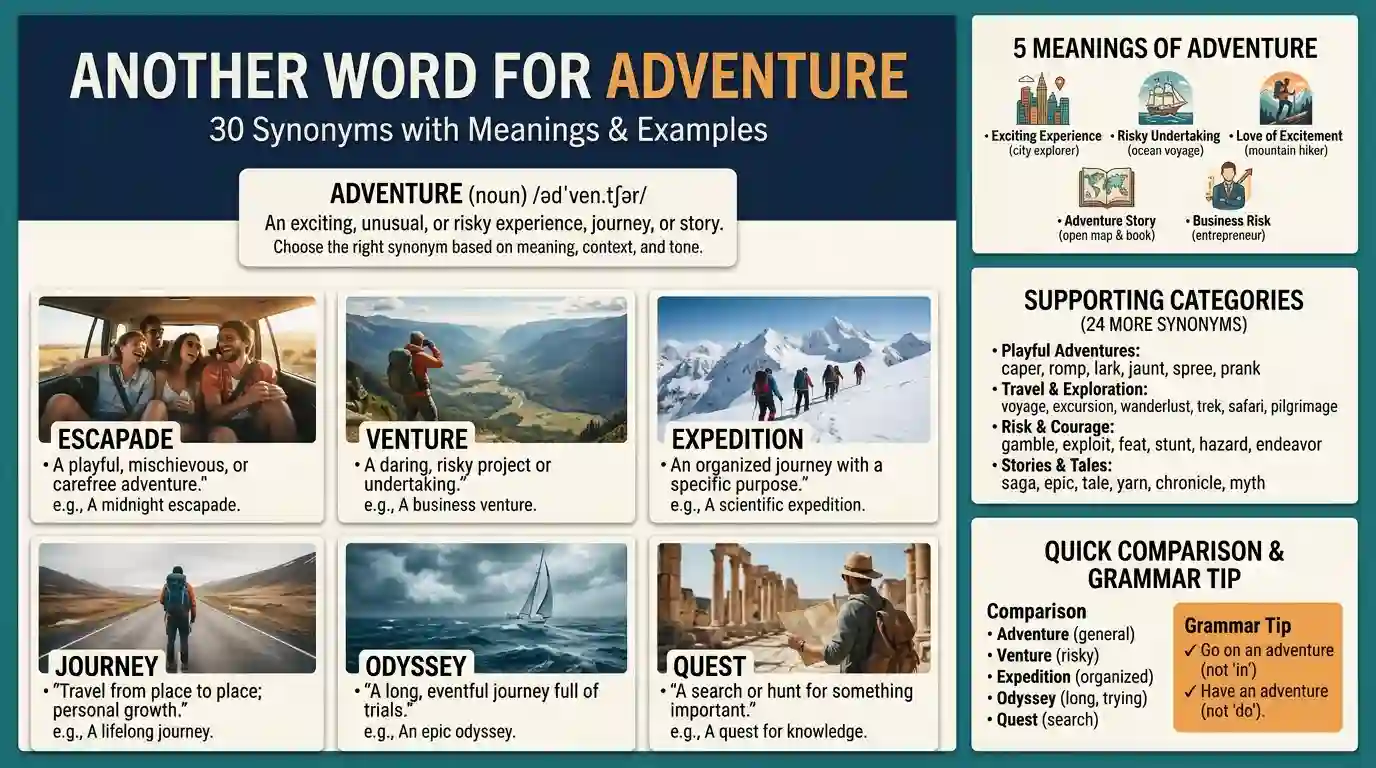
The best everyday alternatives to “adventure” are escapade, venture, experience, and journey, depending on the meaning. “Escapade” fits a lively, playful adventure. “Venture” fits a risky project. “Expedition” fits an organized trip with a purpose.
“Adventure” has several meanings, so no single word replaces it every time. It can mean an exciting experience, a risky undertaking, the love of excitement, or a type of story. This article covers each area, from playful words like caper to serious ones like quest and odyssey.
Quick list: escapade, venture, expedition, journey, odyssey, quest, exploit, caper, thrill
This article examines 30 alternatives to “adventure.” Each one comes with its meaning, IPA, a usage note, an example sentence, and notes on context.
At a Glance: Adventure Synonyms and Related Alternatives
| Alternative | Part of Speech | Meaning | Register / Tone | Ideal Context |
| Venture | noun | a risky project or activity | neutral to formal | business, new projects |
| Escapade | noun | a lively, often playful adventure | light, playful | stories of fun or mischief |
| Expedition | noun | an organized journey with a purpose | formal | exploration, research, mountains |
| Journey | noun | a trip from one place to another | neutral | travel, personal growth |
| Quest | noun | a long search for something important | literary, serious | stories, goals, searches |
| Odyssey | noun | a long, eventful journey | literary | long trips, life stories |
| Caper | noun | a playful or silly adventure | informal, light | comedies, harmless trouble |
| Exploit | noun | a bold or daring act | neutral to formal | heroes, pilots, explorers |
| Thrill | noun | a sudden feeling of excitement | neutral | describing the feeling |
| Saga | noun | a long story of heroic events | neutral to literary | books, films, family history |
Which Word Should You Use?
| If you want to… | Use | Why |
| Describe a fun, lively adventure | escapade or caper | Both suggest light, playful action. |
| Describe an organized trip with a goal | expedition | It suggests planning and a purpose, such as research. |
| Describe a long, hard journey full of events | odyssey | It suggests many events over a long time. |
| Describe a search for something important | quest | It suggests a goal and effort over time. |
| Describe a risky business or project | venture | It is the standard word for risky projects. |
| Describe a daring act that people admire | feat or exploit | Both suggest courage and skill. |
| Describe a love of travel and discovery | wanderlust | It names the desire to travel. |
| Describe a willingness to take risks | daring or adventurousness | Both name the quality in a person. |
| Describe a long story of heroic events | saga or epic | Both are story types. |
Exploring the Multiple Meanings of “Adventure”
1. An Exciting or Unusual Experience
- Meaning: An exciting, unusual, or remarkable experience.
- Explanation: This is the most common modern sense. It does not always involve danger. A day exploring a new city can be an adventure. Etymonline dates this sense to the 1560s, as “novel or exciting incident, remarkable occurrence in one’s life.”
- Example: Our trip to the island was a real adventure.
2. A Risky or Daring Undertaking
- Meaning: An activity or project that involves danger or unknown risks.
- Explanation: This is an older sense. Etymonline traces it through “risk; danger” around 1300 and “perilous undertaking” in the late 14th century. It is still used for dangerous journeys and daring plans.
- Example: The sailors set off on a dangerous adventure across the ocean.
3. A Love of Excitement and Risk
- Meaning: The spirit or quality of enjoying new, exciting, or risky things.
- Explanation: This sense appears without “an” or “the.” It is common in “a sense of adventure” and “the spirit of adventure.” It describes a quality in people, not an event.
- Example: She has a strong sense of adventure.
4. A Type of Story, Game, or Activity
- Meaning: A story, film, game, or activity built around exciting events.
- Explanation: In this sense, “adventure” often works as an adjective before another noun, as in “adventure story,” “adventure game,” and “adventure travel.”
- Example: He loves adventure movies about pirates and treasure.
5. A Risky Business or Financial Enterprise
- Meaning: An enterprise that involves chance or financial risk.
- Explanation: Dictionaries list this as a less common sense. The shorter word “venture” is now far more common in business. Etymonline calls “venture” a 15th-century variant of “adventure.”
- Example: The merchant lost money in a risky sea adventure.
Sources: Merriam-Webster; Collins Dictionary; Dictionary.com; Etymonline
Analyzing 30 Adventure Alternatives in Detail
Some of these words are close synonyms of “adventure,” while others are related alternatives that fit only one meaning or situation, and each Usage note says which is which.
Core Synonyms
1. Venture
IPA: US /ˈvɛntʃər/ · UK /ˈvɛntʃə/
Definition: A project or activity that involves risk, especially in business.
- Usage: This is a related alternative, narrower than “adventure.” Etymonline records it as a 15th-century shortened form of “adventure,” but today it mostly means a risky project, not a fun experience.
- Example: Their new restaurant was a risky venture.
2. Escapade
IPA: US /ˈɛskəˌpeɪd/ · UK /ˌɛskəˈpeɪd/
Definition: An exciting, often playful or reckless adventure.
- Usage: This is a close synonym for a lively, fun adventure. It often suggests mischief or breaking small rules.
- Example: The friends still laugh about their summer escapade.
3. Exploit
IPA: /ˈɛksplɔɪt/ (US and UK)
Definition: A bold, daring, or impressive act.
- Usage: This is a close synonym for the “daring act” sense. It is usually plural: “exploits.” As a noun, it is stressed on the first syllable. The verb “exploit,” which means “use unfairly,” has a different meaning.
- Example: The pilot’s exploits made him a hero.
4. Experience
IPA: US /ɪkˈspɪriəns/ · UK /ɪkˈspɪəriəns/
Definition: Something that happens to you or that you go through.
- Usage: This is a related alternative, much broader than “adventure.” It does not suggest excitement unless an adjective such as “unforgettable” is added.
- Example: Seeing the northern lights was an unforgettable experience.
5. Undertaking
IPA: US /ˈʌndərˌteɪkɪŋ/ · UK /ˌʌndəˈteɪkɪŋ/
Definition: A task or project, especially a large or difficult one.
- Usage: This is a related, formal alternative for the “risky project” sense. It does not suggest fun or excitement.
- Example: Crossing the desert on foot was a huge undertaking.
Journeys and Exploring
6. Expedition
IPA: /ˌɛkspəˈdɪʃən/ (US and UK)
Definition: An organized journey made for a purpose, such as exploring, research, or climbing.
- Usage: This is a close synonym for a planned, serious adventure. It is formal and suggests teamwork and preparation.
- Example: The scientists joined an expedition to the Arctic.
7. Journey
IPA: US /ˈdʒɜːrni/ · UK /ˈdʒɜːni/
Definition: The act of traveling from one place to another, often over a long distance.
- Usage: This is a related alternative. It describes travel, not excitement. It is also used figuratively for personal growth, as in “a journey of discovery.”
- Example: Their journey across Asia took six months.
8. Odyssey
IPA: US /ˈɑːdəsi/ · UK /ˈɒdəsi/
Definition: A long, eventful journey, often with many changes of luck.
- Usage: This is a related, literary alternative. The word comes from the title of Homer’s ancient poem. It suggests length and many events, so it does not suit short trips.
- Example: Their odyssey across Europe lasted two years.
9. Quest
IPA: /kwɛst/ (US and UK)
Definition: A long search for something valuable or important.
- Usage: This is a related, literary alternative. It stresses the goal, not the excitement. It is common in stories, games, and serious personal goals.
- Example: She went on a quest to find her family’s old home.
10. Voyage
IPA: /ˈvɔɪɪdʒ/ (US and UK)
Definition: A long journey, especially by sea or through space.
- Usage: This is a related alternative limited mostly to ships and space travel. It suggests a long trip.
- Example: The voyage across the ocean took several weeks.
Playful and Informal Alternatives
11. Caper
IPA: US /ˈkeɪpər/ · UK /ˈkeɪpə/
Definition: A playful, silly, or lighthearted activity or adventure; also, an informal word for a crime story.
- Usage: This is an informal, close synonym for harmless, funny adventures. In film, a “caper” is a light story about a clever crime.
- Example: The movie is a funny caper about two clumsy thieves.
12. Romp
IPA: US /rɑːmp/ · UK /rɒmp/
Definition: A lively, playful, and enjoyable activity; also, an easy win.
- Usage: This is an informal, related alternative. It suggests lively fun, often in a story, film, or game.
- Example: The film is a fun romp through old London.
13. Lark
IPA: US /lɑːrk/ · UK /lɑːk/
Definition: An amusing or reckless adventure, often done for fun.
- Usage: This is an informal, mostly British alternative. It often appears in the phrase “for a lark,” meaning “just for fun.”
- Example: They climbed the hill for a lark.
14. Jaunt
IPA: /dʒɔːnt/ (US and UK)
Definition: A short trip taken for pleasure.
- Usage: This is a related alternative. It suggests a quick, enjoyable outing, not danger.
- Example: We took a jaunt to the coast on Sunday.
15. Excursion
IPA: US /ɪkˈskɜːrʒən/ · UK /ɪkˈskɜːʃən/
Definition: A short trip made for pleasure or education, often with a group.
- Usage: This is a related alternative. It suggests an organized outing, not excitement or danger.
- Example: The class took an excursion to the science museum.
Risk and Daring Alternatives
16. Gamble
IPA: /ˈɡæmbəl/ (US and UK)
Definition: An action or plan with an uncertain result and a chance of loss.
- Usage: This is a related alternative for the risk side of “adventure.” It does not suggest fun.
- Example: Leaving her job to start a company was a gamble.
17. Risk
IPA: /rɪsk/ (US and UK)
Definition: The chance of loss, harm, or danger.
- Usage: This is a related alternative. It names the danger only, not the excitement or experience.
- Example: Climbing without a rope is a big risk.
18. Feat
IPA: /fiːt/ (US and UK)
Definition: An impressive act of skill, strength, or courage.
- Usage: This is a related alternative for the “daring act” sense. It focuses on the achievement, not the experience.
- Example: Crossing the ocean alone was a remarkable feat.
19. Stunt
IPA: /stʌnt/ (US and UK)
Definition: A daring or showy act, often done to get attention.
- Usage: This is an informal, related alternative. It can also mean a trick for publicity, so check the context.
- Example: He performed a dangerous stunt on his bike.
20. Derring-do
IPA: /ˌdɛrɪŋ ˈduː/ (US and UK)
Definition: Brave and exciting actions, especially in stories.
- Usage: This is a literary or humorous alternative. It suggests old-fashioned heroic action, as in pirate or knight stories.
- Example: The film is full of pirate derring-do.
Spirit and Excitement
21. Adventurousness
IPA: US /ædˈvɛntʃərəsnəs/ · UK /ədˈvɛntʃərəsnəs/
Definition: Willingness to try new, unusual, or risky things.
- Usage: This is a close synonym for the “love of excitement” sense. It describes a personal quality and sounds formal.
- Example: Her adventurousness showed in the unusual food she ordered.
22. Wanderlust
IPA: US /ˈwɑːndərˌlʌst/ · UK /ˈwɒndəlʌst/
Definition: A strong desire to travel and explore.
- Usage: This is a related alternative limited to the wish to travel. It does not suit other kinds of adventure.
- Example: Her wanderlust took her to forty countries.
23. Thrill
IPA: /θrɪl/ (US and UK)
Definition: A sudden strong feeling of excitement or pleasure.
- Usage: This is a related alternative. It names the feeling, not the experience.
- Example: She felt the thrill of the climb.
24. Excitement
IPA: /ɪkˈsaɪtmənt/ (US and UK)
Definition: A feeling of great interest, enthusiasm, or eagerness.
- Usage: This is a related alternative. It is broader than “thrill” and names a feeling, not a risky act.
- Example: The trip was full of excitement.
25. Daring
IPA: US /ˈdɛrɪŋ/ · UK /ˈdɛərɪŋ/
Definition: The courage to take risks.
- Usage: This is a related alternative. As a noun, it names the quality of boldness. It also works as an adjective, as in “a daring escape.”
- Example: Her daring impressed the whole team.
Adventure Stories and Tales
26. Saga
IPA: /ˈsɑːɡə/ (US and UK)
Definition: A long story of heroic events; also, a long series of events.
- Usage: This is a related alternative for the “adventure story” sense. It suggests a long, detailed story, often about a family or a hero.
- Example: He wrote a saga about a Viking family.
27. Epic
IPA: /ˈɛpɪk/ (US and UK)
Definition: A long story or poem about heroes and great events.
- Usage: This is a related, literary alternative for stories only. It is also used informally for anything very large or impressive.
- Example: The epic follows a young sailor across the world.
28. Tale
IPA: /teɪl/ (US and UK)
Definition: A story, especially one about exciting or imagined events.
- Usage: This is a related alternative for the “story” sense. It is simple and flexible, and often appears as “a tale of adventure.”
- Example: She told a tale of adventure in the jungle.
29. Yarn
IPA: US /jɑːrn/ · UK /jɑːn/
Definition: An informal word for a long story, often about adventures and sometimes exaggerated.
- Usage: This is an informal, related alternative. The phrase “spin a yarn” means to tell such a story.
- Example: Grandpa spun a yarn about his years at sea.
30. Romance
IPA: US /roʊˈmæns/ · UK /rəʊˈmæns/
Definition: In older and literary use, a story of adventure or heroic deeds; today, usually a love story or love affair.
- Usage: This is a related alternative, but the older story sense is now rare. Today, “romance” usually means love, so do not use it as a general synonym.
- Example: The old romance told of knights and dragons.
Sources: Merriam-Webster; Collins Dictionary / Collins Thesaurus; Dictionary.com
Adventure vs. Venture vs. Escapade vs. Expedition vs. Odyssey vs. Quest
These words overlap, but each one points to a different kind of adventure.
| Word | Main Idea | Tone | Example |
| Adventure | an exciting or risky experience or undertaking | general, usually positive | We had an adventure in the mountains. |
| Venture | a risky project, especially in business | neutral to formal | She started a new venture. |
| Escapade | a playful, sometimes mischievous adventure | light, playful | His holiday escapade made us laugh. |
| Expedition | an organized journey with a purpose | formal, serious | The team led an expedition to the pole. |
| Odyssey | a long, eventful journey | literary | Their odyssey lasted three years. |
| Quest | a search for something important | literary, serious | He began a quest for the lost map. |
“Adventure” is the most general of these. The others add a particular shape: “venture” adds business risk, “escapade” adds playfulness, “expedition” adds planning, “odyssey” adds length, and “quest” adds a goal.
Sources: Merriam-Webster; Collins Dictionary; Etymonline
Adventure and Opposite/Paired Word Pairs
| Word | Paired Word | Note |
| Adventure | Routine | The opposite of daily, predictable life |
| Adventure | Boredom | The opposite feeling of having nothing exciting to do |
| Adventure | Safety | A contrast between risk and protection |
| Adventure | Misadventure | “Misadventure” means bad luck or an unlucky accident, not a fun adventure |
| Adventure | Ordeal | A contrast: an ordeal is a painful experience, while an adventure is usually exciting |
| Adventure | Comfort | A contrast between trying new things and staying at ease |
“Adventure” has no single perfect opposite, because it covers several meanings. “Routine” and “boredom” fit the exciting-experience sense. “Safety” fits the risk sense. “Misadventure” is a related word, but it does not mean the opposite. It describes an unlucky event.
Sources: Merriam-Webster; Collins Thesaurus; Dictionary.com
Common Word Partners of “Adventure”
| Pattern | Common Partners | Example |
| Adjective + adventure | great, big, exciting, real, epic, daring, outdoor, family | We went on a great family adventure. |
| Verb + adventure | go on, embark on, set off on, have, seek, crave | They set off on an adventure at dawn. |
| Adventure + noun | story, game, film, travel, park, holiday, sports | The kids love adventure stories. |
| Sense / spirit of adventure | sense of adventure, spirit of adventure | He has a strong sense of adventure. |
| Preposition + adventure | on an adventure, in an adventure, for adventure | She left home in search of adventure. |
| Adventure + of | of a lifetime | The trip was the adventure of a lifetime. |
Sources: Merriam-Webster; Collins Dictionary; Oxford Learner’s Dictionaries
Idiomatic Phrases Featuring “Adventure”
“Adventure” appears in very few true idioms. The items below are established expressions and compounds, not figurative idioms.
1. The adventure of a lifetime
- Meaning: An exciting experience that a person is unlikely to have more than once. It is common in travel writing and advertising.
- Example: Seeing the whales up close was the adventure of a lifetime.
2. Adventure playground
- Meaning: A British term for a playground with climbing structures, ropes, and other equipment for active play.
- Example: The children spent the afternoon at the adventure playground.
3. Death by misadventure
- Meaning: A phrase used in legal and news contexts for an accidental death. It contains “misadventure,” which means bad luck or an unlucky accident.
- Example: The report listed the cause of death as misadventure.
Sources: Merriam-Webster; Collins Dictionary; Cambridge Dictionary
Word Formation of “Adventure”
Etymology & Structure
“Adventure” comes from Old French aventure, meaning “chance, accident, occurrence, event.” Etymonline traces it to Latin adventura (res), “(a thing) about to happen,” from adventurus, the future participle of advenire, “to come to, reach, arrive at.” That verb combines ad (“to”) and venire (“to come”), which Etymonline links to a Proto-Indo-European root meaning “to go, come.” Etymonline notes that the English -d- was restored in the 15th and 16th centuries, because writers wanted the spelling to match the Latin. The French tried the same change but did not keep it.
Date and History
Etymonline dates “adventure” to around 1200, in the form aventure, with the meaning “that which happens by chance, fortune, luck.” The meaning moved to “risk; danger” around 1300, to “perilous undertaking” in the late 14th century, and to “novel or exciting incident, remarkable occurrence in one’s life” in the 1560s. Etymonline also records an earlier 13th-century sense, “a wonder, a miracle; accounts of marvelous things.” The verb adventure appears around 1300, meaning “to risk the loss of.” The shorter word “venture” is listed as a 15th-century variant.
Word Class Variations
- Noun: adventure, adventurer, adventuress (dated), adventurousness, misadventure
- Verb: adventure, adventured, adventuring (rare today)
- Adjective: adventurous, adventuresome (chiefly American)
- Adverb: adventurously
- Related word: venture
Sources: Etymonline (entry for adventure); Merriam-Webster
Common Word-Choice Mistakes
- Wrong: “We went in an adventure.” Correct: “We went on an adventure.”
- Wrong: “We did an adventure last summer.” Correct: “We had an adventure last summer.” Use “had” or “went on,” not “did.”
- Wrong: “She is an adventure person.” Correct: “She is an adventurous person.” Use the adjective before a noun.
- Wrong: “She has a lot of adventurous.” Correct: “She has a lot of adventurousness,” or “She has a strong sense of adventure.”
- Wrong: “Our odyssey to the corner shop took five minutes.” Correct: “Our trip to the corner shop took five minutes.” “Odyssey” suggests a long, eventful journey.
- Wrong: “Misadventure means a fun adventure.” Correct: “Misadventure means an unlucky accident.”
- Wrong: “She works for an adventure capital firm.” Correct: “She works for a venture capital firm.”
FAQs
What is the closest synonym for adventure?
It depends on the meaning. “Escapade” is close for a lively adventure, “venture” for a risky project, and “expedition” for an organized trip.
What is another word for an adventure story?
“Saga,” “epic,” “tale,” and “yarn” are good choices. “Saga” suits a long story, and “yarn” suits an informal, exaggerated one.
What is another word for an adventure trip?
“Expedition,” “journey,” “voyage,” and “excursion” all work. Choose “expedition” for a planned trip with a goal and “excursion” for a short outing.
What is the difference between adventure and venture?
They come from the same word. Etymonline lists “venture” as a 15th-century variant. Today, “venture” usually means a risky project, especially in business.
What is the difference between adventure and escapade?
“Adventure” is general. “Escapade” is more playful and often suggests mischief or breaking small rules.
What is a formal alternative to adventure?
“Undertaking” and “expedition” are common in formal writing. Use “undertaking” for a large project and “expedition” for an organized trip.
What is a literary alternative to adventure?
“Derring-do,” “odyssey,” and “quest” are literary. “Derring-do” suits stories of bold action, and “odyssey” suits long, eventful journeys.
What is the opposite of adventure?
“Routine” and “boredom” are the closest opposites for the exciting-experience sense. “Safety” fits the risk sense.
Can “adventure” be a verb?
Yes, but it is rare and old-fashioned. Etymonline records it from around 1300 with the meaning “to risk the loss of.” Today people use “venture” instead.
What does “a sense of adventure” mean?
It means a love of trying new and exciting things. “Adventurousness” and “daring” are close alternatives, and “wanderlust” fits when the wish is to travel.
Conclusion
The closest alternatives to “adventure” depend on the meaning. “Escapade” and “caper” fit playful adventures, “venture” fits risky projects, and “expedition,” “journey,” “odyssey,” and “quest” fit trips and searches. For daring acts, “feat” and “exploit” work well, and for stories, “saga,” “epic,” and “tale” are good choices.
Context and meaning decide the best word. “Adventure” can mean an experience, a risky undertaking, a love of excitement, or a type of story, and each sense has its own alternatives. Related words such as “experience,” “risk,” and “romance” overlap with “adventure” but do not mean the same thing.
To choose the right word, first decide which sense you mean. Then think about the tone and the scale: light or serious, short or long, planned or surprising. When you are unsure, “adventure” itself is often the safest word, with “journey” or “experience” as simple backups.
Discover More Article

Hy, Sophia is a content writer with 3 years of experience creating engaging, informative, and SEO-friendly articles focused on synonyms, vocabulary, and word meanings.