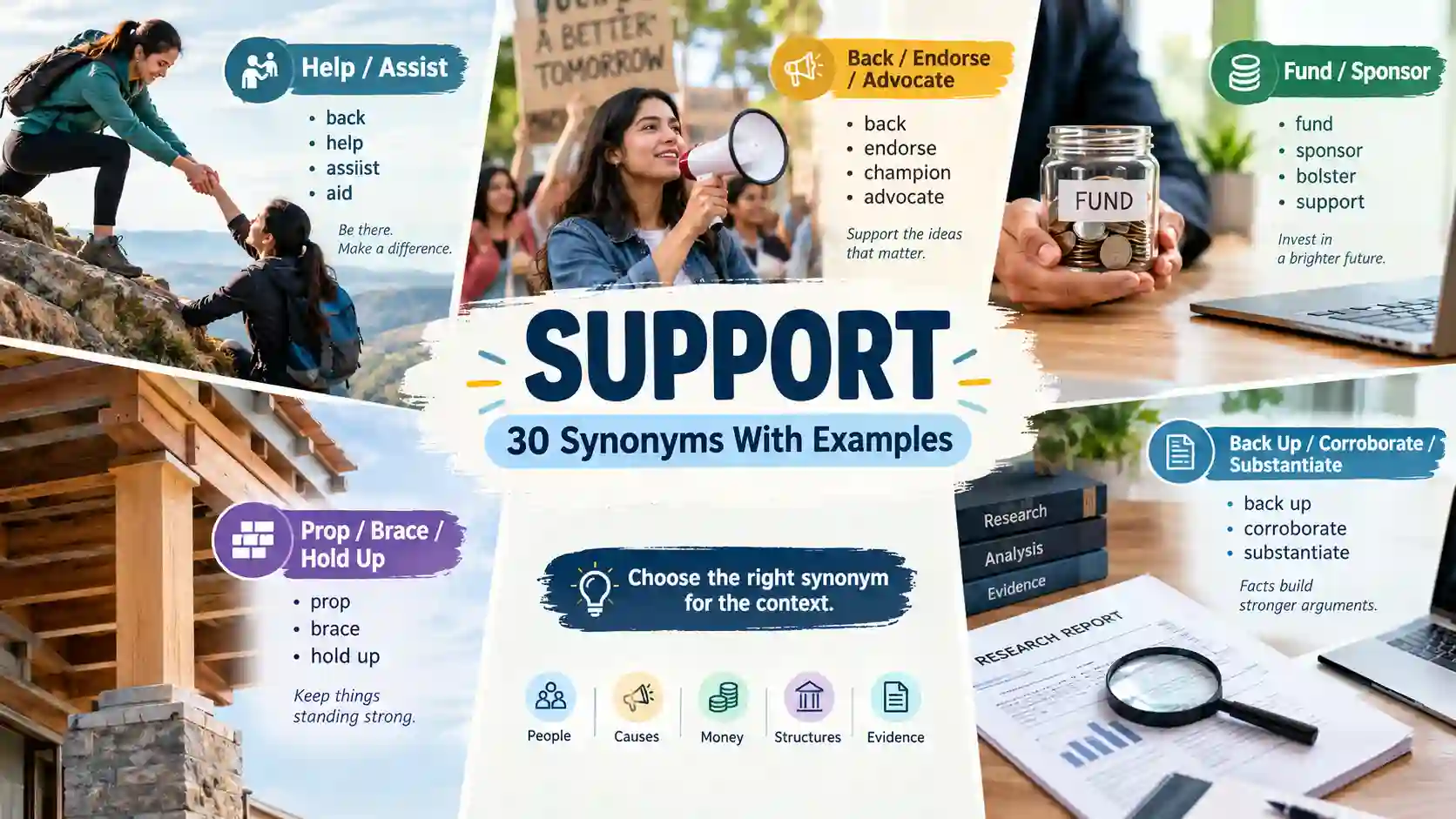
Another Word for Support: 30 Best Synonyms With Meanings and Examples
The closest everyday alternatives to “support” are back, help, assist, and aid. The best choice depends on what kind of support you mean. To favor a person or plan, use back, endorse, champion, or advocate.
“Support” works as both a verb and a noun, so its alternatives span several areas: backing a cause, helping a person, providing money, holding something up, and supplying evidence. Some words are direct synonyms. Others fit only one of these areas, and this article says so when that is the case.
Quick list: back, help, assist, aid, endorse, champion, advocate, fund, bolster, backing
This article looks at 30 alternatives. Each entry gives a meaning, IPA, a usage note, and an example, so you can match the word to the situation.
At a Glance: Support Synonyms and Related Alternatives
| Alternative | Part of Speech | Meaning | Register / Tone | Ideal Context |
| back | verb | to give approval, money, or help to a person or plan | Neutral, short | Elections, projects, plans |
| help | verb, noun | to make something easier for someone | Everyday | Almost any situation |
| assist | verb | to help, often with part of a task | Formal-neutral | Work, services, medical settings |
| aid | verb, noun | to help someone in need | Formal | Relief, legal, medical help |
| endorse | verb | to approve publicly | Formal | Candidates, products, plans |
| champion | verb | to defend and promote a cause | Strong, positive | Rights, reforms, causes |
| fund | verb | to provide money for something | Neutral | Projects, research, charities |
| prop | verb, noun | to hold something up with something else | Informal | Fences, doors, shelves |
| back up | phrasal verb | to support a claim or a person | Informal | Arguments, claims, teammates |
| backing | noun | support, often money or influence | Neutral | Films, campaigns, businesses |
Which Word Should You Use?
| If you want to… | Use | Why |
| Say you are on someone’s side | back, support | Short and clear for people, plans, and teams |
| Approve something in public | endorse | It suggests a public, often formal approval |
| Speak up for a cause | advocate, champion | Both stress active effort, not just agreement |
| Help with a task | help, assist | Help is everyday; assist sounds more formal |
| Pay for something | fund, finance, sponsor | These words are about money |
| Hold up something physical | prop, brace, hold up | They describe real structures and objects |
| Prove a claim is true | corroborate, substantiate, bear out | They point to evidence |
| Ease someone’s sadness | comfort, stand by | They focus on emotional care and loyalty |
Exploring the Multiple Meanings of “Support”
1. To Favor or Back a Person, Idea, or Cause
- Meaning: To approve of and actively favor someone or something.
- Explanation: This is a core verb use. Merriam-Webster notes that in this group of words, “support” is the least specific about how the help is given. You can support a plan by voting, speaking, or giving money.
- Example: Which candidate do you support?
2. To Help or Encourage a Person
- Meaning: To give help, comfort, or encouragement to someone.
- Explanation: This sense is about care and presence. The help may be practical or emotional. It is common in phrases like “emotional support.”
- Example: Her friends supported her through a hard year.
3. To Provide Money or What Is Needed to Live
- Meaning: To pay the living costs of someone, or to supply what a person or thing needs to survive.
- Explanation: It covers family costs and also non-human uses, such as land that can or cannot support life. Etymonline traces the “supply funds or means for” sense to the early 15th century.
- Example: She supports her parents on a teacher’s salary.
4. To Hold Something Up
- Meaning: To bear the weight of something so it stays in place.
- Explanation: This is the oldest sense, close to the Latin roots. It applies to real objects such as beams, posts, and cables.
- Example: Four steel posts support the porch roof.
5. To Provide Evidence for a Claim
- Meaning: To show that a claim, theory, or alibi is probably true.
- Explanation: Here the support is information, not help. The subject is usually data, a witness, or a document.
- Example: The test results support her theory.
6. Services That Keep Something Working
- Meaning: Help that keeps a product, system, or person running.
- Explanation: This is common as a noun, in terms such as “customer support” and “tech support.” Etymonline dates this sense to 1953.
- Example: Call customer support if the app keeps crashing.
Sources: Merriam-Webster.com Dictionary and Thesaurus, entries for “support” and “supported”; Etymonline, entry for “support.”
Analyzing 30 Support Alternatives in Detail
Some of these alternatives are direct synonyms. Others only match one sense of “support,” and the usage notes say which is which.
Group 1: Backing a Person, Cause, or Idea
1. Back
IPA: /bæk/ (US and UK)
Definition: To give help, money, or approval to a person, plan, or cause.
- Usage: A direct synonym. Merriam-Webster lists it as a close alternative to the verb “support.” It is short, neutral, and often used for elections, contests, and money.
- Example: Several local businesses backed her campaign.
2. Endorse
IPA: US /ɪnˈdɔːrs/ · UK /ɪnˈdɔːs/
Definition: To approve of something in public or to recommend it.
- Usage: A close alternative, but narrower. It suggests public approval. It does not cover practical help.
- Example: The mayor endorsed the new bus plan.
3. Champion
IPA: /ˈtʃæmpiən/ (US and UK)
Definition: To fight for, defend, or promote a person or cause.
- Usage: A direct synonym in Merriam-Webster’s list, but with more energy than “support.” It suggests active, committed effort.
- Example: She championed better pay for nurses.
4. Advocate
IPA: /ˈædvəkeɪt/ (US and UK)
Definition: To speak or write in favor of something (as a verb).
- Usage: A direct synonym. Merriam-Webster says it stresses urging or pleading. It is neutral to formal and suits ideas, policies, and changes.
- Example: Doctors advocate regular exercise.
5. Uphold
IPA: US /ʌpˈhoʊld/ · UK /ʌpˈhəʊld/
Definition: To keep something in force, or to support something that is being challenged.
- Usage: A direct synonym with a narrower sense. Merriam-Webster says it implies extended support given to something attacked. It is formal and common with laws, rights, and decisions.
- Example: The court upheld the ruling.
Group 2: Helping and Encouraging People
6. Help
IPA: /hɛlp/ (US and UK)
Definition: To make it easier for someone to do something, or to give aid.
- Usage: The plainest everyday alternative, for both the verb and noun. It is less formal than “support.”
- Example: Her family helped her through college.
7. Assist
IPA: /əˈsɪst/ (US and UK)
Definition: To help, often by doing part of a task.
- Usage: A close alternative to the helping sense. It sounds more formal than “help” and often suggests a secondary role.
- Example: Two nurses assisted the doctor.
8. Aid
IPA: /eɪd/ (US and UK)
Definition: To help someone who is in need; as a noun, help given in need.
- Usage: A close alternative. It is formal and often used for relief, medical, or legal help.
- Example: Volunteers aided the flood victims.
9. Encourage
IPA: US /ɪnˈkɜːrɪdʒ/ · UK /ɪnˈkʌrɪdʒ/
Definition: To give someone hope, courage, or confidence.
- Usage: A related alternative, not an exact synonym. It covers emotional and motivating support only. It does not cover money or physical support.
- Example: Her teacher encouraged her to apply.
10. Comfort
IPA: US /ˈkʌmfərt/ · UK /ˈkʌmfət/
Definition: To ease someone’s sadness or pain.
- Usage: A related alternative for emotional support. It is narrower than “support” and suits moments of loss or worry.
- Example: He comforted his sister after the bad news.
11. Stand by
IPA: /stænd baɪ/ (US and UK)
Definition: To stay loyal to someone and keep supporting them, especially in trouble.
- Usage: A related phrasal verb. It stresses loyalty over time. It is not used for objects or evidence.
- Example: Her friends stood by her during the trial.
Group 3: Providing Money or Resources
12. Fund
IPA: /fʌnd/ (US and UK)
Definition: To provide money for a project, person, or organization.
- Usage: A related alternative. It matches only the money sense of “support.”
- Example: A charity funds the clinic.
13. Finance
IPA: US /ˈfaɪnæns, fəˈnæns/ · UK /ˈfaɪnæns, faɪˈnæns/
Definition: To provide the money for something, often something large.
- Usage: A related alternative. It is more formal than “fund” and common in business and large purchases.
- Example: The bank financed the new factory.
14. Sponsor
IPA: US /ˈspɑːnsər/ · UK /ˈspɒnsə/
Definition: To support a person, event, or activity, often by paying costs.
- Usage: A related alternative. It suggests money plus a public link, such as a name on a shirt.
- Example: A local bakery sponsors the youth team.
15. Subsidize
IPA: /ˈsʌbsɪdaɪz/ (US and UK)
Definition: To help pay for something so that its cost stays lower.
- Usage: A narrow, formal alternative. It usually refers to government or institutional payments.
- Example: The state subsidizes rural bus routes.
16. Sustain
IPA: /səˈsteɪn/ (US and UK)
Definition: To keep something going, or to provide what is needed to live or continue.
- Usage: A close alternative for the “provide what is needed” sense. It suggests long-term support.
- Example: The farm cannot sustain so many animals.
Group 4: Holding Up and Strengthening
17. Hold up
IPA: US /hoʊld ʌp/ · UK /həʊld ʌp/
Definition: To keep something from falling.
- Usage: A direct alternative for the physical sense. It is informal. Note that “hold up” also means “delay” in other contexts.
- Example: Four steel posts hold up the roof.
18. Prop
IPA: US /prɑːp/ · UK /prɒp/
Definition: To support something by placing something under or against it.
- Usage: An informal alternative for physical support. It is also common as “prop up,” which can be figurative.
- Example: She propped the sagging fence with a wooden beam.
19. Brace
IPA: /breɪs/ (US and UK)
Definition: To strengthen or steady something with a support.
- Usage: A related alternative for physical or structural support, such as walls, joints, or limbs.
- Example: Workers braced the wall before the storm.
20. Bolster
IPA: US /ˈboʊlstər/ · UK /ˈbəʊlstə/
Definition: To strengthen or give more support to something.
- Usage: A close alternative, often figurative. It is common with confidence, arguments, and economies.
- Example: New data bolstered the team’s argument.
Group 5: Supporting Claims With Evidence
21. Back up
IPA: /bæk ʌp/ (US and UK)
Definition: To support a claim with proof, or to support a person by agreeing with them.
- Usage: A direct alternative for the evidence sense. It is informal and common in speech.
- Example: Can you back up that claim with numbers?
22. Corroborate
IPA: US /kəˈrɑːbəreɪt/ · UK /kəˈrɒbəreɪt/
Definition: To support a statement with more evidence or testimony.
- Usage: A related alternative. It is formal and used in law, news, and research. It applies only to claims, not to people.
- Example: Two witnesses corroborated her account.
23. Substantiate
IPA: /səbˈstænʃieɪt/ (US and UK)
Definition: To prove or support a claim with evidence.
- Usage: A related alternative. It is formal and fits legal and academic writing.
- Example: The report does not substantiate the charge.
24. Bear out
IPA: US /bɛr aʊt/ · UK /beə aʊt/
Definition: To show that something is true.
- Usage: A related phrasal verb. It is neutral and fits results, facts, and events that confirm an idea.
- Example: The results bear out our theory.
Group 6: Noun Alternatives
25. Backing
IPA: /ˈbækɪŋ/ (US and UK)
Definition: Help or support, especially money or approval from an important person or group.
- Usage: A direct noun alternative. It is neutral and common with projects and campaigns.
- Example: The film had backing from a major studio.
26. Assistance
IPA: /əˈsɪstəns/ (US and UK)
Definition: Help or aid.
- Usage: A direct noun alternative. It is more formal than “help” and common in programs and services.
- Example: Financial assistance is available for students.
27. Encouragement
IPA: US /ɪnˈkɜːrɪdʒmənt/ · UK /ɪnˈkʌrɪdʒmənt/
Definition: Words or actions that give someone hope or confidence.
- Usage: A related noun for emotional support. It does not cover money or physical help.
- Example: His encouragement kept her going.
28. Foundation
IPA: /faʊnˈdeɪʃn/ (US and UK)
Definition: The base on which something is built.
- Usage: A related noun, not an exact synonym. It fits physical and figurative bases but not helpful actions.
- Example: Good sleep is a foundation of health.
29. Mainstay
IPA: /ˈmeɪnsteɪ/ (US and UK)
Definition: A person or thing that is the chief support of something.
- Usage: A related noun. It names the main source of support, not the act of supporting.
- Example: Her income is the mainstay of the household.
30. Pillar
IPA: US /ˈpɪlər/ · UK /ˈpɪlə/
Definition: A strong supporter or an important part of something; also a physical column.
- Usage: A related noun used both literally and figuratively. It names the supporter, not the support.
- Example: He was a pillar of the community.
Sources: Merriam-Webster.com Thesaurus, entry for “support” (for back, advocate, champion, and uphold); Merriam-Webster.com Dictionary, entry for “support.”
Back vs. Advocate vs. Champion vs. Uphold vs. Endorse
These five words often replace “support” when the subject is a person, cause, or idea. Merriam-Webster says the first four share the idea of actively favoring something that meets opposition, and that “support” is the least specific about how the help is given.
| Word | What it stresses | Example |
| back | Giving approval or resources; close to “support” | The union backed the strike. |
| advocate | Urging or pleading in favor of something | She advocates for school meals. |
| champion | Active defense and promotion, often of a cause | He championed the new law. |
| uphold | Long support for something under attack | The board upheld the policy. |
| endorse | Public approval or recommendation | The club endorsed her candidacy. |
Sources: Merriam-Webster.com Thesaurus, entry for “support” (for back, advocate, champion, and uphold; endorse is added here as a related alternative).
Support and Opposite/Paired Word Pairs
| Word | Paired Word | Note |
| support | oppose | The most common opposite for backing a person, plan, or cause. |
| support | undermine | Means to weaken something, often quietly. |
| support | abandon | Means to leave someone without help. |
| support | contradict | Used for evidence that goes against a claim. |
| support | hinder | Means to make progress harder. |
| supporter | opponent | The usual noun pair for people on either side. |
Not every opposite fits every sense. “Oppose” works for ideas and people. “Contradict” fits evidence. “Hinder” fits actions that make things harder. Choose the opposite that matches the sense you are using.
Sources: Merriam-Webster.com Thesaurus, antonym listings for “support” and “supported.”
Common Word Partners of “Support”
| Pattern | Common Partners | Example |
| verb + support | give, offer, provide, show, gain, lose, withdraw | The town gave her strong support. |
| adjective + support | strong, full, public, financial, emotional, moral | The plan has public support. |
| support + noun | staff, system, group, beam, worker | The company hired new support staff. |
| support + object | a candidate, a claim, a family, a decision | They support her decision. |
| in support of | a plan, a cause, a person | Many signed a letter in support of the change. |
| noun use with kind | customer, tech, spousal, life | Customer support answered within minutes. |
Sources: Merriam-Webster.com Dictionary, entry for “support” (which includes examples such as customer support, financial and emotional support, support staff, public support, and support beams).
Idiomatic Phrases Featuring “Support”
“Support” has few true idioms. The phrases below are established expressions, with “on life support” being the closest to a real idiom.
1. Moral support
- Meaning: Encouragement and emotional backing, rather than practical help.
- Example: I’ll come to the appointment with you for moral support.
2. In support of
- Meaning: In favor of something; in order to back it.
- Example: Hundreds of parents signed a letter in support of the teachers.
3. Support system
- Meaning: The people, such as family and friends, whom someone relies on for help.
- Example: A strong support system helps during hard times.
4. On life support
- Meaning: Literally, kept alive by medical equipment; figuratively, surviving only with outside help.
- Example: The small shop has been on life support since the mall opened.
Sources: Merriam-Webster.com Dictionary, entries for “support” and related terms such as “life support.”
Word Formation of “Support”
Etymology & Structure
“Support” comes from Old French suporter and directly from Latin supportare, meaning “to convey, carry, or bring up.” The Latin word is built from sub (“up from under”) and portare (“to carry”). So the core idea is “to carry from underneath.” The same Latin verb is the source of deport, export, import, report, important, and ultimately sports.
Date and History
- Late 14th century: the verb appears as supporten, meaning “to hold up” and also “to aid” or “speak in support of.” The noun appears at the same time, meaning “act of assistance, backing, help.”
- Early 15th century: “supply funds or means for.”
- 1560s: the noun takes on the physical sense “something that supports.”
- 1630s: the verb is used for abstract things, such as a course of action.
- 1736: the verb is used for motions and proposals.
- 1953: the noun gains the modern sense of services that keep something running, as in “tech support.”
Word Class Variations
- Verb: support, supports, supported, supporting
- Noun: support; supporter (early 15th century, “an adherent”)
- Adjective: supportive (1590s, originally figurative); supporting; supported; unsupported
- Adverb: supportively
- Related noun: supportiveness
Sources: Etymonline, entries for “support” and “supportive.”
Common Word-Choice Mistakes
- “Thank you for your supports”: use support. In the sense of help, it is not usually plural. A plural is used for physical supports, such as “the supports under the shelf.”
- “I support to your plan”: use I support your plan or I am in support of your plan.
- “The report is supported for the claim”: use The report supports the claim.
- “Assist to move the boxes”: use assist in moving the boxes or help move the boxes.
- “I can’t support the noise”: use I can’t stand the noise or I can’t put up with the noise. The “tolerate” sense is old, and modern English rarely uses it.
- “Corroborate the shelf”: use brace or prop. Corroborate applies only to claims and evidence.
- “She sponsored me when I was sad”: use comforted or supported. Sponsor suggests paying costs or giving official backing.
FAQs
What is the closest synonym for support?
For general use, back and help are the closest. For formal writing, assist and aid often fit.
What is the difference between support and help?
“Help” is the plainer word for making something easier. “Support” can also mean backing a cause, paying costs, holding something up, or giving evidence.
What is a formal alternative to support?
Endorse, uphold, assist, substantiate, and bolster are formal choices, depending on the sense.
What is a word for emotional support?
Comfort, encourage, and stand by all fit. As a noun, encouragement works well.
What is the opposite of support?
For backing a person or idea, oppose is the usual opposite. For evidence, contradict fits better.
Can “support” mean to pay for something?
Yes. It can mean providing money for living costs, as in “support a family.” Fund, finance, and sponsor are more specific alternatives.
What is the difference between support and endorse?
“Endorse” means to approve something in public. “Support” is broader and can include help, money, or encouragement.
Can I use “prop” and “support” for the same thing?
Yes, for physical objects. “Prop” is more informal and suggests something leaning against or under the object.
What is a word for providing evidence for a claim?
Back up, corroborate, substantiate, and bear out all work. Corroborate and substantiate are the most formal.
Does “support” also mean to cheer for a sports team?
Yes. In British English, “I support Chelsea” is common. Etymonline dates this use to 1952. Americans often say “root for.”
Conclusion
The closest everyday alternatives to “support” are back, help, assist, and aid. Other words cover specific areas. Endorse, champion, and advocate fit backing a cause. Fund and sponsor fit money. Prop and brace fit physical support. Corroborate and substantiate fit evidence.
Context matters because “support” has several senses, and most alternatives match only one. A word that suits a claim, such as corroborate, does not suit a fence. A word that suits money, such as fund, does not suit comfort.
To choose well, first ask what kind of support you mean: approval, help, money, physical strength, or proof. Then pick the word that matches it. When you are unsure, “support,” “back,” or “help” will almost always work.

Hy, Sophia is a content writer with 3 years of experience creating engaging, informative, and SEO-friendly articles focused on synonyms, vocabulary, and word meanings.