30 Another Word for Immediately: Synonyms, Meanings and Usage
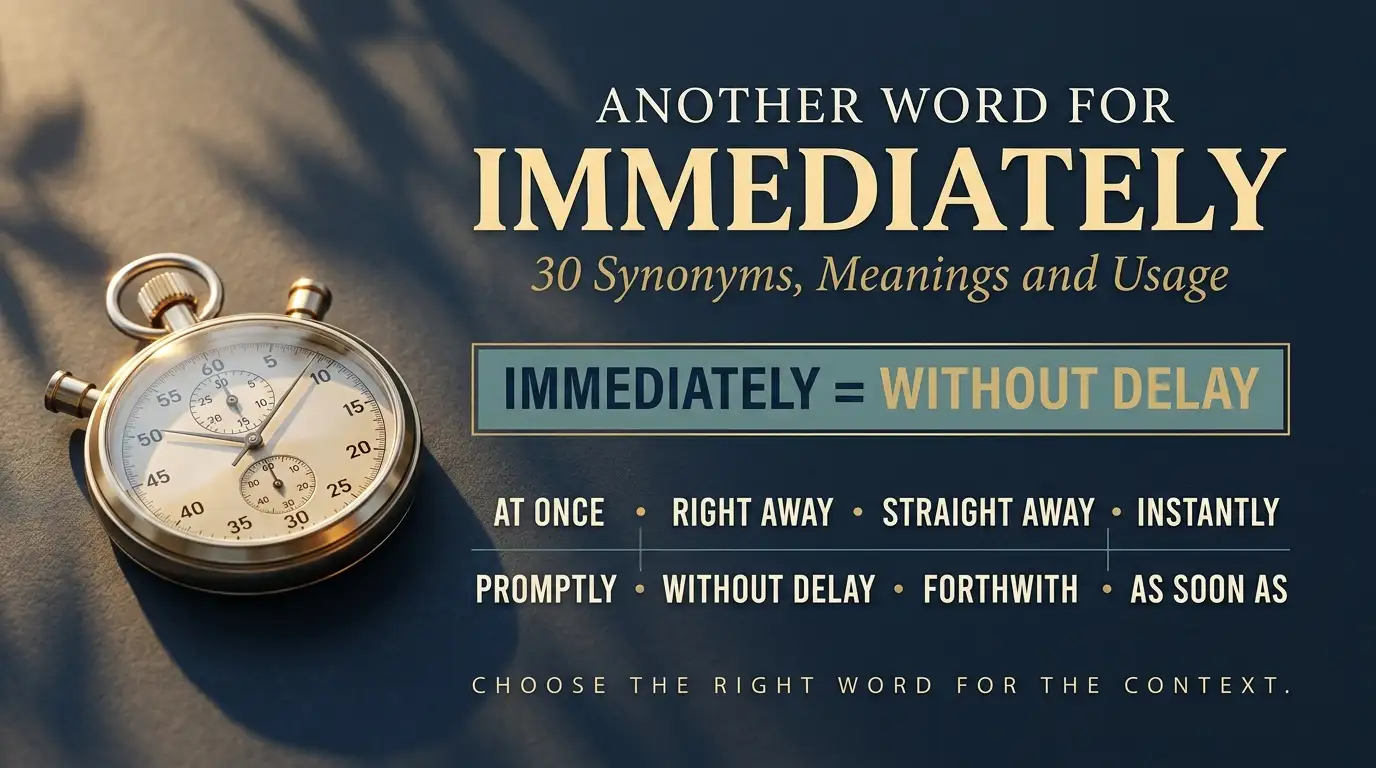
Another word for immediately is at once, right away, straight away, or instantly. All four mean “without waiting.” At once sounds firm, right away sounds friendly, straight away is common in British English, and instantly suggests no time passes at all. In formal writing, you can use promptly, without delay, or forthwith.
The best alternative depends on meaning. Immediately mostly describes time, but it can also describe position (“immediately behind the school”), close connection (“the people immediately affected”), and, in British English, it can mean “as soon as.” Each meaning has its own set of alternatives.
Quick list: at once, right away, straight away, instantly, now, promptly, without delay, directly, forthwith, as soon as
Below are 30 alternatives with meanings, IPA, usage notes, examples, and context. Some are direct synonyms and some fit only one meaning of immediately, and each usage note says which.
At a Glance: Immediately Synonyms and Related Alternatives
| Alternative | Part of Speech | Meaning | Register / Tone | Ideal Context |
| At once | adverb phrase | Right now, with no delay | Neutral, firm | Orders, warnings, urgent requests |
| Right away | adverb phrase | Without waiting | Informal to neutral | Everyday speech, friendly emails |
| Straight away | adverb phrase | Without any delay | Neutral, mostly British | Everyday British speech and writing |
| Instantly | adverb | In a split second | Neutral | Fast reactions, quick results |
| Promptly | adverb | Quickly and on time | Neutral to formal | Business, service, replies |
| Now | adverb | At this moment, or at once | Neutral | Commands, current actions |
| Without delay | adverb phrase | With no waiting | Formal | Notices, instructions, policies |
| Forthwith | adverb | At once | Very formal | Legal and official language |
| Directly | adverb | With nothing in between, or at once | Neutral | Place, order, and sometimes time |
| As soon as | conjunction | At the time that | Neutral | Linking two events in time |
Which Word Should You Use?
| If you want to… | Use | Why |
| Give a firm order or warning | at once | It sounds serious and leaves no room for delay. |
| Sound friendly in daily speech | right away | It is warm and natural. |
| Write natural British English | straight away | It is the usual British choice. |
| Reply to a customer or colleague | promptly | It sounds professional and focuses on speed and good timing. |
| Write a legal or official notice | without delay, forthwith | Both fit formal documents. |
| Show something happened in a split second | instantly | It suggests almost no time passed. |
| Link two events in time | as soon as, the moment | They work as conjunctions. |
| Describe position or order | directly, right, just | They show nothing is in between. |
| Say something took almost no time | in no time, in a flash | They describe speed, not just timing. |
Exploring the Multiple Meanings of “Immediately”
1. Without Delay
- Meaning: At once, with no waiting.
- Explanation: This is the main meaning. It can describe a command, a reaction, or a result. It does not say how fast the action itself is, only that nothing waits before it starts.
- Example: Please call me immediately when you land.
2. Directly, With Nothing in Between
- Meaning: In a direct position or order, with no space or step between.
- Explanation: This sense is about place or sequence, not urgency. It is common with before, after, above, below, behind, and next to.
- Example: The pharmacy is immediately behind the bus station.
3. In Direct Connection
- Meaning: Closely or directly related, with no go-between.
- Explanation: This sense is common in formal writing about people or effects. It means the link is direct, not distant.
- Example: The people immediately affected by the closure will get a letter.
4. As Soon As (Conjunction)
- Meaning: At the very moment that something happens.
- Explanation: This use is mainly British. It joins two events directly, without needing “after.” American English usually prefers “as soon as” or “the moment.”
- Example: Immediately she sat down, the phone rang.
Sources: Merriam-Webster; Collins English Dictionary; Dictionary.com; Cambridge Dictionary
Analyzing 30 Immediately Alternatives in Detail
Some alternatives below are direct synonyms for “without delay,” while others fit only a single meaning, such as place or the conjunction sense.
Group 1: Core Everyday Synonyms
1. At once
IPA: /ət ˈwʌns/ (US and UK)
Definition: Immediately, without any delay.
- Usage: A direct synonym. It sounds firm and is common in orders and urgent requests. Note that “at once” can also mean “at the same time,” as in “They all spoke at once.”
- Example: Leave the building at once.
2. Right away
IPA: /ˌraɪt əˈweɪ/ (US and UK)
Definition: Immediately, without waiting.
- Usage: A direct synonym and the friendliest everyday choice. It is common in speech and informal writing.
- Example: I’ll send you the file right away.
3. Straight away
IPA: /ˌstreɪt əˈweɪ/ (US and UK)
Definition: Immediately, without delay.
- Usage: A direct synonym, used mostly in British English. Americans usually say “right away.” It is also written as one word, “straightaway.”
- Example: If you feel ill, tell a teacher straight away.
4. Instantly
IPA: /ˈɪnstəntli/ (US and UK)
Definition: In a very short moment, with no noticeable delay.
- Usage: A close synonym that stresses an almost zero gap. It fits quick reactions and results better than tasks that need time.
- Example: The message was delivered instantly.
5. Now
IPA: /naʊ/ (US and UK)
Definition: At the present time, or at once.
- Usage: A related alternative. It works as “immediately” mainly in commands and requests.
- Example: Put your phone away now.
Group 2: Quick and Informal Alternatives
6. ASAP
IPA: /ˌeɪ ɛs eɪ ˈpiː/ (US and UK)
Definition: An abbreviation of “as soon as possible.”
- Usage: A related alternative, not an exact synonym. It asks for speed but allows a short wait, so it is softer than “immediately.” It is informal and common in workplace messages.
- Example: Can you send the report ASAP?
7. Pronto
IPA: US /ˈprɑːntoʊ/ · UK /ˈprɒntəʊ/
Definition: Quickly or at once.
- Usage: An informal, playful synonym, borrowed from Spanish. It often sounds humorous or bossy.
- Example: I need these boxes moved, and pronto.
8. In no time
IPA: US /ɪn ˌnoʊ ˈtaɪm/ · UK /ɪn ˌnəʊ ˈtaɪm/
Definition: Very quickly, or very soon.
- Usage: A related alternative. It describes speed or a very short wait, not an instant start.
- Example: We’ll be home in no time.
9. In a flash
IPA: /ɪn ə ˈflæʃ/ (US and UK)
Definition: Extremely quickly.
- Usage: A related, informal alternative that stresses speed. It is lively and common in stories.
- Example: She spotted the mistake in a flash.
10. On the double
IPA: US /ɑːn ðə ˈdʌbəl/ · UK /ɒn ðə ˈdʌbəl/
Definition: Quickly, at once.
- Usage: An informal expression used mostly in orders. It carries a strict, urgent tone.
- Example: Get over here on the double.
Group 3: Formal and Professional Alternatives
11. Promptly
IPA: US /ˈprɑːm(p)tli/ · UK /ˈprɒm(p)tli/
Definition: Quickly and without delay, or exactly on time.
- Usage: A close synonym in professional writing. It suggests fast and reliable action, though not always an instant start. It can also mean “on time,” as in “arrived promptly at nine.”
- Example: The company promptly replied to the complaint.
12. Without delay
IPA: /wɪˌðaʊt dɪˈleɪ/ (US and UK)
Definition: Immediately, with no waiting.
- Usage: A direct, formal synonym. It is common in instructions, policies, and official letters.
- Example: Report any damage to the manager without delay.
13. Forthwith
IPA: US /ˌfɔːrθˈwɪθ/ · UK /ˌfɔːθˈwɪð/
Definition: Immediately, at once.
- Usage: A direct synonym, but very formal. It appears mostly in legal and official documents and sounds old-fashioned in speech.
- Example: The court ordered the files to be returned forthwith.
14. Instantaneously
IPA: /ˌɪnstənˈteɪniəsli/ (US and UK)
Definition: Happening in no measurable time.
- Usage: A close but more technical synonym of “instantly.” It suits science, technology, and exact descriptions.
- Example: The signal travels almost instantaneously.
15. Posthaste
IPA: US /ˌpoʊstˈheɪst/ · UK /ˌpəʊstˈheɪst/
Definition: With great speed, immediately.
- Usage: A literary or old-fashioned synonym. It is rare in everyday speech and may sound humorous.
- Example: He packed his bags and left posthaste.
16. Instanter
IPA: US /ɪnˈstæntər/ · UK /ɪnˈstæntə/
Definition: Immediately, at once.
- Usage: A rare legal word. Use it only if you are writing in a very formal legal style, because most readers will not know it.
- Example: The judge ordered the papers filed instanter.
Group 4: Right Then, On the Spot
17. There and then
IPA: US /ˌðer ən ˈðen/ · UK /ˌðeər ən ˈðen/
Definition: Immediately, in that very place and moment.
- Usage: A close synonym for something done during an event, not after. The variant “then and there” is also common, especially in American English.
- Example: She decided there and then to change jobs.
18. On the spot
IPA: US /ɑːn ðə ˈspɑːt/ · UK /ɒn ðə ˈspɒt/
Definition: Immediately, and at the place where something happens.
- Usage: A related alternative. It stresses acting right when and where something occurs. Note that “put someone on the spot” has a different meaning, which is to put them in a hard position.
- Example: The shop offered him the job on the spot.
19. This instant
IPA: /ðɪs ˈɪnstənt/ (US and UK)
Definition: Right now, at this very moment.
- Usage: A related alternative used mostly in strong commands. It can sound angry or urgent.
- Example: Come downstairs this instant.
20. Like a shot
IPA: US /laɪk ə ˈʃɑːt/ · UK /laɪk ə ˈʃɒt/
Definition: Very quickly, often right after being asked.
- Usage: An informal related alternative. It suggests an eager, fast reaction.
- Example: When I asked for help, he was there like a shot.
21. In a heartbeat
IPA: US /ɪn ə ˈhɑːrtbiːt/ · UK /ɪn ə ˈhɑːtbiːt/
Definition: Very quickly, or without hesitation.
- Usage: A related alternative. It often shows willingness more than speed, as in “I’d do it in a heartbeat.”
- Example: She would move abroad in a heartbeat.
Group 5: Position and Order Alternatives
22. Directly
IPA: /dəˈrɛktli/ (US and UK)
Definition: In a straight line or order with nothing in between; also, at once.
- Usage: A close synonym for the position and order meaning of immediately. It can also mean “at once” in some uses, though that sense is less common today.
- Example: The office is directly above the bakery.
23. Right
IPA: /raɪt/ (US and UK)
Definition: Exactly, or very close in time or place.
- Usage: A related, informal adverb. It strengthens words such as after, before, behind, and next to.
- Example: Call me right after the meeting.
24. Just
IPA: /dʒʌst/ (US and UK)
Definition: Only a very short time or distance away.
- Usage: A related alternative for place and order. “Just after” is a little looser than “immediately after” and can allow a short gap.
- Example: The library is just past the traffic lights.
25. Straight
IPA: /streɪt/ (US and UK)
Definition: Without a pause or stop.
- Usage: A related, informal alternative in phrases like “straight after.” It is especially common in British English.
- Example: She went straight to bed after dinner.
Group 6: Conjunctions Meaning “As Soon As”
26. As soon as
IPA: /əz ˈsuːn əz/ (US and UK)
Definition: At the time that, with no delay between two events.
- Usage: The most natural conjunction alternative. It fits the conjunction sense of “immediately” and works in both speech and writing.
- Example: Text me as soon as you arrive.
27. The moment
IPA: US /ðə ˈmoʊmənt/ · UK /ðə ˈməʊmənt/
Definition: At the exact time that something happens.
- Usage: A conjunction alternative that stresses a sharp, exact point in time. It is neutral and common.
- Example: The moment he walked in, everyone stopped talking.
28. The minute
IPA: /ðə ˈmɪnɪt/ (US and UK)
Definition: As soon as.
- Usage: An informal conjunction alternative. “Minute” here does not mean exactly sixty seconds.
- Example: The minute I sat down, the bus started moving.
29. The instant
IPA: /ðə ˈɪnstənt/ (US and UK)
Definition: At the exact moment that something happens.
- Usage: A conjunction alternative that sounds sharper and more dramatic than “the moment.”
- Example: The instant the door opened, the dog ran out.
30. Once
IPA: /wʌns/ (US and UK)
Definition: As soon as, after a certain event has happened.
- Usage: A related conjunction. It links a condition to what follows, as in “once you finish.” It does not always mean an instant response and can mean “one time” in other uses.
- Example: Once the bell rings, you can leave.
Sources: Merriam-Webster; Collins English Dictionary and Thesaurus; Dictionary.com; Cambridge Dictionary
Immediately vs. Instantly vs. Promptly vs. At Once
These four words are often swapped, but each puts the focus in a different place.
| Word | Main Focus | Time Gap | Example |
| Immediately | No waiting before something starts | None or very short | The alarm sounded, and everyone left immediately. |
| Instantly | An almost zero gap | Almost none | The photo appeared instantly. |
| Promptly | Speed and good timing | A short, reasonable gap | The bank promptly answered my email. |
| At once | A firm demand for action | None expected | Come here at once. |
Immediately is the most general of the four and works in most sentences. Instantly adds a feeling of surprise or speed, promptly adds reliability, and at once adds authority.
Sources: Merriam-Webster; Collins English Dictionary; Cambridge Dictionary
Immediately and Opposite/Paired Word Pairs
| Word | Paired Word | Note |
| Immediately | Later | The simplest opposite. Later means after the present time. |
| Immediately | Eventually | Means after a long time or a series of events. |
| Immediately | Gradually | Describes slow, step-by-step change. |
| Immediately | After a delay | A plain phrase for waiting before acting. |
| Immediately before | Immediately after | Natural paired expressions for direct order in time. |
| Instantly | Slowly | Contrasts a near-zero time with a long time. |
| At once | One by one | Different meaning of “at once” (together) is contrasted with separate steps. |
Immediately has no single perfect opposite. “Later” is the clearest in everyday English, while “eventually” and “gradually” fit when the contrast is about long or slow change. Before and after pair naturally with immediately because both describe a direct position in time.
Sources: Merriam-Webster; Collins English Dictionary; Cambridge Dictionary
Common Word Partners of “Immediately”
| Pattern | Common Partners | Example |
| verb + immediately | respond, reply, react, notice, recognize, realize, stop, call, leave | He recognized her voice immediately. |
| immediately + adjective | obvious, apparent, clear, recognizable | The problem was not immediately clear. |
| immediately + preposition | before, after, following, preceding | We went for a walk immediately after dinner. |
| immediately + place word | above, below, behind, opposite | The cafe is immediately opposite the station. |
| adverb + immediately | almost, not, nearly | The medicine did not work immediately. |
| immediately + adjective (state) | available, ready, necessary | The new software is immediately ready for use. |
Sources: Collins English Dictionary; Cambridge Dictionary; Merriam-Webster
Idiomatic Phrases Featuring “Immediately”
The adverb “immediately” has no true idioms. The phrases below are established, fixed expressions, and they are common in notices, job ads, and formal writing.
1. Effective immediately
- Meaning: Starting right now. This is a standard phrase in announcements about rules, changes, and decisions.
- Example: The parking rules change effective immediately.
2. Immediately upon
- Meaning: At the very moment of a certain event, such as arrival or receipt. It is more formal than “as soon as.”
- Example: Please sign the form immediately upon arrival.
3. Available immediately
- Meaning: Ready for use or ready to start work right now. It is often used in job ads, sales, and property listings.
- Example: The apartment is available immediately.
Sources: Merriam-Webster; Collins English Dictionary; Cambridge Dictionary
Word Formation of “Immediately”
Etymology & Structure
Immediately is built from the adjective immediate plus the adverb ending -ly. Immediate comes from Old French immediat and Late Latin immediatus, meaning “without anything between.” That word combines in- (“not”) with mediatus (“in the middle”). So the idea behind the word is “with nothing in the middle.”
Date and History
According to Etymonline, the adjective immediate appeared in the late 14th century with the sense “intervening, interposed.” In the early 15th century it took on the meaning “with nothing interposed; direct,” and it was also used for time, with the sense “without delay.” The adverb immediately is dated to the early 15th century.
Word Class Variations
- Adverb: immediately
- Conjunction: immediately (chiefly British, meaning “as soon as”)
- Adjective: immediate
- Noun: immediacy, immediateness
- Related word: mediate (verb)
Sources: Etymonline; Merriam-Webster; Collins English Dictionary
Common Word-Choice Mistakes
- Wrong: “Please come all at once.” Correct: “Please come at once.” (All at once means “suddenly” or “all together.”)
- Wrong: “Please respond immediate.” Correct: “Please respond immediately.” (Use the adverb to describe an action.)
- Wrong: “I’ll do it just now.” Correct: “I’ll do it right now.” (In standard English, just now usually means “a moment ago.”)
- Wrong: “Immediately when I got home, I called her.” Correct: “As soon as I got home, I called her.” (Or “Immediately after I got home…”)
- Wrong: “The doctor will see you presently,” when you mean now. Correct: “…right away.” (Presently can mean “soon” or “at the moment,” so it can confuse readers.)
- Wrong: “Reply ASAP, regards” in a formal letter. Correct: “Please reply promptly” or give a date. (ASAP is informal and not very precise.)
- Wrong: “I’ll be there in no times.” Correct: “I’ll be there in no time.”
FAQs
1. What is the closest synonym for immediately?
At once and right away are the closest everyday synonyms. Straight away is the usual British choice.
2. What is a formal word for immediately?
Without delay and promptly work well in professional writing. Forthwith is even more formal and is mostly used in legal documents.
3. What is a casual way to say immediately?
Right away, pronto, and ASAP are casual. On the double is also informal but sounds like an order.
4. Is immediately the same as instantly?
Not exactly. Immediately means without delay, while instantly means in a split second. Something can start immediately but still take time to finish.
5. What is the difference between immediately and promptly?
Immediately means no waiting at all. Promptly means quickly and on time, and it allows a short, reasonable gap.
6. Does ASAP mean immediately?
No. ASAP means “as soon as possible,” which asks for speed but allows time to do the task. Use at once or right away if you need no delay.
7. What does “effective immediately” mean?
It means something starts at the moment it is announced. It is common in notices about rules, jobs, and prices.
8. What is the opposite of immediately?
Later is the simplest opposite. Eventually and gradually fit when the contrast is with a long or slow process.
9. Can immediately mean “as soon as”?
Yes, as a conjunction, mostly in British English: “Immediately she saw him, she smiled.” In most writing, as soon as is the safer choice.
10. Can immediately describe position and not time?
Yes. It can mean “directly” or “with nothing in between,” as in “the shop immediately next to the bank.” Directly and right are good alternatives for this meaning.
Conclusion
The closest alternatives to immediately are at once, right away, straight away, and instantly. Without delay and promptly fit professional writing, and forthwith suits legal documents. Directly and as soon as cover the position and conjunction meanings.
Context matters because immediately does more than one job. Some alternatives describe speed, such as in a flash, while others describe how soon an action starts. ASAP and promptly allow a short wait, so they are not exact matches.
To choose the right word, first decide which meaning you need: time, position, or a link between two events. Then match the tone, using right away for friendly speech, promptly for business, and forthwith only for formal documents. When you are unsure, immediately and at once are safe choices.
Discover More Aticle

Hy, Sophia is a content writer with 3 years of experience creating engaging, informative, and SEO-friendly articles focused on synonyms, vocabulary, and word meanings.