30 Another Word for Connection: Synonyms With Meaning & Examples
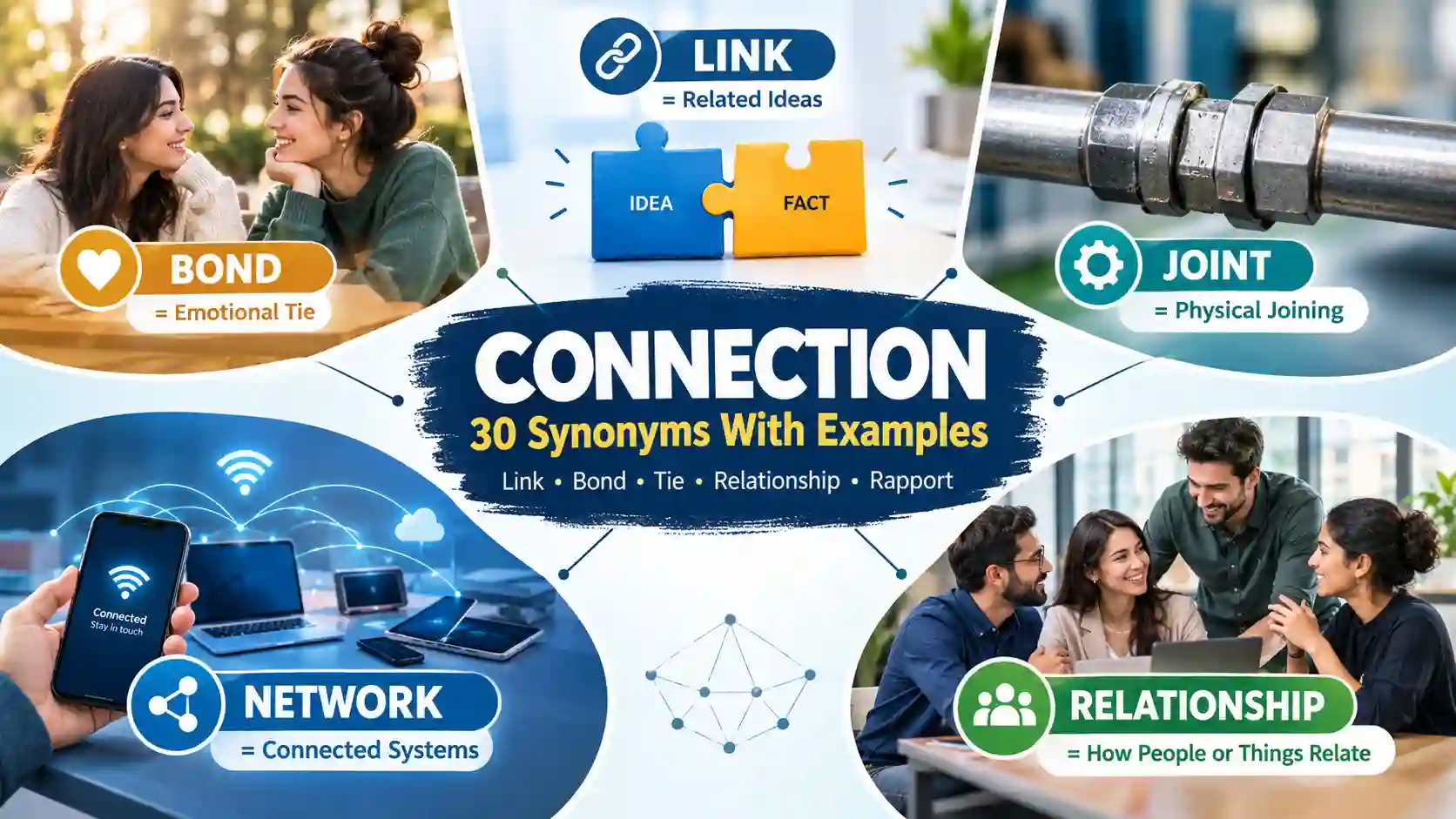
The closest everyday alternatives to “connection” are link, bond, tie, and relationship. “Link” works for most neutral uses, “bond” suits people and feelings, and “relationship” suits how people, groups, or ideas relate to each other.
The best word depends on what is being connected. Two wires join at a junction. Two friends share a bond or a rapport. Two facts can have a link or a correlation. Two companies may have an affiliation. This article covers each of these areas.
Quick list: link, bond, tie, relationship, association, rapport, contact, linkage, correlation
Below you will find 30 alternatives, each with its meaning, IPA, a usage note, and an example sentence. You will also find guides to choosing between similar words, common word partners, idioms, word history, and frequent mistakes.
At a Glance: Connection Synonyms and Related Alternatives
| Alternative | Part of Speech | Meaning | Register / Tone | Ideal Context |
| Link | noun | a connection between two things or people | neutral | facts, events, websites, general use |
| Bond | noun | a strong tie between people | warm, personal | friends, family, emotions |
| Tie | noun | a connection, often with loyalty or duty | neutral | family ties, trade ties |
| Relationship | noun | the way two people or things are connected | neutral | people, groups, ideas |
| Association | noun | a connection through membership, work, or ideas | fairly formal | organizations, mental links |
| Rapport | noun | an easy, friendly understanding | neutral to formal | teaching, sales, interviews |
| Junction | noun | a place where things join | neutral, technical | roads, rail lines, wires |
| Contact | noun | communication, or a person you know | neutral | work, staying in touch |
| Correlation | noun | a pattern in which two things change together | formal, technical | science, statistics |
| Affiliation | noun | an official connection to a group | formal | politics, business, schools |
Which Word Should You Use?
| If you want to… | Use | Why |
| Describe a close emotional tie | bond | It suggests strength and warmth between people. |
| Show that two facts or events are related | link | It is short, clear, and neutral. |
| Say two people get along easily | rapport | It describes understanding and comfort in a relationship. |
| Describe an official tie to a group | affiliation | It is the standard word for membership or official ties. |
| Describe parts joined together physically | joint or coupling | Both name the point where parts meet. |
| Talk about useful people you know for work | contacts or network | Both refer to people you can reach out to. |
| Describe two things that change together in data | correlation | It is the precise word in research and statistics. |
| Name a place where roads or rail lines meet | junction | It is the normal word for a meeting point of routes. |
Exploring the Multiple Meanings of “Connection”
1. A Joining or Physical Link
- Meaning: The act of joining things, or the point or part that joins them.
- Explanation: This is the most literal sense. It applies to pipes, wires, cables, and parts of a machine. The word can describe the act (“the connection of the two pipes”) or the thing itself (“a loose connection”).
- Example: The lamp stopped working because of a loose connection in the plug.
2. A Relationship Between People
- Meaning: A feeling of being close to someone, or a relationship between people or groups.
- Explanation: In this sense, connection stresses emotional closeness or shared understanding. It often appears in phrases such as “feel a connection” and “personal connection.”
- Example: She felt a strong connection with her grandfather.
3. A Logical Link Between Ideas or Events
- Meaning: A relationship in which one thing is related to, or helps explain, another.
- Explanation: This sense is used for facts, causes, results, and ideas. It does not always mean one thing causes the other.
- Example: Police found no connection between the two crimes.
4. A Communication Link
- Meaning: A link that lets people or devices communicate, such as a phone or internet link.
- Explanation: People use this sense when talking about phone calls, Wi-Fi, and networks. It is also used for the quality of the link (“a weak connection”).
- Example: The video call stopped because of a poor internet connection.
5. A Travel Connection
- Meaning: A bus, train, or flight that a traveler changes to in order to continue a trip.
- Explanation: The word refers to the link between two parts of a trip. People say they “made” or “missed” a connection.
- Example: We almost missed our connection in Doha.
6. A Person With Influence or Useful Contacts
- Meaning: A person you know who may help you, usually through business or social links.
- Explanation: In this sense the word is usually plural (“connections”). It often suggests help from people in a position of influence.
- Example: He got the job through family connections.
Sources: Merriam-Webster; Collins Dictionary; Dictionary.com; Etymonline (for sense history)
Choosing the Best Alternative for Connection
The best synonym for “connection” depends on the context. Some words describe emotional closeness, while others refer to links between people, ideas, or things.
1. Link
IPA: /lɪŋk/
Definition: A relationship between two or more people, things, or ideas.
Usage: A common, neutral alternative that works in everyday and professional writing.
Example: Researchers found a link between sleep and memory.
2. Bond
IPA: US /bɑːnd/ · UK /bɒnd/
Definition: A strong emotional connection between people.
Usage: Best for close relationships built on love, trust, friendship, or loyalty.
Example: The sisters share a strong bond.
3. Tie
IPA: /taɪ/
Definition: A connection based on family, friendship, history, or shared interests.
Usage: Often used in phrases such as “family ties,” “close ties,” and “trade ties.”
Example: The two countries have strong trade ties.
4. Relationship
IPA: /rɪˈleɪʃənʃɪp/
Definition: The way people, groups, or things are connected.
Usage: A broad alternative that can describe personal relationships or links between ideas and facts.
Example: She has a positive relationship with her manager.
5. Association
IPA: US /əˌsoʊsiˈeɪʃən/ · UK /əˌsəʊsiˈeɪʃən/
Definition: A link between people, groups, events, or ideas.
Usage: This word suits formal writing, research, and situations involving shared activities or mental links.
Example: His association with the charity lasted ten years.
6. Relation
IPA: /rɪˈleɪʃən/
Definition: A link between two things or the way they relate to each other.
Usage: Common in formal or academic writing, especially in phrases such as “in relation to” and “the relation between.”
Example: The study examines the relation between diet and health.
Joining and Physical Links
7. Junction
IPA: /ˈdʒʌŋkʃən/ (US and UK)
Definition: A place where two or more things, such as roads, rail lines, or wires, join.
- Usage: This is a related alternative, not an exact synonym. It fits only the physical sense of “connection.”
- Example: Turn left at the next junction.
8. Joint
IPA: /dʒɔɪnt/ (US and UK)
Definition: A point or structure where two parts are joined.
- Usage: This is a related alternative for physical connections. It is common in building, plumbing, and the human body. It does not suit emotional or logical connections.
- Example: Water leaked from a joint in the pipe.
9. Coupling
IPA: /ˈkʌplɪŋ/ (US and UK)
Definition: A device or point that joins two parts together, such as two railway cars or two pipes.
- Usage: This is a technical, related alternative for mechanical connections. It is rarely used outside engineering and transport.
- Example: The mechanic replaced the broken coupling on the hose.
10. Linkage
IPA: /ˈlɪŋkɪdʒ/ (US and UK)
Definition: A connection or system of connections, especially between ideas, events, or parts of a system.
- Usage: This is a fairly formal synonym. It often appears in academic, business, and policy writing. In mechanics, it can also mean a set of linked parts.
- Example: The report describes a linkage between education levels and income.
11. Union
IPA: /ˈjuːnjən/ (US and UK)
Definition: The act of joining things together, or the state of being joined.
- Usage: This is a related, formal alternative. It suggests that separate things become one, as in a marriage or a merger. Do not confuse it with “trade union,” which is a different meaning.
- Example: The union of the two companies created a global brand.
Personal and Emotional Alternatives
12. Rapport
IPA: US /ræˈpɔːr/ · UK /ræˈpɔː/
Definition: A friendly relationship in which people understand each other well.
- Usage: This is a close synonym for the “feeling of connection” sense. It is used for how people get along, often in teaching, sales, and interviews.
- Example: The teacher built a good rapport with her students.
13. Affinity
IPA: /əˈfɪnəti/ (US and UK)
Definition: A natural liking for something or someone, or a sense of shared qualities.
- Usage: This is a related alternative, not an exact synonym. It describes a feeling of closeness to a person, place, or idea rather than an actual link.
- Example: He felt a deep affinity with the mountains.
14. Attachment
IPA: /əˈtætʃmənt/ (US and UK)
Definition: A feeling of love or loyalty toward a person, place, or thing.
- Usage: This is a related alternative for emotional connection. It stresses one person’s feeling, not a shared bond. It can also mean something added to something else, which is a different meaning.
- Example: Young children form a strong attachment to their parents.
15. Kinship
IPA: /ˈkɪnʃɪp/ (US and UK)
Definition: A family relationship, or a feeling of being close to others who share your qualities or interests.
- Usage: This is a related alternative that can sound literary. It fits family ties and a sense of belonging.
- Example: The refugees felt a kinship with one another.
16. Closeness
IPA: US /ˈkloʊsnəs/ · UK /ˈkləʊsnəs/
Definition: The state of being near to someone or something, in space or in feeling.
- Usage: This is a related alternative. It describes how strong a connection feels, not the link itself.
- Example: The closeness between the two friends never faded.
Logical and Formal Alternatives
17. Correlation
IPA: US /ˌkɔːrəˈleɪʃən/ · UK /ˌkɒrəˈleɪʃən/
Definition: A relationship in which two or more things change together or are often found together.
- Usage: This is a narrow, technical alternative. It fits data and research and does not prove that one thing causes the other.
- Example: Researchers found a correlation between exercise and better sleep.
18. Relevance
IPA: /ˈrɛləvəns/ (US and UK)
Definition: The quality of being closely connected or appropriate to the matter at hand.
- Usage: This is a related alternative, not an exact synonym. It answers “Is this connected to the topic?” rather than naming the link itself.
- Example: Her question had no relevance to the discussion.
19. Nexus
IPA: /ˈnɛksəs/ (US and UK)
Definition: A connection or series of connections linking two or more things; also a central point where things meet.
- Usage: This is a formal synonym. It often appears in news, policy, and academic writing, usually with “between.”
- Example: The article explores the nexus between money and politics.
20. Interconnection
IPA: US /ˌɪntərkəˈnɛkʃən/ · UK /ˌɪntəkəˈnɛkʃən/
Definition: The state of being connected with each other, or a link between things that depend on each other.
- Usage: This is a formal synonym that stresses links in both directions. It is common in science, economics, and technology.
- Example: The interconnection of global markets means one crisis can spread quickly.
Social and Professional Alternatives
21. Contact
IPA: US /ˈkɑːntækt/ · UK /ˈkɒntækt/
Definition: Communication or touch between people, or a person you know who may be able to help.
- Usage: This is a related alternative for the “communication” and “useful person” senses. A “contact” is a person, while “contact” as a state means being in touch.
- Example: I lost contact with my old classmates after college.
22. Acquaintance
IPA: /əˈkweɪntəns/ (US and UK)
Definition: A person you know slightly, or a slight knowledge of someone.
- Usage: This is a related alternative for a weak personal connection. It is not close to “bond” or “friend.”
- Example: He is an acquaintance from my old job, not a close friend.
23. Affiliation
IPA: /əˌfɪliˈeɪʃən/ (US and UK)
Definition: An official connection with a group or organization.
- Usage: This is a formal synonym for organizational ties. It is common in politics, business, and education.
- Example: The author listed her university affiliation on the paper.
24. Alliance
IPA: /əˈlaɪəns/ (US and UK)
Definition: A union formed for shared benefit, especially between countries, groups, or people.
- Usage: This is a related alternative. It suggests an agreement to work together, which is stronger than an ordinary connection.
- Example: The two parties formed an alliance before the election.
25. Network
IPA: US /ˈnɛtwɜːrk/ · UK /ˈnɛtwɜːk/
Definition: A group of people who are connected, or a system of connected things.
- Usage: This is a related alternative for the “useful people” sense. It describes many connections, not a single one.
- Example: She used her professional network to find a new job.
Technical, Communication, and Bridging Terms
26. Hookup
IPA: /ˈhʊkʌp/ (US and UK)
Definition: A connection of equipment to a source, such as water, power, or a network.
- Usage: This is an informal, related alternative for physical or technical connections. In casual speech, “hookup” can also have a different, slang meaning about romance, so use it with care outside technical contexts.
- Example: The campsite has water and electric hookups.
27. Interface
IPA: US /ˈɪntərfeɪs/ · UK /ˈɪntəfeɪs/
Definition: A point where two systems, groups, or things meet and interact.
- Usage: This is a technical, related alternative. It is most common in computing but is also used for how teams or systems work together.
- Example: The software has a simple interface between the app and the database.
28. Bridge
IPA: /brɪdʒ/ (US and UK)
Definition: Something that connects two things, such as places, groups, or ideas.
- Usage: This is a figurative, related alternative. It describes something that creates a connection, not the connection itself.
- Example: Music can be a bridge between cultures.
29. Channel
IPA: /ˈtʃænl/ (US and UK)
Definition: A way of communicating or passing information between people or groups.
- Usage: This is a related alternative for the communication sense. It describes the path a connection travels along.
- Example: We need a direct channel between the two teams.
30. Liaison
IPA: US /ˈliːəˌzɑːn/ · UK /liˈeɪzɒn/
Definition: A communication or cooperation link between people or groups, or a person who acts as that link.
- Usage: This is a formal, related alternative. It often names a person or a role. It can also mean a secret romantic relationship, so check the context.
- Example: She acts as the liaison between the school and parents.
Sources: Merriam-Webster; Collins Dictionary / Collins Thesaurus; Dictionary.com
Connection vs. Link vs. Bond vs. Relationship
These four words overlap, but each points to a different idea.
| Word | Core Idea | Typical Use | Example |
| Connection | A general joining or relationship, physical or personal | Most senses, including travel and technology | There is a connection between the two events. |
| Link | A direct, neutral connection | Facts, causes, websites | The study found a link between stress and illness. |
| Bond | A strong emotional tie | People and close groups | The soldiers shared a deep bond. |
| Relationship | How two parties relate to each other | People, groups, and ideas | Their relationship improved over time. |
“Connection” is the most flexible of the four. “Bond” is the most emotional, and “link” is the most neutral. “Relationship” describes how two parties relate, and it can be good, bad, or neutral.
Sources: Merriam-Webster; Collins Dictionary; Dictionary.com
Connection and Opposite/Paired Word Pairs
| Word | Paired Word | Note |
| Connection | Disconnection | The direct opposite, in both physical and emotional senses |
| Connection | Separation | The opposite of being joined |
| Connection | Isolation | The opposite of being linked with others |
| Connection | Detachment | An emotional opposite, meaning distance from people or things |
| Bond | Rift | A bond joins people, while a rift divides them |
| Link | Gap | A link joins two points, and a gap leaves them apart |
Most opposites of “connection” describe one of two things: being cut off or being kept apart. “Disconnection” and “separation” are the most direct opposites. “Isolation” and “detachment” fit better when the topic is people and feelings. Not every sense has a perfect opposite, so choose the pair that matches the meaning you want.
Sources: Merriam-Webster; Collins Thesaurus; Dictionary.com
Common Word Partners of “Connection”
| Pattern | Common Partners | Example |
| Adjective + connection | strong, close, direct, personal, emotional, weak | They share a strong connection. |
| Verb + connection | make, establish, lose, break, feel, find | I lost my internet connection. |
| Type + connection | internet, phone, network, Wi-Fi | The Wi-Fi connection is slow. |
| Connection + preposition | between, to, with | There is a connection between the two cases. |
| Travel + connection | missed, flight, bus, train | We missed our connection in Dubai. |
| Connection + noun | error, speed, point | The page shows a connection error. |
Sources: Merriam-Webster; Collins Dictionary; Oxford Learner’s Dictionaries
Idiomatic Phrases Featuring “Connection”
“Connection” appears in only a few fixed expressions, and most of them are established phrases rather than true idioms. The last item below uses the verb “connect,” which is related but not the same word.
1. In connection with
- Meaning: Relating to or about something. It is a formal, fixed phrase, often used in news and official writing.
- Example: Two men were questioned in connection with the theft.
2. Make the connection
- Meaning: To see how two things are related, or to understand a link.
- Example: When she heard his name, she suddenly made the connection.
3. Have connections
- Meaning: To know influential people who can help you.
- Example: She got the interview because she has connections in the industry.
4. Connect the dots
- Meaning: To see how separate facts fit together. This phrase uses the verb “connect,” not “connection.”
- Example: The detective finally connected the dots and found the answer.
Sources: Merriam-Webster; Cambridge Dictionary; Collins Dictionary
Word Formation of “Connection”
Etymology & Structure
“Connection” comes from Old French connexion, which came from Latin connexionem, meaning “a binding or joining together.” The Latin word is linked to conectere, “to fasten together.” That verb combines com- (“together”) with nectere (“to bind, tie”), from a Proto-Indo-European root meaning “to bind, tie.” The ending -ion turns the idea of joining into a noun. The same root gives English words such as nexus and annex.
Date and History
Etymonline dates the word to the late 14th century, when it appeared as conneccion with the meaning “state or fact of being connected.” The spelling shifted from connexion to connection in the mid-18th century, especially in American English, under the influence of connect. Etymonline also records later senses: “anything that connects” from 1741, a circle of people with whom one has relationships from 1767, and a meeting of travel routes from 1862. The older spelling connexion is still seen in some British contexts but is rare today.
Word Class Variations
- Verb: connect, reconnect, disconnect, interconnect
- Noun: connection, connector, connectivity, connectedness, disconnection, interconnection
- Adjective: connected, connective, unconnected, disconnected, interconnected
- Related participle form: connecting (as in “connecting flight”)
Sources: Etymonline (entries for connection, connect, and connexion); Merriam-Webster
Common Word-Choice Mistakes
- Wrong: “A connection among two things.” Correct: “A connection between two things.” Use “among” for three or more.
- Wrong: “I have a good connection with the internet.” Correct: “I have a good internet connection.”
- Wrong: “In connection to the case.” Correct: “In connection with the case.”
- Wrong: “The bond between the two pipes leaked.” Correct: “The joint between the two pipes leaked.” “Bond” suits people, not pipes.
- Wrong: “The link of friendship.” Correct: “The bond of friendship” (or “ties of friendship”).
- Wrong: “He is my acquaintance, and we are very close.” Correct: “He is my friend, and we are very close.” An acquaintance is someone you know only slightly.
- Wrong: “The correlation proves one thing caused the other.” Correct: “The correlation shows a pattern, but it does not prove a cause.”
Frequently Asked Questions
What is the closest synonym for connection?
“Link” is the closest everyday synonym. It is neutral and works for people, facts, and things.
What is another word for an emotional connection?
“Bond,” “rapport,” and “affinity” are the most common choices. “Bond” is the strongest, while “rapport” describes an easy understanding between people.
What is a formal alternative to connection?
“Linkage,” “nexus,” “affiliation,” and “association” are common in formal writing. “Affiliation” is best for official ties to a group.
What is the difference between a connection and a relationship?
“Connection” is broader and can describe things as well as people. “Relationship” describes how two parties relate and is often used for people and groups.
Are “link” and “connection” the same?
They are often interchangeable. “Link” is shorter and more direct, while “connection” can also mean a feeling, a travel change, or a person who can help.
What is the opposite of connection?
The most direct opposites are “disconnection” and “separation.” “Isolation” and “detachment” are better for feelings and relationships.
Can “connection” mean a person?
Yes. In the plural, “connections” often means people you know who may help you, as in “She has connections in the industry.”
What is the difference between connection and correlation?
A connection is any kind of link. A correlation is a specific pattern in which two things change together, and it does not prove that one causes the other.
What is a literary alternative to connection?
“Kinship,” “union,” and “bond” can sound more literary. They suit writing about family, belonging, and deep ties.
Is “connexion” a correct spelling?
“Connexion” is an older variant that is still seen in some British uses. “Connection” is the standard spelling today.
Conclusion
The closest alternatives to “connection” are “link,” “bond,” “tie,” and “relationship.” “Link” is the safest neutral choice, and “bond” is best for strong feelings between people. “Relationship” fits how people and groups relate to each other.
Context decides which word is best. Some alternatives fit only one sense: “junction” and “joint” are physical, “correlation” is statistical, and “affiliation” is official. Others describe feelings, such as “rapport,” “affinity,” and “kinship.” Using a word outside its sense can change the meaning or sound unnatural.
To choose, first ask what is being connected: parts, people, ideas, or systems. Then think about how formal the writing is and whether the link is emotional or neutral. If you are unsure, “link” or “connection” is usually safe.
Discover More Article

Hy, Sophia is a content writer with 3 years of experience creating engaging, informative, and SEO-friendly articles focused on synonyms, vocabulary, and word meanings.